
Red Eyes After Marijuana and CBD: Where They Come From and How to Remedy Them (FAQ)
Red eyes after THC are caused by vessel dilation, not smoke. The mechanism, duration, ways to alleviate, and what is really known about glaucoma.
Red eyes reveal more quickly than smell. This is the most recognizable external symptom after marijuana, and at the same time, the one surrounded by the most misunderstandings. The most common of these is: it’s from smoke. Meanwhile, the same symptom appears after vaporization and edibles, so smoke cannot be the cause. The cause lies in the blood vessels, and the trace of the same process is visible in blood pressure and intraocular pressure measurements. Below, we explain what really happens in the eye’s vessels, how long it lasts, what helps, and what is just a repeated piece of advice without backing. Separately, we return to the oldest thread in this story: does marijuana lower eye pressure enough to treat glaucoma.
KEY INFORMATION
• Redness is the result of vessel dilation, not irritation from smoke: the same effect is seen after vaporization and edibles.
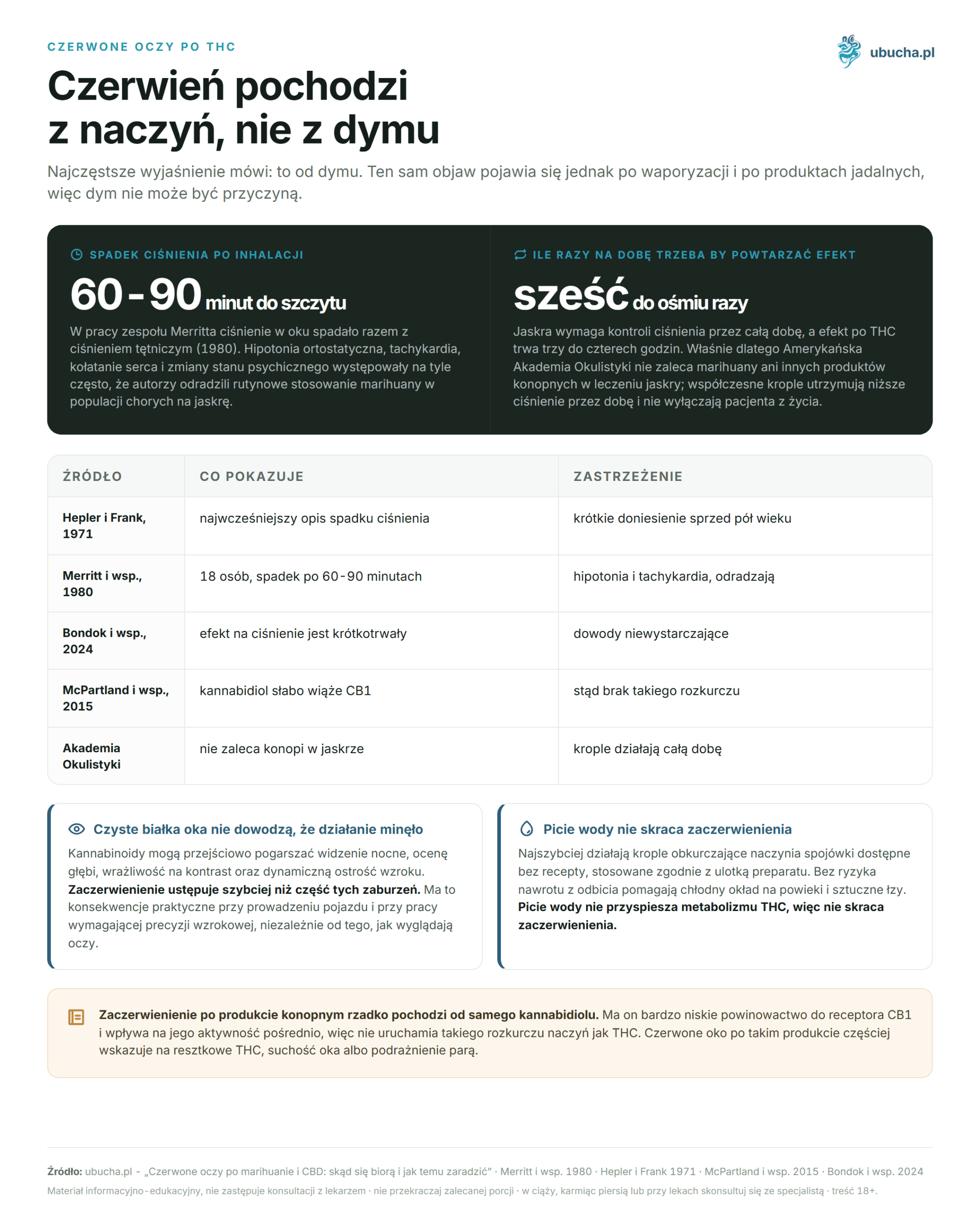
• Marijuana simultaneously lowers eye pressure and blood pressure, with a decrease appearing 60-90 minutes after inhalation (Merritt et al., Ophthalmology 1980).
• Cannabidiol has a very low affinity for the CB1 receptor, so it does not cause the same dilation of blood vessels as THC (McPartland et al., British Journal of Pharmacology 2015).
• The American Academy of Ophthalmology does not recommend marijuana for glaucoma: the effect lasts three to four hours, so it would need to be repeated six to eight times a day.
Why does marijuana cause red eyes?
Red eyes after marijuana are the result of dilation of small vessels in the conjunctiva and sclera. THC stimulates cannabinoid receptors CB1 present in the smooth muscle of blood vessels, causing the vessels to dilate, blood flow to increase, and the white of the eye to appear red. This same peripheral vessel dilation is responsible for the drop in blood pressure after THC and for dizziness when standing up quickly.
That it is about the vessels and not smoke is best seen in the work of Merritt’s team from 1980. Eighteen patients with glaucoma after inhaling marijuana had increased heart rate and decreased intraocular and blood pressure, and the authors explained the decrease in intraocular pressure precisely by peripheral vessel dilation, which reduces perfusion pressure in the ciliary body (Merritt et al., Ophthalmology 1980). The mechanism is therefore systemic: THC in the blood acts on vessels throughout the body, and the eye simply shows this externally.
Hence the practical conclusion. A person using a vaporizer or an edible product will experience redness just like a person smoking, because the concentration of THC in the blood is what matters. Smoke can additionally irritate the conjunctiva mechanically, but that is a separate phenomenon that overlaps with the first and also occurs after smoke without THC. We described more about the receptors themselves in our post about CB1 and CB2 receptors.
Does CBD also cause red eyes?
Much less often than THC and for a different reason. Cannabidiol is not a CB1 receptor agonist. A systematic review by McPartland and colleagues describes it as a ligand with very low affinity for CB1, which affects the activity of this receptor indirectly, rather than through direct stimulation (McPartland et al., British Journal of Pharmacology 2015). Since this CB1 stimulation triggers vessel dilation, cannabidiol itself has no means to produce the same effect.
In practice, redness after a non-intoxicating cannabis product usually indicates something other than cannabidiol: residual THC, dryness of the eye, or irritation from vapor or smoke. Legally sold cannabis in Poland must contain less than 0.3 percent, calculated as the sum of delta-9-THC and THCA in the dry mass of flowering and fruiting tops (art. 4 point 5 of the Act on Counteracting Drug Addiction, Dz.U. 2022 poz. 763). That is little, but not always zero, so in vascularly sensitive individuals, trace amounts can be felt.
It is worth separating two questions that readers usually conflate into one. The question of whether a given product will cause red eyes concerns THC content. The question of whether redness indicates the product’s effect makes no sense: it is a vascular symptom, not a measure of the effectiveness of anything.
How long does eye redness last?
As long as the systemic effect of THC lasts, because redness is its external trace. After inhalation, the concentration in the blood rises within minutes, and in Merritt’s study, the decrease in intraocular and blood pressure appeared 60-90 minutes after inhalation. After edibles, the entire shift is later and stretched out, because THC must pass through the digestive tract and liver.
We have not found a study that measured the duration of redness separately from other effects, so any number of hours given online is an approximation derived from the course of THC’s action, not a measurement. It is more honest to say this: the symptom increases and decreases together with the rest of the effects, and the method of administration shifts the entire graph in time.
Differences between individuals can be significant and cannot be reduced to a single variable. Factors include dosage, vascular sensitivity, medications taken, and how often someone uses THC. Regular use changes the response of CB1 receptors, which we discuss in the text about tolerance breaks.
How to reduce redness after marijuana?
The quickest remedies are over-the-counter vasoconstrictor eye drops, which are preparations with substances from the alpha-adrenergic agonist group. Since the problem is vessel dilation, a vasoconstrictor medication addresses the symptom at its source. The frequency and maximum duration of use are specified in the leaflet of the specific preparation, and in case of doubts, a pharmacist can clarify.
It is important to know a catch that is rarely mentioned. Vasoconstrictor drops used for too long can lead to rebound redness, meaning the symptom returns stronger after discontinuation, and the user reaches for the drops more frequently. This is a well-known mechanism for this entire group of medications, including nasal drops. Therefore, for occasional redness, it makes more sense to reach for solutions that do not have this limitation.
Two things work without the risk of rebound. A cool compress on closed eyelids constricts the vessels locally and temporarily improves the appearance of the eye. Moisturizing drops without a vasoconstrictor, i.e., artificial tears, improve comfort and reduce the feeling of sand under the eyelid, which after THC comes from poorer hydration of the eye surface. They do not shorten the action of THC itself, but can be used multiple times. The popular advice that drinking water speeds up THC metabolism is not supported by data: hydration improves well-being but does not shorten the action of the substance itself.
Are red eyes after marijuana dangerous?
The redness itself is a cosmetic symptom and does not damage the eye. A review by Bondok and colleagues from 2024 lists red eyes among the undesirable ocular effects of cannabis alongside dry eyes, eyelid tremors, drooping eyelids, decreased density of corneal endothelial cells, and neuro-retinal disorders (Bondok et al., Clinical Ophthalmology 2024). Redness is the most visible and least significant on this list.
What is more important is what is not visible in the mirror. The same review indicates that cannabinoids can temporarily worsen night vision, depth perception, contrast sensitivity, and dynamic visual acuity. This has practical consequences for driving and work requiring visual precision, regardless of how the eyes look. Redness subsides faster than some of these disturbances, so clear whites of the eyes are not evidence that the effects have passed.
It is advisable to see an ophthalmologist if redness persists despite a break in use, if it is accompanied by eye pain, light sensitivity, or deterioration of vision, and always if glaucoma is diagnosed. In the latter case, a conversation with a doctor is necessary not because of the color of the eye, but because of the effect of THC on intraocular pressure.
Does THC treat glaucoma since it lowers eye pressure?
It lowers it, but that is not enough to make it a treatment. The first description of decreased intraocular pressure after smoking marijuana comes from a brief report by Hepler and Frank in JAMA in 1971 (Hepler and Frank, JAMA 1971). This observation spread widely and is still cited as an argument that marijuana is a natural remedy for glaucoma.
Further studies have shown where the problem lies. In Merritt’s patients, intraocular pressure did indeed drop, but along with blood pressure, and orthostatic hypotension, tachycardia, palpitations, and changes in mental state occurred frequently enough that the authors advised against routine use of marijuana in the glaucoma patient population. A review from 2024 summarizes this in one sentence: the decrease in pressure after delta-9-THC is short-lived, and there is insufficient evidence to treat glaucoma.
| Source | What it shows | Caveat |
|---|---|---|
| Hepler and Frank, JAMA 1971 | First description of decreased eye pressure after smoking marijuana | Brief report from half a century ago, without modern methodology |
| Merritt et al., Ophthalmology 1980 | 18 people with glaucoma, decrease in eye and arterial pressure after 60-90 minutes | Frequent orthostatic hypotension and tachycardia, authors advise against routine use |
| Bondok et al., Clinical Ophthalmology 2024 | Summary: the effect on pressure is short-lived | Insufficient evidence to use cannabinoids in glaucoma |
However, what is decisive is not the action itself, but the arithmetic of the day. Glaucoma requires pressure control around the clock, and the effect of THC lasts three to four hours, so it would need to be recreated six to eight times a day, with all the effects of intoxication. That is why the American Academy of Ophthalmology does not recommend marijuana or other cannabis products for treating glaucoma. Modern ophthalmic drops maintain lower pressure for a day and do not exclude the patient from life.
Frequently Asked Questions
Why do eyes turn red after marijuana?
Because THC stimulates CB1 receptors in the smooth muscle of blood vessels, causing the vessels in the conjunctiva and sclera to dilate, and the increased blood flow is seen as redness. This is a vascular phenomenon, not irritation or allergy, which is why it occurs with every method of administration, including vaporization and edibles.
Do red eyes come from smoke?
No. Smoke can additionally irritate the conjunctiva mechanically, but the same symptom occurs after vaporization and edibles, where there is no smoke. The concentration of THC in the blood is what matters, not the method of delivery. Smoke irritation is a separate phenomenon that overlaps with the first.
Does CBD also cause red eyes?
Rarely. Cannabidiol has a very low affinity for the CB1 receptor and affects its activity indirectly, so it does not trigger the same dilation of blood vessels as THC (McPartland et al., British Journal of Pharmacology 2015). Redness after a cannabis product more often indicates residual THC, dryness of the eye, or irritation from vapor.
How quickly can you get rid of red eyes?
The quickest remedy is over-the-counter vasoconstrictor eye drops used according to the product leaflet. Without the risk of rebound redness, a cool compress on the eyelids and artificial tears help. Drinking water does not speed up THC metabolism, so it does not shorten redness.
Are red eyes after marijuana harmful?
The redness itself does not damage the eye. A review by Bondok and colleagues from 2024 lists it among the ocular effects of cannabis alongside dry eyes and temporary deterioration of night vision, depth perception, and contrast sensitivity. The latter have more practical significance than the color of the eye whites.
Does marijuana help with glaucoma?
It lowers intraocular pressure, but only for three to four hours, so it would need to be used six to eight times a day. The American Academy of Ophthalmology does not recommend marijuana or other cannabis products for glaucoma. Discuss any changes with your ophthalmologist if glaucoma is diagnosed.
Legal cannabis flower within the Polish THC content threshold can be found in the flower category.
This article is for informational and educational purposes and does not constitute medical advice. Before starting to use cannabis or CBD for therapeutic purposes, consult your doctor, especially if you are taking other medications, are pregnant, or breastfeeding.
Author: Michał Waluk · Published: 2026-08-09 · Updated: 2026-08-16