
CBD Oil for Seniors: Drug Interactions and Real Risks
CBD inhibits liver enzymes through which seniors metabolize their medications. A list of 57 drugs with a narrow index, fall risk, and why no one has established dosages.
A person over 65 rarely takes just one medication. Usually, there are several at once: for blood pressure, cholesterol, clotting, and sleep. CBD oil enters this system as another substance metabolized by the same liver enzymes as most of these medications, and this is the real topic of this article. Not whether CBD helps with joint pain, but what it does to the medications that the senior is already taking. In a survey conducted in 2025 in an American emergency department, among those reporting CBD at home, 69.7% were simultaneously taking at least one prescription medication with documented interaction risk. Below you will find where exactly this risk lies and why the question of dosage does not have a good answer today.
KEY INFORMATION
• Kocis and Vrana listed 57 prescription medications with a narrow therapeutic index that cannabinoids may affect (PMID 34676340, 2020).
• A single dose of 30 mg of CBD increased the area under the curve of amitriptyline by 13% in healthy volunteers (Gorbenko et al., 2026).
• At 1500 mg of CBD per day, 7 out of 16 healthy adults had ALT above normal (Watkins et al., 2021).
• Drowsiness and gait disturbances translate to falls and fractures in seniors (Brown and Winterstein, 2019).
• EFSA states that the safety of CBD cannot be established in individuals taking medications (EFSA, 2026).
Why does age change the risk calculation with CBD oil?
Because it is not CBD that changes, but the environment into which it enters. Older individuals take more chronic medications than any other age group, and CBD inhibits the enzymes through which these medications are metabolized. The result is not a reaction to the oil itself, but a higher concentration of the medication taken for years.
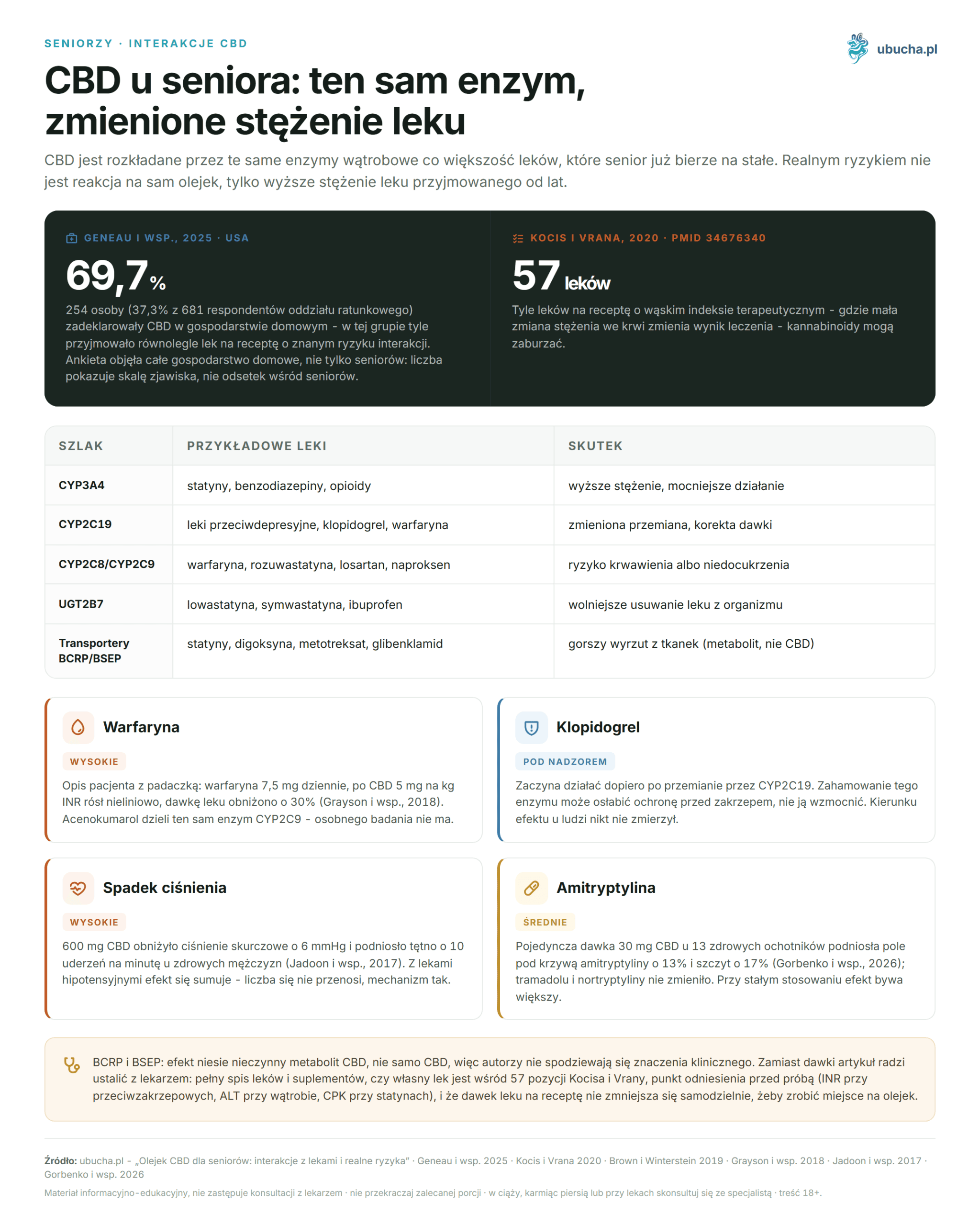
The scale of the problem is shown by a cross-sectional study conducted in a level one trauma center in eastern North Carolina. Of 681 respondents, 254 individuals (37.3%) reported using CBD in their household, and in this group, 69.7% were concurrently taking a medication with known potential for interaction (Geneau et al., 2025). The most common were antidepressants (64.4%) and antihypertensives (41.8%). The survey covered the entire household, not just seniors, so the number describes the scale of the phenomenon, not the percentage among older individuals.
The second part of the answer concerns CBD itself. Contrary to popular belief, it is not a biologically inert substance. In the review by Brown and Winterstein (Journal of Clinical Medicine, 2019), adverse effects occurred in nearly half of CBD users and depended on the dose. The most common included increased transaminase activity, drowsiness, sleep disturbances, infections, and anemia. CBD acts in both directions: it inhibits the metabolism of other medications, but it is also influenced by them. Rifampicin at a dose of 600 mg for ten days reduced the peak concentration of CBD by 52%, while omeprazole at a dose of 40 mg for six days did not change it at all, although it is sometimes mentioned as a drug that raises CBD levels.
How many medications can CBD interact with?
The most specific number was provided by Kocis and Vrana: 57 prescription medications with a narrow therapeutic index, meaning that a small change in blood concentration changes the treatment outcome (Kocis and Vrana, 2020). The full list of interactions is longer, but it is these 57 items that do not forgive mistakes.
In Polish guides, a different number from the same work circulates, 139 medications, and is sometimes presented as contradictory to the first. We checked the full text: both numbers are true and describe two different sets. The authors included in the online supplementary material a list of 139 medications for which interaction with the cannabinoid is possible, and in Table 2, they isolated 57 items with a narrow therapeutic index. The broader list indicates where it is worth asking a pharmacist; the narrower one indicates where a mistake costs the most.
| Metabolic Pathway | Medications Listed in Source | Possible Effect |
|---|---|---|
| CYP3A4 | statins, calcium channel blockers, benzodiazepines, opioids, immunosuppressants | higher drug concentration, stronger adverse effects |
| CYP2C19 | antidepressants, proton pump inhibitors, clopidogrel, propranolol, warfarin | altered drug metabolism, possible dose adjustment |
| CYP2C8 and CYP2C9 | warfarin, rosuvastatin, losartan, naproxen, sulfonylurea derivatives | risk of bleeding or hypoglycemia |
| UGT2B7 | lovastatin, simvastatin, ibuprofen, naproxen, ezetimibe | slower drug elimination from the body |
| transporters BCRP and BSEP | statins, digoxin, methotrexate, glibenclamide, dipyridamole | poorer drug release from tissues |
The table comes from the compilations of Brown and Winterstein (2019). The last row requires a disclaimer that the authors do not hide: the transporters BCRP and BSEP are inhibited not by CBD itself, but by its inactive metabolite, and for this reason, the authors do not expect clinically significant effects here nor recommend changing the dose. The entire table is a starting point for a conversation with a pharmacist, not a verdict: the presence of a drug on the list indicates a mechanism of possible interaction, not certainty that it will occur.
Does CBD increase the risk of bleeding with anticoagulant medications?
It may increase it, and this is the best-described interaction of CBD. Warfarin is listed as a substrate of CYP2C19 and CYP2C8 and CYP2C9, which are pathways inhibited by CBD. Grayson and colleagues (2018) described one patient with epilepsy who was taking 7.5 mg of warfarin daily with a stable INR for over six months. After starting CBD at a dose of 5 mg per kilogram of body weight and further increasing it, the INR increased non-linearly, and the warfarin dose had to be reduced by about 30%. No bleeding complications were reported.
Three things are worth noting from this description. It is one case, not a study; the doses of CBD were for epilepsy, meaning they were many times higher than from a bottle of oil; the signal was detected because the patient had their INR regularly monitored. The last point is practically the most important here.
In Poland, acenocoumarol is prescribed more often than warfarin. It has the same mechanism of action and the same enzyme CYP2C9, so there is no reason to assume that it will escape what happens with warfarin. There is simply no separate study of acenocoumarol with CBD. The lack of a study is not the same as proof of safety, and with an anticoagulant, the difference between these two things can be measured in hematomas.
Clopidogrel is a separate case. It appears on the list of CYP2C19 substrates, but it only starts working after being metabolized by that very enzyme. Inhibition of CYP2C19 may therefore not so much enhance its action as weaken it, thus worsening protection against thrombosis. No one has measured the direction of this effect with CBD in humans, so caution and monitoring by a cardiologist remain.
The practical conclusion is simple. With warfarin and acenocoumarol, the reference point remains INR, not well-being. If the doctor agrees to a trial with CBD, monitoring should be more frequent in the first weeks. Self-reducing the dose of anticoagulant medication to make room for the oil is much more dangerous than the interaction itself.
How does CBD affect blood pressure medications and statins?
In two ways, and this is the biggest problem with hypertension. CBD itself lowers blood pressure: in a crossover study with placebo, a single dose of 600 mg lowered resting systolic blood pressure by about 6 mmHg in nine healthy men, while simultaneously increasing heart rate by about 10 beats per minute (Jadoon et al., JCI Insight, 2017). Additionally, it inhibits the enzymes that break down antihypertensive medications, so both effects add up.
In older individuals treated with antihypertensives, nitrates, levodopa, or tricyclic antidepressants, Brown and Winterstein indicate a specific sequence of events: orthostatic hypotension, fainting, falling, fracture. Dizziness when getting up from a chair is not a trivial matter for a seventy-year-old; it is the beginning of this sequence. The Jadoon study involved young men, so the mechanism is transferred from there, not the number.
With statins, it is important to know which one is being referred to, as guides mix them without distinction. In the Brown and Winterstein compilation, rosuvastatin is listed as a substrate of CYP2C8 and CYP2C9. Lovastatin and simvastatin appear with UGT2B7. Statins as a group also return with transporters BCRP and BSEP, responsible for drug removal from tissues. Atorvastatin, the most commonly prescribed statin in Poland, is not listed in these reports, although it is sometimes mentioned online as a flagship example of conflict with CBD. It is also not in the full text, not just in the summary.
This does not mean that atorvastatin is free from risk, as it is metabolized by CYP3A4, which CBD inhibits. It only means that citing this source regarding it is unjustified.
Can CBD burden a senior’s liver?
At high doses, yes, and this is also true for healthy individuals. In an open phase I study, 16 healthy adults took 1500 mg of CBD per day for about 3.5 weeks. In 7 individuals (44%), ALT activity exceeded the upper limit of normal, and in 5 individuals (31%), it exceeded it fivefold, meeting international criteria for drug-induced liver injury (Watkins et al., 2021). Six participants were excluded from the protocol, and some of them had symptoms corresponding to hepatitis or hypersensitivity reactions.
The most concerning aspect is the lack of predictability. The authors found no correlation between the increase in transaminases and baseline health status, CYP2C19 genotype, or CBD concentration in the blood. Therefore, it is impossible to predict in advance who will react. All ALT increases began between the second and fourth week from the first dose, which is the period when an oil user usually considers that nothing bad is happening.
This must be compared with the dose. A 10 ml bottle with a concentration of 5% contains a total of 500 mg, so 1500 mg per day is unattainable for an oil user. However, the signal remains important for seniors for two reasons: the liver after 65 years has less reserve, and the CBD drug manufacturer lowers the recommended starting and maximum dose by half already with moderate liver damage, and even more with severe damage. There is no correction for mild degrees, and it is also worth knowing, as it is sometimes cited the other way around. If a senior is taking other liver-burdening medications, measuring ALT before trying and after a month is a cheap safeguard.
Why is drowsiness after CBD a separate risk for seniors?
Because in a younger person, it ends with a nap, while in an older person, it ends with a fall. In registration studies, drowsiness, sedation, and fatigue occurred in 41% and 51% of patients treated with CBD compared to 15% in the placebo group, depending on the dose. Gait disturbances were noted in 3% at a dose of 10 mg per kilogram and in 2% at 20 mg per kilogram, compared to below 1% on placebo (Brown and Winterstein, 2019).
These numbers refer to high doses used in epilepsy, so they do not directly transfer to a few drops of oil. However, the mechanism does transfer. The sedative effect of CBD adds up with the action of medications that seniors often already take: benzodiazepines, opioids, antidepressants, and antihistamines. Brown and Winterstein separately point out medications with anticholinergic effects, as combining them raises the risk of falls ending in fractures.
Hence the practical rule that requires no study: if a senior is trying CBD at all, the first doses should be taken in the evening, at home, with someone present. Not before going out for shopping and not before driving a car. The first night after starting the preparation is also a good time to turn on the light before getting up to go to the bathroom, as drowsiness is accompanied by a drop in blood pressure.
What is the official ceiling for CBD and what has really been measured?
The only number of official rank is a limit, not a recommendation. The EFSA panel derived a temporary safe dose of 0.0275 mg per kilogram of body weight per day using the benchmark dose method, with an uncertainty factor of 400, which is about 2 mg daily for a person weighing 70 kg (EFSA, 2026). This applies only to supplements with at least 98% purity of CBD, without nanoparticles. The same document states explicitly that the safety of CBD cannot be established in individuals under 25 years of age, in pregnant and breastfeeding women, and in individuals taking medications simultaneously. This third group is precisely the reader of this text.
It is worth seeing what the doses that have actually been tested look like. Adverse effects in registration studies were described at 10 mg and 20 mg per kilogram of body weight daily, which is 700 mg to 1400 mg for a person weighing 70 kg. Liver damage was described at 1500 mg per day in sixteen individuals. All of this is beyond the reach of a bottle of oil and says nothing about what a few drops do.
We compared this data with a study that shifts the interaction threshold lower than intuition suggests. In a crossover study of 13 healthy volunteers, of whom 12 completed it, a single dose of 30 mg of CBD given one hour before amitriptyline increased the area under the curve of amitriptyline by 13% (p = 0.033), and the peak concentration by 17% (p = 0.041). It did not change the concentrations of tramadol or nortriptyline (Gorbenko et al., 2026). The effect is therefore small and concerns one drug out of two studied, but it was measured at 30 mg, which is six drops of 10% oil, not at epilepsy doses. The authors add that with chronic use, the interaction may be more pronounced.
How much CBD oil should a senior take?
There is no such dose, and that is an honest answer. No study has established a safe or effective dose of CBD oil for individuals over 65 years old. Protocols circulating in guides, such as 5 mg with an increase every two weeks, are based on market custom, not on study results.
Therefore, instead of a dosing protocol, a more sensible approach is a list of things to discuss with a doctor or pharmacist:
- Medication List is the basis of the conversation: bring a complete list of what you take regularly, along with over-the-counter supplements.
- Narrow Therapeutic Index is checked by name: ask directly if any of your medications are on Kocis and Vrana’s list of 57 items.
- Reference Point is established before trying: INR with anticoagulants, ALT with liver burden, CPK with statins.
- Self-Reducing is out of the question: prescription medication doses are not reduced to make room for oil.
We have compiled a list of medications for which caution is greatest in the text CBD Interactions with Medications. Separately, we describe what is known about polypharmacy in older adults in the text Seniors, Polypharmacy, and CBD Oil, and a broader overview of supplementation after 65 years can be found in the text Supplements for Seniors.
Frequently Asked Questions
Is CBD oil safe for a person over 65 years old?
CBD itself is usually well tolerated, but it rarely occurs alone in seniors. Brown and Winterstein (2019) described adverse effects in nearly half of CBD users, and the risk increases with the number of chronic medications. Safety depends on the set of medications, not the product itself.
What is a safe dose of CBD for a senior?
No one has established it. There is no study that has tested the safety and efficacy of CBD oil in people over 65 years old. EFSA provides a temporary safe dose of 0.0275 mg per kilogram of body weight, which is about 2 mg daily for a 70 kg person, and notes that safety cannot be established in individuals taking medications.
Does CBD interact with warfarin and acenocoumarol?
Yes, with warfarin. Grayson and colleagues (2018) described a patient whose INR increased after starting CBD, and the warfarin dose had to be reduced by about 30%. No one has studied acenocoumarol with CBD separately, but it is metabolized by the same CYP2C9, so it requires the same caution.
Can CBD be combined with statins?
Not without consulting a doctor. In the Brown and Winterstein study, rosuvastatin is listed as a substrate of CYP2C8 and CYP2C9, while lovastatin and simvastatin are substrates of UGT2B7. Statins also appear with transporters BCRP and BSEP. Atorvastatin is not listed in these reports.
Can CBD damage the liver?
At high doses, yes. In a phase I study, 16 healthy adults took 1500 mg of CBD per day, and 7 individuals had ALT above normal, with 5 exceeding it fivefold (Watkins et al., 2021). Increases occurred in the 2nd to 4th week of use and could not be predicted from baseline tests.
Does CBD increase the risk of falls in older adults?
Indirectly, yes. Drowsiness and fatigue occurred in 41% to 51% of individuals treated with CBD compared to 15% on placebo, and gait disturbances in 2% to 3% (Brown and Winterstein, 2019). Additionally, there is a drop in blood pressure upon standing, which is a classic mechanism for falls and fractures.
If after talking to your doctor you want to check what is available, you can find the assortment in the hemp oils section.
This article is for informational and educational purposes and does not constitute medical advice. Before starting to use cannabis or CBD for therapeutic purposes, consult your doctor, especially if you are taking other medications, are pregnant, or breastfeeding.
Author: Michał Waluk · Published: 2026-06-22 · Updated: 2026-08-15