
Care for a Loved One Using CBD: Child, Senior, Chronically Ill Person
What is unknown about CBD in children, seniors, and chronically ill individuals, which interactions were measured in humans, and under what symptoms does the caregiver call for help.
When a loved one takes the product, the caregiver becomes a second observer and part of the responsibility for safety. Guides for caregivers are often written as if the question were solely “how to monitor.” The earlier question is different: is it even known that use is safe for this particular person. For the three groups described in this article, the regulator’s answer is directly negative, not because harm has been demonstrated, but because there is no data. This text provides what has actually been measured and where the boundary of knowledge lies. It separates things that are usually presented together in caregiver guides as equally certain: one prescription indication for which there is a registration study, from all other uses for which there is nothing. It ends with a list of symptoms for which the caregiver does not wait for a visit but calls.
KEY INFORMATION
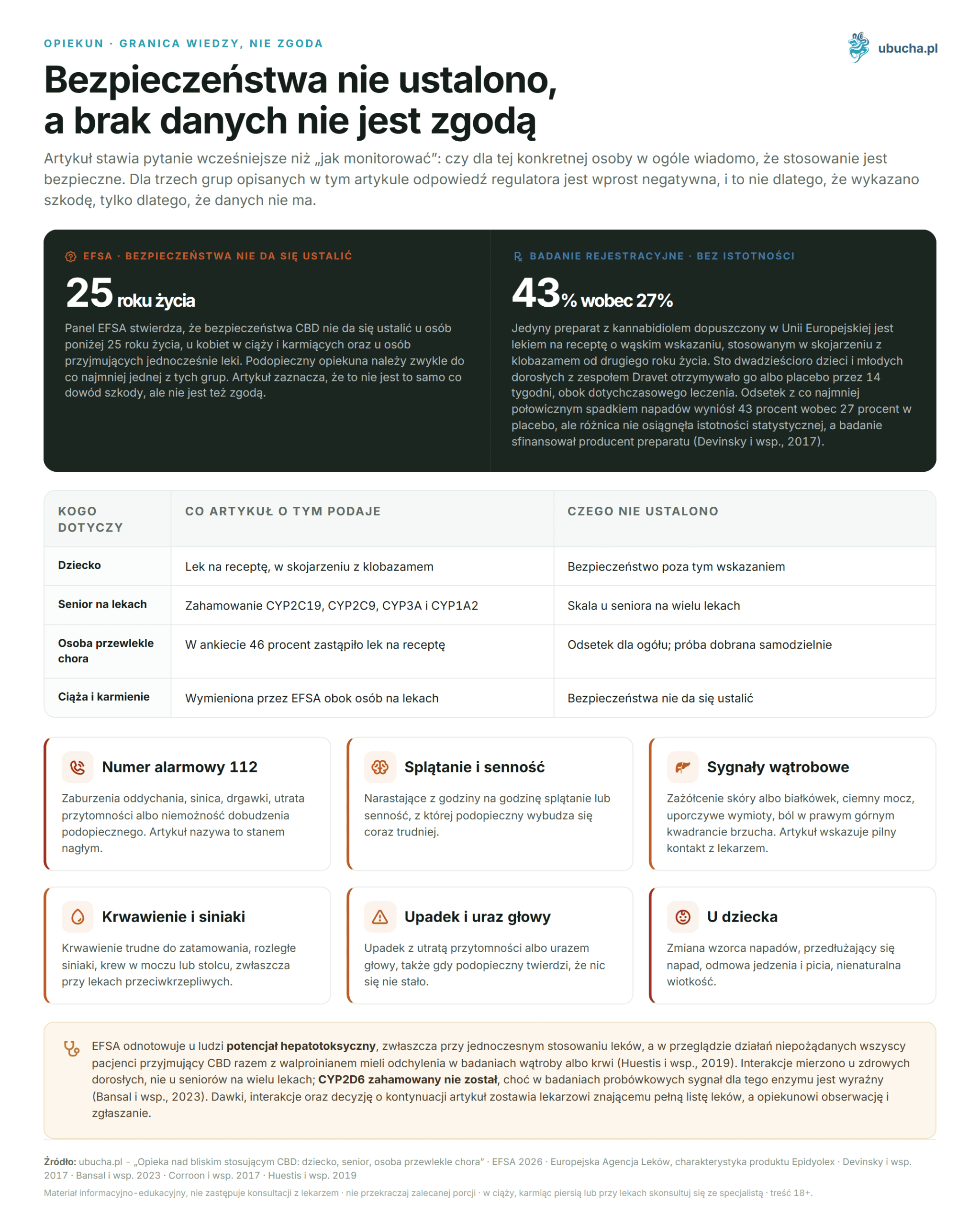
• EFSA states that the safety of CBD cannot be established in individuals under 25 years of age, in pregnant and breastfeeding women, and in individuals taking medications simultaneously. The dependent of the caregiver usually belongs to at least one of these groups.
• The only cannabidiol product approved in the European Union is a prescription medication with a narrow indication, used in combination with clobazam from the age of two.
• In a human study, CBD inhibited CYP2C19, CYP2C9, CYP3A, and CYP1A2, but not CYP2D6.
• In a review of adverse effects, all patients taking CBD together with valproate had deviations in liver or blood tests.
• The observation diary turns the caregiver’s impressions into data for the physician.
• Alarm symptoms and number 112: the last section.
What does the caregiver see that the study will not show?
A change over time, in a specific person, in their own daily rhythm. A child, a senior with cognitive impairments, or a person exhausted by a chronic illness rarely assesses their own condition reliably, and the study result describes one moment. It is the caregiver who will notice that drowsiness came earlier than usual or that gait has become unsteady.
This same closeness is, however, the source of two mistakes. The first is attributing changes to the product that result from disease progression or another medication. The second is the opposite: stopping the product after one bad day, without a record that would allow it to be recreated later. Both arise from observations held in memory instead of on paper.
The role of the caregiver also has a boundary that is worth naming at the outset. The caregiver observes and reports, but does not determine doses or decide whether the product should be continued. Those are decisions for the attending physician, who knows the full list of medications. How to prepare for such a conversation is described in the text about how to talk to a doctor about CBD and cannabis.
Can a child receive CBD?
Aside from one prescription indication, there is no basis to answer affirmatively. The product Epidyolex, whose active substance is cannabidiol, was approved for marketing in the European Union on September 19, 2019. The indication is narrow: as an adjunct in seizures in Lennox-Gastaut syndrome and Dravet syndrome, in combination with clobazam, in patients from the age of two, as well as in tuberous sclerosis (European Medicines Agency, product characteristics of Epidyolex).
It is worth knowing what the registration study showed, because a number from it circulates in guides that is not there. One hundred and twenty children and young adults with Dravet syndrome received cannabidiol for 14 weeks at a dose of 20 mg per kilogram of body weight per day or placebo, alongside their existing treatment. The median number of seizures per month decreased from 12.4 to 5.9 with cannabidiol and from 14.9 to 14.1 with placebo. The percentage of patients with at least a 50% reduction was 43 percent versus 27 percent, but the difference did not reach statistical significance. Abnormal liver function tests were also noted, and more individuals from the cannabidiol group withdrew from the study. The study was funded by the product’s manufacturer (Devinsky et al., The New England Journal of Medicine, 2017).
Aside from this indication, there is a boundary set by the regulator: the EFSA panel states that the safety of CBD cannot be established in individuals under 25 years of age (EFSA, update on the safety of CBD as a novel food, 2026). This is not the same as proof of harm, but it is also not consent. The decision to administer anything to a child is made by a pediatrician or pediatric neurologist who knows their history, not the caregiver and not the article.
What to watch for in a senior taking medications?
First of all, that CBD changes the fate of other medications, and seniors usually take several. The measurement in humans looks like this: eighteen healthy adults received a crossover randomized extract of 640 mg of CBD and 20 mg of THC, and then a set of probe medications. Exposure to omeprazole increased by 207 percent, to losartan by 77 percent, to midazolam by 56 percent, and to caffeine by 39 percent. This corresponds to the inhibition of CYP2C19, CYP2C9, CYP3A, and CYP1A2, while CYP2D6 was not inhibited (Bansal et al., Clinical Pharmacology and Therapeutics, 2023).
For the caregiver, this leads to one question for the physician: does any of the dependent’s medications depend on these isoforms? If so, a change in supplementation is a matter for the office, not to be resolved at home. It must be honestly added that the study was conducted in healthy adults, not in seniors on multiple medications, so the scale for a specific person may be different.
Things worth observing in seniors are four: increased drowsiness and unsteady gait, as they pose a risk of falling, drops in blood pressure, increasing confusion, and bleeding symptoms with anticoagulant medications. Separately, it is worth knowing that in a review of adverse effects, all patients taking CBD together with valproate had deviations in liver or blood tests (Huestis et al., Current Neuropharmacology, 2019).
What are the risks of silently replacing a medication with a CBD product?
Loss of treatment with established efficacy, and for a chronically ill person, this is the most serious threat. In a survey of 2774 cannabis users, 46 percent reported that they replaced their prescription medication, most often opioids, benzodiazepines, or antidepressants (Corroon et al., Journal of Pain Research, 2017). The sample was self-selected, so the percentage should not be generalized to all patients, but the phenomenon itself is documented and pertains to medications that should not be stopped without supervision.
The caregiver is usually the only person who will notice such a change, as they see the packaging. It is worth asking directly and without judgment, especially when the dependent starts to speak of the product as something better than pills.
The second mechanism concerns the product itself. Missing or inaccurate reporting of CBD and THC content, as well as contaminants such as pesticides or heavy metals, can lead to harm or lack of expected effects, and unjustified health claims may encourage abandoning better-documented methods (Corroon et al., Cannabis and Cannabinoid Research, 2020). The caregiver should therefore have access to the packaging and the certificate of analysis, if only so that the physician knows what we are talking about.
How to keep an observation diary?
Straightforward and daily, for a predetermined time. A table with five columns is sufficient: date, what and when was given, sleep assessment, mood and pain assessment on a ten-point scale, and finally notes. Six weeks of recording provides the physician with material that cannot be replaced by memory, and is a short enough period that the caregiver can realistically endure it. Stick to one period throughout the record, as comparability is more important than length.
Three things increase the value of such a diary. Also note days without changes, as without them the background is not visible. Record all other medications and their changes, as they most often explain sudden turns. Finally, record the results of tests ordered by the physician along with dates.
What is not in the diary: personal dose adjustments. The record serves for the physician to decide, not the caregiver. If the dependent is going for a procedure, the diary and packaging should be taken to the pre-operative visit, as described in the text about what to know before surgery and anesthesia.
When does the caregiver call for help?
With symptoms from the first point immediately, to number 112. Caregiver guides usually list signals to discuss with the physician, but do not mention what constitutes an emergency.
- Breathing disturbances, cyanosis, seizures, loss of consciousness, or inability to awaken the dependent. The emergency number is 112.
- Increasing confusion or drowsiness, from which the dependent is becoming increasingly difficult to awaken.
- Jaundice of the skin or sclera, dark urine, persistent vomiting, pain in the upper right quadrant of the abdomen. EFSA notes the potential hepatotoxicity in humans, especially with simultaneous use of medications, so this is a signal for urgent contact with a physician.
- Difficult-to-stop bleeding, extensive bruising, blood in urine or stool, especially with anticoagulant medications.
- Fall with loss of consciousness or head injury, even if the dependent claims that nothing happened.
- In a child: change in seizure pattern, prolonged seizure, refusal to eat and drink, unnatural floppiness.
Less severe symptoms, such as diarrhea, vomiting, and drowsiness, do not require the emergency number, but do require reporting at the next contact with the physician, especially if they persist for several days. Record them in the diary with the date, instead of trying to recall them from memory in the office.
Frequently Asked Questions
Can children use CBD?
Aside from one prescription medication, there is no basis to claim that. The approved product with cannabidiol is used as an adjunct in two epilepsy syndromes, in combination with clobazam, from the age of two. Apart from this indication, EFSA states that the safety of CBD cannot be established in individuals under 25 years of age.
What was the actual improvement in the registration study?
The median number of seizures decreased from 12.4 to 5.9 per month with cannabidiol and from 14.9 to 14.1 with placebo. The percentage of individuals with at least a 50% reduction was 43 versus 27 percent and did not reach statistical significance. The study was funded by the product’s manufacturer.
Which interactions were measured in humans and which only in vitro?
In humans, after 640 mg of CBD, CYP2C19, CYP2C9, CYP3A, and CYP1A2 were inhibited. CYP2D6 was not inhibited, even though the signal for this enzyme is clear in in vitro studies. Lists of isoforms derived from in vitro studies therefore overestimate the clinical risk range.
What to do if the dependent has stopped taking the prescription medication on their own?
Report to the attending physician immediately and without judging the dependent. This phenomenon is documented: in a survey among cannabis users, 46 percent replaced their prescription medication, most often opioids, benzodiazepines, or antidepressants. Stopping such medications without supervision can be dangerous in itself.
Can the caregiver adjust the dose on their own?
No. The caregiver observes, records, and reports, while doses, interactions, and the decision to continue are determined by the physician who knows the full list of the dependent’s medications. The observation diary serves precisely to ensure that this decision is based on data, not on impressions from the last week.
This article is for informational and educational purposes only and does not constitute medical advice. Before starting to use cannabis or CBD for therapeutic purposes, consult a physician, especially if you are taking other medications, are pregnant, or breastfeeding.
Author: Michał Waluk · Published: 2026-08-09 · Updated: 2026-08-16