
Ketamine Therapy in Poland: How It Works and Who It’s For (Legally)
Ketamine and esketamine in Polish law, drug program B.147, results of meta-analyses, and studies with centers in Poland. No price lists and no protocols.
Ketamine is often described as a breakthrough in the treatment of depression, while also being a controlled substance. Both statements are true and stem from the same regulation. Below, we separate three issues that are usually conflated in texts about ketamine therapy: what Polish law says, what has been measured in randomized studies, and what this means for patients diagnosed with treatment-resistant depression. You will not find a price list or a description of the session process here, as both are determined by the attending physician, not the article. However, you will find what is missing in most discussions: the legal basis read in the text of the act itself, numbers transcribed from registration documents, and the contents of the clinical trial registry, including studies conducted with the participation of Polish centers. One widespread belief about the action of ketamine in a suicidal crisis is also corrected.
KEY INFORMATION
• Ketamine is listed as a psychotropic substance of group II-P, and Article 33(1) of the Act on Counteracting Drug Addiction allows the use of substances from this group solely for medical, industrial, or research purposes (Journal of Laws 2023, item 1939).
• Esketamine in a nasal spray has been authorized by the European Medicines Agency since December 18, 2019, and is included in the drug program B.147 in Poland.
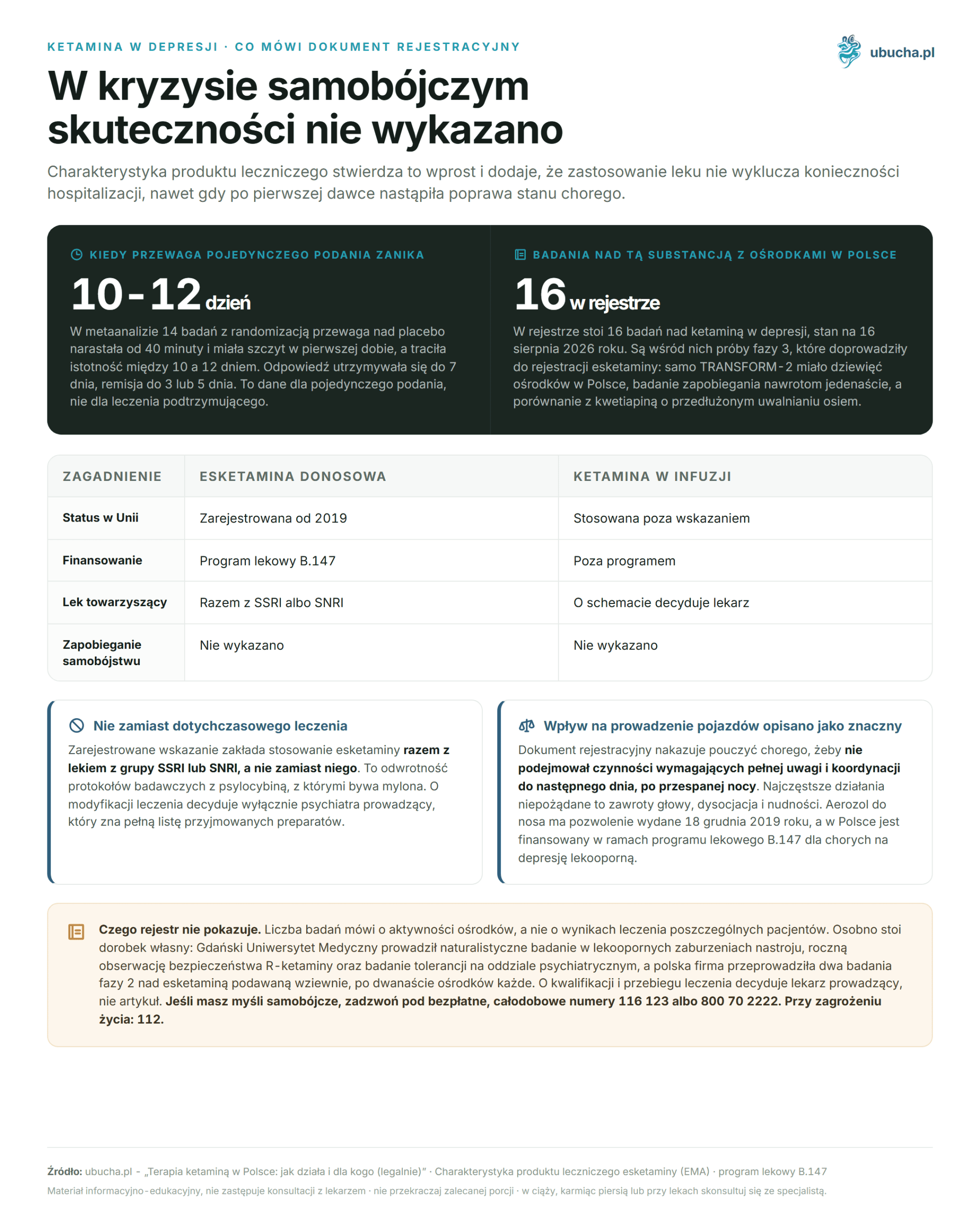
• In a meta-analysis of 14 randomized studies, the advantage of a single ketamine infusion over placebo increased from 40 minutes, peaked on the first day, and faded between days 10 and 12.
• The clinical trial registry lists 16 studies on ketamine in depression with centers in Poland (as of August 16, 2026).
What is the legal status of ketamine and esketamine in Poland?
Ketamine is a controlled substance and at the same time a medication. It is listed under position 19 in the list of psychotropic substances of group II-P, which is an annex to the regulation of the Minister of Health regarding the list of psychotropic substances, narcotic drugs, and new psychoactive substances (consolidated text: Journal of Laws 2024, item 1139). The lists are annexes to the regulation, not to the act, and this difference is often confused in studies.
The designation II-P refers to a psychotropic substance, not a narcotic drug. These are two separate lists: narcotic drugs are divided into groups marked with the letter N, while psychotropic substances are divided into groups marked with the letter P (Articles 31 and 32 of the Act). The decisive factor is Article 33(1): psychotropic substances of groups II-P, III-P, and IV-P may be used solely for medical, industrial, or research purposes. This is where the legality of medical use and the illegality of non-medical use comes from, for which Article 62(1) provides for a penalty of imprisonment of up to 3 years.
The use of ketamine in depression is an off-label use. The basis is Article 4 of the Act on the Professions of Doctor and Dentist, which requires practicing the profession in accordance with current medical knowledge, available methods and means, and with due diligence. The situation is different for esketamine: the nasal spray has been authorized by the European Medicines Agency since December 18, 2019, and in Poland, it is funded under the drug program B.147 for patients with treatment-resistant depression. We discuss the difference between the two molecules in the text about ketamine and esketamine in depression therapy.
What is the difference between nasal esketamine and ketamine infusion?
The differences do not boil down to the route of administration. They concern who makes the decision, what the registration document says, and how supervision looks. The following comparison is based on the product characteristics published by the European Medicines Agency and the description of the drug program.
| Issue | Esketamine in nasal spray | Ketamine in infusion |
|---|---|---|
| Status | Registered in the European Union since December 18, 2019 | Medication registered for a different indication, used off-label in depression |
| Registered indications | Treatment-resistant depression in combination with an SSRI or SNRI; separately, psychiatric emergency | Anesthesia and analgesia |
| Who decides | The psychiatrist makes the decision to use it | The attending physician, at their own professional responsibility |
| Supervision after administration | Observation in appropriate clinical conditions until the patient’s condition stabilizes | Dependent on the center’s protocol |
| Blood pressure | Measurement before administration and again after about 40 minutes | Monitoring during the infusion |
| Driving | Prohibited until the next day, after a full night’s sleep | Prohibited on the day of administration |
| Funding in Poland | Drug program B.147, free for qualified patients | Outside the drug program |
What do studies say about the effectiveness of ketamine in depression?
The effect of a single infusion is best described. The meta-analysis included 14 randomized studies, including nine with ketamine in 234 individuals. The advantage of ketamine over placebo appeared as early as 40 minutes, peaked on the first day, and lost significance between days 10 and 12; the response rate was higher from 40 minutes to day 7, and remission from 80 minutes to days 3 or 5 (Kishimoto et al., Psychological Medicine, 2016). A later meta-analysis of 28 studies described a similar course: a strong effect within four hours, peaking after one day, weaker after one week (Marcantoni et al., Journal of Affective Disorders, 2020).
Data from clinical practice are more modest than from registration trials. A review of 79 studies involving 2665 patients with treatment-resistant depression showed a response in 45 percent and remission in 30 percent, with significant variability among patients. The same work showed two important things for prognosis: patients most resistant to treatment less frequently achieved remission, but the therapeutic effect did not weaken with repeated administrations (Alnefeesi et al., Journal of Psychiatric Research, 2022).
For esketamine, the decisive study is the registration study TRANSFORM-2. It involved 227 randomly assigned patients, of whom 197 completed the four-week blinded phase; the advantage of esketamine with an oral medication over the oral medication alone on the MADRS scale was 4 points on day 28 (Popova et al., American Journal of Psychiatry, 2019). In the product characteristics table, remission after four weeks was 46.5 percent versus 28.4 percent, and response 61.4 percent versus 47.7 percent.
Who can be qualified, and who cannot?
The drug program B.147 includes adults with treatment-resistant depression, meaning no improvement after at least two different antidepressants used in the current episode. The registered indication states the same in different words and adds a condition that is easy to forget: esketamine is used in combination with an SSRI or SNRI, not instead of it.
Contraindications in the product characteristics are narrow and specific. They include hypersensitivity to esketamine or ketamine and conditions where increased blood pressure or intracranial pressure poses a serious threat: vascular aneurysm, history of intracerebral hemorrhage, and cardiovascular incident within the last six weeks. Patients with unstable cardiovascular or respiratory conditions are separately mentioned, where administration should occur where resuscitation equipment and trained personnel are available.
One widespread belief requires correction. Ketamine is often described as a drug for people with suicidal thoughts, which is supposed to act before other treatments take effect. The product characteristics state explicitly that the effectiveness of esketamine in preventing suicide or reducing suicidal thoughts and behaviors has not been demonstrated, and its use does not exclude the need for hospitalization, even if improvement occurs after the first dose.
What studies on ketamine have been conducted in Poland?
The statement that Poland is just starting out does not withstand the confrontation with the clinical trial registry. A query about ketamine in depression with centers in Poland returns 16 studies (as of August 16, 2026). Among them are phase 3 trials that led to the registration of esketamine. The TRANSFORM-2 study had nine centers in Poland, the SUSTAIN-1 relapse prevention study had eleven, and a later comparison of esketamine with extended-release quetiapine had eight, from Białystok and Bydgoszcz to Gdańsk and Katowice.
Separately stands the own contribution. The Gdańsk Medical University conducted a naturalistic study of ketamine in treatment-resistant mood disorders, a one-year safety observation of R-ketamine, and a study of ketamine tolerance in a psychiatric ward. The Polish company Celon Pharma conducted two phase 2 studies on inhaled esketamine, with twelve centers each, separately in treatment-resistant depression and in depression during bipolar affective disorder.
What the registry does not show is the results of commercially conducted treatments. There is no national registry of the effects of ketamine therapy outside of studies, so the question of the effectiveness of a specific center remains without data. This is an argument for asking about the protocol and qualification, not about statistics that no one collects.
What is known about long-term risks?
The best-described physical harm is ulcerative cystitis. A systematic review of the literature on harms from ketamine identifies it as the main somatic problem, particularly associated with chronic and frequent non-medical use, although the authors note that the cause is unclear. The same review describes working and episodic memory impairments in individuals using ketamine daily and that many report unsuccessful attempts to quit (Morgan and Curran, Addiction, 2012).
Translating these observations to treatment conducted by a psychiatrist requires caution in both directions. The material concerns non-medical use at doses and frequencies incomparable to treatment, so it does not describe the risk for patients in the drug program. However, this does not mean that the risk is zero, as there is simply a lack of long-term data on maintenance treatment conducted for years; the authors of the 2020 meta-analysis state this explicitly.
The practical consequence is mundane. Symptoms from the urinary system during treatment should be reported to the doctor immediately, not at the next follow-up visit. We discuss the risks on the other side of the spectrum of psychedelics, where the problem is the heart, in the text about ibogaine and its cardiac toxicity.
Frequently Asked Questions
Is ketamine therapy legal in Poland?
Yes, in a medical context. Ketamine is listed as a psychotropic substance of group II-P, and Article 33(1) of the Act on Counteracting Drug Addiction allows the use of substances from this group solely for medical, industrial, or research purposes. Its use in depression is an off-label use based on Article 4 of the Act on the Professions of Doctor.
Is esketamine reimbursed in Poland?
Yes, under the drug program B.147 for patients with treatment-resistant depression, for qualified patients free of charge. The program’s content is published as an annex to the announcement of the Minister of Health regarding the list of reimbursed drugs. Qualification requires no improvement after at least two different antidepressants in the current episode.
How long does the effect of a single ketamine infusion last?
In a meta-analysis of 14 randomized studies, the advantage of ketamine over placebo increased from 40 minutes, peaked on the first day, and lost significance between days 10 and 12. The response lasted until day 7, with remission until day 3 or 5. These data are for a single administration, not for maintenance treatment.
Does ketamine prevent suicide?
The product characteristics of esketamine state explicitly that its effectiveness in preventing suicide or reducing suicidal thoughts and behaviors has not been demonstrated. The use of the drug does not exclude the need for hospitalization if clinically indicated, even if improvement occurs after the first dose.
Do I need to stop my current antidepressants?
No. The registered indication for esketamine assumes its use together with an SSRI or SNRI, not instead of it. This is the opposite of research protocols with psilocybin. Modification of treatment is decided solely by the attending psychiatrist, who knows the full list of medications taken.
Can I drive after administration?
No. The product characteristics of esketamine describe the impact on the ability to drive as significant and require informing the patient not to engage in activities requiring full attention and coordination until the next day, after a full night’s sleep. The most common side effects are dizziness, dissociation, and nausea.
This article is for informational and educational purposes. It describes clinical studies in which the substance is administered under the supervision of a physician after participant qualification; using it on your own does not replicate these conditions. These substances are controlled in Poland under the Act on Counteracting Drug Addiction. If you have suicidal thoughts, call the free, 24-hour numbers 116 123 or 800 70 2222. In case of life-threatening situations: 112.
Author: Michał Waluk · Published: 2026-08-09 · Updated: 2026-08-16