
Red Eyes After THC and CBD: How Long and How to Reduce Them
CBD alone does not cause red eyes, and THC redness fades in 2-3 hours. Mechanism, time frames, and which drops help or harm long-term.
CBD alone does not cause red eyes because cannabidiol does not stimulate the CB1 receptor. THC causes redness that fades along with intoxication, usually within 2 to 3 hours after inhalation, and later after edible products. Red sclera are the most recognizable sign after a THC session and also the one most often misdescribed. The culprit is not smoke, as the symptom also appears after edibles and sublingual oils, which contain no smoke at all. The change in appearance is due to dilation of small conjunctival vessels, the same type of vascular reaction the endocannabinoid system triggers in other tissues. This guide presents what can be based on peer-reviewed studies: mechanism, realistic time frames, measured eye pressure values after THC, and an honest assessment of which remedies for red eyes work and which harm with long-term use.
KEY INFORMATION
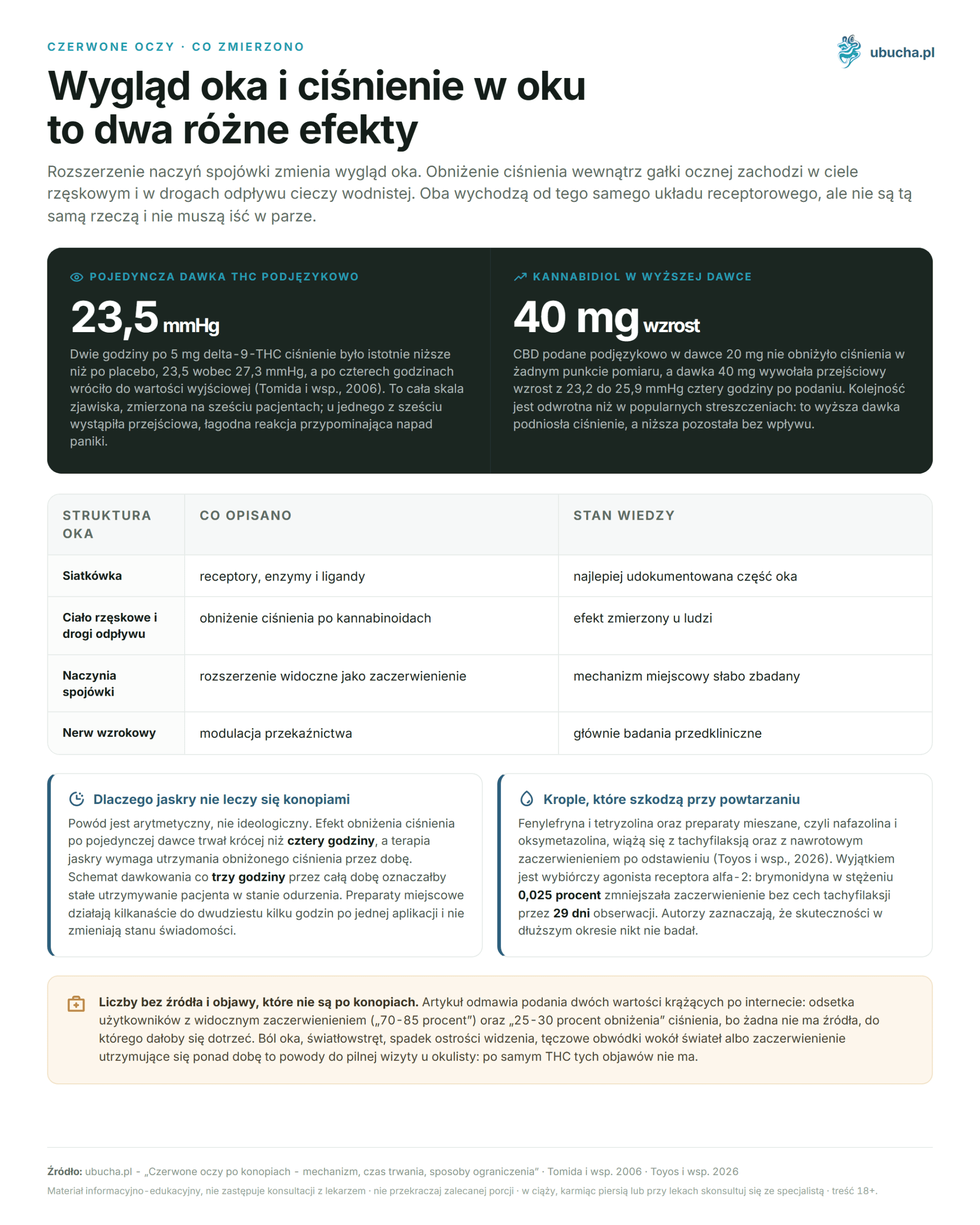
• A single 5 mg dose of THC given sublingually lowered eye pressure from 27.3 to 23.5 mmHg after two hours, returning to baseline after four hours (Tomida et al., 2006).
• After inhalation, THC effects rise within 15 to 30 minutes and fade within 2-3 hours; after oral route, effects start after 30-90 minutes and last 4-12 hours (Grotenhermen, 2003).
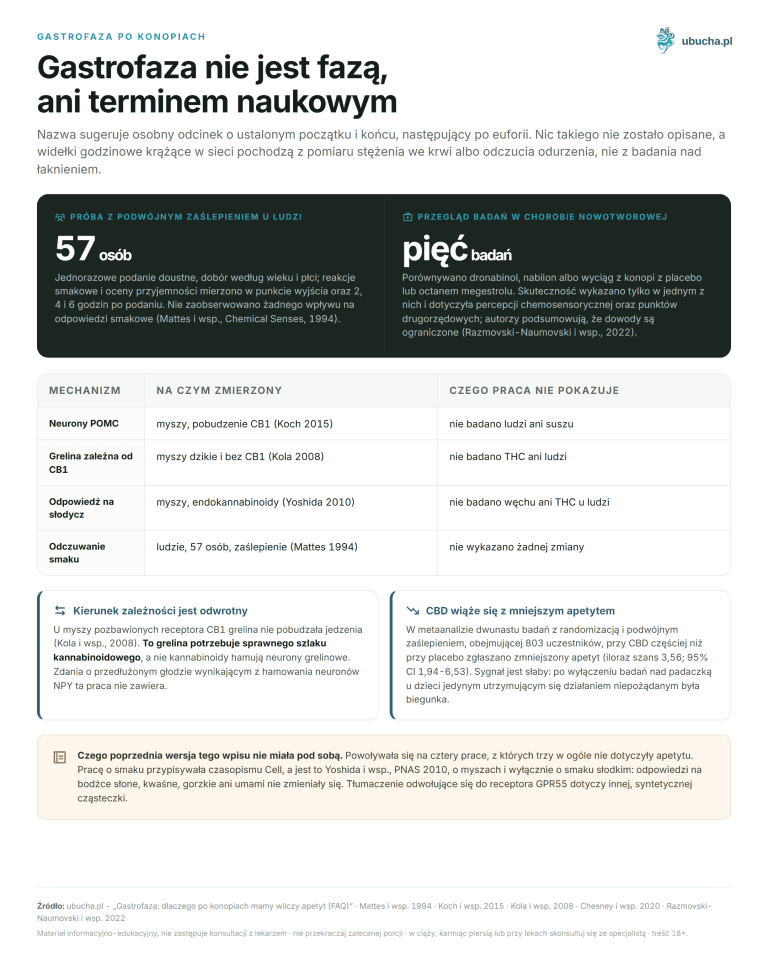
• CBD does not lower eye pressure. At 20 mg it had no effect, and at 40 mg it temporarily raised it.
• Drops with tetryzoline, naphazoline, and oxymetazoline give quick effect but are associated with tachyphylaxis and rebound redness (Toyos et al., 2026).
• Eye pain, photophobia, decreased visual acuity, or redness lasting more than 24 hours are reasons for urgent ophthalmologist visit regardless of cause.
Why do eyes turn red after cannabis?
Redness results from dilation of superficial conjunctival and episcleral vessels. Larger vessels carry more blood, and the red pigment hemoglobin becomes visible against the white sclera. This is a vascular reaction, not irritation: that is why it also appears when no one has smoked anything.
It is caused by the endocannabinoid system, a network of cannabinoid receptors and their lipid ligands distributed in the central nervous system and peripheral organs. A review of this system as a pharmacotherapy target lists hypertension, atherosclerosis, and glaucoma among its vascular action areas (Pacher et al., 2006). THC is a CB1 receptor agonist and mimics endogenous ligands with greater strength and longer duration.
It is important to separate two phenomena often conflated in consumer texts. Conjunctival vessel dilation changes eye appearance. Lowering intraocular pressure is a separate effect occurring in the ciliary body and aqueous humor outflow pathways. Both originate from the same receptor system but are not the same and do not necessarily occur together.
No peer-reviewed study was found reporting the percentage of cannabis users with visible redness. Internet figures like “70-85 percent of users” lack accessible sources, so they are not cited here. The symptom is common and widely described, but its prevalence has not been properly measured.
Where is the endocannabinoid system located in the eye?
Elements of the endocannabinoid system are widely present in the eye, best described in the retina. There are cannabinoid receptors, enzymes synthesizing and degrading endocannabinoids, and the ligands themselves, forming a complete local signaling regulation system (Bouchard et al., 2016).
A review on retinal endocannabinoids notes a point often omitted in popular texts: there are far fewer studies on this system in the eye than in the brain, and much knowledge comes from extra-retinal preparations extrapolated by analogy (Yazulla, 2008). Consistency concerns inhibition of dopamine release and presynaptic limitation of transmission from cones and bipolar cells. The implications for night vision, receptive fields of ganglion cells, or perception remain unresolved.
The practical takeaway is cautious. The claim “CB1 receptors are in smooth muscles of conjunctival vessels, so THC directly dilates them” is a plausible mechanistic hypothesis, not a measured fact from human conjunctiva studies. The clinical effect, visible redness after THC, has been described for decades and is undisputed.
| Eye Structure | Described Features | Knowledge Status |
|---|---|---|
| retina | cannabinoid receptors, enzymes, and ligands | best documented eye part |
| ciliary body and outflow pathways | intraocular pressure reduction after cannabinoids | effect measured in humans, mechanism partially described |
| conjunctival and episcleral vessels | vessel dilation visible as redness | undisputed effect, local mechanism poorly studied |
| optic nerve and visual pathway | transmission modulation, neuroprotective potential | mainly preclinical studies |
How long does redness last by different methods?
Redness duration follows THC pharmacokinetics, so the answer depends on administration route. After inhalation, plasma concentration peaks within minutes, psychotropic effects rise over 15-30 minutes and fade within 2-3 hours. After ingestion, onset shifts by 30-90 minutes, peak occurs at 2-3 hours, and total duration is about 4-12 hours (Grotenhermen, 2003).
These frames concern effects measured in the cited review, mainly psychotropic and cardiovascular. Red eye has no separate published time curve, so it is reasonable to treat these intervals as approximations for it too, rather than giving precise quarter-hour values.
The difference between smoking and edibles is often misunderstood. Oral route does not mean “stronger effect” but a different course: slower start, later peak, and clearly longer tail. If redness bothers you socially, not only dose but also how many hours before the event you took it matters.
If you want to compare these frames with the full THC effect course, it is described separately in the post how long effects last after smoking marijuana.
| Route of Administration | Onset | Peak | Duration | When Redness Fades |
|---|---|---|---|---|
| inhalation (smoking, vaporizing) | seconds to minutes | 15-30 minutes | 2-3 hours | 2-3 hours, with intoxication |
| edibles and capsules | 30-90 minutes | 2-3 hours | 4-12 hours | 4-12 hours, with intoxication |
Time frames for THC effects according to Grotenhermen’s 2003 review.
Are red eyes from cannabis dangerous?
Conjunctival hyperemia itself is reversible and subsides as THC concentration falls. There is no data indicating occasional conjunctival vessel dilation damages eye structures. The problem arises when redness no longer fits this picture, as then it is not a cannabis symptom.
Conjunctival redness without infectious background is one of the most common ophthalmologic complaints, increasing with lifestyle and screen work (Toyos et al., 2026). The authors note two important points: some patients self-treat without knowing risks of chosen preparations, and surgical eye whitening procedures have been subject to market withdrawals.
A symptom resembling ordinary red eyes after a session may mask conjunctivitis, iritis, keratitis, or acute angle-closure glaucoma. Differentiation relies on presence of pain, discharge, photophobia, and visual acuity changes, which do not occur with THC alone.
See an ophthalmologist or emergency department immediately if any of the following occur.
- Eye or head pain lasting more than two hours
- Worsening or blurred vision lasting more than four hours
- Photophobia, excessive tearing, eyelid swelling
- Seeing rainbow halos around light sources
- Redness lasting more than 24 hours after last dose
- Nausea or vomiting accompanying eye pain
- Purulent discharge or eyelid sticking after sleep
What is really known about THC and eye pressure?
The best documented measurement comes from a randomized, double-blind trial with six patients with ocular hypertension or early open-angle glaucoma receiving a single sublingual dose. Two hours after 5 mg delta-9-THC, pressure was significantly lower than placebo, 23.5 vs. 27.3 mmHg, returning to baseline after four hours (Tomida et al., 2006).
This is the full scale of the phenomenon: a few mmHg and less than four hours of effect measured in six people. The circulating “25-30 percent reduction” figure does not come from this study. The first description by Hepler and Frank in 1971 exists and is indexed (PMID 5109652), but Europe PMC does not provide its abstract, so no specific percentage can be confirmed or cited here.
The effect direction is unquestioned. A review on cannabinoids in glaucoma states cannabinoids effectively lower intraocular pressure and have neuroprotective action, making them potentially useful (Tomida et al., 2004). The word “potentially” is key and will be explained shortly.
One safety note from the 2006 study: one of six patients had a transient mild panic-like reaction after THC. With such a small sample, that is one sixth of participants, so not a marginal event.
Why doesn’t ophthalmology treat glaucoma with cannabis?
The reason is arithmetic, not ideological. The pressure-lowering effect after a single THC dose lasted less than four hours. Glaucoma therapy requires maintaining lowered pressure over 24 hours, not a few hours, so dosing every few hours, including at night, would be necessary.
Additionally, psychotropic effects occur. A cannabinoid pharmacology review lists acute adverse effects above the psychotropic threshold including anxiety, panic attacks, increased heart rate, and blood pressure changes (Grotenhermen, 2003). A dosing schedule every three hours around the clock would keep the patient intoxicated, which is not an option for chronic disease.
The third problem is tolerance. Positron emission tomography in daily cannabis smokers showed reversible and regionally selective CB1 receptor density reduction in the cortex correlated with years of smoking, returning to normal after about four weeks of abstinence (Hirvonen et al., 2012). This study concerns the brain, not the eye, so direct extrapolation to conjunctiva would be overinterpretation. However, it shows the receptor system downregulates with constant exposure.
Modern glaucoma treatment standards rely on topical preparations acting 12 to 24+ hours after one application, without altering consciousness and with documented long-term profiles. Cannabis does not compete with them in duration, convenience, or safety.
How does CBD’s effect on the eye differ from THC’s?
Does CBD cause red eyes? No, if the product contains only cannabidiol. Redness results from CB1 receptor stimulation in conjunctival vessels, and CBD is not its agonist, so it does not cause this reaction by itself. If you see redness after oil, check two things: whether the preparation is full-spectrum, containing residual THC below threshold, and whether irritation is caused by the carrier or dry air.
This is often reversed in cannabis and eye texts, so it is recorded exactly as in the source study. In Tomida’s 2006 study, 20 mg CBD given sublingually did not lower intraocular pressure at any measurement point. A higher 40 mg dose caused a transient increase from 23.2 to 25.9 mmHg four hours after administration.
The order is thus opposite to popular summaries: 40 mg raised pressure, 20 mg had no effect. The practical conclusion for glaucoma or ocular hypertension patients is clear. CBD is not a candidate for glaucoma support and at higher doses may act contrary to intended. Supplementation decisions should be made with the treating ophthalmologist.
CBD affects eye appearance differently than THC because it is not a CB1 agonist and does not cause characteristic conjunctival redness. THC-free products do not change sclera color, which for some is the sole reason to choose them.
A separate issue is absorption data. A human CBD pharmacokinetics review established absolute bioavailability only for inhalation at 31 percent and states no one has measured it for other routes despite intravenous preparations being available (Millar et al., 2018). Tables with percentages for oral and sublingual routes circulating in commercial texts lack support in this review. Differences among minor cannabinoids are described separately in the CBG vs CBD comparison.
Which red eye drops work and which harm?
Vasoconstrictor drops act quickly, but not all are equal, and this distinction determines whether after a week it gets better or worse. Alpha-1 adrenergic receptor agonists, phenylephrine and tetryzoline, and mixed alpha-1/alpha-2 agents, naphazoline and oxymetazoline, are associated with tachyphylaxis and rebound redness after discontinuation (Toyos et al., 2026).
The exception is the selective alpha-2 agonist brimonidine. At 0.025 percent concentration, it reduced redness without tachyphylaxis over 29 days and minimal rebound after stopping. Authors note no long-term efficacy studies exist, so “no tachyphylaxis for a month” does not mean “safe indefinitely.”
This is an important correction to common advice grouping brimonidine with tetryzoline and naphazoline. Pharmacologically, these have different mechanisms and consequences with repeated use.
Besides decongestants, the review lists lubricants, antihistamines with mast cell stabilizers, and anti-inflammatory preparations. Moisturizers do not constrict vessels, so they do not restore white color but improve comfort and are suitable for daily use. Authors emphasize lack of guidelines dedicated to this symptom and that patients rarely know when redness requires medical evaluation or self-treatment suffices.
What else besides drops reduces redness?
Non-pharmacological methods are less effective than decongestants but lack rebound drawbacks. A cold compress on closed eyelids for several minutes causes superficial vessel constriction and is safe. Dark glasses do not change vessels but effectively mask redness and protect from wind and bright light.
Route choice matters more than all quick tricks combined. Since inhalation effects fade in 2-3 hours and edibles last up to twelve, shifting session timing or changing administration form changes the situation more than drops. THC-free products cause no redness at all. If considering switching from smoking to vapor, see the vaporizers category for equipment reviews.
Hydration is often promoted for red eyes and must be addressed honestly. Drinking water improves comfort and relieves dryness but does not constrict conjunctival vessels or eliminate redness. Similarly, caffeine is described as a vasoconstrictor, but no study measuring its effect on THC-induced conjunctival redness was found, so this method is unconfirmed.
Alcohol acts oppositely by dilating vessels and dehydrating. Combining it with cannabis predictably deepens and prolongs the effect, which is obvious without separate study.
What does the 0.3% THC threshold mean and why is it counted as a sum?
This threshold determines whether a product can cause conjunctival redness at all, so it is worth knowing what exactly is measured. Industrial hemp are Cannabis sativa L. plants with the sum of delta-9-THC and tetrahydrocannabinolic acid (THCA) in flower or fruiting tops, from which resin has not been removed, not exceeding 0.3% dry weight.
The basis is Article 4 point 5 of the Act of July 29, 2005 on counteracting drug addiction (consolidated text Dz.U. 2023 item 1939), as amended by the Act of March 24, 2022 (Dz.U. 2022 item 763), effective May 7, 2022. Until May 6, 2022, the threshold was 0.20%, so older texts cite that value though it has not been current for over four years.
Distinguishing delta-9-THC alone from the sum with THCA is not formal. THCA is the acidic form present in fresh plants and converts to delta-9-THC only under heat. A lab measuring only delta-9-THC reports a lower value than the legal threshold, and results are rounded to one decimal place.
Separately, EU law since January 1, 2023 allows hemp varieties eligible for Common Agricultural Policy support to contain up to 0.3% THC under Article 4(4) of Regulation (EU) 2021/2115; previously the EU threshold was 0.2%. The value matches the national one but these are separate regulations. The Polish threshold corresponds to the EU threshold, not derived from it.
Do THC-free products change eye appearance?
No, because without a CB1 receptor agonist there is no vascular reaction causing redness. Preparations based on CBD or CBG with THC content within legal limits do not cause characteristic scleral redness. For those using cannabis for health reasons who do not want visible signs, this is usually a decisive selection criterion.
However, two promises should be separated. Lack of redness is predictable and pharmacologically explained. Claims about efficacy are a separate matter requiring separate evidence, which is lacking for many indications. The CBD pharmacokinetics review notes an additional problem: absorption data are sparse and inconsistent despite widespread use (Millar et al., 2018).
A practical tip concerns labeling. “0% THC” and “below legal threshold” declarations do not mean the same and differences appear only in certificates of analysis. Full-spectrum products may have low but nonzero THC, so at higher daily doses the total THC intake rises and becomes non-negligible.
If you seek a form that does not change eye appearance, a sensible starting point is preparations with known concentration and available certificates, not products described only by marketing slogans. Available concentrations are listed in the hemp oils category.
What to watch for with contact lenses and dry eye?
Contact lenses and conjunctival redness interact unfavorably. The lens lies on the eye surface, limits tear exchange, and itself can cause redness, so in lens wearers it is harder to determine the symptom cause. The simplest rule: remove lenses if redness is pronounced and return to them when the eye looks normal.
A separate issue is drops used with lenses. Some contain preservatives that deposit in lens material, and vasoconstrictors mask symptoms that should signal a break. The conjunctival redness review lists lubricants as first choice for surface complaints and warns against self-treatment without cause evaluation (Toyos et al., 2026).
Dry eye adds to the picture from another side. The same review links increasing conjunctival redness prevalence to lifestyle and technology-based work, i.e., long screen hours and less blinking. If you work at a monitor and use THC products, two independent factors overlap on the same tissue.
Warning signs with lenses are sharper than without. Pain, photophobia, or decreased visual acuity in lens wearers require urgent ophthalmologic evaluation because keratitis, which must not be ignored, is possible.
What should patients using prescription cannabis know?
For patients with Rpw prescriptions, eye redness has a different meaning than for recreational users, as it is a visible treatment effect, not a choice consequence. The first thing to clarify with the doctor is whether the symptom requires intervention or observation.
The second concerns eye pressure. Since THC lowers it temporarily and CBD at higher doses can raise it (Tomida et al., 2006), patients with glaucoma or ocular hypertension should have periodic measurements and not assume cannabinoids act unidirectionally. THC’s effect is too short to be treatment and too real to ignore during measurement.
The third is interaction with topical therapy. If the patient uses anti-glaucoma drops, adding an over-the-counter decongestant is not neutral, as brimonidine appears in both categories at different concentrations. Such decisions are made by the ophthalmologist, not the pharmacist or patient.
The fourth is organizational. Prescription cannabis patients should carry documentation confirming treatment, as visible redness is often the first noticed sign by others. Cannabis availability in treatment is based on Article 33a of the Act on counteracting drug addiction, introduced by the July 7, 2017 Act (Dz.U. 2017 item 1458), effective November 1, 2017.
How to distinguish THC redness from conjunctivitis?
Differentiation relies on four symptoms absent with THC alone: discharge, itching, pain, and photophobia. Cannabis redness is dry, painless, bilateral, and resolves spontaneously within hours. Any other presentation requires ophthalmologic evaluation, not guessing at home.
Bacterial conjunctivitis produces thick purulent discharge and eyelid sticking after sleep. Viral, mostly adenoviral, causes watery discharge, strong tearing, and swollen preauricular lymph nodes, often with upper respiratory infection. Allergic is recognized by itching and eyelid swelling, usually seasonal or after contact with a specific allergen.
Dry eye syndrome features burning and sand-in-eye sensation worsening in the evening and after long screen work. THC increases subjective dryness, so in those already affected symptoms overlap and mistakes are easy. Another clue is laterality: bacterial infection often starts in one eye, THC reaction is always bilateral and symmetrical.
| Feature | After THC | Bacterial | Viral | Allergic |
|---|---|---|---|---|
| discharge | none | purulent, thick | watery, abundant | watery, scant |
| itching | none | mild | mild | severe |
| duration | hours | until treated | 7-14 days | while exposed |
| management | observation | ophthalmologist | ophthalmologist, contact hygiene | avoid allergen, antihistamines |
What factors affect redness intensity?
The strongest are THC dose and individual sensitivity, which can cause two people using the same product to have very different appearances. No published dose threshold for redness exists, so values like “2-5 mg” cited in guides lack research support and are not repeated here.
Tolerance reduces the effect. This is inferred indirectly from observations of reduced CB1 receptor density in daily smokers and its reversibility after about four weeks abstinence (Hirvonen et al., 2012). The practical consequence is that after a longer break the same dose produces a stronger effect, which regular users often forget.
Environmental factors add to vascular reaction and deepen subjective sensation. Dry air conditioning, tobacco smoke, chlorinated water, dust, and many hours at screens irritate the eye surface by themselves, and the redness review links increased prevalence to lifestyle and technology work (Toyos et al., 2026).
One misunderstanding often arises in reader discussions: redness differences between two people using the same package are attributed to strain. Strain is the least likely explanation compared to actual dose taken, current tolerance, and eye surface condition.
Can red eyes be a legal problem in Poland?
Red eyes alone are not evidence but may prompt an officer to order testing. The basis for testing drivers for substances acting like alcohol is Article 129j of the Road Traffic Act (consolidated text Dz.U. 2024 item 1251), not alcohol regulations or criminal procedure rules on witnesses and experts.
Risk is measured. A meta-analysis of nine observational studies found driving under cannabis influence is associated with an odds ratio of 1.92 for accidents with confidence interval 1.35 to 2.73; higher values concerned fatal collisions (Asbridge et al., 2012). Authors noted high heterogeneity, so the number should be read as an order of magnitude, not a precise multiplier.
Two sanction regimes apply. Driving under influence is a crime under Article 178a §1 of the Penal Code, punishable by up to 3 years imprisonment (consolidated text Dz.U. 2025 item 383). Being under the influence of a similar substance is a misdemeanor under Article 87 §1 of the Misdemeanor Code, punishable by a fine not less than 2500 PLN (Dz.U. 2025 item 734). The 1 ng/ml value repeated as a “threshold” is the detection limit of the analytical method, not a criminal liability threshold.
Possession is a separate issue. Possession of a narcotic is punishable under Article 62 of the Act on counteracting drug addiction (consolidated text Dz.U. 2023 item 1939), with basic type under paragraph 1 punishable by up to 3 years, and significant quantity under paragraph 2 punishable by 1 to 10 years. Article 62a allows discontinuation of proceedings for small amounts for personal use, even before investigation starts, but only for cases under paragraphs 1 or 3.
Which popular claims about red eyes are false?
The most persistent myth attributes redness to smoke. If true, edibles and sublingual oils would not cause it, but they do. Smoke may additionally irritate the eye surface mechanically, deepening discomfort, but redness is a vascular reaction to THC.
The second myth concerns water. Hydration relieves dryness and improves comfort but does not constrict vessels or change sclera color. The third myth claims CBD causes the same effects as THC, contradicting data: CBD is not a CB1 agonist and does not cause redness, and at higher doses raised eye pressure instead of lowering it.
The fourth myth says tolerance eliminates the problem. CB1 receptor density reduction in daily smokers is documented but reversible and regional, not complete. After a break, the effect returns.
| Popular Claim | What Data Shows |
|---|---|
| “It’s the smoke’s fault” | symptom occurs without smoke, after oral and sublingual administration |
| “Just drink water” | hydration improves comfort, does not constrict conjunctival vessels |
| “CBD also reddens eyes” | CBD is not a CB1 agonist; 40 mg raised eye pressure but did not cause redness |
| “Drops can be used daily” | tetryzoline, naphazoline, and oxymetazoline cause tachyphylaxis and rebound redness |
| “THC cures glaucoma” | effect lasted less than four hours and would require dosing every few hours daily |
Frequently Asked Questions
How long do red eyes last after cannabis?
No separate time frames for redness alone have been published, so a reasonable approximation is the course of THC effects: after inhalation, effects weaken within 2-3 hours, and after oral administration, they last 4-12 hours (Grotenhermen, 2003). The time depends on dose, route of administration, and current tolerance.
Does CBD cause red eyes?
No. CBD is not a CB1 receptor agonist and does not cause the characteristic conjunctival redness that THC does. It has a different ocular effect: in Tomida’s 2006 study, a 20 mg dose did not change intraocular pressure, while a 40 mg dose temporarily raised it from 23.2 to 25.9 mmHg.
By how much does THC lower eye pressure?
In the only well-documented measurement, a single 5 mg dose of delta-9-THC given sublingually lowered pressure from 27.3 to 23.5 mmHg after two hours, and after four hours the value returned to baseline (Tomida et al., 2006). The study included six patients, so this is a pilot result.
Do cannabis products treat glaucoma?
Not in clinical practice. Cannabinoids lower intraocular pressure, but the effect of a single dose lasted less than four hours, which would require dosing every few hours around the clock, along with psychotropic effects and tolerance development. Modern topical preparations act much longer after one application.
Which red eye drops do not cause rebound redness?
The selective alpha-2 agonist brimonidine at 0.025 percent concentration reduced redness without tachyphylaxis over 29 days of observation and with minimal rebound after discontinuation (Toyos et al., 2026). Tetryzoline, naphazoline, and oxymetazoline are associated with tachyphylaxis and rebound redness.
Do red eyes from cannabis damage vision?
There is no data indicating that reversible dilation of conjunctival vessels damages eye structures. Risk arises when redness is accompanied by pain, photophobia, discharge, or decreased visual acuity, as then the cause is something other than THC and requires ophthalmologic evaluation.
When to see an ophthalmologist?
Without delay if eye or head pain lasts more than two hours, vision worsens, photophobia occurs, seeing rainbow halos around lights, purulent discharge, or redness persists more than 24 hours after the last dose. Nausea with eye pain requires urgent assessment for acute glaucoma attack.
Can red eyes alone cause loss of driving license?
Redness alone is not evidence but may be a reason for testing for substances acting similarly to alcohol, based on Article 129j of the Road Traffic Act. Responsibility is determined by test results, not eye appearance. The risk of accidents after cannabis is described by an odds ratio of 1.92 (Asbridge et al., 2012).
If you want products that do not change eye appearance, find them in the u Bucha store in the hemp oils category. We also separately described where red eyes after marijuana and CBD come from and how to address them in short Q&A form.
This article is informational and educational and does not constitute medical advice. Before starting cannabis or CBD for therapeutic purposes, consult a doctor, especially if you take other medications, are pregnant, or breastfeeding.
Author: Michał Waluk · Published: 2026-05-04 · Updated: 2026-08-24