
Treatment of Neuropathic Pain with Cannabis - Clinical Studies, Dosage, and Safety 2026
Cannabinoids in neuropathic pain without marketing: Cochrane review, NeuPSIG guidelines, Hamburg study, drug interactions, and Polish Rpw prescription rules.
Chronic pain with a neuropathic component affects 6-10% of the population, and first-line drugs provide real benefit to only some patients and often cause side effects that force therapy discontinuation (Mücke et al., Cochrane Database of Systematic Reviews, 2018). Hence, the question about cannabis returns in neurology offices. The answer from data is less impressive than the internet promises: cannabinoids are not included in any recommended treatment line in NeuPSIG guidelines, and the Cochrane review concludes that possible benefits may be outweighed by harms. However, there are studies where patients experienced clear relief. This text separates one from the other: what was measured, on whom, how strongly, and what was not measured at all. We do not provide doses because that is the attending physician’s decision.
KEY INFORMATION
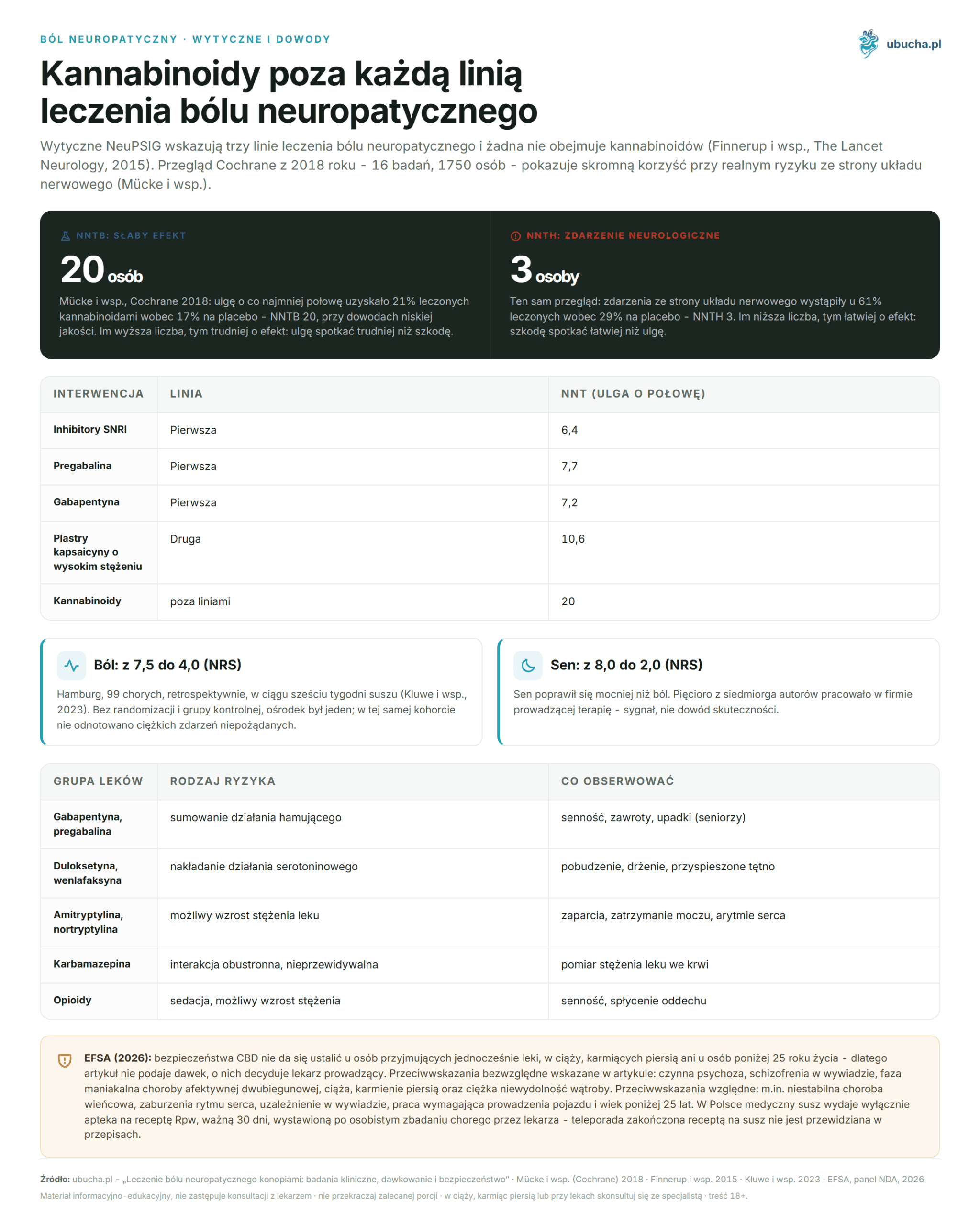
• Cochrane review 2018: at least 50% relief in 21% vs. 17% on placebo, NNTB 20 (Mücke et al.).
• NeuPSIG guidelines do not include cannabinoids in any recommended treatment line (Finnerup et al., 2015).
• EFSA 2026: CBD safety cannot be established in people taking medications.
• Medical cannabis flower is dispensed by pharmacies only on Rpw prescription after personal patient examination.
What did the Hamburg study on cannabis in neuropathic pain show?
A retrospective analysis of 99 patients with chronic neuropathic pain conducted by the Neurology Clinic of the University Medical Center Hamburg-Eppendorf showed a median pain intensity drop from 7.5 to 4.0 points on the NRS scale over six weeks of inhaled medical cannabis flower administration (Kluwe et al., Medical Cannabis and Cannabinoids, 2023). The proportion of patients with severe pain dropped from 96% to 16%.
Patients inhaled flower with THC content ranging from below 12% to 22%, with a daily dose not exceeding 0.15-1 gram. Follow-ups occurred every four to six weeks, up to six times, and the entire observation lasted half a year. Improvement persisted throughout. The second measured domain, sleep disturbances, improved even more markedly.
| Measured Parameter | Before Therapy | After Six Weeks |
|---|---|---|
| Median Pain Intensity (NRS) | 7.5 | 4.0 |
| Percentage with Pain Above 6 Points | 96% | 16% |
| Median Sleep Disturbance Severity | 8.0 | 2.0 |
| Serious Adverse Events | - | none |
General condition improvement was reported by 90% of patients at the first follow-up, and at least once during the half-year by 97 of 99 patients. Good tolerance was noted in 279 of 307 responses. Mild side effects included mucous membrane dryness in 5.4%, fatigue in 4.8%, and increased appetite in 2.7%.
Limitations must be considered alongside results, as they are significant. There was no randomization or control group, data were collected retrospectively, the center was single, and patients self-selected for cannabis therapy, so expectations may have biased assessments. Eighty-six of 99 patients were men, although chronic pain more often affects women. Five of seven authors worked for a telemedicine company providing this therapy and declare this in the paper. Thus, the result is a signal worth verifying in a randomized trial, not proof of efficacy.
What causes neuropathic pain and who does it affect?
Neuropathic pain arises from damage or disease of the somatosensory part of the nervous system (International Association for the Study of Pain). Estimates of chronic pain with a neuropathic component in the general population range from 6% to 10%, with variation due to different definitions and screening tools (Mücke et al., Cochrane, 2018).
Patients describe this pain differently than tissue injury pain. Burning, stinging, shooting, electric shock sensations, sometimes attacks without any stimulus. Location may not match nerve damage site. Two symptoms are characteristic: allodynia, pain caused by normally non-painful stimuli like bed linen touch, and hyperalgesia, an exaggerated response to actually painful stimuli.
The mechanism has several layers. The damaged nerve generates spontaneous discharges, signals leak between adjacent fibers, dorsal horns of the spinal cord become hyperexcitable, and microglia around damaged neurons release inflammatory cytokines. This is why drugs acting only peripherally often fail, and the same diagnosed syndrome in two people responds to two different drugs.
| Cause Group | Examples |
|---|---|
| Metabolic | diabetes, kidney failure, vitamin B12 deficiency |
| Infectious and post-infectious | shingles, HIV, hepatitis C |
| Iatrogenic | chemotherapy, some antitubercular and antiarrhythmic drugs |
| Traumatic and compressive | amputations, carpal tunnel syndrome, trigeminal neuralgia |
| Central | post-stroke pain, spinal cord injury, multiple sclerosis |
| Toxic | alcohol, lead, mercury, organic solvents |
Not every nerve damage results in pain. Risk is modified by genetics, age, sex, and mental state, with anxiety and depression lowering pain threshold. Therefore, therapy efficacy assessment cannot rely solely on pain intensity. It is useful to keep a diary of four dimensions simultaneously: pain, sleep, mood, and daily functioning. A pain intensity reduction of at least 30% is considered a clinically significant response.
How do cannabinoids act on neuropathic pain?
Cannabinoids do not have a single target. THC stimulates the CB1 receptor in the dorsal horns of the spinal cord and brain structures responsible for the affective perception of pain. CBD does not bind CB1 directly but modulates TRPV1 channel, 5-HT1A receptor, and nuclear PPAR gamma. These are two different mechanisms, not two versions of the same.
CB1 stimulation in the spinal cord inhibits glutamate and substance P release from afferent fibers, thus suppressing pain signal transmission upward. The effect resembles opioids acting on the mu receptor but without respiratory depression, as CB1 receptor density in the brainstem respiratory center is minimal. CB1 presence in the somatosensory cortex explains patients’ reports like “the pain is there, but I care less.”
| Compound | Main Targets | Evidence Status |
|---|---|---|
| THC | CB1 agonism, weaker CB2 | human studies, including randomized |
| CBD | TRPV1, 5-HT1A, PPAR gamma, FAAH inhibition | very limited human neuropathy data |
| CBG | mechanism in pain unknown | only animal neurodegenerative disease models |
| Beta-caryophyllene | selective CB2 agonism | mouse inflammatory and neuropathic pain models |
For CBG, there is a study where cannabigerol protected striatal neurons in mice with Huntington’s disease model, reduced microglial response, and improved motor function (Valdeolivas et al., Neurotherapeutics, 2015). This is a neuroprotection animal study, not about neuropathic pain in humans, and should be read as such.
Beta-caryophyllene, a terpene found in pepper and cloves, orally administered to mice reduced thermal hyperalgesia and mechanical allodynia in neuropathy models and decreased spinal inflammation without tolerance development (Klauke et al., European Neuropsychopharmacology, 2014). Similar mechanisms are studied for other endocannabinoid-like compounds, including palmitoylethanolamide.
What does the Cochrane review say about cannabinoids in neuropathy?
The Cochrane review included 16 randomized trials with 1750 people with chronic neuropathic pain and showed a small advantage over placebo with noticeable adverse effects (Mücke et al., 2018). At least 50% relief was achieved by 21% treated with cannabinoids versus 17% on placebo, yielding NNTB 20 with low-quality evidence.
Tested preparations were mainly THC and CBD oromucosal sprays, two studies with nabilone, two with inhaled flower, and two with dronabinol. CBD isolate was not tested in any of these, so claims about “CBD isolate in neuropathy” cannot be derived from this review. The authors separately note they cannot determine if flower reduces average pain intensity.
| Endpoint | Cannabinoids | Placebo | NNTB or NNTH |
|---|---|---|---|
| At least 50% relief | 21% | 17% | NNTB 20 |
| At least 30% relief | 39% | 33% | NNTB 11 |
| Discontinuation due to adverse events | 10% | 5% | NNTH 25 |
| Nervous system events | 61% | 29% | NNTH 3 |
| Psychiatric disorders | 17% | 5% | NNTH 10 |
Note the proportions in this table. To have one person achieve 50% relief, twenty must be treated, but to have one experience a nervous system event, only three need treatment. Regarding serious adverse events, the authors state data were insufficient to determine differences versus placebo. This is not the same as “serious adverse events occurred similarly.”
The authors’ conclusion is as stated: potential benefits of cannabis-based drugs in chronic neuropathic pain may be outweighed by potential harms. They also note that studies excluded people with addiction history and serious comorbidities, a large part of the real patient population.
What does NNT mean and why does this number determine drug evaluation?
NNT is the number of patients who must be treated for one to achieve the intended benefit beyond placebo. The risk counterpart is NNTH, indicating how many must be treated for one to experience an additional harm. The lower the number, the stronger the effect. Both values make sense only together.
The Cochrane example shows why this is not trivial. NNTB 20 for 50% relief means one in twenty treated benefits beyond placebo. Simultaneously, NNTH 3 for nervous system events means one in three treated experiences an additional symptom. The ratio is reversed compared to advertising intuition.
The same arithmetic orders recommended drugs. NNT 6.4 for serotonin-norepinephrine reuptake inhibitors means five out of six do not achieve 50% relief. A first-line drug is thus not one that works for most, but one with the best benefit-risk ratio among available options. This distinction is important when planning expectations.
Three caveats about the number are worth knowing. First, NNT depends on the chosen benefit threshold: for 30% relief, it is usually lower than for 50%. Second, it transfers poorly between populations, as studies include healthier patients than typical clinic populations. Third, it is affected by publication bias, estimated at about 10% effect inflation in the NeuPSIG meta-analysis.
The practical takeaway: when reading about a new neuropathic pain drug, look for NNT together with NNTH and the benefit threshold used. The phrase “statistically significant pain reduction” alone does not tell how many will feel a difference or how many will pay with drowsiness.
Are cannabinoids included in neuropathic pain treatment guidelines?
No. The NeuPSIG update, prepared by the International Association for the Study of Pain working group based on a meta-analysis of 229 studies, lists three lines of drugs and cannabinoids are not in any (Finnerup et al., The Lancet Neurology, 2015). This is one of the most frequently misquoted statements about cannabis in the Polish internet.
The repeated version says cannabinoids are “third-line with weak recommendation.” The third line in these guidelines includes strong opioids and botulinum toxin type A. Cannabinoids are not included there or anywhere else among recommended options. The authors also note that the analysis indicates about 10% effect inflation due to publication bias.
| Line | Drugs | Recommendation Strength |
|---|---|---|
| First | tricyclic antidepressants, serotonin-norepinephrine reuptake inhibitors, pregabalin, gabapentin | strong |
| Second | lidocaine patches, high-concentration capsaicin patches, tramadol | weak |
| Third | strong opioids, botulinum toxin type A | weak |
| Outside lines | cannabinoids | no recommendation |
What does this mean practically? A cannabinoid is not a drug you ask for instead of pregabalin because a forum suggested it. It is a solution a doctor may consider individually when recommended lines have failed or are intolerable, and must document why they deviate from guidelines. Such a conversation differs from a prescription request.
The guideline authors also emphasize something marketing ignores: lack of satisfactory response to available drugs in neuropathic pain is a large unmet need. Skepticism about cannabis does not mean medicine has a ready solution. It means no one does.
How do recommended drugs perform?
Effectiveness is measured by the number needed to treat for one to achieve at least 50% relief. NeuPSIG meta-analysis found 6.4 for serotonin-norepinephrine reuptake inhibitors, 7.7 for pregabalin, 7.2 for gabapentin, and 10.6 for high-concentration capsaicin patches (Finnerup et al., 2015). Values were lower for tricyclics, strong opioids, tramadol, and botulinum toxin.
These numbers are better than NNTB 20 from the Cochrane review for cannabinoids but still modest. With pregabalin, seven out of eight do not achieve 50% relief. For lidocaine patches, guidelines do not provide values due to insufficient data. No drug here works for the majority.
It is also worth knowing the adverse effect profile, as it often determines therapy continuation more than efficacy. The Cochrane update on pregabalin included 45 studies with 11,906 participants, mostly postherpetic neuralgia, painful diabetic neuropathy, and mixed pain (Derry et al., Cochrane Database of Systematic Reviews, 2019).
| Clinical Situation | Dizziness | Drowsiness | Placebo (dizziness / drowsiness) |
|---|---|---|---|
| Postherpetic neuralgia, lower dose | 29% | 16% | 8.1% / 5.5% |
| Diabetic neuropathy, lower dose | 13% | 11% | 3.8% / 3.1% |
| Central pain, higher dose | 23% | 32% | 8.6% / 11% |
Serious adverse events did not occur more often than placebo with high-quality evidence. Authors confirmed pregabalin efficacy in postherpetic neuralgia, painful diabetic neuropathy, and post-traumatic pain, but not in HIV-associated neuropathy. Data for central pain were insufficient. This is a realistic first-line drug picture.
In which neuropathies is evidence for cannabis strongest?
The best documented are three situations: painful diabetic neuropathy, central pain in multiple sclerosis, and early symptoms of chemotherapy-induced neuropathy. In none is the evidence strong as for pregabalin. All three studies are small or yielded inconclusive results.
In a randomized, double-blind, crossover study of 16 people with painful diabetic neuropathy, inhaled cannabis reduced spontaneous pain dose-dependently, comparing three THC concentrations with placebo (Wallace et al., The Journal of Pain, 2015). The highest concentration worsened two of three neuropsychological tests, so relief came at a cognitive cost.
| Situation | Study | Findings |
|---|---|---|
| Diabetic neuropathy | Wallace 2015, n=16 | dose-dependent pain reduction, cognitive function cost |
| Central pain in MS | Langford 2013, n=339 | primary endpoint not met, advantage only in withdrawal phase |
| Chemotherapy neuropathy | Nielsen 2022, n=54 | early symptom relief, non-randomized control group |
A phase 3 study with THC and CBD aerosol in 339 MS patients did not reach the primary endpoint: 30% relief was achieved by 50% treated versus 45% placebo. During randomized withdrawal, the picture reversed as therapy failed in 57% placebo versus 24% aerosol group (Langford et al., Journal of Neurology, 2013). Authors called their result inconclusive.
In chemotherapy neuropathy, oral CBD given for eight days around the first oxaliplatin or paclitaxel cycle alleviated early symptoms compared to control, measured by vibrometry and patient-reported scales (Nielsen et al., Supportive Care in Cancer, 2022). Groups were not randomized, and CBD patients were older. Authors call for repetition in a randomized trial. Related topics are discussed in the post on CBD oil for sciatica and nerve pain.
Do cannabis plants improve sleep in neuropathic pain?
Sleep is the second measured outcome in these studies and fares better than pain itself. In the Hamburg observation, median sleep disturbance severity dropped from 8.0 to 2.0 points over six weeks, more than median pain intensity (Kluwe et al., 2023). In Langford’s study, sleep quality was a secondary endpoint and showed advantage over placebo in the withdrawal phase.
This matters mechanistically. Pain disrupts sleep, and sleep deprivation lowers pain threshold, creating a self-reinforcing loop that worsens weekly. Breaking it anywhere improves both sides. Thus, a drug that shortens sleep onset can reduce reported pain intensity without direct analgesic action.
This leads to an interpretive trap easily overlooked. If therapy improves sleep and the patient rates pain the next day, part of the decrease comes from better sleep. This is a real benefit but not proof of action on damaged nerves. Hamburg authors measured both domains separately to distinguish this.
Also note the cost side. The Cochrane review shows nervous system adverse events in 61% treated with cannabinoids versus 29% placebo, with drowsiness among the most common. Nighttime sleep improvement and daytime drowsiness are different phenomena, though both arise from the same mechanism.
Practically: if you and your doctor assess therapy effect, record sleep onset time and number of awakenings separately from pain intensity. Also record morning drowsiness separately. These three records help determine if the drug helps or just shifts sedation to the wrong time of day.
What do other meta-analyses and observational studies show?
Two large reviews align with Cochrane and are less optimistic than online summaries suggest. A meta-analysis of 43 randomized trials with 2437 patients quantitatively analyzed 24 studies with 1334 people and found limited evidence for chronic pain reduction (Aviram and Samuelly-Leichtag, Pain Physician, 2017).
The effect size was -0.61 overall and -0.93 for inhalation. Authors add a rarely quoted sentence: most included studies showed no effect, so clinical significance of the pooled result remains uncertain. Most common adverse events involved nervous and gastrointestinal systems, with GI symptoms more frequent after oral than inhaled administration.
A review of reviews published in European Journal of Pain collected ten systematic reviews and summarized more cautiously than marketing (Häuser et al., European Journal of Pain, 2018). Four gave inconsistent conclusions on neuropathic pain efficacy, and in rheumatic diseases and cancer pain conclusions were consistently negative: evidence is insufficient.
When reading these, note one easy-to-miss point. All studies here used THC-containing preparations: spray, flower, or dronabinol. Results obtained with such substances are often summarized as if they concerned CBD-predominant oil available without prescription. These are different substances with different targets and risk profiles, so transferring conclusions between them is misuse, not shorthand.
From observational studies, one is worth knowing. A prospective single-arm observation of 97 chronic pain patients on opioids for at least a year showed that after eight weeks of CBD cannabis extract use, 53% reduced or stopped opioids, and 94% reported quality of life improvement (Capano et al., Postgraduate Medicine, 2020). There was no control group, so placebo effect is not excluded. This topic is expanded in the post on cannabis versus opioids in pain treatment.
Why is placebo so strong in neuropathic pain?
Because we measure sensation, not a laboratory parameter. In a phase 3 study in MS patients, 45% receiving placebo aerosol reported 30% relief (Langford et al., 2013). This is neither strange nor exceptional. NeuPSIG guidelines list large placebo response as a cause of modest results in this field.
At least three phenomena contribute. Natural symptom fluctuation means patients enroll during worse periods and then return to their average. Study participation changes behavior: more staff contact, diary keeping, and regular measurements improve well-being regardless of drug. Plus, expectation of relief modulates pain processing.
With cannabis, a fourth technical factor applies. Blinding is difficult because THC causes noticeable psychoactive effects, so participants often guess their group. Aviram and Samuelly-Leichtag meta-analysis explicitly lists insufficient blinding as a limitation. Results measured under such conditions tend to be biased toward active substance.
This explains why uncontrolled observational studies look good, but randomized trials are average. Hamburg and Capano observations describe real patient improvement but cannot separate drug effect from other factors. Langford’s randomized trial separates them and the result immediately weakens.
For you, this means practically: if you feel improvement in the first week of therapy, it is not yet proof the drug works. Proof is effect maintenance over weeks and symptom return after stopping, ideally recorded in a diary from before therapy.
Why does this article not provide doses?
Because there is no dose safe to recommend to a reader with a diagnosed condition. The European Food Safety Authority stated in its 2026 position that cannabidiol safety cannot be established in people taking medications, pregnant or breastfeeding women, and those under 25 (EFSA, NDA panel, 2026). Neuropathy patients almost always take medications.
The second reason is pharmacokinetic. A systematic review of human cannabidiol data established absolute bioavailability only for inhalation at 31%, and found no study measuring oral or sublingual bioavailability despite intravenous forms being available (Millar et al., Frontiers in Pharmacology, 2018). Internet tables with sublingual drop percentages lack human measurement support.
The third reason concerns the preparation itself. The provisional safe dose calculated by EFSA applies only to supplements with at least 98% pure cannabidiol, without nanoparticles, and excluded genotoxicity. It does not apply at all to full-spectrum pharmacy oils or prescription flower. Transferring numbers between these forms is an error, not simplification.
Additionally, EFSA lists safety signals explicitly: consistent liver toxicity in animal studies, potential hepatotoxicity in humans especially with drugs, placental transfer with systemic accumulation, and thyroid hormone changes. No study has examined immunotoxicity. With such knowledge, a milligram dose in a consumer article pretends to precision that does not exist.
The practical takeaway is simple. The attending physician determines the dose, knowing your medication list, liver and kidney function, and treatment goal. If the doctor decides on a trial, ask for the regimen to be documented and a follow-up date for effect assessment.
How do cannabinoids interact with neuropathy drugs?
Two ways simultaneously. First, pharmacokinetic: cannabidiol inhibits some cytochrome P450 isoenzymes, so drug levels metabolized by the same pathway may increase. Second, pharmacodynamic: sedation, dizziness, and coordination impairment add to effects of gabapentinoids or tricyclic antidepressants. The latter is often more dangerous as it appears faster.
EFSA’s 2026 position highlights cannabidiol’s hepatotoxic potential in humans as greatest when combined with drugs, and sees no way to establish safe exposure in this group. This concerns exactly the population reading neuropathy articles: people on gabapentin, duloxetine, amitriptyline, carbamazepine, or opioids.
| Drug Group | Risk Type | What to Monitor |
|---|---|---|
| Gabapentin, pregabalin | additive inhibitory effects | drowsiness, dizziness, falls, especially in seniors |
| Duloxetine, venlafaxine | serotonergic effect overlap | agitation, tremor, increased heart rate |
| Amitriptyline, nortriptyline | possible drug level increase | constipation, urinary retention, arrhythmias |
| Carbamazepine | bidirectional interaction, unpredictable outcome | blood drug level monitoring required |
| Opioids | sedation, possible increase of some opioid levels | daytime drowsiness, respiratory depression |
Risk timing is uneven. Sedation summation appears in first days and weeks, when falls or accidents are most common. Metabolic effects, i.e., increased drug levels inhibited by cannabidiol, develop slower and may be noticed only after weeks, after overdose symptoms of the primary drug. Therefore, the first check after cannabis introduction should be early, and the second after a month.
Carbamazepine, used in trigeminal neuralgia, is special. It induces the same isoenzyme inhibited by cannabidiol, so the net effect depends on doses and treatment duration. This cannot be predicted from a table. The only sensible approach is blood level measurement before and after change.
The practical rule, not replacing consultation: do not modify any of these drugs on your own. Abrupt gabapentinoid cessation risks pain worsening, and opioid cessation risks withdrawal syndrome. If the doctor decides to reduce doses, it is done gradually with planned monitoring.
Who should avoid cannabis in neuropathic pain?
The list of absolute contraindications is short but firm. Active psychosis, schizophrenia history, manic phase of bipolar disorder, pregnancy, and breastfeeding. Also severe liver failure, as EFSA’s strictest warnings concern the liver.
Relative contraindications cover a much larger group. Unstable coronary disease and recent myocardial infarction, arrhythmias, substance addiction history, jobs requiring driving, and age under 25, for which EFSA cannot establish safety. In the Hamburg study, patients from some of these groups were simply excluded from therapy.
Cognitive function is a separate issue. Wallace’s study shows even a single inhalation session at higher THC concentration worsens attention and processing speed tests. For someone working mentally or driving, this is a real therapy cost, not a side effect to ignore.
In seniors, caution arises from arithmetic, not ideology. Slower liver metabolism, multiple drugs, poorer balance, and higher fracture risk after falls. The Cochrane pregabalin review showed drowsiness in central pain reaching 32%. Adding a second sedating drug must be planned, not tried on one’s own.
Also note what studies simply have not checked. EFSA notes no study examined cannabidiol immunotoxicity, and methodological gaps identified in 2022 remain unclosed. There is also no long-term data, as Cochrane review studies lasted from two to twenty-six weeks. Lack of warning signals in such a short horizon is not proof of safety.
If you still consider a trial, ask your doctor about product quality: batch analysis certificate, heavy metal content, and solvent residues. Regulatory context is described in detail in the post on CBD product regulation in Poland.
What is access to medical cannabis like in Poland?
Cannabis other than fiber hemp is allowed in Poland as a pharmaceutical raw material for magistral preparations under Article 33a of the Act on Counteracting Drug Addiction, as amended by the July 7, 2017 law (Dz.U. 2017 item 1458), effective November 1, 2017. It is dispensed by pharmacies only on Rpw prescription.
The boundary between legal non-prescription products and controlled substances is based on THC content in the plant, not the finished product. Fiber hemp plants have a sum of delta-9-THC and tetrahydrocannabinolic acid in flowering tops not exceeding 0.3% dry weight, rounded to one decimal place. Basis is Article 4 point 5 of the Act on Counteracting Drug Addiction of July 29, 2005 (consolidated text Dz.U. 2023 item 1939), as amended March 24, 2022 (Dz.U. 2022 item 763). The national threshold corresponds to the EU threshold but is not derived from it.
| Procedure Element | Legal Status |
|---|---|
| Who issues Rpw prescription | doctor, after personal patient examination |
| Prescription validity | 30 days from issue date |
| Maximum treatment period per prescription | 90 days |
| Number of preparations per prescription | one |
| Reimbursement | none, patient pays full cost |
Two points from this table deserve elaboration. The validity of narcotic prescriptions is 30 days, not one year as with regular e-prescriptions, per Article 96a paragraph 7 point 4 of the Pharmaceutical Law (consolidated text Dz.U. 2026 item 612). Treatment period and number of preparations are regulated by the Minister of Health’s prescription regulation (consolidated text Dz.U. 2025 item 1678).
The most important practical rule is the personal examination requirement. For cannabis flower other than fiber hemp and cannabis resin, the regulation requires personal patient examination, with narrow exceptions. Teleconsultation after which a doctor immediately issues a flower prescription is not provided for. Check this before paying for an online consultation.
What to do if you consider cannabis for neuropathic pain?
Start with diagnostics, not the preparation. New neuropathic pain requires cause determination, as some causes are reversible and causal treatment works better than any analgesic. Neuropathy from vitamin B12 deficiency or uncontrolled diabetes will not resolve with any oil.
The second step is honest trial of recommended lines. NeuPSIG guidelines list four first-line and three second-line drugs, each with its own adverse effect profile. Switching within this list due to intolerance is usually wiser than going off-guideline after first failure.
The third step is conversation, not order. If recommended lines failed, ask a neurologist or pain specialist if a cannabinoid trial makes sense in your case, what risks they see with your medication list, and when you will assess effect. Ask for this decision and rationale to be documented.
The fourth step is measurement. Keep a diary before and during therapy: pain intensity, sleep quality, mood, and what you actually managed daily. Without a pre-therapy baseline, you cannot distinguish improvement from natural symptom fluctuation, which is large in neuropathic pain.
And the last point, directly from data in this text. Cannabinoids are not a first-line option in neuropathic pain and do not replace treatment. They are a solution a doctor may consider individually, aware that evidence is limited and interaction risk in polypharmacy is real. Any text promising more promises beyond current knowledge.
Frequently Asked Questions
Do cannabis plants relieve neuropathic pain?
A Cochrane review covering 16 randomized studies and 1750 participants showed at least 50% relief in 21% treated with cannabinoids versus 17% on placebo, with NNTB 20 and low-quality evidence (Mücke et al., Cochrane Database of Systematic Reviews, 2018). The authors concluded that possible benefits may be outweighed by potential harms.
Are cannabinoids included in neuropathic pain treatment guidelines?
No. The NeuPSIG update indicates three lines of treatment and cannabinoids are not included in any of them (Finnerup et al., The Lancet Neurology, 2015). The third line includes strong opioids and botulinum toxin type A. The repeated statement about cannabinoids being in the third line is a misinterpretation of these guidelines.
Why does this article not provide doses in milligrams?
Because EFSA stated in 2026 that cannabidiol safety cannot be established in people taking concurrent medications, pregnant or breastfeeding women, and those under 25 years old. Patients with neuropathy almost always take medications, so the dose is determined by the attending physician, not the article.
Do cannabis plants work in diabetic neuropathy?
In a randomized study of 16 people with painful diabetic neuropathy, inhaled cannabis reduced spontaneous pain dose-dependently (Wallace et al., The Journal of Pain, 2015). However, the highest THC concentration worsened performance in two of three neuropsychological tests. This was a small, single study, not proof of long-term efficacy.
Do cannabis plants help with neuropathic pain in multiple sclerosis?
The result is inconclusive. In a phase 3 study of 339 people, a THC and CBD aerosol did not reach the primary endpoint, as 50% of treated patients achieved 30% relief versus 45% on placebo (Langford et al., Journal of Neurology, 2013). The advantage appeared only during the randomized withdrawal phase.
Does CBD protect against chemotherapy-induced neuropathy?
Oral CBD administered for eight days around the first chemotherapy cycle alleviated early neuropathy symptoms compared to the control group (Nielsen et al., Supportive Care in Cancer, 2022). Groups were not randomized, and CBD patients were older, so the authors call for confirmation in a larger randomized trial.
Can cannabis be combined with opioids?
Only under medical supervision. In a single-arm observation of 97 opioid users, 53% reduced or stopped opioids after eight weeks of CBD extract use (Capano et al., Postgraduate Medicine, 2020). There was no control group. Abrupt opioid cessation risks withdrawal syndrome and increased pain.
How to obtain medical cannabis flower in Poland?
Only with an Rpw prescription issued by a doctor after a personal examination, as per the Minister of Health’s regulation on prescriptions (consolidated text Dz.U. 2025 item 1678). The narcotic prescription is valid for 30 days, covers up to 90 days of use, and one preparation. Therapy is not reimbursed.
This article is for informational and educational purposes and does not constitute medical advice. Before starting cannabis or CBD for therapeutic purposes, consult a doctor, especially if you take other medications, are pregnant, or breastfeeding.
Author: Michał Waluk · Published: 2026-05-04 · Updated: 2026-08-10