
CBD Cookies: How Much to Add and at What Temperature to Bake
From 5 to 10 mg cannabidiol per piece, baking at 160-170 degrees. Step-by-step recipe, dosing, and what is not definitely known about thermostability.
Typically, one cookie contains between 5 and 10 mg of cannabidiol and is baked at 160 to 170 degrees Celsius for several minutes. For brownies, see the separate post, as it uses a different base and baking time. CBD cookies are one of the most popular ways to prepare homemade cannabis edibles because the baked form effectively masks the herbal taste of the oil and prolongs the effect compared to sublingual drops. The market for CBD edibles like gummies is growing at a CAGR of 30.8% through 2030 (Grand View Research, 2025). Making cookies at home gives control over the dose and quality of the carrier fat: this is a simple recipe if you understand three principles - decarboxylation, cannabinoid thermostability, and distributing CBD in fat before baking. This guide shows step by step how to bake CBD cookies without losing active substance, with verified temperatures, doses per serving, and vegan and gluten-free variants.
KEY INFORMATION
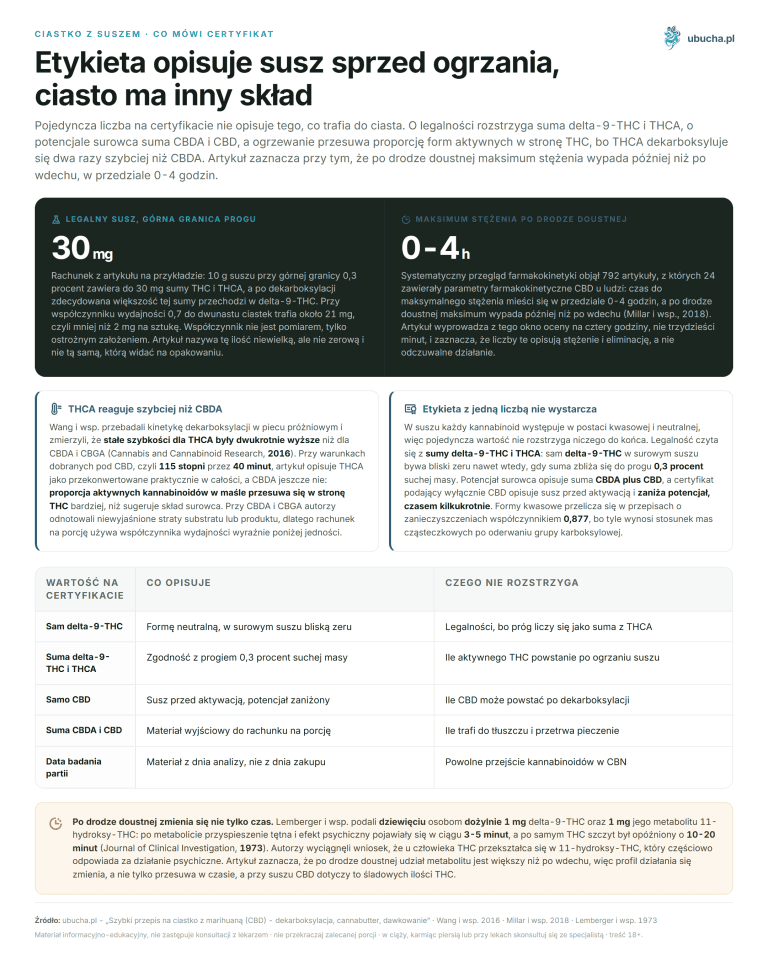
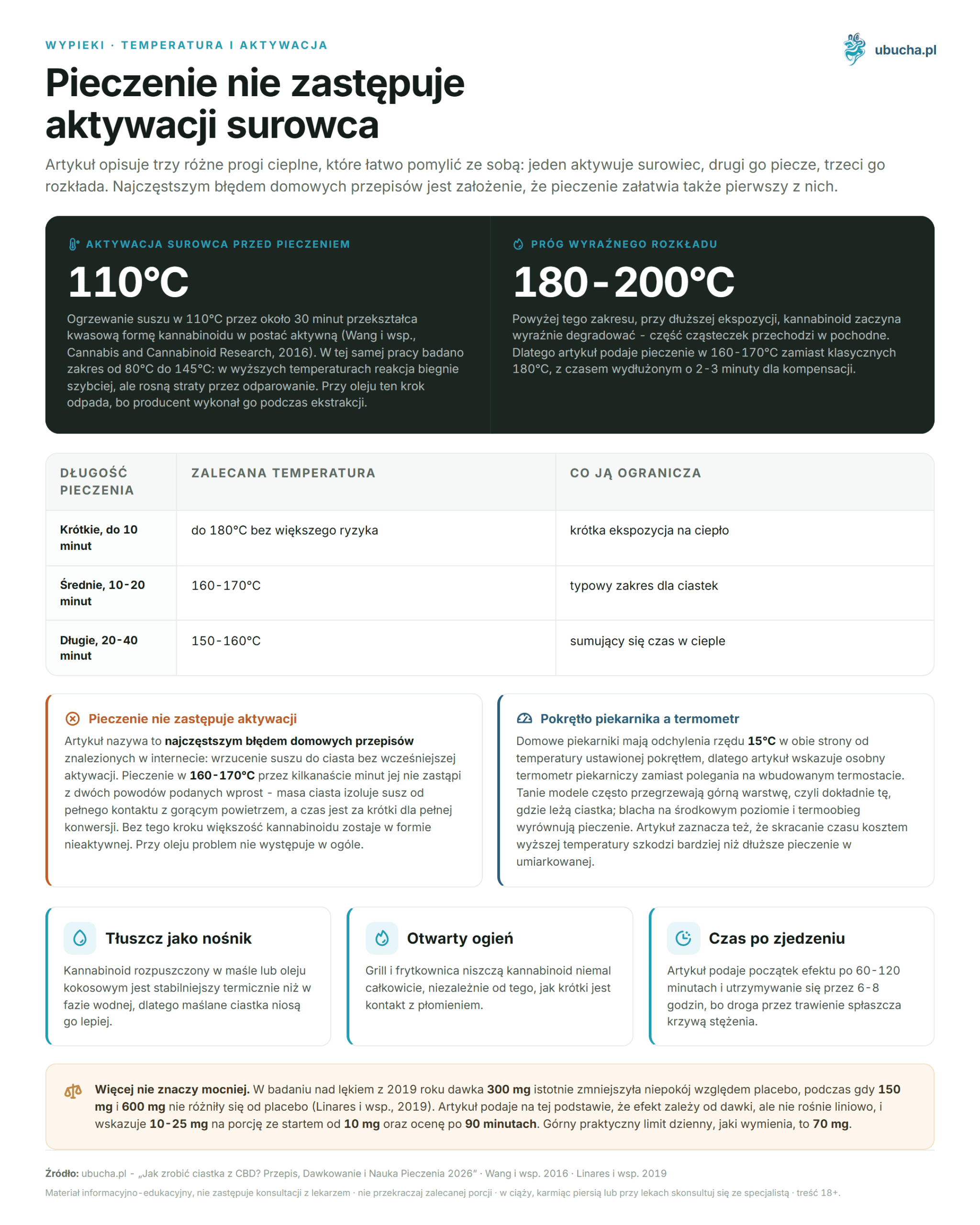
• Decarboxylation of CBD flower at 110°C for 30 minutes effectively converts CBDA to active CBD (Wang et al., Cannabis and Cannabinoid Research, 2016); skip this step when using CBD oil.
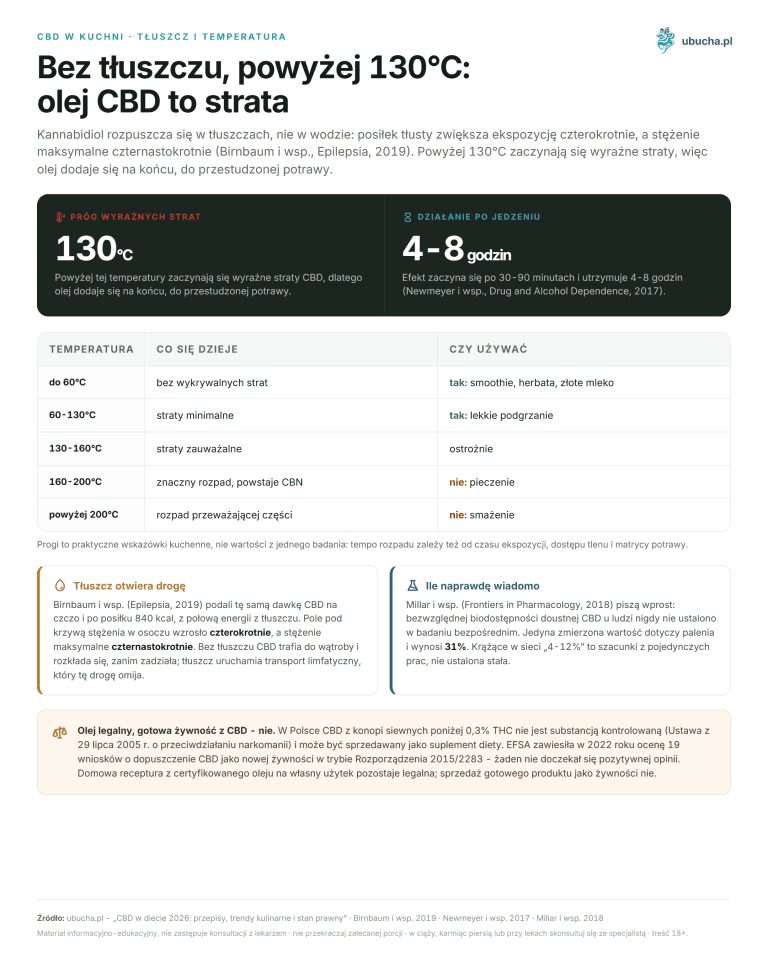
• CBD starts to noticeably degrade only above about 180-200°C, so cookies are baked at 160-170°C.
• Typical dose is 10-25 mg CBD per cookie, starting at 10 mg.
• Effects appear 60-120 minutes after ingestion and last 6-8 hours.
• Combine CBD with fat (butter, coconut oil) BEFORE baking to achieve an even dose throughout the batch.
Why choose CBD cookies instead of drops?
CBD cookies provide a longer and more stable effect than sublingual drops because they undergo full digestion instead of absorption through the mucous membrane. They also mask the herbal taste of the oil, which many new users dislike, and allow precise division of the daily dose into equal portions.
The difference is pharmacokinetic. Drops partially enter the bloodstream through the oral mucosa, bypassing the stomach, so they act faster but for a shorter time. Cookies must first pass through the stomach and intestines, where CBD is gradually absorbed with the fat from the baked good, flattening and extending the blood concentration curve. The effect builds more slowly but lasts significantly longer than drops.
The table below shows the difference between popular forms:
| Form | Onset | Peak | Duration |
|---|---|---|---|
| Inhalation (vaping) | 1-5 minutes | 10-30 minutes | 2-4 hours |
| Sublingual drops | 15-45 minutes | 60-90 minutes | 4-6 hours |
| Cookies and other edibles | 60-120 minutes | 2-3 hours | 6-8 hours |
| Soft capsules | 60-120 minutes | 2-3 hours | 6-8 hours |
Capsules behave similarly to cookies regarding onset and duration because both follow the same digestive route and are subject to the same first-pass liver effect. Cookies are better for shift workers needing steady cannabinoid levels for many hours and travelers wanting portioned doses without bottles and droppers. Those seeking a fast, short effect will prefer vaping or drops over baked goods. Vaping is fastest but requires equipment and is less discreet than eating a cookie anywhere without smoke smell or measuring drops in public. Cookies are easy to take to work, travel, or trips without risk of bottle leakage. Unlike vaping, they leave no characteristic smell in rooms or on clothes. For a fat-free form, see the separate CBD gummies recipe; they have different, less predictable bioavailability than fat-based baked goods.
Is decarboxylation necessary for CBD cookies?
Decarboxylation is only necessary when using CBD hemp flower. Raw flower mainly contains CBDA, an acidic form with different receptor affinity than CBD. Heating at 110°C for about 30 minutes effectively converts it to active CBD (Wang et al., Cannabis and Cannabinoid Research, 2016).
Chemically, CBDA loses a carboxyl group as carbon dioxide during heating, changing its shape and ability to bind endocannabinoid receptors. A study on cannabinoid decarboxylation kinetics tested temperatures from 80°C to 145°C and showed the reaction proceeds faster at higher temperatures, though losses from evaporation also increase above a threshold (Wang et al., Cannabis and Cannabinoid Research, 2016). Thus, 110°C is a reasonable compromise between speed and losses.
Without decarboxylation, most cannabinoid remains inactive, so the baked good won’t work as expected. This is the most common mistake in home recipes found online: simply adding flower to dough without prior activation yields a weak effect. Baking cookies at 160-170°C for several minutes does not replace decarboxylation because the dough mass insulates the flower from full contact with hot air, and the time is too short for full conversion. Freshness of flower also matters: overly dried or long-stored flower loses some cannabinoids before decarboxylation, so use recently purchased raw material stored in a sealed, dark container away from heat and moisture.
When using CBD oil, skip this step entirely because the producer already performed decarboxylation during extraction. This is the easiest path for beginners: measure the dose with a pipette or syringe and add to melted fat, no 110°C oven step, no sieving, no risk of under- or over-baking flower. For a broader chemistry overview, see the separate cannabis decarboxylation guide.
What is CBD thermostability in the oven?
We could not confirm a precise threshold temperature above which cannabidiol clearly breaks down during baking from any open-source study, so we do not provide a specific number here. Lower temperatures are common kitchen practice with a safety margin: 160-170°C instead of classic 180°C, with baking time extended by 2-3 minutes.
Thermal degradation of CBD mainly involves slow molecule breakdown and conversion of some cannabinoid into derivatives, including trace CBN. The process accelerates with temperature and exposure time, so longer baking at lower temperature usually preserves more active substance than short baking at higher temperature. This is typical for lipophilic compounds with phenol groups, similar to degradation of many essential oils during heat treatment. The practical conclusion is simple: do not shorten baking time by increasing temperature hoping to reduce cannabinoid heat exposure. A shorter but hotter session usually causes more harm than a longer one at moderate temperature, so patience during baking pays off more than rushing, even if it means a few extra minutes at the oven.
Fat in the dough further protects the cannabinoid: CBD dissolved in butter or coconut oil is more thermally stable than in the aqueous phase, so classic butter cookies are a better carrier than fluffy egg-based sponge cakes. Direct exposure to open flame, e.g., grill or deep fryer, almost completely destroys CBD and is unsuitable for edible preparation regardless of contact duration.
| Baking time | Baking temperature |
|---|---|
| Short, up to 10 minutes | up to 180°C |
| Medium, 10-20 minutes (cookies) | 160-170°C |
| Long, 20-40 minutes (e.g., brownie) | 150-160°C |
Home ovens can vary by +/- 15°C from the set temperature relative to the dial, so it’s worth using a separate oven thermometer on the first try instead of relying solely on the built-in thermostat. Cheap models often overheat the top layer where cookies lie, so placing the baking sheet on the middle rack and using convection ensures even baking and protects cannabinoids on the cookie surface, which heats fastest.
How to dose CBD in cookies without overdosing?
The dose per serving is 10-25 mg CBD for adults: beginners start at 10 mg, experienced users use 20-25 mg. Project CBD dosing guide recommends the “start low, go slow” principle with effect assessment after 90 minutes (Project CBD, 2023), and a provisional safe dose set by EFSA in 2026 is 0.0275 mg per kilogram body weight daily, about 2 mg for 70 kg, much less than 20-70 mg at which most users feel effects.
Individual response depends on body weight, metabolism rate, and prior cannabinoid exposure. A lighter person with no prior experience usually feels the same dose more strongly than a regular heavier user, so treat doses here as a starting point, not a strict rule. Keeping brief notes after each trial, e.g., dose and feelings after 90 minutes, helps find your optimal level faster than relying solely on general ranges. This is especially useful if sharing cookies with household members of different weights and tolerances.
Batch math is simple: sum CBD in all oil or flower and divide by the number of cookies.
| Raw material | Amount per 12-piece batch (180 mg CBD) |
|---|---|
| CBD oil 10% | 1.8 ml |
| CBD oil 5% | 3.6 ml |
| CBD flower 9%, after decarboxylation | about 2 g (weigh 2.3 g to allow for losses) |
The practical upper daily limit for most people is 70 mg CBD from edibles: above this dose, the dose-effect curve flattens and drowsiness risk rises. A 2019 anxiety study showed 300 mg significantly reduced anxiety versus placebo, while 150 mg and 600 mg did not differ from placebo (Linares et al., PMC, 2019). The effect depends on dose and is not linear. It’s better to split the daily dose into two or three portions rather than eat it all at once, e.g., 10 mg morning and 10 mg evening instead of one 20 mg cookie. For the first trial, eat one 10 mg cookie in the evening and wait 90 minutes before deciding on more.
Which cookie bases work best with CBD?
The best bases are cookies with high fat content: butter, oat with butter, and chocolate brownies. Fat improves both taste and CBD absorption because cannabinoids dissolve better in lipids than in aqueous or carbohydrate phases.
Base choice also affects texture and shelf life. Butter cookies are crumbly and break easily, requiring careful storage. Brownies and oat baked goods retain moisture longer due to higher fat and sugar content, extending fridge shelf life by several days compared to drier, more brittle butter cookies. Gluten-free variants with rice and almond flour tend to be more crumbly than wheat versions, so chill longer before storing to prevent breakage. Vegan variants with flaxseed instead of egg are less crumbly but denser inside.
| Base | Key ingredients | Baking | For whom |
|---|---|---|---|
| Classic butter | clarified butter, sugar, wheat flour | 15 min, 170°C | beginners |
| Oat | oats, honey, cinnamon | 12-15 min, 165°C | longer effect |
| Chocolate brownie | separate base and baking time | described in separate post | see CBD brownie recipe |
| Vegan | coconut oil, flaxseed instead of egg | 15-18 min, 165°C | plant-based diets |
| Gluten-free | rice and almond flour, xanthan gum | 14-16 min, 160°C | gluten intolerance |
Clarified butter and coconut oil have high smoke points and bind lipophilic cannabinoids well, so they work better for longer baking than rapeseed oil. CBD taste is slightly herbal and bitter, well masked by dark chocolate, cocoa, and cinnamon. For those sensitive to hemp flavor, chocolate or spiced oat bases are better than simple butter bases where oil taste is most noticeable. For a ready chocolate recipe, see our separate CBD brownie recipe with exact proportions and baking time for a larger pan.
How to make CBD cookies step by step?
Basic recipe for 12 butter CBD cookies, total 180 mg CBD per batch, i.e., 15 mg per serving. Total time about 1.5 hours including 30 minutes decarboxylation if using flower. The overriding rule: combine CBD with fat BEFORE adding to dough, never after. All quantities are base amounts; scale proportionally for larger batches, remembering to recalculate CBD dose per serving.
Ingredients: 200 g wheat flour, 100 g clarified butter, 100 g cane sugar, 1 egg, a pinch of salt, and 1.8 ml CBD oil 10% or 2 g decarboxylated CBD flower 9%. Equipment: bowl, baking sheet with parchment, oven thermometer, kitchen scale, and sieve if using flower. For preparing larger fat infusions at once, see the separate cannabis butter recipe and use it instead of the infusion step below.
- Decarboxylate flower, 30 minutes (skip if using oil). Crush 2.3 g flower into pea-sized pieces, spread in one layer on parchment-lined baking sheet, bake at 110°C with convection for 30 minutes. Cool 10 minutes before use.
- Fat infusion, 30-45 minutes. Melt 100 g butter at 60-70°C, add CBD oil or decarboxylated flower. Stir 30 minutes with flower and strain, or 5 minutes with oil.
- Mix dough, 10 minutes. Combine flour, sugar, salt, crack in egg, add cooled CBD fat, knead uniform dough. Chill 15 minutes before shaping.
- Portioning, 10 minutes. Divide dough into 12 equal parts by weight, form balls, flatten to 1 cm thickness spaced 3 cm apart on baking sheet.
- Baking, 12-15 minutes. Bake at 160-170°C with convection on middle rack until edges lightly brown. Better to remove cookies a minute early than late.
- Cooling and storage. Cool 30-45 minutes at room temperature, then transfer to airtight container. Store in fridge 5-7 days or freezer up to 3 months, labeling dose on container.
When and how to eat CBD cookies for best effect?
CBD cookies work best eaten with or immediately after a fatty meal. A 2019 pharmacokinetic study showed that a high-fat meal increased CBD exposure (AUC) about 4-fold and maximum concentration up to 14-fold compared to fasting (Birnbaum et al., Epilepsia, 2019). Cookies with butter or coconut oil naturally meet this condition. Full-fat yogurt, nuts, or avocado eaten with the cookie have similar effects, while a low-fat meal like a salad without dressing gives weaker support.
Ideal timing is 30-60 minutes after lunch or dinner: eating a cookie on an empty stomach delays and weakens the effect, which anyway starts only after 60-120 minutes. For sleep support, eat a cookie 2-3 hours before planned bedtime so the effect fully develops before lying down. Water, tea, or warm milk are best drink companions; avoid alcohol as it enhances CBD’s sedative effect. Caffeine usually does not interfere but may mask mild drowsiness at doses above 20 mg CBD, sometimes misread as no effect. Plan the first trial on a day without important tasks. Eat a fatty dinner, then one 10 mg cookie 45 minutes later, and set a timer for 90 minutes. Do not drive or operate machinery for 6-8 hours after consumption. For active people, a cookie after training with a recovery meal combines high-protein benefits with longer CBD action during recovery. Regular use for 2-4 weeks shows full endocannabinoid system modulation, and tolerance develops very slowly, so most maintain the same dose for months without increase.
What mistakes to avoid when baking CBD cookies?
Common mistakes include adding CBD oil directly to flour instead of mixing with fat, baking at too high temperature, and skipping flower decarboxylation. Incorrect procedure can significantly reduce effective CBD dose in the final dough, so knowing solutions is valuable. Many errors come from copying classic recipes without adapting for cannabinoids, as standard cookie recipes do not consider CBD-safe temperatures or the need to pre-mix substances with fat. Keeping a simple batch journal - date, raw material, dose per serving, and subjective effect rating - helps refine your repeatable recipe over time instead of recalculating from scratch each bake. A short note on the container label also helps, especially if baking several variants with different doses at once.
| Mistake | Effect | Solution |
|---|---|---|
| CBD oil added directly to dough | uneven dosing between cookies | mix oil first with melted fat |
| Oven at 200°C instead of 165°C | accelerated CBD thermal degradation | lower by 10-15°C, extend time by 2-3 minutes |
| Skipping flower decarboxylation | baked good contains mostly inactive CBDA | always decarboxylate flower at 110°C for 30 minutes |
| Inaccurate dose measurement | lack of batch repeatability | use precise scale for flower, syringe for oil |
| Storing at room temperature | faster cannabinoid oxidation | fridge or freezer, airtight container |
Too hot a baking sheet surface burns the cookie’s top layer faster than its interior, so convection and middle rack placement are proven standards when baking with cannabinoids. A dosing syringe usually costs 10-20 PLN and provides accuracy of +/- 0.05 ml, especially worthwhile for regular baking. Before baking a whole batch, test one cookie with a lower dose and assess the effect before committing all oil or flower to one recipe.
Do CBD cookies have side effects?
CBD is generally well tolerated by adults. EFSA in 2026 set a provisional safe dose at 0.0275 mg per kilogram body weight daily, about 2 mg for 70 kg, and stated safety cannot be established for people under 25, pregnant or breastfeeding women, or those taking medications. Clinical data review shows most common side effects are fatigue, diarrhea, and changes in appetite or weight (Iffland and Grotenhermen, 2017). Side effects usually increase with dose, typical for most active substances: at typical home cookie doses of 10-25 mg per serving, risk of noticeable effects is low and mostly limited to mild drowsiness. Dry mouth and mild fatigue after the first trial usually resolve spontaneously within hours without intervention beyond rest and drinking water.
CBD inhibits liver cytochrome P450 enzymes including CYP3A4 and CYP2C19, which metabolize many common drugs such as antiepileptics, SSRIs, and benzodiazepines (Brown and Winterstein, 2019). This is a real interaction risk, not theoretical. If you take prescription drugs, consult your doctor or pharmacist before regular CBD cookie use. Separating CBD and drug intake by at least two hours reduces but does not eliminate risk, as enzyme inhibition lasts longer than CBD absorption from the gut.
If any side effect occurs, reduce dose by half or pause for a few days: symptoms usually resolve within 24-48 hours. For worsening reactions or allergy symptoms like hives or breathing difficulty, seek medical help. Monitor drug effects after starting regular CBD cookies and report any noticeable changes to your doctor, especially if stable blood drug levels are critical.
Who should avoid CBD cookies?
CBD cookies are not intended for children or adolescents under 18 except under medical supervision. Pregnant and breastfeeding women should avoid CBD: safety data are insufficient, and animal studies indicate significant reproductive toxicity (EFSA, 2022). The following groups should exercise caution or avoid CBD cookies without prior medical consultation regardless of planned dose:
- Severe liver disease: CBD is metabolized in the liver, and existing enzyme dysfunction may worsen with regular long-term use, so consult your doctor first.
- Hemp allergy: rare but possible; first trial should be low dose (5-10 mg) under observation and preferably with another person present.
- Post-transplant or undergoing chemotherapy: avoid cannabinoids without oncologist approval due to possible interactions with immunosuppressants.
- People on chronic medications: consult your doctor before regular use, especially if drugs are metabolized by cytochrome P450 enzymes, e.g., anticoagulants, antiepileptics, benzodiazepines.
Sale of ready-made CBD edibles in stores requires EU novel food authorization, a process ongoing since 2019 without full closure due to safety data gaps (EFSA, 2022). For home use with legal raw material containing less than 0.3% THC, this restriction does not apply, though regulations on cannabis and CBD change frequently in Poland and the EU. Keep receipts or labels of purchased raw material as proof of legal origin.
Summary: CBD cookies that work consistently
CBD cookies are a practical way to support with cannabinoids over a long time with precisely controlled dosing. Three principles determine effectiveness: decarboxylate flower at 110°C for 30 minutes if using flower, mix CBD with melted fat before adding to dough, and bake at moderate 160-170°C instead of classic 180°C.
A dose of 10-25 mg per serving covers most adult users’ needs. Start at 10 mg and observe effects for 90 minutes: onset is 60-120 minutes and lasts 6-8 hours, longer than drops. For best bioavailability, eat cookies with or after a fatty meal, and split the daily dose into several smaller portions rather than one large one.
The easiest path for beginners is CBD oil 5% or 10% with a classic butter or chocolate base: no decarboxylation, no sieving, repeatable dose. More experienced users can use CBD hemp flower for a fuller terpene profile but require the extra decarboxylation step and precise scale. Store cookies in the fridge up to 7 days or freezer up to 3 months, labeled with dose and out of children’s reach. If you take chronic medications, treat regular CBD cookie baking as a topic for doctor discussion, not just a kitchen experiment.
The biggest advantage of homemade recipes over ready products is full control at every stage: you know exactly what raw material went into the dough, at what temperature it was processed, and how much cannabinoid is in each serving. Record proportions and results of each trial to develop your own proven recipe tailored to your tolerance and taste preferences. Start with small batches until you find the base, dose, and baking time combination that works most predictably for you, then scale up for longer supply.
Frequently Asked Questions
Does CBD degrade during cookie baking?
CBD remains stable at typical baking temperatures and only starts to noticeably degrade after prolonged exposure above about 180-200°C. Therefore, the recommended baking temperature for CBD cookies is 160-170°C, slightly lower than classic recipes, with an extended baking time of 2-3 minutes to compensate.
How much CBD to add per cookie?
A typical dose is 10-25 mg CBD per cookie for adults; beginners start at 10 mg, experienced users use 20-25 mg. Project CBD recommends the ‘start low, go slow’ principle with effect assessment after 90 minutes (Project CBD, 2023). The daily dose should not exceed 70 mg without medical consultation.
Is decarboxylation of CBD flower necessary before baking?
Yes, if you use CBD hemp flower. Raw flower mainly contains CBDA, which acts differently than CBD. Decarboxylation at 110°C for 30 minutes effectively converts CBDA to CBD (Wang et al., Cannabis and Cannabinoid Research, 2016). Skip this step when using CBD oil, as the producer has already done it during extraction.
When do CBD cookies start to work?
CBD cookies take effect 60-120 minutes after consumption; the slower onset is due to digestion and first-pass liver metabolism. Effects last 6-8 hours, longer than sublingual drops (4-6 hours). Oral bioavailability of CBD is low and variable, with limited precise human data (Millar et al., PMC, 2018).
How long can CBD cookies be stored?
Store CBD cookies in an airtight container in the fridge for 5-7 days or in the freezer for up to 3 months. CBD in a fat matrix is stable, but the dough loses freshness. Protecting from light and oxygen limits cannabinoid oxidation. Label cookies with the dose and keep out of reach of children.
Are CBD cookies legal in Poland?
CBD cookies made at home from legal oil or hemp flower are legal if the THC content in the raw material is below 0.3%, according to the anti-narcotics law amended on March 24, 2022 (Dz.U. 2022 poz. 763). Selling ready-made edibles requires EU authorization as novel food since 2019 (EFSA, 2022). There are no restrictions for home use.
Current assortment is available in the hemp flower category. Stock levels change continuously.
This article is for informational and educational purposes and does not constitute medical advice. Consult a doctor before starting cannabis or CBD for therapeutic purposes, especially if taking other medications, pregnant, or breastfeeding.
Author: Michał Waluk · Published: 2026-05-04 · Updated: 2026-08-24