
Psychological First Aid in Difficult Experiences (psychedelic first aid)
What is known about difficult experiences after psychedelics, what support principles does the Zendo Project describe, and how to recognize that medical help is needed.
A difficult experience after a psychedelic substance is not a malfunction or a rare accident. It is a documented element of the spectrum of reactions and has its own numerical data. This text collects three things: how often such episodes have been recorded in studies, what support principles are published by harm reduction organizations, and, most importantly, how to recognize that the situation has crossed the boundary of psychological help and requires an ambulance. The last part is the most important here, as popular materials often omit it or replace it with a list of calming techniques that do not define the boundary. We also separate what has been realistically measured in studies from what is a description of the practices of non-governmental organizations. The text is educational and is not a guide to conducting interventions.
KEY INFORMATION
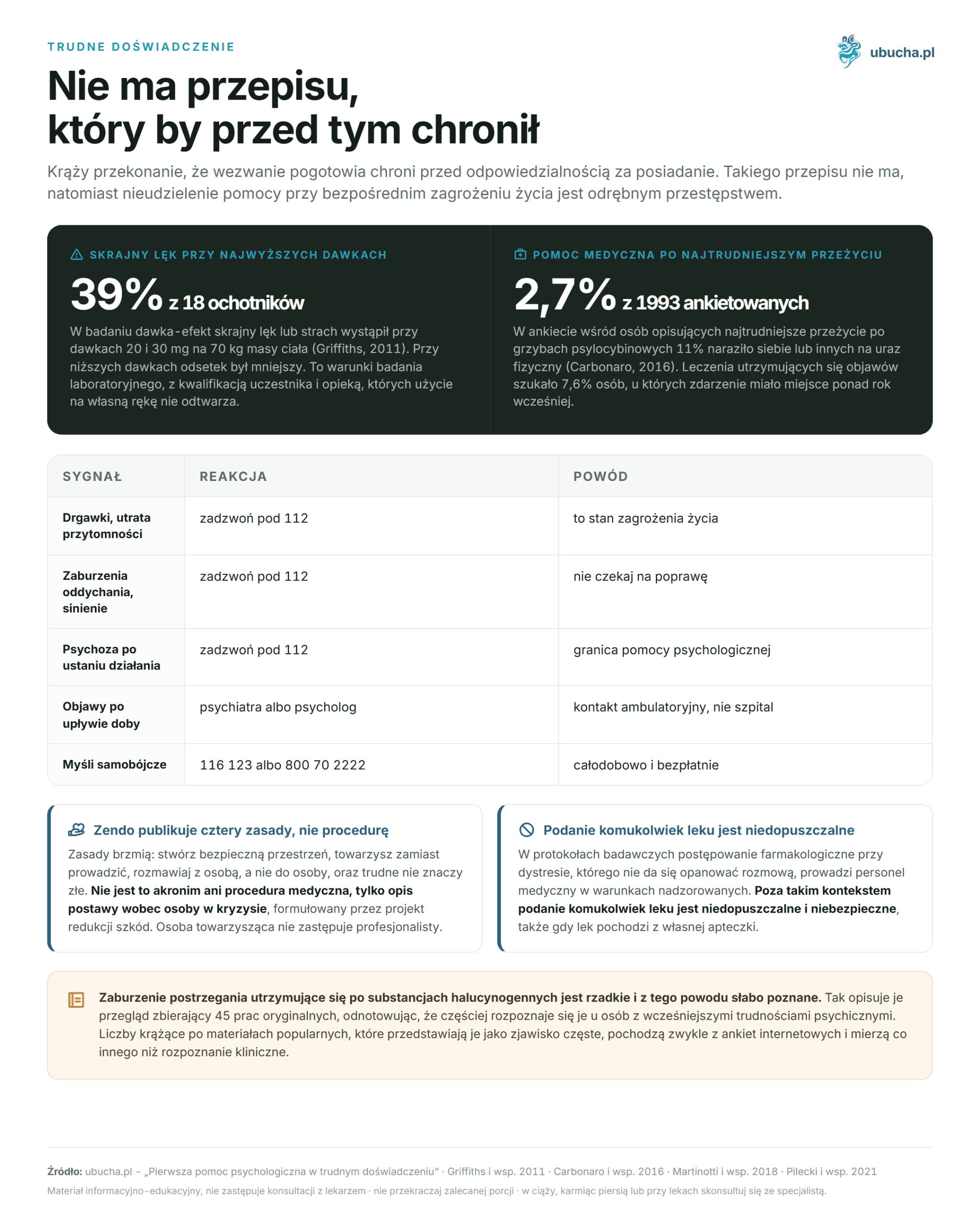
• Call 112 in case of seizures, loss of consciousness, breathing difficulties, high fever, heart symptoms, and when disorientation or psychosis persists after the substance has worn off.
• In a dose-effect study involving 18 volunteers, extreme anxiety or fear occurred in 39% of participants at doses of 20 and 30 mg per 70 kg body weight, which were the highest doses studied (Griffiths et al., Psychopharmacology, 2011).
• In a survey of 1993 individuals describing their most difficult experience after psilocybin mushrooms, 11% put themselves or others at risk of physical harm, and 2.7% received medical assistance (Carbonaro et al., Journal of Psychopharmacology, 2016).
• The same authors caution that the risk is extremely low only in laboratory research conditions, with qualification and care.
• The Zendo Project publishes four support principles, not a medical procedure. A companion does not replace a professional.
When should you call an ambulance?
This section is intentionally placed at the beginning because recognizing the boundary is more important than knowing any calming technique. The emergency number in Poland is 112. Call without hesitation when seizures or loss of consciousness occur, when breathing becomes irregular or shallow, when lips and nails turn blue, when there is chest pain or irregular heartbeat, when body temperature clearly rises and the skin is hot, and also when a person actively tries to harm themselves or someone else.
A separate signal is time. Disorientation, agitation, or psychotic symptoms that do not subside after the substance’s effects should have worn off go beyond the picture of a difficult experience and require medical assessment. The safety guidelines from 2008 list prolonged psychotic states as a rare but serious complication and classify them as risks that are mitigated by participant qualification (Johnson et al., Journal of Psychopharmacology, 2008).
An increase in temperature deserves a separate mention because it concerns a different mechanism and a different group of substances. With MDMA, hyperthermia and serotonin syndrome are described, and both conditions are life-threatening and do not resolve spontaneously. Hot skin, muscle rigidity, and rapidly rising temperature are a set of symptoms that should not be waited out. This is a call for an ambulance, not a conversation.
How often do difficult experiences occur?
The answer depends on where it is measured, and the difference is significant. In a dose-effect study involving 18 adults, of whom 17 had no prior experience with hallucinogenic substances, extreme anxiety or fear occurred in 39% of participants at the two highest doses, namely 20 and 30 mg per 70 kg body weight. At lower doses, the percentage was lower, and the sessions took place under constant supervision (Griffiths et al., Psychopharmacology, 2011).
The picture outside the laboratory looks different. A survey included 1993 individuals describing their most difficult psychological experience after psilocybin mushrooms. Eleven percent put themselves or others at risk of physical harm, 2.7% received medical assistance, and among those whose event occurred more than a year earlier, 7.6% sought treatment for persistent psychological symptoms. Three cases were described related to the onset of persistent psychotic symptoms and three suicide attempts (Carbonaro et al., Journal of Psychopharmacology, 2016).
The authors conclude this work with a statement that is often overlooked: the frequency of risky behaviors and persistent distress is extremely low when psilocybin is administered in a laboratory study to qualified, prepared, and supported individuals. Thus, both sets of numbers do not describe one phenomenon in two places, but two situations, one of which has safeguards and the other does not.
What support principles does the Zendo Project publish?
The Zendo Project, operating under the MAPS organization, is a harm reduction project present at festivals and mass events, and it publishes four support principles. In translation, they are: create a safe space, accompany instead of lead, talk to the person, not at them, and difficult does not mean bad. That’s all. It is not an acronym, clinical model, or medical procedure, and the project does not present it as such.
The first principle concerns both the environment and the relationship: a calmer place than where the episode began, removal of physical threats, fewer stimuli. The second speaks to the role of the accompanying person, who is present but does not direct the course of the experience. The third boils down to treating the person as the subject of conversation, not as an object of treatment.
The fourth is the one most often lost in summaries. It states that a difficult experience is not the same as a harmful experience, so the goal of presence is not to interrupt it at all costs. In the Carbonaro survey, the level of difficulty was positively correlated with a later sense of benefit, and 84% of respondents felt they gained something from it. This does not mean that every difficult experience ends well; the same work provides cases where it ended badly.
Can a bystander replace a professional?
No. This is a gap that popular materials on psychological first aid often leave, and it is worth closing it directly. The four principles listed above describe an attitude towards a person in crisis, not the competence to conduct an intervention. They do not include an assessment of the somatic state, do not recognize serotonin syndrome, do not distinguish prolonged psychosis from transient disorientation, and do not replace medical examination.
This is clearly seen in how clinical trials are secured. Before a participant receives a substance, they undergo qualification excluding individuals with a psychotic diagnosis in themselves or in their family, and the session takes place in a prepared location, under the supervision of at least two people, and with access to medical assistance. The guidelines also describe the pharmacological course of action in distress that cannot be managed through conversation and stipulate that transporting a participant to the emergency room is a last resort (Johnson et al., Journal of Psychopharmacology, 2008). Administering medication to anyone outside of a medical context is not part of any of these principles.
The practical consequence is simple. The presence of a calm, sober person reduces the risk of dangerous behaviors, and that is their entire role. Everything above this boundary belongs to the services and specialists. The difference between a prepared research environment and a random situation is described in the text about set and setting.
What does Polish law say when help needs to be called?
There is a belief in circulation that in Poland there is a procedure protecting a person who called for help after using a substance from criminal liability. There is no such provision, nor is it a procedure established by cities. The Good Samaritan clause, which is mentioned in the Polish context, concerns something else: protecting a person providing first aid in good faith from liability for any mistakes.
The factual state is as follows. Possession of narcotic drugs and psychotropic substances is a crime under Article 62 of the Act on Counteracting Drug Addiction. Article 62a allows for the discontinuation of proceedings when the object of the act is a small amount for personal use, and the imposition of a penalty would be pointless; this is a decision of the prosecutor or the court, not a guarantee. On the other hand, failing to provide assistance to a person in a situation posing an immediate threat of loss of life or serious health impairment is a separate crime under Article 162 of the Penal Code.
The practical conclusion is, however, unequivocal. Delaying in the face of a life-threatening situation is a risk incomparably greater than the proceedings for possession. If you are seeking support after a difficult experience, the Polish Society for Psychedelic Integration operates in Poland, offering free support groups in several cities and online, and publishes a list of psychologists, psychotherapists, and doctors working in this area.
When should you contact a specialist later?
Some difficulties begin only after the effects of the substance have worn off and are not visible at the moment of crisis. Reasons to contact a psychiatrist or psychologist include persistent symptoms: disorientation or agitation after a day, recurring perceptual disturbances in the following days, suicidal thoughts, as well as a clear deterioration in functioning lasting longer than a week. In the aforementioned survey, 7.6% of individuals whose event occurred more than a year earlier sought treatment for persistent symptoms.
It is worth maintaining proportions in describing the disorder of perception persisting after hallucinogenic substances, known by the acronym HPPD. A review collecting 45 original works describes it as a rare disorder and, for this reason, poorly understood, more frequently recognized in individuals with previous mental difficulties or problematic substance use, although it can also occur after a one-time exposure (Martinotti et al., Brain Sciences, 2018). Numbers circulating in popular materials that present HPPD as a common phenomenon usually come from online surveys and measure something different than clinical diagnosis.
The first contact should be an outpatient specialist, not immediately a hospital. The ethical and legal frameworks for therapists working with individuals reporting such experiences are analyzed by the Pilecki team (Harm Reduction Journal, 2021). We discuss the episode itself in the text Bad trip: what it means and where it comes from.
Frequently Asked Questions
When does a difficult experience require calling an ambulance?
Call 112 in case of seizures, loss of consciousness, breathing difficulties, bluish lips and nails, chest pain, rapidly rising body temperature, and when a person is trying to harm themselves or someone else. A separate signal is disorientation or psychosis persisting after the substance has worn off.
How often does extreme anxiety occur during sessions?
In a dose-effect study involving 18 adults, extreme anxiety or fear occurred in 39% of participants at doses of 20 and 30 mg per 70 kg body weight, which were the two highest doses studied. At lower doses, the percentage was lower (Griffiths et al., Psychopharmacology, 2011).
What support principles does the Zendo Project publish?
Four: create a safe space, accompany instead of lead, talk to the person, not at them, and difficult does not mean bad. This is not an acronym or a medical procedure, but a description of the attitude towards a person in crisis, formulated by a harm reduction project operating under the MAPS organization.
Does calling for help in Poland protect against possession charges?
There is no such provision. Possession remains a crime under Article 62 of the Act on Counteracting Drug Addiction, and Article 62a only allows for the discontinuation of proceedings in the case of a small amount for personal use. At the same time, failing to provide assistance in the face of immediate life-threatening danger is a crime under Article 162 of the Penal Code.
Can a calming medication be given to someone?
No. In research protocols, pharmacological intervention in distress that cannot be managed through conversation is conducted by medical personnel in supervised conditions. Outside of such a context, administering medication to anyone is unacceptable and dangerous, even if the medication comes from one’s own first aid kit.
This article is informational and educational. It describes clinical studies in which the substance is administered under the supervision of a doctor after participant qualification; using these conditions on one’s own does not replicate them. These substances are controlled in Poland under the Act on Counteracting Drug Addiction. If you have suicidal thoughts, call the free, 24-hour numbers 116 123 or 800 70 2222. In case of life-threatening situations: 112.
Author: Michał Waluk · Published: 2026-08-09 · Updated: 2026-08-16