
Berberine - properties, dosage and safety 2026
Berberine in studies by Yin, Kong, Dong, and Lan: what was really measured, in which groups, and which popular numbers lack support in sources.
Berberine is described online as a natural metformin, but this comparison does not withstand scrutiny against sources. The pilot study by Yin in 2008 indeed showed a drop in glycated hemoglobin similar to metformin, but it involved 36 people at a single center (Yin, Metabolism, 2008). This text clarifies exactly what was measured, in which groups, and with what author reservations. Separately, it points out numbers circulating under the names Yin, Kong, Dong, and Lan that do not appear in those works because they were created by combining results from three different meta-analyses. You will also find what the studies did not check: absorption in humans, safety longer than a few months, and effects of combining with chronic medications. Every dose given below describes the protocol of a specific study and is nowhere a recommendation for the reader.
KEY INFORMATION
• In Yin’s study, 36 people with newly diagnosed type 2 diabetes had HbA1c drop from 9.5% to 7.5% over three months (Metabolism, 2008).
• Absolute oral bioavailability of berberine in rats was 0.36% (Liu, Drug Metabolism and Disposition, 2010).
• A meta-analysis of eleven studies reports an LDL cholesterol decrease of 0.65 mmol/l (Dong, Planta Medica, 2013).
• Berberine displaces bilirubin from albumin binding, so it is not recommended for newborns with jaundice and pregnant women (Chan, Biology of the Neonate, 1993).
• Memorial Sloan Kettering notes decreased activity of CYP2D6, CYP2C9, and CYP3A4 after repeated oral administration.
What is berberine and in which plants does it occur?
Berberine is a yellow isoquinoline alkaloid found in the bark, roots, and rhizomes of a few plant species. The Memorial Sloan Kettering monograph lists five species: common barberry (Berberis vulgaris), Coptis chinensis, goldenseal (Hydrastis canadensis), Berberis aristata, and Oregon grape, described there as Berberis aquifolium (Memorial Sloan Kettering, 2024).
The same monograph describes traditional use without specifying centuries. Berberine was and is used in traditional Chinese medicine, Ayurveda, and other healing traditions for infections, diarrhea, and inflammatory disorders. The popular supplement texts’ claim of two and a half thousand years of documented use does not come from this source and was removed from the article along with the claim of thirty plant genera containing this alkaloid.
The distinction between the plant and the preparation is practically important here. A decoction from the root and a standardized extract in a capsule are two different things in terms of the amount of active substance taken daily, and the clinical studies discussed below were conducted exclusively on preparations with a defined content. Transferring conclusions from these studies to any product on the shelf requires checking how much berberine the manufacturer declares and whether the declaration refers to pure alkaloid or extract mass.
Why is berberine almost not absorbed?
Pharmacokinetics is the most interesting and most often distorted part of knowledge about this alkaloid. Liu and colleagues administered berberine to rats by four routes: gastric, duodenal, portal vein, and intravenous, to separate gastric, intestinal, and hepatic elimination. After gastric administration, about half the dose passed through the gastrointestinal tract unchanged, and the other half was removed by the small intestine. Absolute oral bioavailability in rats was 0.36% (Liu, Drug Metabolism and Disposition, 2010).
The second observation from this work concerns where the substance accumulates. The ratio of the area under the concentration curve in the liver to that in plasma was seventy-fold. The authors indicate intestinal first-pass elimination as the main barrier to bioavailability, and high uptake and accumulation in the liver as the second reason for low blood concentrations. Three main metabolites were formed in the intestine, labeled M1, glucuronide M2, and M3. They were identified simultaneously in several materials: in rat enterocyte S9 fraction, portal vein plasma, and intestinal perfusion fluid, allowing separation of formation site from accumulation site.
Two things must be said clearly about this work. First, the measurement was done in rats, so applying the 0.36% value to humans is an assumption, not a result. Second, the widespread range of 0.5-5% does not appear in this publication in any form and was removed from the article. Low bioavailability is now sometimes presented as an advantage because part of the dose acts locally in the intestine, but this interpretation is a hypothesis, not a finding of the cited work.
How does berberine act at the cellular level?
The best-documented mechanism was described by Turner and colleagues in 2008. Berberine dose-dependently inhibited respiration in L6 muscle cells and isolated muscle mitochondria, acting selectively on complex I of the respiratory chain, similarly to metformin and rosiglitazone (Turner, Diabetes, 2008). Inhibition of respiration lowers the cell’s energy reserve, which activates AMP-activated kinase, abbreviated AMPK.
The way this kinase is activated turned out to be non-obvious. AMPK activation by berberine did not depend on LKB1 kinase activity nor CAMKK beta kinase, which the authors explain by regulation at the level of the phosphatase removing the phosphate group from AMPK itself. The same team described a derivative called dihydroberberine, which acted more effectively in the organism, counteracting fat tissue gain, triglyceride accumulation in tissues, and insulin resistance in rodents fed a high-fat diet.
The authors attribute this advantage probably to better absorption after oral administration, but the word probably must not be omitted because they did not measure it directly. Circulating numbers about fivefold better absorption of dihydroberberine and tenfold better absorption of the phytosomal form do not come from this work and were removed along with their assigned doses. The study was conducted on rodents, not humans, and should be described as such.
Does berberine act the same as metformin?
The statement about identical mechanisms of both substances is almost obligatory in supplement texts but rests on weaker grounds than believed. Turner indeed showed that both inhibit complex I of the respiratory chain. The problem is that the role of AMPK in metformin’s action was questioned around the same time.
Foretz and colleagues tested this in mice lacking AMPK in the liver. Blood glucose levels in these animals did not differ from wild-type mice, and the glucose-lowering effect of metformin remained. Hepatocytes without AMPK produced glucose normally. Moreover, inhibition of glucose production by metformin was even stronger in cells lacking AMPK and LKB1 than in control cells, and its magnitude correlated with intracellular ATP depletion. The authors conclude clearly: metformin inhibits hepatic glucose production independently of LKB1 and AMPK by lowering the liver’s energy state (Foretz, Journal of Clinical Investigation, 2010).
What does this mean for berberine? The common point is the cause, i.e., lowering the cell’s energy reserve by inhibiting complex I. The downstream messenger is disputed. The statement about identical mechanisms should therefore be replaced by a more cautious one: both substances hit the same point in the respiratory chain, and the further signaling pathway remains a subject of debate. We develop the comparison of both substances in a separate text about berberine and metformin.
What exactly did Yin’s 2008 study show?
This study is the foundation of berberine’s popularity, so it is worth knowing its size. The authors describe it directly as a pilot study and divide it into two parts. In part A, thirty-six adults with newly diagnosed type 2 diabetes were randomly assigned to berberine or metformin, both at 0.5 g three times daily, i.e., 1.5 g per day, for three months. The glucose-lowering effect was similar in both groups (Yin, Metabolism, 2008).
| Parameter in berberine group (part A) | Before | After three months |
|---|---|---|
| HbA1c | 9.5% | 7.5% |
| fasting glucose | 10.6 mmol/l | 6.9 mmol/l |
| postprandial glucose | 19.8 mmol/l | 11.1 mmol/l |
| plasma triglycerides | 1.13 mmol/l | 0.89 mmol/l |
In part B, forty-eight people with poorly controlled type 2 diabetes received berberine as an addition to their current treatment. Their glycated hemoglobin dropped from 8.1% to 7.3%, fasting insulin decreased by 28.1%, and the HOMA insulin resistance index by 44.7%. Total cholesterol and LDL fraction also decreased. Twenty participants, i.e., 34.5% of those studied, reported transient gastrointestinal complaints; no liver or kidney damage was found in anyone.
One number requires correction. The 34.5% refers to all transient gastrointestinal complaints in this study, not just diarrhea, and comes from Yin’s work, not from Lan’s meta-analysis, to which it was previously attributed. It is also worth noting the speed of action in part B: fasting and postprandial glucose reductions were observed from the first week until the end of the study, not only after several months.
What do meta-analyses say about berberine’s effectiveness?
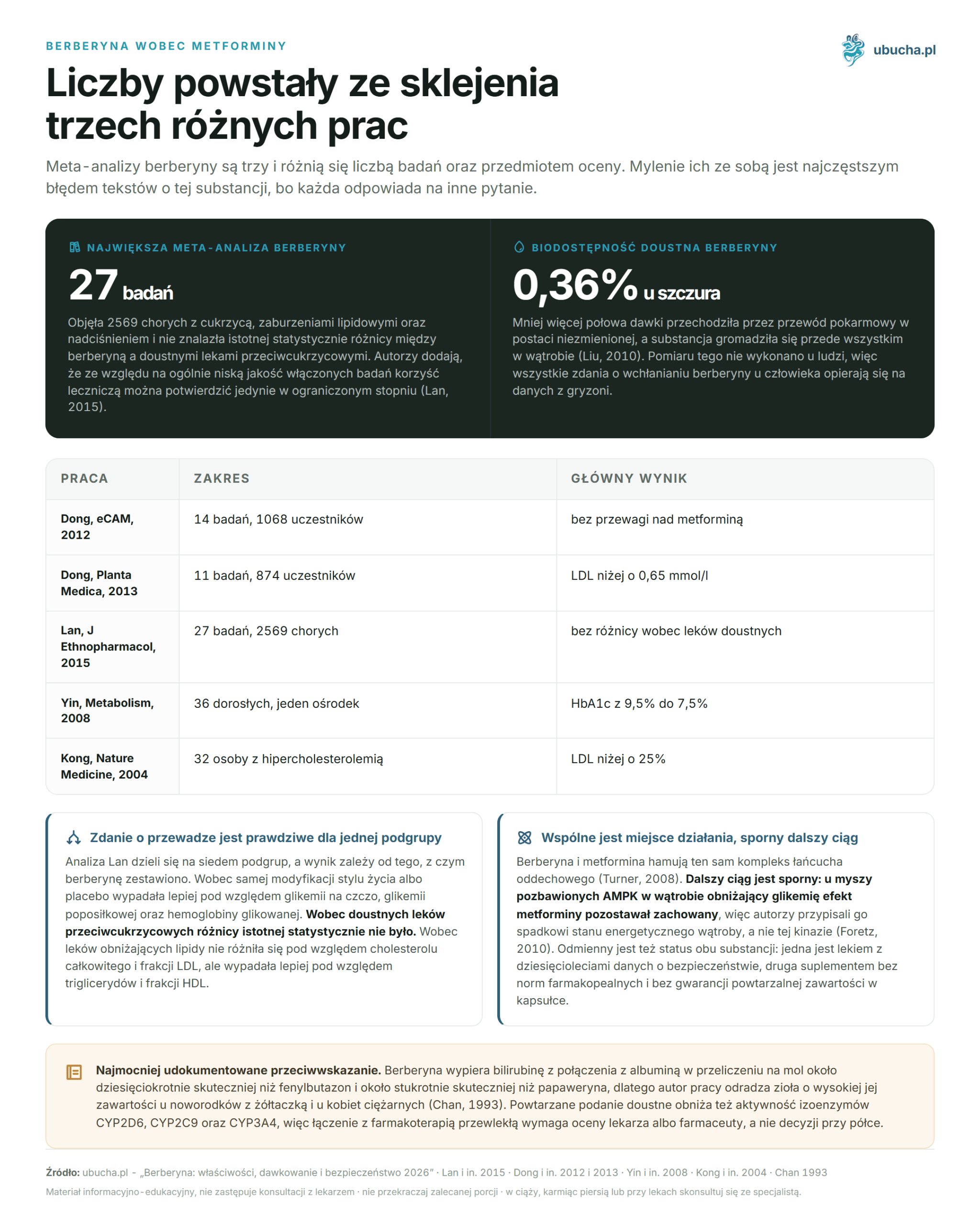
There are three meta-analyses, and confusing them is the most common error in berberine texts. They differ in the number of studies and the subject of evaluation.
| Study | Scope | Main result |
|---|---|---|
| Dong, eCAM, 2012 | 14 studies, 1068 participants, type 2 diabetes | berberine plus lifestyle modification better than lifestyle alone; versus metformin, glipizide, and rosiglitazone no superiority in glycemic control; superiority only when berberine added to these drugs |
| Dong, Planta Medica, 2013 | 11 studies, 874 participants, lipids | total cholesterol lower by 0.61 mmol/l, triglycerides by 0.50 mmol/l, LDL by 0.65 mmol/l, with confidence interval including decrease from 0.54 to 0.76 mmol/l; HDL higher by 0.05 mmol/l |
| Lan, J Ethnopharmacol, 2015 | 27 studies, 2569 patients, diabetes, lipid disorders, and hypertension | no statistically significant difference between berberine and oral antidiabetic drugs; no serious adverse effects reported |
The set of 27 studies with 2569 patients comes from Lan, and the LDL decrease of 0.65 mmol/l from Dong 2013. The previous version of this article combined these two values into one sentence and attributed them to Dong’s eCAM paper, which reports completely different numbers. The values of glycated hemoglobin decrease by 0.71 percentage points and fasting glucose by 0.69 mmol/l do not appear in the abstracts of any of the three works and were removed.
The authors’ reservation is stronger than the results themselves. All three teams assessed the methodological quality of included studies as generally low. Lan states directly that berberine’s therapeutic benefit can only be confirmed to a limited extent and that larger controlled studies on standardized preparations are needed.
Lan’s comparison layout is also noteworthy. The analysis divides into seven subgroups, and the result depends on what berberine was compared with. Versus lifestyle modification alone or placebo, it performed better in fasting glucose, postprandial glucose, and glycated hemoglobin. Versus oral antidiabetic drugs, there was no statistically significant difference. Compared with oral lipid-lowering drugs, it did not differ in total cholesterol and LDL but performed better in triglycerides and HDL cholesterol. The statement about berberine’s superiority over drugs is therefore true only for one of these subgroups.
How does berberine affect cholesterol?
Kong’s 2004 study remains the most frequently cited source on this topic and is the only one describing a mechanism different from statins. In thirty-two people with hypercholesterolemia, three months of oral administration reduced total cholesterol by 29%, triglycerides by 35%, and LDL cholesterol by 25% (Kong, Nature Medicine, 2004). In hamsters with hyperlipidemia, decreases were greater: total cholesterol by 40%, LDL by 42%.
The authors traced the mechanism in human hepatocellular carcinoma cells. Berberine increases LDL receptor amount not through sterol regulatory element-binding proteins but via an ERK kinase-dependent pathway. It acts post-transcriptionally, stabilizing the LDL receptor mRNA, and the responsible region was located in the 3′ untranslated region. In hamster liver, LDL receptor mRNA increased 3.5-fold, and receptor protein amount 2.6-fold.
The abstract does not state the dose used in humans, so the widespread claim of 500 mg twice daily for three months was removed as unconfirmed. It also lacks any statement confirming the mechanism in cells lacking HMG-CoA reductase activity. The difference from statins is stated, but the conclusion about combining both substances does not follow.
What does a one percentage point drop in HbA1c mean?
The laboratory result change alone says little until related to complication risk. An observational analysis of the UKPDS study, including 4585 patients from 23 hospital centers, provides the answer (Stratton, BMJ, 2000). The authors calculated how much risk decreases per one percentage point reduction in average glycated hemoglobin.
| Event | Risk reduction per 1 percentage point HbA1c drop |
|---|---|
| any diabetes-related endpoint | 21% |
| diabetes-related death | 21% |
| heart attack | 14% |
| microvascular complications | 37% |
The previous article version assigned 21% to microvascular complications, a number belonging to two other endpoints. The correct value is 37%, the largest of the four effects. The authors found no threshold below which risk stopped decreasing; the lowest risk was observed in people with glycated hemoglobin in the normal range. All four values are statistically significant, with confidence intervals for any diabetes-related endpoint ranging from 17% to 24%. The relative risk analysis included 3642 patients out of 4585 in the incidence analysis.
However, this is an observational analysis, not a randomized trial. It shows the relationship between glycemic control and complications, not the efficacy of any specific preparation. Participants were treated in the British healthcare system, of European, South Asian, and Afro-Caribbean origin, and observed over years. Applying these proportions to a three-month supplement study is an extension the authors do not propose. Other supplements studied this way are ranked in our insulin resistance supplements ranking.
Does berberine change gut microbiota?
Yes, and this is one of the best-documented threads, though not in humans. Zhang and colleagues gave berberine and metformin to rats with obesity induced by a high-fat diet. Both substances shifted the overall microbiota structure similarly and reversed diet-induced changes. Microbiota diversity significantly decreased after both treatments (Zhang, Scientific Reports, 2015).
The analysis identified 134 taxonomic units responding to treatment. Sixty were reduced by both substances, while bacteria producing short-chain fatty acids clearly increased. Named genera include Allobaculum, Bacteroides, Blautia, Butyricoccus, and Phascolarctobacterium, with a stronger effect after berberine than metformin.
Names appearing in popular texts here do not appear in the cited work. There is no Akkermansia muciniphila, no 100-300% increase of this population, no Faecalibacterium prausnitzii, nor decrease of lipopolysaccharide-producing bacteria. All these claims were removed. Akkermansia was studied in humans but administered directly, not stimulated by berberine: in a three-month placebo-controlled study in overweight people, pasteurized bacteria improved insulin sensitivity by 28.62% and lowered total cholesterol by 8.68% (Depommier, Nature Medicine, 2019). This is a separate intervention and must not be attributed to berberine. Forty people were enrolled, thirty-two completed; ten billion bacteria were given daily, live or pasteurized, for three months. The procedure was safe and well tolerated, and insulinemia decreased by 34.08%.
What doses were used in clinical studies?
The table below is not a dosing scheme or recommendation. It summarizes study protocols described in this article so the reader can see where numbers repeated in product descriptions come from and discuss them with a doctor. The decision about any supplementation is made by the treating person, not the article.
| Study | Who | Protocol |
|---|---|---|
| Yin, Metabolism, 2008, part A | 36 adults with newly diagnosed type 2 diabetes | 0.5 g three times daily for three months, compared with metformin at the same dose |
| Yin, Metabolism, 2008, part B | 48 adults with poorly controlled type 2 diabetes | berberine added to current treatment for three months |
| Kong, Nature Medicine, 2004 | 32 people with hypercholesterolemia | oral administration for three months; abstract does not state dose |
| Turner, Diabetes, 2008 | rodents on high-fat diet and cell cultures | preclinical study, no human dose translation |
The article removed the entire scheme of gradual dose introduction week by week, dividing the day into three portions with meals, twelve-week cycles with four-week breaks, and the schedule of control tests. None of these appear in the cited works, and all were given as recommendations to readers. The sentence about reducing gastrointestinal complaints by 70% with slow dose increase was also removed due to lack of source.
It is also worth noting what the studies did not cover. All three clinical studies discussed above lasted three months, and meta-analyses collected studies of similar duration. There are no data on safety of use for a year or longer in these sources, so claims about long-term safety profiles cannot be supported by them in any way.
When is berberine contraindicated?
The most strongly documented contraindication concerns newborns and pregnant women and is based on Chan’s 1993 study. The author studied berberine’s effect on bilirubin binding to protein, starting from reports of kernicterus risk in Chinese infants with jaundice. In an in vitro study, berberine displaced bilirubin about ten times more effectively per mole than phenylbutazone, considered a strong displacer, and about one hundred times more effectively than papaverine (Chan, Biology of the Neonate, 1993).
The experimental part also included animals. Intraperitoneal administration of berberine to adult rats daily for a week significantly lowered average bilirubin binding to serum proteins and maintained elevated free and total bilirubin levels, probably also by inhibiting its metabolism. The author’s conclusion is that herbs with high berberine content should be avoided in newborns with jaundice and pregnant women.
The Memorial Sloan Kettering monograph formulates the same warning clinically: berberine may worsen jaundice in infants or cause kernicterus, a condition where prolonged high bilirubin causes irreversible damage. The center advises against use during pregnancy and breastfeeding. Adverse effects described there as mild include loss of appetite, gastrointestinal complaints, diarrhea, constipation, and rash, with generally good tolerance of the preparation.
How does a supplement differ from a drug here?
This difference is not a formality and comes directly from the meta-analyses authors’ reservations. Lan and colleagues conclude that berberine has comparable therapeutic effects in type 2 diabetes, hyperlipidemia, and hypertension and no serious adverse effects were reported, but then add two sentences often omitted in reprints. Due to generally limited quality of included studies, therapeutic benefit can only be confirmed to a limited extent, and larger controlled studies on standardized preparations are needed (Lan, Journal of Ethnopharmacology, 2015).
The word standardized is the key point. Clinical trials are conducted on preparations with known and reproducible active substance content, while dietary supplements are not subject to pharmacopoeial standards guaranteeing such reproducibility in every capsule. Results obtained on one preparation do not automatically transfer to another product with the same common name.
The second reservation concerns data origin. Dong and colleagues assessed the methodological quality of included studies as generally low and pointed to small group sizes, few studies, and unrecognized risk of systematic error as reasons to read conclusions cautiously (Dong, eCAM, 2012). This is not an argument against berberine but an indication of the current evidence level.
What drug interactions have been described for berberine?
Interactions are the part where popular articles diverge most from the source, usually by giving precise percentages without support. The Memorial Sloan Kettering monograph notes that repeated oral berberine administration significantly reduced activity of CYP2D6, CYP2C9, and CYP3A4 isoenzymes and warns against combining it with drugs that are substrates of these enzymes. It separately mentions increased blood cyclosporine levels in adults after kidney transplantation.
Four things are not in this source and were removed from the article. There is no number describing cyclosporine level increase by 24-29%. There is no mention of P-glycoprotein or blood-brain barrier. There is also no claim that CYP3A4 metabolizes half of all drugs on the market, nor named interactions with statins, warfarin, and metformin, although all four sentences previously appeared under the same reference.
What remains is caution derived directly from what was measured. Since berberine reduces activity of three isoenzymes responsible for metabolizing many drugs, any combination with chronic pharmacotherapy requires evaluation by a doctor or pharmacist. Since in Yin’s study it lowered glucose similarly to metformin, adding it to antidiabetic treatment sums two effects in the same direction, not a neutral addition. Similar warnings apply to other substances affecting glucose, as discussed in our article on apple cider vinegar and glycemia.
What to ask your doctor before taking berberine?
Talking to a doctor here is a condition, not a formality, and it is best to come prepared. Bring a full list of medications, including supplements and herbs, because most doubts described in the previous section are resolved on that list. Attach current results the doctor will order anyway: fasting glucose, glycated hemoglobin, lipid panel, and liver function tests.
Name your goal. A conversation about support in prediabetes looks different than about lipid disorder or adding a preparation to diagnosed type 2 diabetes treated pharmacologically. The last situation is the hardest and requires a diabetologist’s consultation, not a self-made decision at the shelf.
Three questions are worth asking directly. Is this substance safe in my situation? Does any of my drugs pass through isoenzymes whose activity it reduces? What parameters and how often should we monitor if we decide to try it? If you take drugs after organ transplantation, are pregnant, breastfeeding, or planning surgery, the starting point is rather to avoid than to establish a way to take it.
There is one more question worth asking yourself before the visit: how will I know it works? In the studies described above, reference points were glycated hemoglobin, fasting and postprandial glucose, and lipid panel, measured at intervals of several months. Well-being or body weight were not efficacy measures in these works, so judging the preparation after a week of observation has no basis in any cited study.
Frequently Asked Questions
What is berberine and where does it come from?
It is a yellow isoquinoline alkaloid. The Memorial Sloan Kettering monograph lists five species in which it occurs: Berberis vulgaris, Coptis chinensis, Hydrastis canadensis, Berberis aristata, and Berberis aquifolium. It is used in traditional Chinese medicine and Ayurveda for infections, diarrhea, and inflammatory disorders (Memorial Sloan Kettering, 2024).
By how much did berberine reduce glycated hemoglobin?
In a pilot study by Yin, thirty-six people with newly diagnosed type 2 diabetes took 0.5 g three times daily for three months. Glycated hemoglobin dropped in this group from 9.5% to 7.5%, and the glucose-lowering effect was similar to metformin at the same dose (Metabolism, 2008).
Does berberine act by the same mechanism as metformin?
Both inhibit complex I of the respiratory chain (Turner, Diabetes, 2008). The further pathway is disputed: in mice lacking AMPK in the liver, the glucose-lowering effect of metformin remained, so the authors attributed it to a decrease in the liver’s energy state, not this kinase (Foretz, Journal of Clinical Investigation, 2010).
How does berberine affect cholesterol?
In thirty-two people with hypercholesterolemia, three months of oral administration reduced total cholesterol by 29%, triglycerides by 35%, and LDL fraction by 25%. The mechanism involves stabilization of the LDL receptor mRNA and differs from the statin mechanism (Kong, Nature Medicine, 2004).
Is berberine absorbed from the gastrointestinal tract?
Very poorly. In rats, the absolute oral bioavailability was 0.36%, about half the dose passed through the gastrointestinal tract unchanged, and the substance accumulated mainly in the liver (Liu, Drug Metabolism and Disposition, 2010). This measurement has not been done in humans.
Is berberine safe during pregnancy and in newborns?
No. Berberine displaces bilirubin from albumin binding much more effectively than phenylbutazone, and the author advises against herbs with high berberine content in newborns with jaundice and in pregnant women (Chan, Biology of the Neonate, 1993). Memorial Sloan Kettering also advises against use during breastfeeding.
What drug interactions have been described for berberine?
Repeated oral administration significantly reduced the activity of three cytochrome isoenzymes: CYP2D6, CYP2C9, and CYP3A4. In adults after kidney transplantation, berberine increased blood cyclosporine levels (Memorial Sloan Kettering, 2024). Combining it with any chronically taken drug requires prior evaluation by a doctor or pharmacist, not a self-made decision.
Does berberine change the gut microbiota?
In rats on a high-fat diet, berberine and metformin shifted the microbiota structure in a similar direction, reduced its diversity, and increased bacteria producing short-chain fatty acids, including the genera Allobaculum and Butyricoccus (Zhang, Scientific Reports, 2015). The effect was stronger with berberine than with metformin. This has not been tested in humans.
Summary
Berberine has a real, repeatedly measured effect on glycemia and lipid profile, but a much narrower evidence base than product descriptions suggest. Three meta-analyses consistently assess the methodological quality of included studies as low, and the largest found no statistically significant difference between berberine and oral antidiabetic drugs. The study that built its popularity is called a pilot by the authors and included thirty-six people at one center.
The comparison to metformin should be made more cautiously than most texts do. The common point is the site of action in the respiratory chain; the downstream messenger is disputed; and above all, the status of the two substances differs: one is a drug with decades of safety data, the other a supplement without pharmacopoeial standards and without guaranteed reproducible content in a capsule.
We removed seven incorrect identifiers from this editorial, each leading to a study from another field, the entire dosing scheme given as a recommendation, and all numbers not in cited sources, including statistics described as the store’s own observations. Absolute contraindications remain in force: pregnancy, breastfeeding, and the newborn period.
This article is for informational and educational purposes and does not constitute medical advice. Consult a doctor before starting supplementation, especially if you take medications regularly, are pregnant or breastfeeding, or have chronic illness.
Author: Michał Waluk · Published: 2026-05-11 · Updated: 2026-08-10