
Can CBD be combined with ashwagandha? What is known about the safety of this combination
Can CBD be combined with ashwagandha? There are no studies on this combination in humans, and both substances burden the liver. Check the risks, interactions, and contraindications.
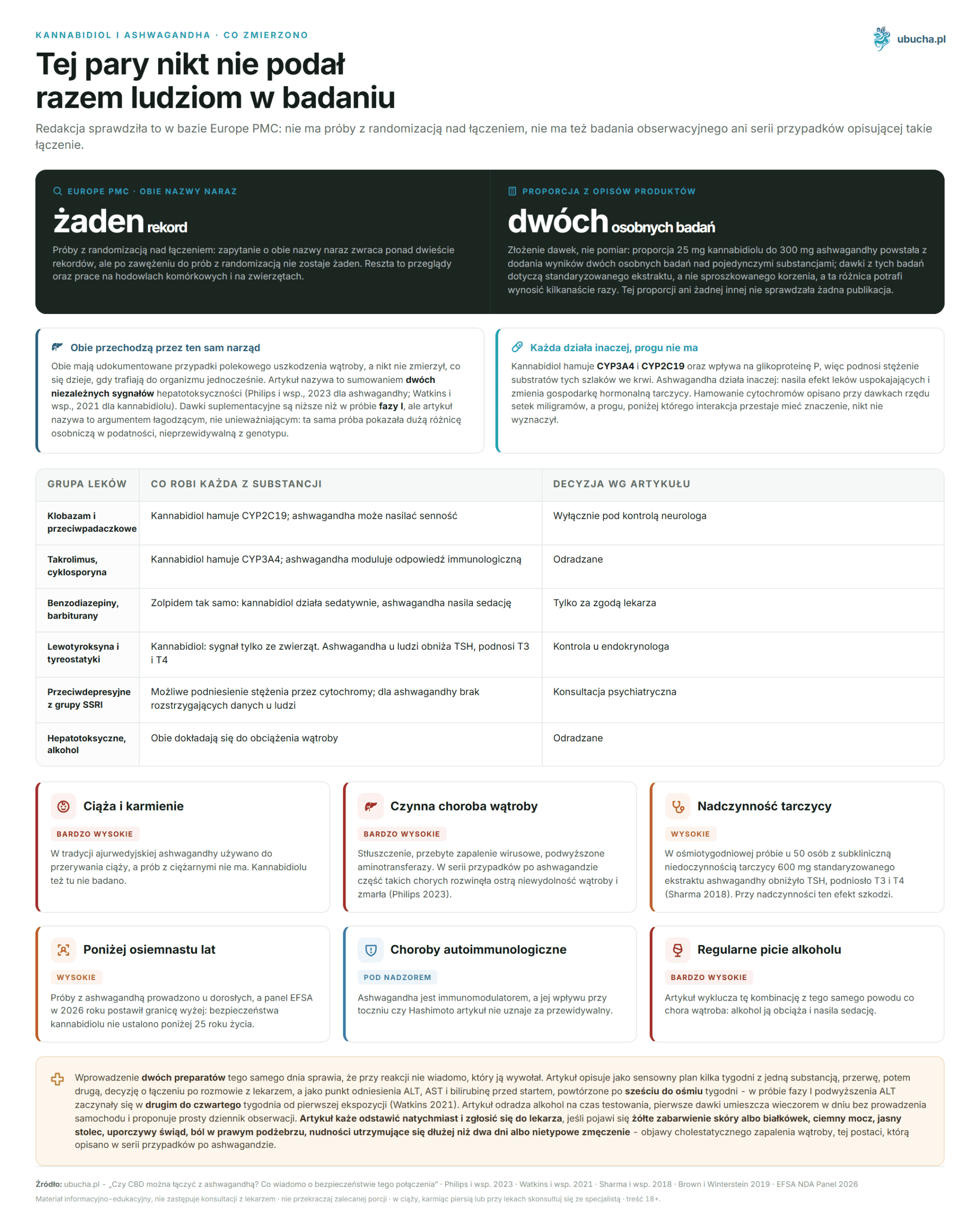
We did not find a single clinical study in which people received CBD and ashwagandha together. Not one. Everything circulating online about the synergy of this pair, about a “double anti-stress umbrella” and about the proportions of 25 mg to 300 mg, was created by adding the results of two separate studies. This is an arithmetic operation, not a measurement. The matter has a second layer that product descriptions remain silent about: both substances have documented cases of liver damage, and one of them alters drug metabolism. Additionally, the EFSA panel stated in 2026 that the safety of cannabidiol itself cannot be established today in individuals taking medications. Below you will find what is actually known about each of these substances separately, where the limits of this knowledge lie, and to whom this combination is strongly discouraged.
KEY INFORMATION
• A series of 23 cases of liver damage after ashwagandha from centers in India describes three deaths among patients with pre-existing liver disease (Philips et al., Hepatology Communications 2023).
• There is no randomized trial on the combination of CBD with ashwagandha in humans in the Europe PMC database, so no dosing proportion is supported by data.
• In a phase I trial with CBD at a dose of 1500 mg per day, 7 out of 16 healthy adults had alanine aminotransferase exceed the upper limit of normal.
• CBD inhibits CYP3A4 and CYP2C19, so in the case of ongoing pharmacotherapy, a medical consultation is needed.
• Ashwagandha is contraindicated during pregnancy, lowers TSH, and raises T3 and T4.
Has anyone studied the combination of CBD with ashwagandha in humans?
No. We could not find a clinical trial in which participants would take both preparations simultaneously, and researchers would measure the outcome; we also did not find an observational study or case series describing such a combination. Both substances have their own randomized trials, but no one has checked their combined effect in humans.
We checked this directly in the Europe PMC database. A query for both names at once returns over two hundred records, but narrowing it down to randomized trials leaves none, and the only record marked as a clinical study turns out to be a protocol for a trial on a completely different plant. Records that mention cannabidiol alongside Withania somnifera are mostly reviews of plants with anxiolytic effects and studies on cell cultures and animals. We could not find a publication in which both substances were given together to humans.
So where do the protocols on the internet come from? Someone took a dose from a study on CBD alone, added to it a dose from a study on ashwagandha alone, and called the result a protocol. The numbers are true separately. Their sum has never been measured, and pharmacology does not work like addition: two substances passing through the same organ may behave differently together than each one separately.
On the shelf, you will already find ready-made preparations combining hemp oil with root extract in one capsule. Their presence on the market does not mean that anyone has checked such a mixture. A dietary supplement enters circulation based on a sanitary notification, not a study of effectiveness, so the manufacturer does not have to demonstrate the action of the combination itself. The notification itself is not an authorization of new food and does not determine the status of the ingredient.
We noticed, while organizing sources for this entry, a recurring pattern. Texts promising synergy cite studies that did not study synergy and, in the process, attribute numbers to them that are not present in the publications. This does not mean that combining is inherently bad. It only means that no one knows what happens, and the burden of caution falls on you.
Why does this combination burden the liver?
Because both substances have documented cases of drug-induced liver damage, and no one has measured what happens when they enter the body simultaneously. This is the most serious accusation against this combination and at the same time the one that product descriptions do not raise at all.
Ashwagandha has the strongest documentation. Philips’ team analyzed the documentation of 23 patients with liver damage after this raw material, admitted to centers in India between January 2019 and December 2022. In eight cases, the preparation was single-component, so the culprit could not be blamed on a herbal mixture. The most common form was cholestatic hepatitis. Five patients had a prior chronic liver disease, three of whom developed acute liver failure on that basis, and all three died during observation (Philips et al., 2023). Chemical analysis of the preparations did not show any adulteration or contamination, meaning the raw material itself was harmful. The authors note that previous reports of liver damage after this raw material mainly came from the United States; two years earlier, ashwagandha was described as a cause of liver damage in a separate letter to the editor of Liver International (Björnsson et al., 2020).
With CBD, the problem emerged already at the stage of registration studies. In a phase I trial, sixteen healthy adults took 1500 mg of CBD per day for about three and a half weeks. In seven of them (44 percent), alanine aminotransferase exceeded the upper limit of normal, in five (31 percent) it exceeded it fivefold, which meets international criteria for drug-induced liver injury. Six participants were excluded from the protocol, some with symptoms resembling hepatitis (Watkins et al., 2021). Elevated aminotransferases are also among the most common adverse effects of CBD in the review of registration data, with a visible dose-dependent relationship (Brown and Winterstein, 2019).
Supplemental doses of CBD are significantly lower than 1500 mg. This is a mitigating argument, not a disqualifying one: the study showed a large individual difference in susceptibility that could not be predicted from genotype or CBD concentration in the blood. Summing two independent signals of hepatotoxicity without any data on their combined action is a risk that should be named outright.
What medications may interact with CBD and ashwagandha?
Significantly more than suggested by the supplement label. CBD inhibits cytochromes CYP3A4 and CYP2C19 and affects P-glycoprotein responsible for drug excretion, thereby increasing the concentration of substrates of these pathways in the blood. Ashwagandha acts differently but enhances the effect of sedative medications and alters thyroid hormone metabolism.
A review of registration data describes CBD as a substance that is both a victim and a perpetrator of interactions, and recommends in patients taking multiple medications to reduce the dose of the substrate, monitor adverse effects, or change therapy (Brown and Winterstein, 2019). The table below summarizes situations in which the decision to supplement is made by the attending physician.
| Drug Group | What CBD does | What ashwagandha does | Management |
|---|---|---|---|
| Clobazam and other antiepileptic drugs | inhibits CYP2C19, raises the concentration of the active metabolite | may enhance drowsiness | only under the supervision of a neurologist |
| Tacrolimus, cyclosporine | inhibits CYP3A4, raises the concentration of the drug | modulates the immune response | recommended after transplantation |
| Benzodiazepines, zolpidem, barbiturates | acts sedatively | enhances sedation | only with a doctor’s consent |
| Levothyroxine and antithyroid drugs | signal changes in thyroid hormone levels in animal studies | lowers TSH, raises T3 and T4 | monitoring by an endocrinologist |
| Antidepressants from the SSRI group | possible increase in concentration by inhibiting cytochromes | no conclusive data in humans | psychiatric consultation |
| Hepatotoxic drugs, alcohol | adds to liver burden | adds to liver burden | discouraged |
The scale of this impact depends on the dose. Inhibition of cytochromes has been best described at therapeutic doses in the hundreds of milligrams of CBD, and there is significantly less data at doses in the tens of milligrams from oil. The problem is that no one has established a threshold below which the interaction ceases to be significant. With drugs that have a narrow therapeutic window, even a slight increase in concentration can be felt.
The list of drugs that interact with cannabidiol is detailed in our entry on CBD drug interactions. If you take anything regularly, start the conversation with a pharmacist before you buy a second preparation.
What have studies shown about ashwagandha alone?
A dozen small randomized trials in which root extract lowered cortisol and improved scores on stress scales compared to placebo. The trials usually involved 50 to 60 participants, lasted from four to sixteen weeks, and were most often funded by the manufacturer of the tested extract.
The most frequently cited study is the work of Chandrasekhar’s team. Sixty-four adults under chronic stress received 300 mg of extract twice daily for 60 days. The active group had significantly better results on all applied stress scales, and serum cortisol levels dropped by 27.9 percent compared to baseline, with 7.9 percent in the placebo group (Chandrasekhar et al., 2012). This difference between the two drops, rather than the number 27.9 itself, is the proper result of this work and is often lost in abstracts. Salve’s team tested two doses in 60 stressed individuals, of which 58 completed the study: both 250 mg and 600 mg per day reduced the score on the PSS scale and cortisol, and sleep quality improved compared to placebo (Salve et al., 2019).
The third trial used a significantly lower dose. Lopresti’s team administered 240 mg of standardized extract once daily for 60 days to 60 adults. Compared to placebo, the HAM-A anxiety score and morning cortisol and DHEA sulfate levels decreased, and the authors linked the effect to modulation of the hypothalamic-pituitary-adrenal axis (Lopresti et al., 2019).
It is worth keeping in mind who funded these studies. Almost all trials with standardized extract were financed by the company selling it, and the number of participants rarely exceeds sixty. This does not invalidate the results, but it requires treating them as signals that need confirmation in a larger and independent study.
Separately, it is worth looking at sleep. A meta-analysis of five randomized trials involving 400 participants showed a small but statistically significant effect on overall sleep, with a standardized mean difference of minus 0.59. It was more pronounced in individuals with diagnosed insomnia, at a dose of at least 600 mg per day and with therapy lasting at least eight weeks. The authors noted that there is insufficient data on serious adverse effects to assess the safety of long-term use (Cheah et al., 2021).
What have studies shown about CBD alone?
A few small trials with a single dose and one large retrospective case series. Evidence mainly concerns anxiety and sleep, and the best-described effect is the immediate reduction of anxiety before public speaking. There is practically no data on daily use for many months.
In a retrospective review of psychiatric clinic documentation, 72 adults were analyzed, who were added CBD to their existing treatment. Anxiety scores dropped in the first month for 57 of them (79.2 percent) and remained at a lower level, while sleep scores improved for 48 individuals (66.7 percent), although they fluctuated in subsequent months (Shannon et al., 2019). This is a case series without a control group, so it speaks of clinical observation, not of efficacy proven against placebo.
Methodologically stronger are two small Brazilian trials. Twenty-four never-treated individuals with social phobia were assigned to either 600 mg of CBD or placebo one and a half hours before a simulated public speaking event. In the CBD group, anxiety, cognitive impairment, and discomfort during speech were lower, and alertness in the pre-speech phase was lower (Bergamaschi et al., 2011). In the second study, ten untreated patients with the same diagnosis received 400 mg of CBD, and SPECT imaging showed reduced anxiety and changes in cerebral blood flow in limbic system structures (Crippa et al., 2011).
There is, however, a catch that undermines the logic of “more means better.” When sixty healthy volunteers were given CBD in three doses before a real public speaking event, only the 300 mg dose reduced anxiety in the post-speech phase. Neither 100 mg nor 900 mg differed from placebo, which shapes the dose-effect curve into an inverted U (Zuardi et al., 2017). Increasing the dose when nothing is happening may therefore move you away from the effect rather than closer to it.
Who should avoid this combination?
The list is shorter than the list of indications, but it is firm. Pregnancy, breastfeeding, hyperthyroidism, active liver disease, and age under eighteen are situations in which the answer is no, regardless of the dose and form of the preparation.
Pregnancy is the simplest matter here. Ashwagandha has been used in Ayurvedic tradition to induce abortion, and there are simply no trials involving pregnant women. CBD has also not been studied in this group. The lack of data is not evidence of safety, and in pregnancy, this distinction has practical significance.
The thyroid is the second firm point. In an eight-week trial involving 50 individuals with subclinical hypothyroidism, a dose of 600 mg of ashwagandha per day lowered TSH and raised T3 and T4 compared to placebo (Sharma et al., 2018). In hypothyroidism, this effect is desirable, as long as it is monitored by an endocrinologist. In hyperthyroidism or when establishing the dose of levothyroxine, the same mechanism disrupts treatment.
Separately, it is worth mentioning young individuals. Clinical trials with ashwagandha have been conducted in adults, and the only well-documented use of CBD in this group concerns a prescription drug for rare drug-resistant epilepsy, administered under the supervision of a neurologist. The EFSA panel set the threshold in 2026 higher than adulthood: it stated that the safety of cannabidiol cannot be established in individuals under 25 years of age, in pregnant and breastfeeding women, and in those taking medications simultaneously (EFSA NDA Panel, 2026). The same opinion derived a provisional safe dose of 0.0275 mg per kilogram of body weight per day, or about 2 mg daily for a person weighing 70 kg, and reserved it exclusively for supplements with a purity of cannabidiol of at least 98 percent.
The liver requires a separate caution. In Philips’ series, the worst outcomes concerned individuals who already had chronic liver disease. If you have fatty liver, a history of viral hepatitis, or elevated aminotransferases in recent tests, this is not a group in which to experiment with two preparations at once. Autoimmune diseases also require special caution, as ashwagandha is an immunomodulator, and predicting the direction of its influence in lupus or Hashimoto’s disease is not possible without consultation. Regular alcohol consumption excludes this combination for the same reason as active liver disease.
What doses have been tested in studies?
The doses known from publications concern each substance separately. Ashwagandha has been studied in the range of 240 to 600 mg of standardized extract per day, CBD in the range from several dozen milligrams in case series to 400 and 600 mg in single trials with anxiety. There is no proven proportion for the combination.
The table below shows where the numbers repeated in product descriptions come from and what they specifically referred to.
| Study | Substance and dose | Number of participants | Duration |
|---|---|---|---|
| Chandrasekhar et al., 2012 | ashwagandha 2 x 300 mg | 64 | 60 days |
| Salve et al., 2019 | ashwagandha 250 or 600 mg | 60 | 8 weeks |
| Lopresti et al., 2019 | ashwagandha 240 mg | 60 | 60 days |
| Sharma et al., 2018 | ashwagandha 600 mg | 50 | 8 weeks |
| Bergamaschi et al., 2011 | CBD 600 mg single dose | 24 | one session |
| Zuardi et al., 2017 | CBD 100, 300 or 900 mg single dose | 60 | one session |
| Watkins et al., 2021 | CBD 1500 mg per day | 16 | about 3.5 weeks |
| CBD with ashwagandha | no data | no data | no data |
Note the second column. The doses of ashwagandha are given for standardized extract, not for powdered root, and this difference can be several times. A manufacturer declaring “600 mg of ashwagandha” without information on the content of withanolides does not necessarily sell what was given to participants in the cited trials.
The last row in this table is the most important. Everything above it is measurements, everything someone adds below is speculation. Practical dosing of ashwagandha alone is detailed in our entry on ashwagandha for sleep and stress, and dosing of the oil alone in the guide on CBD oil for sleep.
How to check tolerance if you still want to try?
Individually and sequentially, never both at once. Introducing two preparations on the same day means that with any reaction, you do not know which one caused it. A sensible plan is to spend a few weeks with one substance, take a break, then the other, and the decision to combine only at the end and after consulting with a doctor.
Start with a blood test. ALT and AST aminotransferases and bilirubin before starting provide a reference point, without which later results say little. Repeat them after six to eight weeks if you are supplementing daily. In the phase I trial with CBD, ALT elevations began in the second to fourth week from the first exposure, so it is worth monitoring this window (Watkins et al., 2021).
During the testing period, abstain from alcohol. This is not about moralizing, but about the purity of observation: alcohol burdens the liver and enhances sedation, so with discomfort, you will not know what caused it. For the same reason, take the first doses in the evening on a day when you do not have to drive.
Keep a record of what you observe. A simple journal with the time of intake, dose, sleep quality, and morning well-being provides material after eight weeks on which something can be assessed. Memory after this time is useless, as it adjusts memories to expectations.
Stop immediately and consult a doctor if you experience yellowing of the skin or sclera, dark urine, light stool, persistent itching, pain in the right upper quadrant, nausea lasting more than two days, or unusual fatigue. These are symptoms of cholestatic hepatitis, which is exactly the form described in the case series after ashwagandha. How to support the liver daily is described in our entry on liver supplements.
What to look for on the label before purchasing?
Three things: single-component composition, declared standardization, and a current batch testing report. A preparation that does not provide the percentage of withanolides or the content of cannabidiol in milligrams sells you the name of the plant, not the dose.
With ashwagandha, standardization is the basic distinction between extract and ground root. Commercial extracts provide the content of withanolides, usually from 2.5 to 10 percent, and these are the ones referred to in clinical trial doses. Ground root without such a declaration is not the same product, even if the name on the package sounds identical.
For the oil, check two numbers: the content of cannabidiol in milligrams per package and the THC measurement result provided in the report. The legal threshold of 0.3 percent describes the plant, not the finished product, and counts as the sum of delta-9-THC and tetrahydrocannabinolic acid, so on the label, the value has a specific measurement of the batch, not a reference to the regulation. A laboratory testing report for the batch, i.e., a certificate of analysis, should be available upon request and refer to the batch number from your package, not to any archival batch.
From our store practice, the most common mistake when comparing oils is looking at the price of the package instead of the price per milligram. A 10 ml bottle with 5 percent content contains about 500 mg of cannabidiol, while the same bottle with 10 percent content contains about 1,000 mg. Without this conversion, two packages at a similar price can differ in active substance content by twofold.
Choose single-component preparations. In the case series after ashwagandha, the authors deliberately excluded patients taking multi-herb mixtures to identify the culprit. The same logic applies in your home pharmacy: the more ingredients in a capsule, the harder it is to determine what caused harm.
Frequently asked questions
Is there a study on combining CBD with ashwagandha?
We could not find such a study. A query in the Europe PMC database for both names returns over two hundred records, but narrowing it down to randomized trials leaves none. Everything you read about the synergy of this pair is a conclusion from separate studies, not a measurement result.
Where do the proportions of 25 mg CBD and 300 mg ashwagandha come from?
From the combination of doses from two independent studies on single substances. No publication has tested this proportion or any other. Adding two doses from separate trials is an arithmetic operation and says nothing about how the preparations will behave together.
Do CBD and ashwagandha harm the liver?
Both substances have documented cases of liver damage. Philips et al. described 23 patients with liver damage after ashwagandha in 2023, three of whom died. In a phase I trial with 1500 mg of CBD per day, 7 out of 16 healthy individuals had ALT exceed the norm (Watkins et al., 2021).
What medications interact with this combination?
CBD inhibits CYP3A4 and CYP2C19, thus increasing the concentration of drugs metabolized by these pathways, including clobazam and tacrolimus (Brown and Winterstein, 2019). Ashwagandha enhances the effects of sedative medications and affects thyroid hormones. In the case of ongoing pharmacotherapy, the decision is made by a doctor, not a supplement seller.
Is ashwagandha safe during pregnancy?
No. Ashwagandha is contraindicated during pregnancy and breastfeeding, as it has been used in Ayurvedic tradition to induce abortion, and there are no studies involving pregnant women. CBD has also not been studied in this group. The combination is contraindicated during pregnancy.
How does ashwagandha affect the thyroid?
It lowers TSH and raises T3 and T4. In an eight-week trial involving 50 individuals with subclinical hypothyroidism, a dose of 600 mg per day changed all three parameters compared to placebo (Sharma et al., 2018). In hyperthyroidism, the same effect is harmful.
How long does it take to assess whether supplementation works?
Studies on ashwagandha measured the effect after 8 weeks, and a meta-analysis of sleep showed a clearer result with therapy lasting at least that long (Cheah et al., 2021). CBD in the described case series acted on sleep and anxiety in the first month. Assessment after a week is not supported by data.
Is it worth combining CBD with ashwagandha?
The honest answer is: it is unknown, and this is not the same as “yes.” Each of these substances has its own, albeit modest, evidence in humans. Their combination has none. A healthy person, not taking medications, with normal liver tests, is unlikely to harm themselves with a few weeks of cautious supplementation. However, this is an assessment based on pharmacology, not on measurement.
An argument that should not be overlooked concerns the liver. Both substances pass through the same organ, and both have documented cases of its damage in the literature. No one has studied what happens when they enter there together, so adding a second preparation to the first increases exposure without any measured benefit in return. In the case of liver disease, pregnancy, hyperthyroidism, and ongoing pharmacotherapy, the answer is unequivocally negative.
If you still want to try, do so sequentially, with a blood test at the start and after two months, using single-component preparations with known standardization and after consulting with your attending physician. A supplement will not replace sleep, exercise, or addressing the cause of stress.
Standardized preparations with specified active substance content can be found in the supplements category, and oils with declared cannabidiol content in the oils category. Compare labels with the doses in the table above before choosing anything.
This article is for informational and educational purposes only and does not constitute medical advice. Before starting to use cannabis or CBD for therapeutic purposes, consult a doctor, especially if you are taking other medications, are pregnant, or breastfeeding.
Author: Michał Waluk · Published: 2026-05-11 · Updated: 2026-08-15