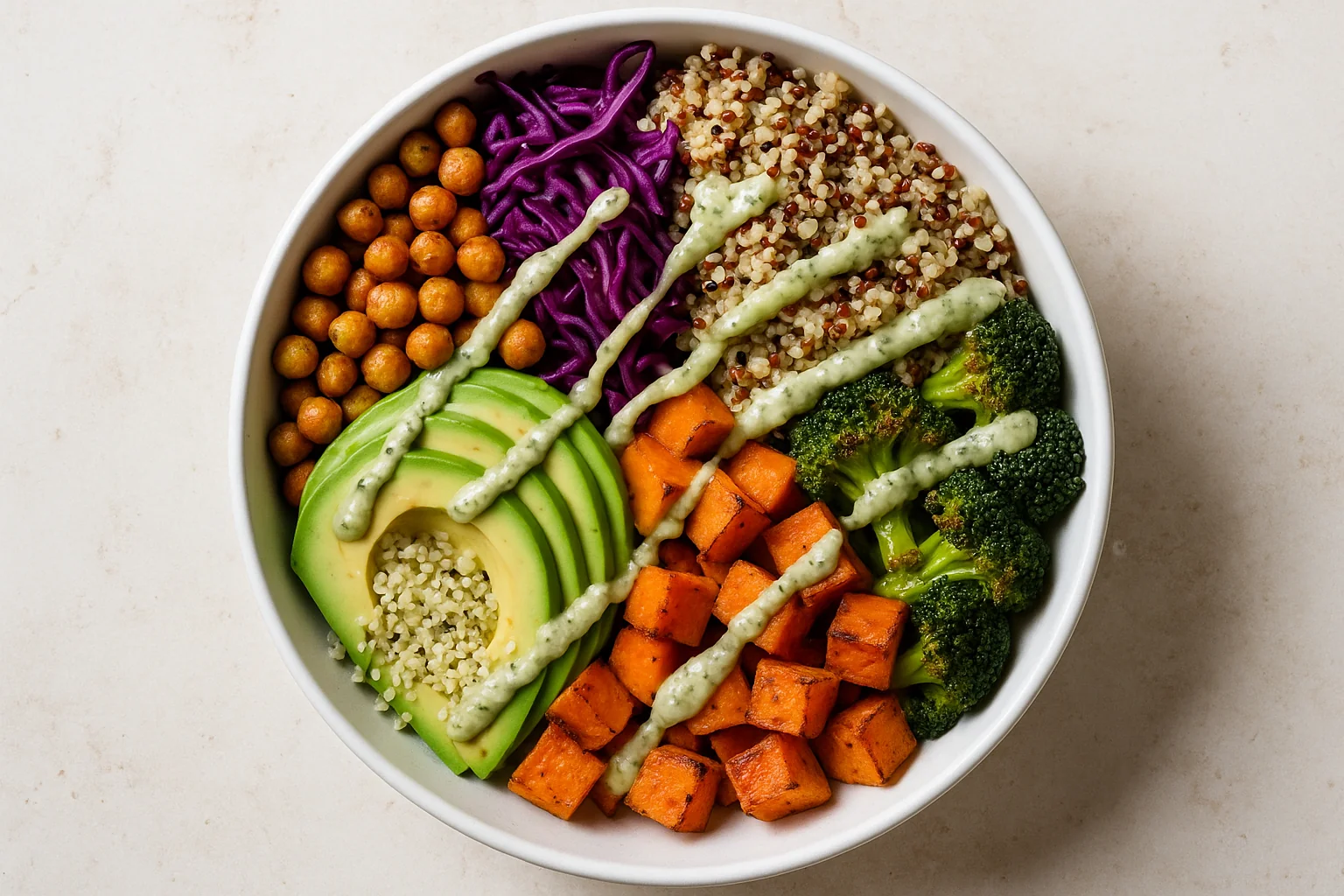

Buddha bowl with hemp dressing: colorful lunch
Buddha bowl with dressing made from hemp oil: proportions for two servings, 35 minutes of work, and verified numbers about fats, protein, and absorption.
A buddha bowl is first eaten with the eyes. A bowl of roasted vegetables, creamy avocado, and golden quinoa looks good on its own, but it is the dressing that determines whether the ingredients will work together. This one made from cold-pressed hemp oil, tahini, and lemon is thick and nutty, so it binds the bowl better than a regular vinaigrette. It also has a second advantage, which is less often mentioned: the fat in the dressing changes how many pigments you absorb from the vegetables underneath. Below you will find proportions for two servings, a workflow that fits within 35 minutes, and numbers from research and food composition databases, including those that are often misrepresented in popular descriptions of hemp oil.
KEY INFORMATION
• Hemp seed oil is over 80% polyunsaturated fatty acids, and the omega-6 to omega-3 ratio is usually from 2:1 to 3:1 (Callaway, Euphytica, 2004).
• The statement about the “optimal ratio for human health” comes from the author of that work, not from WHO recommendations.
• Adding fat to a salad increased the absorption of lutein by 5.1 times and beta-carotene by 15.3 times in 11 individuals (Unlu, J Nutr, 2005).
• Lysine is the first limiting amino acid in all tested hemp seed products (House, J Agric Food Chem, 2010).
Why does hemp dressing stand out among dressings?
This is determined by the fat composition. Hemp seed oil is over 80% polyunsaturated fatty acids, and the omega-6 to omega-3 ratio is usually from 2:1 to 3:1 (Callaway, Euphytica, 2004). Olive oil, the classic base for dressings, has this ratio more than four times wider.
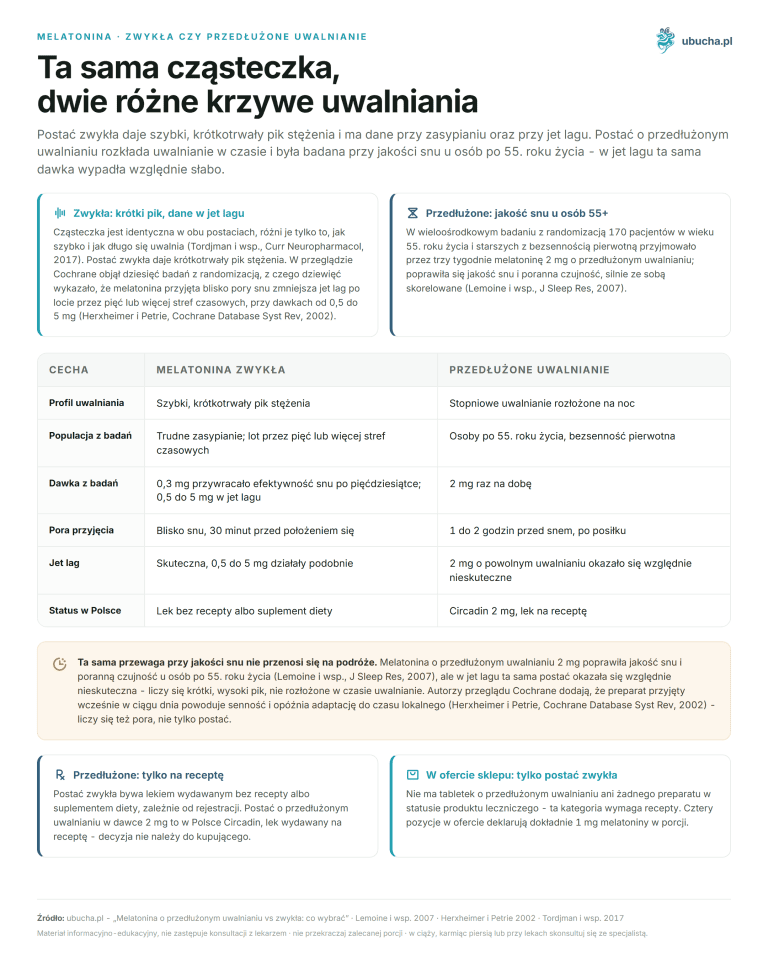
The numbers are found in the USDA food composition database. Olive oil contains 9.76 g of linoleic acid and 0.76 g of alpha-linolenic acid per 100 g (record 171413), which is close to 13:1. High-linoleic sunflower oil has 65.7 g of linoleic acid and zero alpha-linolenic acid (record 171025). For it, the ratio cannot be given at all, as the denominator is zero. This also clarifies a number that circulates in descriptions of oils: sunflower oil is often attributed a ratio of 65:1, although with zero omega-3, no finite quotient is correct. Sixty-five is in this record the number of grams of linoleic acid.
One thing needs clarification here, as it is repeated in almost every description of hemp oil. The statement about the “ratio considered optimal for human health” is in Callaway’s summary just after providing the range of 2:1 to 3:1 and is the author’s assessment. It is not a quote from WHO recommendations, although it is often signed as such. The ratio in hemp oil is indeed narrower than in olive oil; the threshold of 4:1, to which popular texts apply it, is not present in this work.
Does the fat in the dressing increase absorption from vegetables?
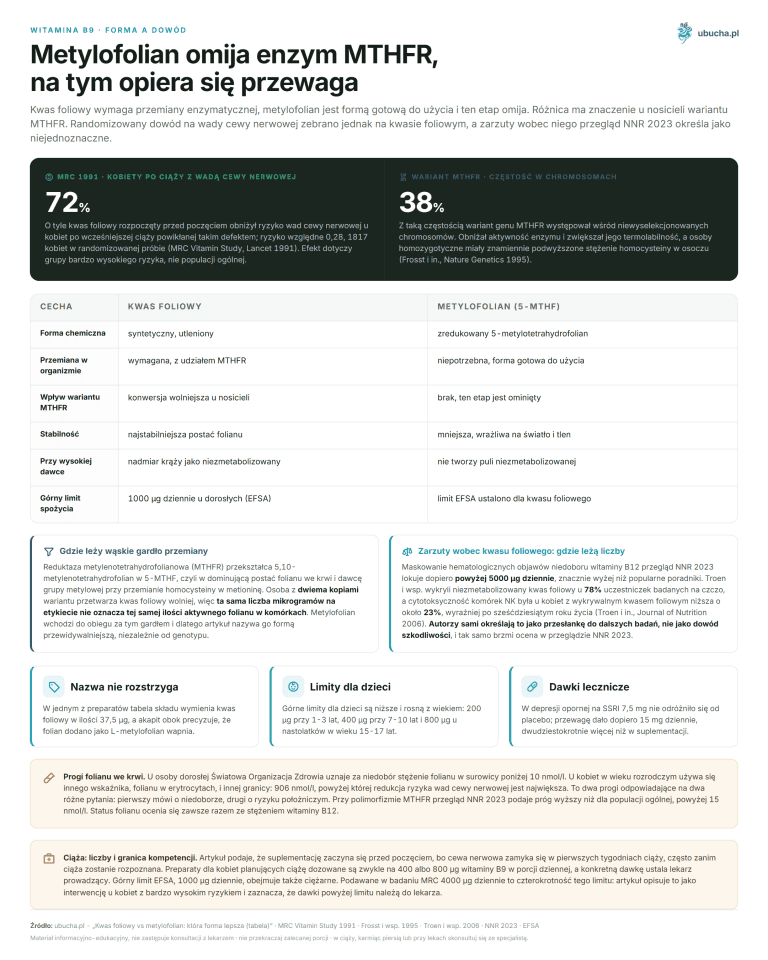
Yes, and the effect is surprisingly large. In a study by Unlu and colleagues (J Nutr, 2005), eleven healthy volunteers ate a salad in a crossover design: once without fat, once with 150 g of avocado. The absorption of lutein increased 5.1 times, alpha-carotene 7.2 times, and beta-carotene 15.3 times.
The measurement involved counting the area under the curve of pigment concentrations in triglyceride-rich lipoprotein fractions over 9.5 hours after the meal. Neither the dose of avocado (75 versus 150 g) nor the source of fat (fruit versus avocado oil) changed the result, so the authors attribute the effect to the lipids themselves.
Two things are worth taking away from this. The study measured carotenoids, not all fat-soluble vitamins at once. The source of fat was avocado, not hemp oil, so the hemp dressing serves the same physical role, but no one has measured it specifically. The practical conclusion remains the same: a dry bowl with roasted sweet potato and spinach yields less than the same bowl drizzled with dressing. The same portion of vegetables, different availability of pigments.
How much protein and of what quality does this bowl provide?
A serving with 75 g of dry quinoa, vegetables, avocado, and a spoonful of shelled hemp seeds provides about 16 g of protein. More important than the quantity is that popular descriptions equate quinoa with hemp seeds, which the data do not support.
| Dry product, 100 g | Protein | Lysine per 1 g of protein |
|---|---|---|
| Quinoa (USDA 168874) | 14.1 g | 54 mg |
| Hulled hemp seeds (USDA 170148) | 31.6 g | 41 mg |
House and colleagues (J Agric Food Chem, 2010) examined thirty samples of hemp seed products and found that lysine is the first limiting amino acid in all of them. The PDCAAS was 63-66% for hulled seeds, 49-53% for whole seeds, and 46-51% for the oil cake after oil extraction.
Callaway also writes that the proteins in hemp seeds contain nutritionally significant amounts of all essential amino acids. Both statements are true at the same time, as the presence of an amino acid is not the same as its proportion. In this bowl, the direction of complementarity runs the opposite way than is usually written: quinoa adds lysine, which hemp seeds lack. If you want to see this pair in a different arrangement, we have a separate recipe for tabbouleh with quinoa and hemp seeds.
What ingredients do you need for two servings?
Preparation takes 10 minutes, cooking and baking another 25, with both processes running in parallel. When shopping, one distinction matters: cold-pressed hemp seed oil is a food product with a dark green color and nutty aroma, completely different from aromatic hemp oils sold in droppers. Only the former is suitable for dressing. For the base of the bowl, you need:
- 150 g of quinoa or brown rice
- 1 sweet potato, about 200 g
- 1 beetroot, about 150 g, or 1 zucchini
- a handful of fresh spinach or arugula
- half an avocado
- 2 hard-boiled eggs or 150 g of tofu if you want to add protein
- a tablespoon of oil for roasting and salt and cumin for the vegetables
The dressing is made separately, in a jar, and is enough for both servings with a surplus. For it, you need:
- 3 tablespoons of cold-pressed hemp oil
- 1 tablespoon of tahini, or sesame paste
- 1 tablespoon of lemon juice
- 1 teaspoon of honey or maple syrup
- a small clove of garlic
- 2 tablespoons of water and salt to taste
- 1 tablespoon of shelled hemp seeds for sprinkling
How to prepare the buddha bowl step by step?
The order matters only in one place: the dressing and fresh ingredients go in last, after taking the vegetables out of the oven. The rest of the work happens in parallel, so the whole process fits within 35 minutes.
- Preheat the oven and set the water. Set to 200°C. Rinse quinoa under cold water to remove the bitter saponin coating, and cook in a ratio of one part grain to two parts water for 15 minutes, until the water is absorbed. Brown rice takes 35-40 minutes.
- Roast the vegetables. Peel the sweet potato and beetroot and cut into 2 cm cubes. Transfer to a baking sheet lined with paper. Drizzle with oil and season with salt and cumin. Bake for 20-25 minutes, until soft and slightly browned.
- Make the dressing. In a jar, combine hemp oil, tahini, lemon juice, honey, minced garlic, water, and salt. Seal and shake for 30 seconds. More lemon will give a tangy version, more water a thinner one.
- Prepare fresh toppings. Slice the avocado. Boil the eggs for 10 minutes from boiling, then transfer to cold water, peel, and cut in half. Leave the spinach whole.
- Assemble the bowl. At the bottom, place the quinoa. Arrange the roasted vegetables next to the spinach and avocado in sections, and place the egg or tofu on top. Drizzle with dressing just before serving and sprinkle with a spoonful of shelled hemp seeds. Do not mix: the buddha bowl thrives on the arrangement of ingredients next to each other.
How to modify the recipe and prepare it in advance?
The bowl can accommodate almost any element exchange except for the dressing, as it holds the flavor of the whole. In autumn, millet with pumpkin works well, in winter, lentils with roasted carrots. The dressing remains unchanged in both versions.
Instead of an egg, you can bake tofu. Cut it into 2 cm cubes, marinate for 20 minutes in soy sauce with garlic and ginger, and then place it on the same baking sheet as the vegetables for 20-25 minutes. If you prefer an Asian direction, replace tahini with a tablespoon of soy sauce with a teaspoon of sesame oil and grated ginger; hemp oil remains the base.
For meal prep, everything is suitable except for fresh toppings. Keep quinoa and roasted vegetables separately in the fridge for up to four days, and the dressing for five. Add avocado and greens only in the bowl, as those drizzled in advance wilt. Similarly, our chicken salad with hemp seeds is suitable if you are looking for a work lunch, and a more festive variant can be found in the recipe for salad with pear, blue cheese, and hemp oil.
Frequently asked questions
What should a good buddha bowl contain?
A classic bowl has four layers: a carbohydrate base, a protein source, roasted and fresh vegetables, and dressing. The dressing is not just a decorative addition, as its fat is responsible for the absorption of pigments from the vegetables (Unlu, J Nutr, 2005). Hemp oil contributes a ratio of omega-6 to omega-3 from 2:1 to 3:1.
How many calories are in a serving of buddha bowl with hemp dressing?
A serving with 75 g of dry quinoa, roasted vegetables, a quarter of an avocado, and two tablespoons of dressing is about 650 kcal, 16 g of protein, and 32 g of fat. This is an estimate calculated from the given proportions, not a measurement of the finished dish. The most energy comes from quinoa, as 75 g of dry grain is already 276 kcal (USDA, record 168874).
How long can hemp dressing be stored?
Up to five days in the refrigerator, in a tightly sealed jar. Hemp oil is over 80% polyunsaturated (Callaway, 2004), and such fats oxidize under the influence of light and heat faster than saturated ones, so coolness and darkness extend shelf life. If the dressing separates, just shake the jar.
Do hemp seeds have complete protein?
They contain all essential amino acids, but lysine is the first limiting amino acid, and the PDCAAS of hulled seeds is 63-66% (House, J Agric Food Chem, 2010). Quinoa has more lysine per gram of protein: 54 mg versus 41 mg. They complement each other well in one bowl.
Is the buddha bowl suitable for meal prep?
Yes, provided the elements are separated. Store cooked quinoa and roasted vegetables separately for up to four days, and the dressing for five. Add avocado, greens, and the dressing just before eating, as greens drizzled in advance lose their crispness, and the bowl becomes watery.
This article is for informational and educational purposes and does not replace consultation with a doctor. If you are pregnant, breastfeeding, taking medications, or have chronic conditions, consult the use of supplements or herbs with a specialist.
Author: Michał Waluk · Published: 2026-05-29 · Updated: 2026-08-16