
Psychedelics in Anxiety at the End of Life: A Review of Research
Two studies from 2016 and 80 oncology patients: what was really measured, with what scales, at what point in time, and what these results do not resolve.
Two clinical studies published in December 2016 in the Journal of Psychopharmacology included a total of 80 oncology patients with significant anxiety or depression. Both examined the same question: whether a single session with psilocybin, conducted alongside psychotherapy, reduces psychological suffering when the disease is life-threatening. Nine years later, these remain the most cited data in this area, and they are still small trials conducted at two centers. Below, we break them down: how many people, what measurement scale, what measurement point, what result. We also check what this means for patients in Poland, where the substance remains banned, and what is currently visible in the public clinical trial registry.
KEY INFORMATION
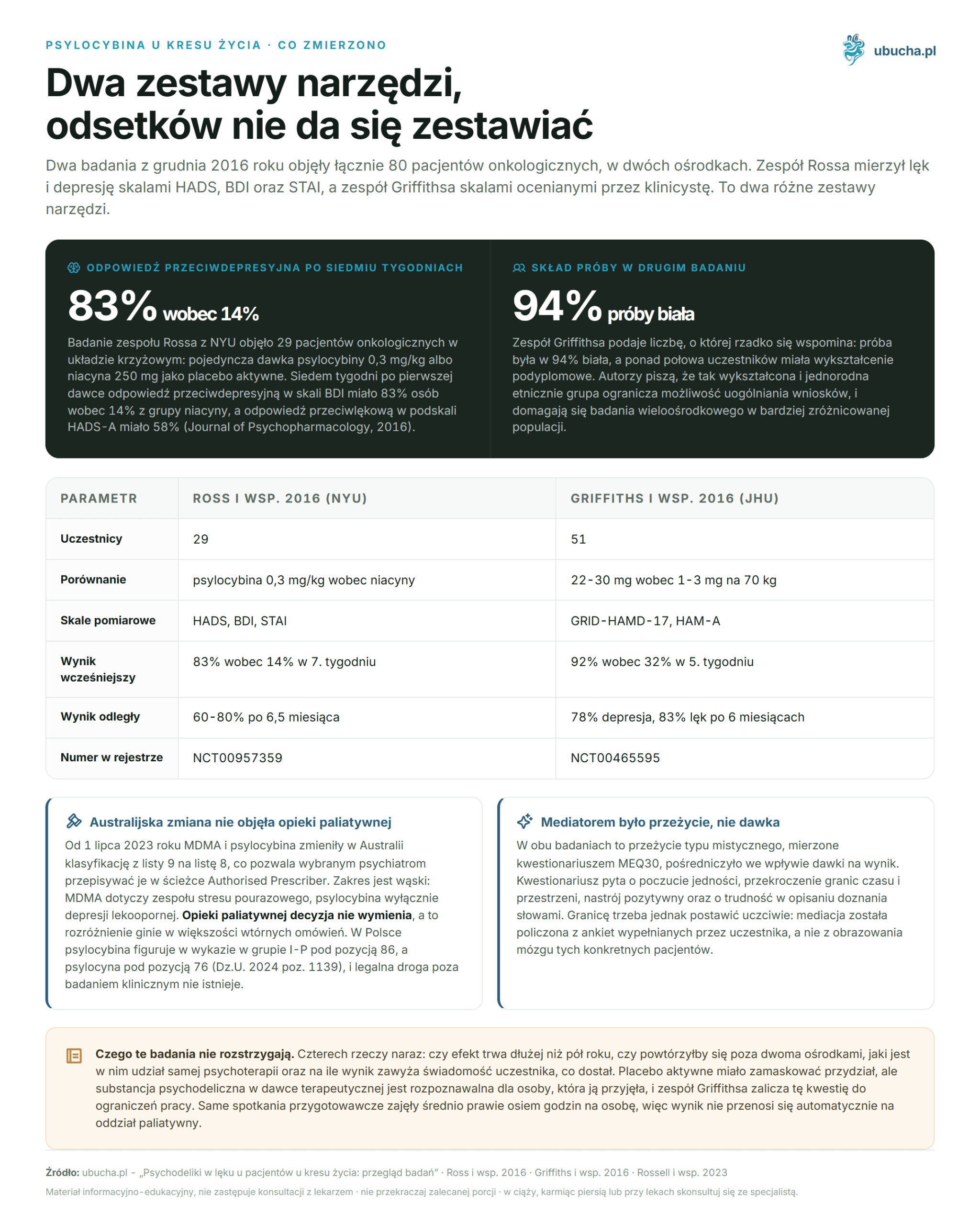
• Seven weeks after the dose, the antidepressant response on the BDI scale was observed in 83% of participants after psilocybin compared to 14% after niacin (Ross et al., Journal of Psychopharmacology, 2016, n=29).
• In the second study (Griffiths et al., n=51), the clinical response after six months was 78% for depression and 83% for anxiety.
• The strength of the effect was determined by the intensity of the mystical experience, not the dose level.
• The Australian change from 2023 did not include palliative care. In Poland, psilocybin is classified in group I-P of the list.
What is existential anxiety at the end of life and why is it difficult to treat?
Anxiety in a person with a life-threatening illness has two different cores. The first is somatic: rapid heartbeat, insomnia, muscle tension. The second is existential and concerns meaning, loss of continuity of one’s existence, and unresolved matters with loved ones. Sedatives address the first core. They have no way to translate to the second.
This division is evident in the studies themselves. In Ross’s team’s work, the inclusion criterion was a diagnosis of anxiety or adjustment disorder in a person with cancer, and in the results description, the authors mention alongside anxiety and depression also demoralization and a sense of hopelessness. No standard anxiety scale measures these two things directly, and they are the ones that come up in conversations in palliative care wards.
The second difficulty is practical. Existential psychotherapy requires a series of meetings and cognitive effort, and a patient in an advanced stage of illness may be too weakened to complete it. Hence the interest in an intervention that works after a single administration. This was the assumption, not proof, and that is why the results from 2016 became so prominent. The broader context of this method is described in the text about psilocybin as an element of psychotherapy.
What exactly did the two studies from December 2016 show?
They showed an improvement greater than that after active placebo, lasting for six months, in groups of 29 and 51 people. That is all and no more. Below are the numbers transcribed from both studies along with the name of the measurement scale, as this is where secondary discussions most often go awry.
The study by Ross’s team from NYU included 29 oncology patients in a crossover design: a single dose of psilocybin 0.3 mg/kg or niacin 250 mg as active placebo, switching groups after seven weeks, observation up to the 26th week after the second dose. Seven weeks after the first dose, the antidepressant response on the BDI scale was observed in 83% of the psilocybin group compared to 14% in the niacin group, and the anxiety response on the HADS-A subscale was observed in 58%. After 6.5 months, 60 to 80% of participants maintained improvement in anxiety or depression.
The study by Griffiths’s team from Johns Hopkins included 51 patients and compared a very low dose (1 or 3 mg per 70 kg, as placebo) with a high dose (22 or 30 mg per 70 kg), with five weeks between sessions. Five weeks after the first session, a clinical response on the GRID-HAMD-17 scale was observed in 92% of those who started with the high dose, compared to 32% starting with the low dose; on the HAM-A scale, it was 76% versus 24%. After six months, after combining both sequences, the clinical response was 78% for depression and 83% for anxiety (Griffiths et al., Journal of Psychopharmacology, 2016).
| Parameter | Ross et al. 2016 (NYU) | Griffiths et al. 2016 (JHU) |
|---|---|---|
| Participants | 29 | 51 |
| Comparison | psilocybin 0.3 mg/kg vs niacin 250 mg | 22-30 mg/70 kg vs 1-3 mg/70 kg |
| Measurement scales | HADS, BDI, STAI | GRID-HAMD-17, HAM-A |
| Early result | 83% vs 14% at 7 weeks (BDI) | 92% vs 32% at 5 weeks (GRID-HAMD-17) |
| Distant result | 60-80% after 6.5 months | 78% (depression) and 83% (anxiety) after 6 months |
| Registry number | NCT00957359 | NCT00465595 |
What do these two studies not resolve?
They do not resolve four things at once: whether the effect lasts longer than six months, whether it would be replicated outside of the two centers, what the role of psychotherapy itself is, and to what extent the result is inflated by the participant’s awareness of what they received.
The last problem is more serious here than in a typical drug study. The active placebo was supposed to mask the assignment, as niacin causes a flushing effect, and a very low dose of psilocybin provides weak experiences. However, the psychedelic substance at a therapeutic dose is recognizable to the person who has taken it. Griffiths’s team tried to limit this with instructions for participants and staff aimed at suppressing the expectation effect, and they themselves classify this issue as a limitation of the work.
Additionally, there is the selection of participants. The authors from Johns Hopkins explicitly mention two barriers: an extensive list of exclusion criteria and the time and cost of accompanying care before, during, and after the session. The preparatory meetings alone took an average of almost eight hours per person. Therefore, the result does not automatically transfer to the palliative ward, where the patient may be weakened and lacks the resources for such a cycle.
Griffiths’s team also provides one more number that is rarely mentioned: the trial was 94% white, and over half of the participants had postgraduate education. The authors write that such an educated and ethnically homogeneous group limits the ability to generalize the conclusions, and they call for a multicenter study in a more diverse population.
Why is mystical experience considered a mechanism of action?
Because in both studies, it was the mystical experience, not the dose level, that mediated the therapeutic effect. The authors used the technical term: mystical experience, measured by the MEQ30 questionnaire, was a mediator of the dose’s effect on the outcome. A mediator is not the same as a predictor, and the difference has practical significance.
The MEQ30 questionnaire consists of thirty items extracted from a broader consciousness state survey. It asks about the sense of unity, transcending the boundaries of time and space, positive mood, and the difficulty of describing the experience in words. A high score on this scale on the day of the session was associated with greater improvement in anxiety and depression scales measured weeks later.
At the neurobiological level, the most commonly described pathway is the 5-HT2A receptor and the transient disorganization of the default mode network, which is the structure responsible for the narrative sense of one’s “self.” This thread is developed separately in the text about the default mode network and afterglow. However, a boundary must be set honestly: mediation was calculated from questionnaires filled out by participants, not from brain imaging of these specific patients.
What did the LSD studies show in individuals with life-threatening illness?
The same direction as psilocybin studies, in two controlled Swiss trials, with twelve and forty-two participants. Both measured anxiety using the STAI scale, both were double-blind, and both reported improvements lasting for months after the last session.
The pilot study by Gasser administered 200 micrograms of LSD to eight participants and 20 micrograms as active placebo to four, in two sessions spaced two to three weeks apart. After two months, anxiety as a trait decreased with an effect size of 1.1, and anxiety as a state with an effect size of 1.2. Reductions were maintained for twelve months, and the authors reported no adverse events lasting longer than a day, nor serious treatment-related events (Gasser et al., Journal of Nervous and Mental Disease, 2014).
A larger trial came only in 2023. A multicenter crossover study included 42 patients with anxiety, some of whom were in the course of a life-threatening illness, and compared 200 micrograms of LSD with placebo. Sixteen weeks after the last session, the overall score on the STAI scale decreased by 16.2 points compared to placebo, with an effect size of 1.18. Transient, mild adverse effects were reported by 8 individuals (19%), and one serious treatment-related event, namely a transient anxiety attack, concerned one patient (2%) (Holze et al., Biological Psychiatry, 2023). Here too, the intensity of the mystical experience correlated with distant improvement.
What does access to such therapy look like in Australia, and how does it compare to Poland?
In Australia, as of July 1, 2023, MDMA and psilocybin changed classification from list 9 to list 8, allowing selected psychiatrists to prescribe them under the Authorised Prescriber pathway. The scope is narrow and does not include palliative care: MDMA pertains to post-traumatic stress disorder, and psilocybin exclusively to treatment-resistant depression.
This distinction is lost in most secondary discussions of that decision, yet it is the most significant aspect. In a letter published in the Australian and New Zealand Journal of Psychiatry, Rossell and co-authors add that the regulator did not consult with Australian researchers experienced in psilocybin-assisted psychotherapy and did not specify what qualifications the prescribing person should have (Rossell et al., Aust N Z J Psychiatry, 2023).
In Poland, psilocybin is listed among controlled substances in group I-P under position 86, and psilocin under position 76. The list is an annex to the regulation of the Minister of Health, in the consolidated text Dz.U. 2024 poz. 1139. There is no legal pathway outside of clinical trials. The public clinical trial registry shows, as of August 16, 2026, two studies with psilocybin being conducted in Poland, both concerning depression, not palliative care; there are no studies with MDMA listed in Poland. We describe how the same map looks for another population in the text about veterans and psychedelic therapy.
Frequently Asked Questions
What psychedelics have been studied in anxiety at the end of life?
The most data is available for psilocybin: two randomized studies from 2016 involving 29 and 51 oncology patients. LSD was studied in one controlled pilot study in Switzerland with twelve individuals facing life-threatening illness. Ketamine is legally used in palliative care, but for a different indication and in a different manner than psychedelic therapy.
What exactly was measured in the NYU and Johns Hopkins studies?
Ross’s team measured anxiety and depression using the HADS, BDI, and STAI scales, defining a response as a decrease in score of at least half. Griffiths’s team used clinician-rated scales, GRID-HAMD-17 and HAM-A. These are two different sets of tools, so percentages from both studies cannot be directly compared.
Why would one session work for six months?
The authors provide a cautious answer: the dose effect on the outcome was mediated by the intensity of mystical experience measured by the MEQ30 questionnaire. Durability was described up to the 26th week in one study and up to six months in the other. Beyond these measurement points, neither study extends.
Do psychedelics change attitudes towards death?
Griffiths’s team’s work reports a decrease in fear of death and an increase in the sense of life’s meaning, while Ross’s team discusses an improvement in attitudes towards death. Both measurements are based on self-reported questionnaires filled out by participants. These are self-reported data, not an objective measurement of attitudes towards dying.
Can one participate in such a study in Poland?
As of August 16, 2026, the public clinical trial registry lists two studies with psilocybin being conducted in Poland, both concerning depression, not palliative care. There are no studies with MDMA listed in Poland. Recruitment and inclusion criteria change, so the status must be checked regularly in the registry.
Does the Australian change from 2023 include terminal patients?
No. The regulator’s decision covered two indications: MDMA for post-traumatic stress disorder and psilocybin for treatment-resistant depression. Palliative care or terminal illness is not mentioned. We have compiled a review of the entire field, along with phase 3 studies and registration decisions, in the text about therapies using psychedelics.
This article is for informational and educational purposes. It describes clinical studies in which the substance is administered under medical supervision after participant qualification; self-use of these conditions does not replicate. These substances are controlled in Poland under the Act on Counteracting Drug Addiction. If you have suicidal thoughts, call the free, 24-hour numbers 116 123 or 800 70 2222. In case of life-threatening situations: 112.
Author: Michał Waluk · Published: 2026-08-09 · Updated: 2026-08-16