
5-HT2A Receptor: How Psychedelics Activate Brain Plasticity
The 5-HT2A receptor is the entry point for classic psychedelics. Check what the experiment with ketanserin showed and how neuroplasticity arises.
Psilocybin, LSD, DMT, and mescaline differ in structure, duration of action, and origin, yet they share one common entry point into the brain: the serotonin receptor 5-HT2A. This is not a coincidence or a simplification for popularization. We know this because someone blocked this receptor and checked what remains of the effect. Understanding where 5-HT2A is located and what it activates upon stimulation explains both the subjective effects of these substances and why psychiatry has begun to take an interest in them after a fifty-year hiatus. This text shows the basis of these findings, where research disagrees, and what cannot be transferred from animal models to humans.
KEY INFORMATION
• Administration of ketanserin, a 5-HT2A antagonist, dose-dependently blocked the psychotomimetic effects of psilocybin in healthy volunteers (Vollenweider et al., Neuroreport, 1998).
• LSD and psilocin bind directly to the TrkB receptor, and this effect does not require 5-HT2A and works by enhancing the body’s own BDNF signal (Moliner et al., Nature Neuroscience, 2023).
• A separate study shows that plasticity is triggered by 5-HT2A receptors located inside the cell, not on its surface (Vargas et al., Science, 2023).
• Separating plasticity from hallucinations is currently a finding from rodent studies.
What is the 5-HT2A receptor and where is it located in the brain?
The 5-HT2A receptor belongs to the family of metabotropic receptors coupled with G protein, subtype Gq/11. Its activation triggers the phospholipase C pathway, which produces secondary messengers that activate protein kinase C and release calcium from intracellular stores. The signal is therefore not a simple opening of a channel, but a cascade spread over seconds and minutes (Nichols, Pharmacological Reviews, 2016).
The distribution of this receptor in the brain is not uniform, which makes it interesting. The highest density is found in the cortex, primarily in the fifth layer of the prefrontal cortex, as well as in the sensory and visual cortex. The prefrontal cortex integrates incoming information and builds predictions about the world. When the 5-HT2A receptors there are suddenly strongly activated, this hierarchy of predictions temporarily fails, which directly translates into altered perception and thought processes.
The receptor also has measurable baseline activity, meaning it signals to some extent even without a bound ligand. From a pharmacological perspective, this means it is not a switch that turns on and off, but an element with a regulated setting. A substance can raise, lower, or change the signal profile without changing its strength. The last of these possibilities will prove to be the most important.
How does receptor activation lead to neuroplasticity?
For years, the answer was: indirectly. Activated 5-HT2A increases glutamate release in the prefrontal cortex, which stimulates AMPA receptors, and further activates the BDNF and mTOR-dependent pathway that builds new dendritic spines. This description was not incorrect. A 2018 study showed an increase in neuritogenesis and spinogenesis after psychedelics and the dependence of this effect on TrkB, mTOR, and indeed 5-HT2A (Ly et al., Cell Reports, 2018). The study was conducted on cell cultures and rodents.
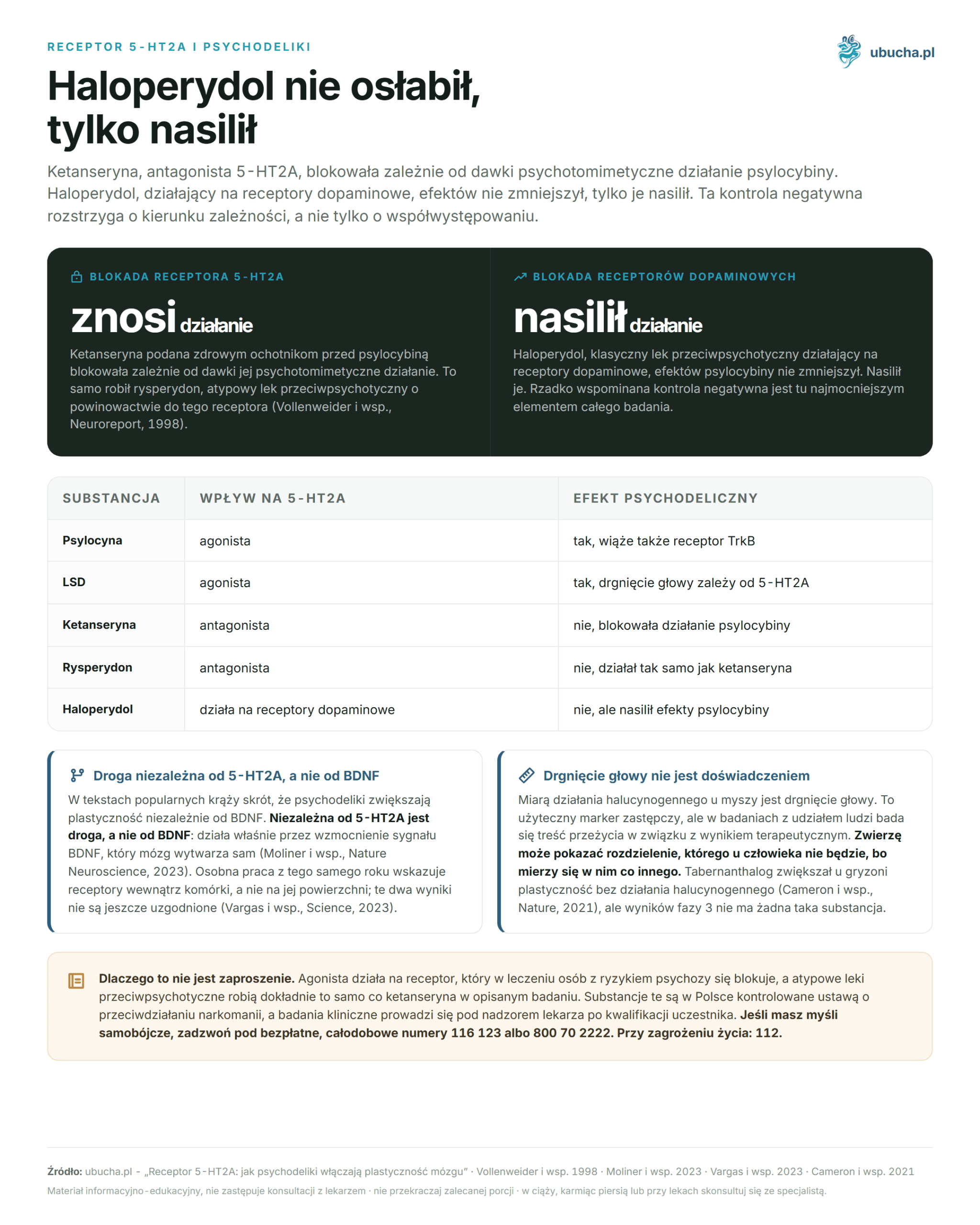
In 2023, a completely different pathway was added. It turned out that LSD and psilocin bind directly to the TrkB receptor, which is the receptor for BDNF, and with an affinity about a thousand times higher than other antidepressants. The binding site lies in the transmembrane domain of the TrkB dimer. The effect on neurotrophic signaling and animal behavior depended on this binding and the enhancement of the body’s own BDNF signal, and did not require 5-HT2A. At the same time, head twitching, the animal equivalent of hallucinogenic action, depended on 5-HT2A and did not depend on TrkB (Moliner et al., Nature Neuroscience, 2023).
It is worth being cautious about a shortcut that circulates in popular texts. This pathway is independent of the 5-HT2A receptor, not BDNF. On the contrary: it works by enhancing the BDNF signal that the brain produces itself. More about why psychedelics have begun to be called psychoplastogens for this reason can be found in the text about neuroplasticity and BDNF.
The picture is complicated by a third study from the same year. It demonstrated that the plasticity effects are mediated by 5-HT2A receptors located inside the cell, not those on its surface, and that is why serotonin itself does not induce such plasticity, even though it fits the receptor (Vargas et al., Science, 2023). These two results are not yet reconciled, and it is fair to state this rather than choose the more convenient option.
Can plasticity be separated from hallucinations?
This is currently the loudest question in this field, and the answer is: in rodents, yes; in humans, it is unknown. The reference point is tabernanthalog, a designed analog of ibogaine. It was created by selecting from the ibogaine molecule those elements responsible for therapeutic action and rejecting the rest, as ibogaine itself is toxic and causes heart rhythm disturbances.
In rodents, tabernanthalog increased structural plasticity, reduced alcohol and heroin seeking, and provided antidepressant effects in behavioral tests without inducing hallucinogenic effects (Cameron et al., Nature, 2021). Moliner’s work adds a pharmacological premise: since plasticity goes through TrkB, and head twitching through 5-HT2A, separating these two is not inherently impossible.
Reading this literature, we noticed a barrier that is difficult to overcome methodologically. The measure of hallucinogenic action in mice is head twitching. This is a useful surrogate marker, but it is not an experience, and in studies involving humans, it is the content of the experience that is examined in relation to the therapeutic outcome. Therefore, an animal may show a separation that will not exist in humans because something different is measured in them. Until there are data from studies involving humans, this is a promise, not a result.
What does 5-HT2A mean in psychiatry beyond psychedelics?
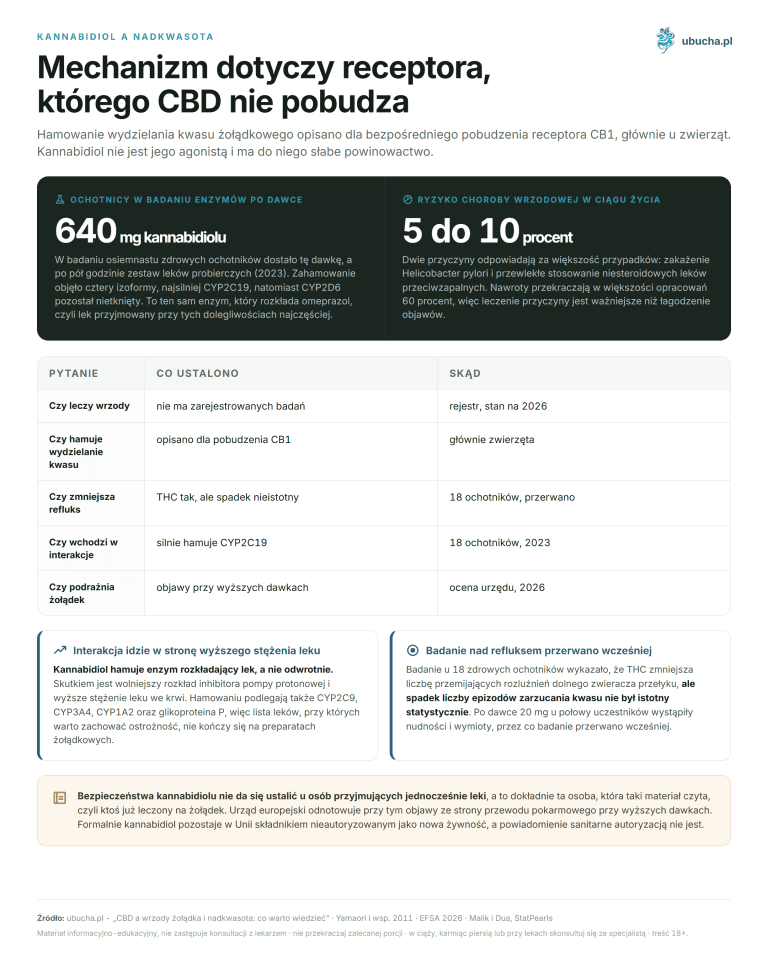
Most notably in schizophrenia, and not by analogy. Atypical second-generation antipsychotic drugs, led by risperidone, block among other things 5-HT2A, and this is the same mechanism that in the study described above extinguished the effects of psilocybin. This is where caution regarding psychedelics in individuals at risk of psychosis comes from: the agonist acts on the receptor that is blocked in the treatment of this group. Separately, we discuss how cannabidiol fits into this picture in the text about the antipsychotic action of CBD.
The second issue concerns antidepressants and is interesting precisely because the data is inconsistent. A survey among users of psilocybin mushrooms describes a weakening of their effects during the use of SSRI and SNRI medications and after their discontinuation (Gukasyan et al., J Psychopharmacol, 2023). However, a controlled crossover study with a double-blind design yielded a different result: two weeks of escitalopram did not significantly affect the positive effects of psilocybin, but it did reduce anxiety, malaise, and cardiovascular side effects without changing receptor gene expression (Becker et al., Clin Pharmacol Ther, 2022).
The authors of the second study themselves note what it does not resolve: participants were healthy, and the treatment lasted two weeks, while a patient takes SSRIs for months. The discrepancy between user reports and the results of the controlled trial is therefore real and unresolved, not merely apparent. What happens to the neuronal network in the days following the experience itself is described in the text about afterglow and the window of neuroplasticity. It is also worth remembering that not every substance interested in this receptor is its agonist, as we discuss in connection with CBD and the 5-HT2A receptor.
Frequently Asked Questions
What is the 5-HT2A receptor and where is it located?
It is a serotonin receptor coupled with the Gq/11 protein, activating the phospholipase C pathway. It is most densely located in the cortex, especially in the fifth layer of the prefrontal cortex and in the sensory and visual cortex. It regulates the excitation of cortical networks responsible for perception and information integration (Nichols, Pharmacological Reviews, 2016).
How do we know that psychedelics act through this receptor?
From a blockade experiment. Ketanserin, a 5-HT2A antagonist, dose-dependently blocked the psychotomimetic effects of psilocybin in healthy volunteers, similar to risperidone. Haloperidol, which acts on dopamine receptors, did not diminish the effect, but rather intensified it (Vollenweider et al., Neuroreport, 1998).
Do psychedelics increase neuroplasticity independently of BDNF?
No, and this is a common misconception. LSD and psilocin bind directly to the TrkB receptor, but the effect depends on the enhancement of the body’s own BDNF signal. It is independent of the 5-HT2A receptor (Moliner et al., Nature Neuroscience, 2023).
Is every substance acting on 5-HT2A psychedelic?
No. Ketanserin and atypical antipsychotic drugs block this receptor and do not produce psychedelic effects. Serotonin itself fits the receptor but does not induce plasticity because it acts on its surface pool, not intracellularly (Vargas et al., Science, 2023).
Are there psychoplastogens without hallucinogenic effects?
So far, only in animal studies. Tabernanthalog, a designed analog of ibogaine, increased structural plasticity in rodents and reduced alcohol and heroin seeking without inducing hallucinogenic effects. No such substance has yet had results from phase 3 clinical trials (Cameron et al., Nature, 2021).
Do antidepressants weaken the effects of psilocybin?
The data is inconsistent. A survey among users describes a weakening of effects during SSRI use. A controlled study with escitalopram in healthy volunteers did not show an impact on the positive effects of psilocybin, although it reduced anxiety and side effects. The question remains open (Becker et al., Clin Pharmacol Ther, 2022).
This article is for informational and educational purposes. It describes clinical studies in which the substance is administered under medical supervision after participant qualification; using these substances on your own does not replicate those conditions. These substances are controlled in Poland under the Act on Counteracting Drug Addiction. If you have suicidal thoughts, call the free, 24-hour numbers 116 123 or 800 70 2222. In case of life-threatening situations: 112.
Author: Michał Waluk · Published: 2026-08-09 · Updated: 2026-08-16