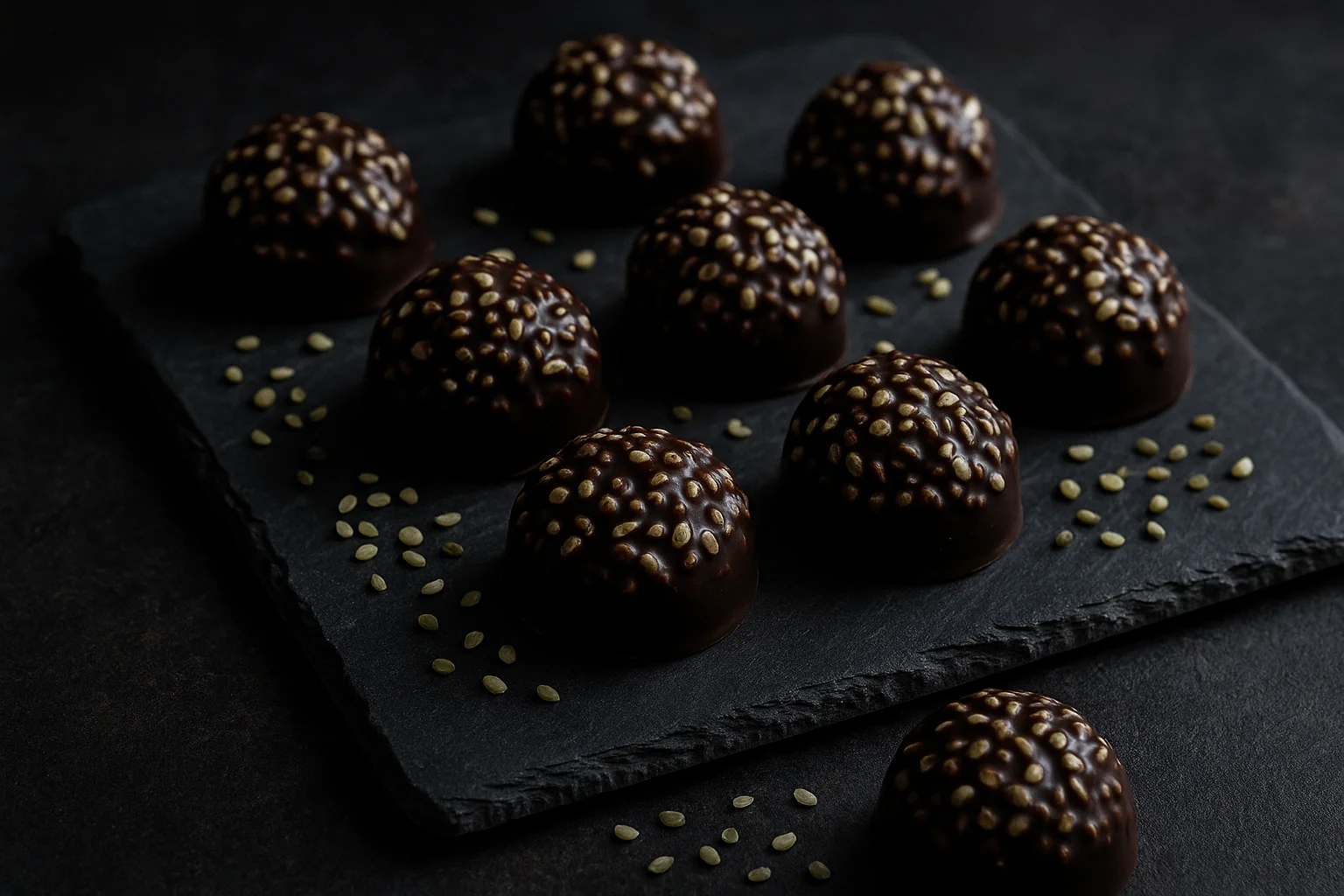

Hemp Seed Pralines in Dark Chocolate
Homemade hemp seed pralines in dark chocolate, no baking required. Proportions for 24 pieces, nutritional values from USDA database, and four variations.
Hemp seed pralines look like a confectionery product and are made without an oven and without a thermometer. The filling is almond butter mixed with hulled hemp seeds and a bit of honey, and the coating is dark chocolate. One step determines whether they turn out: the filling balls must be frozen before dipping, otherwise the warm chocolate will melt the nut butter and the mass will spread in the bowl. Below you will find proportions for 20-24 pieces, nutritional values calculated from USDA records for each ingredient separately, and four filling variations in case the basic version gets boring. The whole process takes about an hour, of which two-thirds is idle waiting for the filling to harden in the freezer and the coating to set in the fridge.
KEY INFORMATION
• Hulled hemp seeds contain 31.6 g of protein and 700 mg of magnesium per 100 g (USDA).
• Dark chocolate with 70-85% cocoa contains 228 mg of magnesium per 100 g, almond butter 279 mg (USDA).
• Lysine is the first limiting amino acid in all studied hemp products (House et al., 2010).
• The success of the recipe depends on freezing the filling balls before dipping in chocolate.
Why do hemp seeds and chocolate make a good combination?
Because they have a similar flavor profile and complementary compositions. Hemp seeds are nutty and slightly earthy, and dark chocolate is too, so they do not clash like fruit with cocoa. Additionally, the seeds add protein and unsaturated fat where chocolate mainly provides saturated fat and sugar.
It is worth organizing the numbers. Dark chocolate with 70-85% cocoa contains 228 mg of magnesium per 100 g and 7.79 g of protein and 42.6 g of fat (USDA, dark chocolate 70-85%). This is a lot for a sweet treat, although still less than cocoa powder itself, which has 499 mg of magnesium per 100 g (USDA, unsweetened cocoa powder). Hemp seeds beat both: 700 mg of magnesium and 31.6 g of protein per 100 g (USDA, hulled hemp seeds).
The protein from hemp seeds is sometimes described as complete, and this abbreviation needs to be expanded. Callaway, Euphytica, 2004 states that edestin and albumin, the two main proteins in seeds, contain nutritionally significant amounts of all essential amino acids. House et al., Journal of Agricultural and Food Chemistry, 2010 however, checked how much of this the body utilizes, and the result is more cautious: lysine turned out to be the first limiting amino acid in all studied hemp products, and the PDCAAS score was 63-66% for hulled seeds. Therefore, the praline is not a source of complete protein, but rather a dessert with a sensible protein addition.
Separately about the ratio of fatty acids, because a false attribution is repeated in texts about hemp. The omega-6 to omega-3 ratio in hemp seed oil usually falls between 2:1 and 3:1, and Callaway calls it beneficial for human health. This is the author’s assessment of the review, not a WHO recommendation: a joint FAO and WHO consultation does not indicate any specific value of this ratio as a target.
What does one praline provide?
When dividing the mass into 22 pieces, one praline weighs about 18 g and provides approximately 2.4 g of protein, 7.5 g of fat, and 49 mg of magnesium. These values are calculated from USDA records for the four ingredients, not a measurement of the finished dessert, so treat them as an order of magnitude.
The calculation looks like this. The entire batch with filling and coating weighs about 390 g. From USDA records for its ingredients, it comes out to about 52 g of protein and 1085 mg of magnesium, which when divided by 22 pieces gives the values mentioned above. Energetically, one praline is about 100 kcal, with honey being the only ingredient not read from the database.
Thus, three pralines provide about 7 g of protein and 150 mg of magnesium. For comparison: to get the same amount of magnesium from dark chocolate alone, you would need to eat about 65 g, which is two-thirds of a bar. Hemp seeds and almond butter do the larger part of the work here, even though it is the coating that gives the dessert its character.
What do you need for hemp seed pralines?
The proportions are enough for 20-24 pieces. There is about 20 minutes of active work, the rest is cooling. You do not need a chocolate tempering device or silicone molds, just a baking sheet lined with paper and a toothpick.
- 100 g of almond or cashew butter, unsweetened
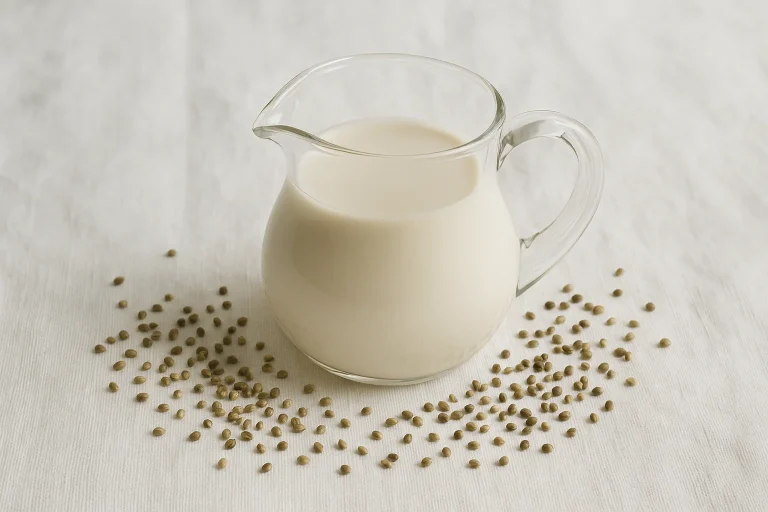
- 50 g of hulled hemp seeds
- 2 tablespoons of honey or maple syrup
- 1 teaspoon of vanilla extract
- pinch of sea salt
- 200 g of dark chocolate with at least 70 percent cocoa
- 1 teaspoon of coconut oil for the coating, optional
- sea salt flakes for decoration, optional
Choose nut butter that is thick and has no additives, one-ingredient types. Versions with sugar and palm oil are more liquid, so the filling will not hold its shape and you will need to add ground almonds. Chocolate below 70 percent cocoa is too sweet and too soft for a hard shell.
Use hulled hemp seeds. You do not heat the filling, so the hard shell cannot soften and will crunch in your teeth. House’s team measured whole seeds at 24% protein and 30.4% fat, and hulled at 35.9% and 46.7%, so the shell also dilutes what you are reaching for in the seeds.
How to make hemp seed pralines step by step?
Five steps, with the second being non-removable: freezing the balls. The melted chocolate is about 45-50 degrees, and the filling at room temperature will simply melt in it. A frozen ball withstands the few seconds needed for coating and draining.
- Mix almond butter with hemp seeds, honey, vanilla, and salt into a thick, uniform mass. The test is simple: the mass holds the shape of a ball formed in your hand. If it spreads, place it in the fridge for 15 minutes; if it crumbles, add a teaspoon of honey.
- Scoop portions of about 10 g with a teaspoon and shape them into balls with cool hands, placing them on a baking sheet lined with paper. Place the sheet in the freezer for 20-30 minutes. Work quickly, as the heat from your hands softens the mass.
- Chop the chocolate and melt it in a water bath or in the microwave in 30-second intervals, stirring in between. A teaspoon of coconut oil will thin the coating and add shine.
- Insert a toothpick into the frozen ball, dip it in chocolate, and drain the excess by tapping it against the edge of the bowl. Place it on paper and immediately sprinkle with hemp seeds or sea salt flakes before the coating starts to set.
- Place the sheet in the fridge for 15-20 minutes until the coating hardens and becomes matte. Store the pralines in the fridge in an airtight container.
We noticed in our tests that the coating with the addition of a teaspoon of coconut oil per 200 g of chocolate comes out noticeably thinner and smoother. Thinner chocolate drains better from the ball when draining and does not leave a thick layer at the bottom, which causes the praline to stand unevenly. This is an observation from our kitchen, not a viscosity measurement result.
What variations of hemp pralines work best?
The base with nut butter can withstand many modifications, as long as you keep one thing in mind: the filling must be shapeable and chillable. Anything that adds liquid thins the mass, and you need to balance it with something dry. Four variations below were tested with the same coating proportions.
| Variant | Change in filling | What to watch out for |
|---|---|---|
| With ganache | 200 g of chocolate and 80 ml of cream instead of almond butter | ganache must thicken in the fridge before you shape the balls |
| With fruit | Replace 20 g of hemp seeds with dried cherries or cranberries | chop the fruit finely, as large pieces break through the coating |
| With alcohol | a tablespoon of orange liqueur or rum extract | liquid thins the mass, add a tablespoon of ground almonds |
| Chewy | an extra tablespoon of maple syrup, cooling in the fridge instead of the freezer | soft balls are harder to dip, work with a fork |
If you are looking for similar desserts with the same base, we have also prepared chocolate truffles with CBD oil and more rustic homemade hemp balms. Warm, the same pair of ingredients returns in hot chocolate with hemp seeds, and in a baking version in chocolate tart with hemp flour.
Frequently Asked Questions
Why does the chocolate on the pralines turn gray?
This is a fat bloom: cocoa butter migrates to the surface with temperature fluctuations and solidifies in a different crystalline form. It is not harmful and does not change the taste, it only spoils the appearance. Prevent it by storing at a constant refrigerator temperature and tempering the chocolate before dipping.
How much protein is in one praline?
About 2.4 g, based on USDA records for the four ingredients. The largest contributions come from almond butter and hemp seeds, which have 21 g and 31.6 g of protein per 100 g, respectively. Keep in mind that lysine is a limiting amino acid in hemp products, so it is an addition, not a source of protein.
How long can you store hemp seed pralines?
In an airtight container in the fridge for up to two weeks, in the freezer for up to three months. Take them out 10 minutes before serving, as they taste flat straight from the cold. At temperatures above 22 degrees, the coating softens, and the almond butter filling starts to spread.
What chocolate should I choose for the coating?
At least 70 percent cocoa. The bitterness balances the sweet filling, and a higher cocoa butter content gives a harder shell. Milk chocolate below 50 percent is too soft and too sweet. Couverture, which is dessert chocolate with a higher cocoa butter content, gives the best shine.
Can hemp pralines be made without nut butter?
Yes, using a date paste made from 100 g of dates and 20 g of ground almonds or a thick cottage cheese with cocoa. Both bases hold the hemp seeds equally well, although the date version is sweeter and requires omitting the honey. Freezing the balls before dipping applies the same.
Ready-made chocolates with additives can be found in the adaptogens category in the Bucha store; hulled hemp seeds for the filling are not in our assortment, so buy them at a grocery store (as of August 16, 2026).
This article is for informational and educational purposes and does not replace consultation with a doctor. If you are pregnant, breastfeeding, taking medications, or have chronic conditions, consult the use of supplements or herbs with a specialist.
Author: Michał Waluk · Published: 2026-06-22 · Updated: 2026-08-16