
Where Did the 0.3% THC Limit Come From: The History of the Arbitrary Boundary from 1976
The 0.3% THC threshold comes from a taxonomic work from 1976, not from clinical studies. Check how it made its way into law and how it is calculated today in Poland.
Every package of legal hemp flower carries the same number on its label: THC below 0.3%. Where does it come from? Not from clinical studies and not from safety work, but from a taxonomic article published in 1976 by two botanists who were looking for a line separating two groups of plants, not a threshold of intoxication. The authors themselves wrote that they accepted this value arbitrarily. Half a century later, the same number stands in American agricultural law, Canadian regulations, EU agricultural policy, and the Polish Act on Counteracting Drug Addiction. Below, we describe where this number came from, how it made its way into regulations, and what this history changes in reading the analysis certificate attached to the flower.
KEY INFORMATION
• The 0.3% threshold comes from the work of Ernest Small and Arthur Cronquist published in the journal Taxon in 1976 (Small and Cronquist, Taxon 25, pp. 405-435).
• The authors adopted this value as a taxonomic guideline and described their choice as arbitrary.
• They measured THC content in young, strong leaves of relatively mature plants, not in the dry mass of the entire plant.
• In the EU, the 0.3% threshold has been in effect since January 1, 2023, based on Regulation 2021/2115; previously, it was 0.2%.
• In Poland, the threshold comes from the Act on Counteracting Drug Addiction and is calculated as the sum of delta-9-THC and THCA, rounded to one decimal place.
Where Did the Number 0.3% Come From?
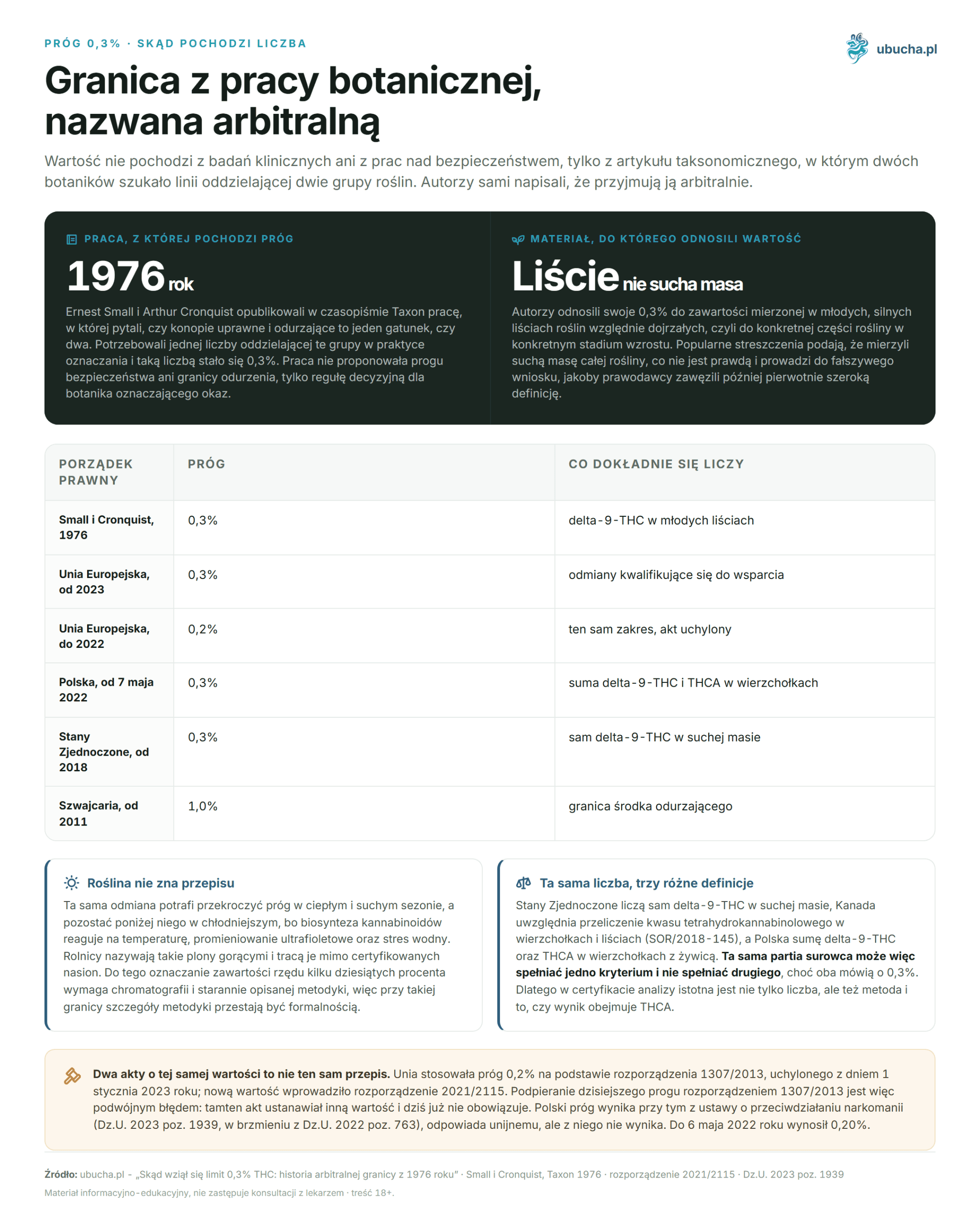
From a botanical article aimed at resolving a species dispute. Ernest Small worked in the Canadian Department of Agriculture, and Arthur Cronquist was a botanist at the New York Botanical Garden. In 1976, they published a paper in the journal Taxon titled “A Practical and Natural Taxonomy for Cannabis,” in which they asked whether cultivated hemp and intoxicating hemp are one species or two separate ones.
The researchers collected samples of hemp plants from various regions of the world and measured their cannabinoid content. The distribution of results turned out to be heterogeneous: plants traditionally grown for fiber clustered at low values, while varieties used as drugs clustered at high values. The authors needed a single number that would allow them to separate these two groups in practical identification, and that number became 0.3%.
The paper did not propose a safety threshold or intoxication limit. Its authors were solving a classification problem: the goal was to provide a botanist identifying a specimen with a decision rule. The legal significance of this number only emerged several decades later, not because someone experimentally verified it, but because it was already at hand and came from a peer-reviewed publication.
Why Did the Authors Call This Limit Arbitrary?
Because they themselves described it as such in the text of the paper. The article contains the phrase that the authors “arbitrarily accept a concentration of 0.3% delta-9-THC” as a guideline for distinguishing two classes of plants. Therefore, this is not an interpretation of later commentators, but a statement from the original.
The second detail of the same phrase is often overlooked, and it changes a lot. Small and Cronquist referred their 0.3% to the content measured in young, strong leaves of relatively mature plants, meaning a specific part of the plant at a specific growth stage. Popular summaries state that they measured the dry mass of the entire plant, which is not true and leads to the false conclusion that lawmakers later narrowed the originally broad definition.
The consequence is practical. Since the result depends on which part of the plant is being studied, the number itself without specifying the research material means little. Today’s regulations add this missing part: EU regulations relate the threshold to the cultivated variety, while Polish regulations relate it to flowering or fruiting tops of plants from which resin has not been removed. Each of these methods gives a different result for the same plant.
How Did the Number from the Botanical Article End Up in Law?
Through various paths and at different times, with the European Union arriving at this value the latest. For many years, it used a lower threshold and only raised it in 2023, while Canada and the United States had been using Small’s number earlier, although each of these countries defined it differently.
In Canada, the threshold was recorded in the industrial hemp regulations issued under the Cannabis Act: industrial hemp is defined as a plant with a THC concentration not exceeding 0.3% in flowering tops and leaves, with the measurement accounting for the possibility of converting tetrahydrocannabinolic acid to THC (Industrial Hemp Regulations, SOR/2018-145). The American Farm Bill of 2018 took a different approach and defined hemp by the content of delta-9-THC not exceeding 0.3% in dry mass.
| Legal Order | Threshold | What Exactly is Counted |
|---|---|---|
| The Work of Small and Cronquist, 1976 | 0.3% | delta-9-THC in young leaves, taxonomic guideline |
| European Union, since January 1, 2023 | 0.3% | varieties of hemp eligible for agricultural support |
| European Union, until December 31, 2022 | 0.2% | the same range, repealed Regulation 1307/2013 |
| Poland, since May 7, 2022 | 0.3% | the sum of delta-9-THC and THCA in tops with resin |
| United States, since 2018 | 0.3% | only delta-9-THC in dry mass |
| Canada | 0.3% | THC in tops and leaves, with THCA conversion |
| Switzerland, since 2011 | 1.0% | the limit below which the product is not a narcotic |
The European Union applied a threshold of 0.2% based on Article 32 paragraph 6 of Regulation 1307/2013. This act was repealed on January 1, 2023, and the new value of 0.3% was introduced by Article 4 paragraph 4 of Regulation 2021/2115 concerning the strategic plans of the common agricultural policy (EUR-Lex, Regulation 2021/2115). Therefore, supporting today’s 0.3% threshold with Regulation 1307/2013 is a double mistake: that act established a different value and is no longer in force today.
How is the 0.3% Threshold Calculated in Poland?
As the sum of two compounds, not as one of them. The Polish definition refers to the sum of delta-9-THC and tetrahydrocannabinolic acid (THCA), rounded to one decimal place, measured in flowering or fruiting tops of plants from which resin has not been removed. This distinction determines the result of the laboratory test.
The basis is Article 4 point 5 of the Act of July 29, 2005 on Counteracting Drug Addiction (consolidated text Journal of Laws 2023, item 1939), as amended by the Act of March 24, 2022 (Journal of Laws 2022, item 763), in force since May 7, 2022. Until May 6, 2022, the national threshold was 0.20%, so statements about the Polish limit of 0.2% are true only in a historical context and with a date.
It is also worth separating the two regulations that today have the same numerical value. The Polish threshold comes from the Act on Counteracting Drug Addiction, while the EU one comes from agricultural regulation 2021/2115. The national threshold corresponds to the EU one, but does not derive from it, so citing the EU regulation as the basis for the Polish limit is inaccurate. More about the practical effects of these regulations when purchasing is discussed in our post about the legality of CBD purchases in Poland, and about the compounds measured in the test in our post about the differences between THC and THCV.
What Goes Wrong with the Arbitrary Boundary?
First of all, the plant does not know the regulation. The same variety can exceed the threshold in a warm and dry season and remain below it in a cooler one, as cannabinoid biosynthesis responds to temperature, ultraviolet radiation, and water stress. Farmers call such crops hot and lose them despite certified seeds.
The second problem is what exactly is being measured. As shown in the table above, legal orders using the same number define it differently: the United States counts only delta-9-THC in dry mass, Canada includes the conversion of THCA in tops and leaves, and Poland counts the sum of delta-9-THC and THCA in tops with resin. Therefore, the same batch of raw material may meet one criterion and not the other, even though both refer to 0.3%.
The third difficulty is analytical. Measuring a content of a few tenths of a percent requires chromatography and a carefully described methodology, and with a limit expressed in tenths of a percent, the details of this methodology cease to be a formality. Therefore, in the analysis certificate, not only the number itself is important, but also information about the method and whether the result includes THCA.
What Does the 0.3% Threshold Mean for the Buyer of CBD Flower?
It means that the analysis certificate confirms compliance with the regulation, not pharmacological safety. When you see a laboratory report showing THC below the threshold, you know that the product meets the legal requirement derived from botanical classification from half a century ago, not from studies on human effects.
This leads to several practical habits. Check whether the certificate provides the sum of THC and THCA, as the result for delta-9-THC alone does not correspond to the Polish definition. Look at the date of the test and the batch number, as the result pertains to a specific harvest, not the name of the variety. Besides THC, the character of the product is determined by the content of CBD and the terpene profile, so hemp flower is worth comparing based on the full profile, not just one number from the label.
Finally, one thing that the arbitrariness of the threshold does not change. Exceeding the limit is enforced regardless of where that limit comes from, and knowing its history is knowledge of the law, not an argument against it. The debate about raising the threshold has been ongoing in EU institutions for years, and its outcome will affect the availability of varieties and the risk of hot crops, but until the regulation changes, the value recorded today applies.
Frequently Asked Questions
Where did the 0.3% THC limit for industrial hemp come from?
From the work of Ernest Small and Arthur Cronquist published in 1976 in the journal Taxon. The researchers were looking for a rule to separate hemp grown for fiber from intoxicating varieties and adopted 0.3% as a taxonomic guideline, not as a safety threshold or intoxication limit.
Does the 0.3% THC limit have pharmacological justification?
No. The authors of the 1976 paper described their choice as arbitrary, and no clinical experiment at that time showed that this value defines the limit of intoxication. The threshold comes from plant classification, not from human studies, and has never been verified for that purpose.
How is the 0.3% threshold calculated in Poland?
As the sum of delta-9-THC and tetrahydrocannabinolic acid, rounded to one decimal place, measured in flowering or fruiting tops of plants from which resin has not been removed. The basis is Article 4 point 5 of the Act on Counteracting Drug Addiction in the wording in force since May 7, 2022.
Why did the European Union previously use a threshold of 0.2%?
The value of 0.2% came from Article 32 paragraph 6 of Regulation 1307/2013. This act was repealed on January 1, 2023, and the 0.3% threshold was introduced by Article 4 paragraph 4 of Regulation 2021/2115. Therefore, citing Regulation 1307/2013 as the basis for today’s threshold is a mistake.
Is the threshold the same in other countries?
The number may be the same, but the definition is different. The United States counts only delta-9-THC in dry mass, Canada includes the conversion of THCA in tops and leaves, and Switzerland applies a limit of 1% effective since the amendment in 2011. Therefore, the same batch of raw material may meet one criterion and not the other.
Can the 0.3% THC limit change in the future?
It is possible, as the debate about the threshold is ongoing in EU institutions, and Switzerland has been using a higher value for years. An argument for change is the variability of THC content depending on cultivation and harvesting conditions. However, until the amendment, the value recorded in the current regulations applies.
This article is for informational and educational purposes and does not constitute legal advice. The legal status described in the article is valid as of the publication date: regulations regarding cannabis may change. Before making a decision, consult a lawyer or current legal acts.
Author: Michał Waluk · Published: 2026-08-09 · Updated: 2026-08-11