
Hempcrete (beton konopny) - konopna alternatywa w budownictwie
Hempcrete — co to, jak dziala i na co. Zrozumialy przewodnik u Bucha.
A wall made of hemp and lime, which absorbs carbon dioxide throughout the life of the building, breathes with the indoor climate and does not mold - sounds like an eco-architect's utopia. However, hempcrete is a realistically used building material with a decades-long history in France and the UK, and interest in it is growing alongside EU requirements for energy-efficient buildings. This article explains what exactly hempcrete is, how it is produced, what distinguishes it from traditional materials, and where its use makes sense - and where it does not.
KEY INFORMATION
• Hempcrete is a mixture of hemp shives, lime, and water - it is not a load-bearing material, but an exceptional insulator with a negative carbon balance.
• 1 m³ of hempcrete can absorb a net 35-110 kg of CO2 over the entire life cycle of the building (Ip and Miller, Journal of Biobased Materials and Bioenergy, 2012).
• The thermal conductivity coefficient λ ≈ 0.06-0.12 W/(m·K) - comparable to cellular concrete blocks, but with better moisture regulation and thermal mass.
• Hempcrete is legal in Poland - used from industrial hemp with THC below 0.2%.
What is hempcrete and what is it made of?
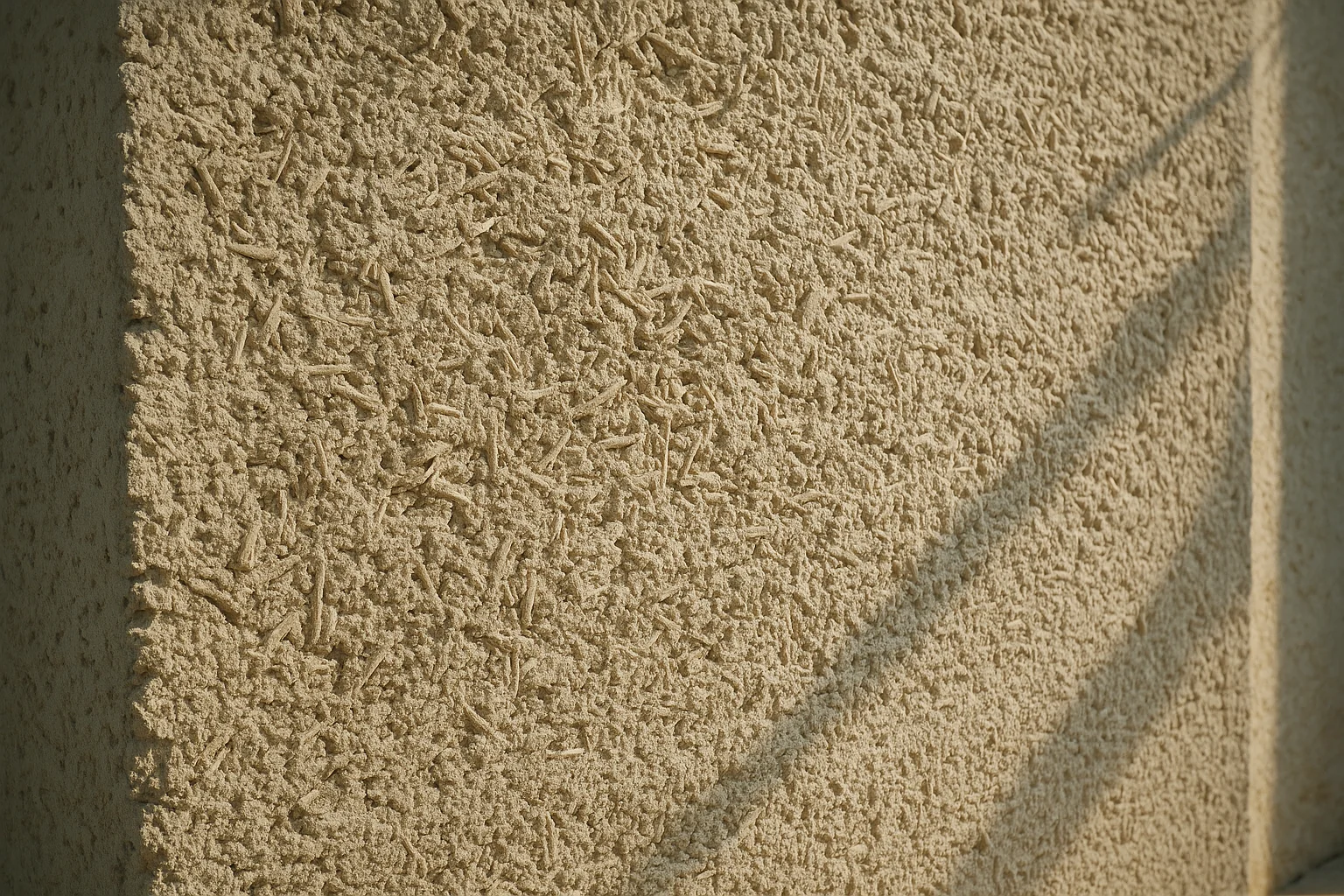
Hempcrete (also known as hemp lime, in Polish „beton konopny” or „hemp-lime”) is a building composite made of three components: hemp shives, hydraulic or hydrated lime, and water. Shives are the hard, porous core of industrial hemp stalks - a byproduct of fiber extraction that has been waste for decades. Today, it is a key raw material for this technology.
The mixture ratio varies depending on the application: for external wall insulation, a mass ratio of 2:1 (shives:lime) is typically used, while for ceiling or floor fills - ratios richer in lime for higher density. The mixture is poured into formwork or manually compacted around the structural framework (wooden or steel). Lime reacts with air and moisture, slowly mineralizing and binding the crushed shives into a cohesive mass.
It is important to emphasize the fundamental difference from cement concrete: hempcrete is not a structural material. With a specific weight of 200-500 kg/m³ (compared to 2400 kg/m³ of concrete), it cannot withstand the compressive loads required of foundations or columns. It is used solely as an insulating fill between load-bearing structural elements - hence the necessity for a framework.
Physical properties of hempcrete - insulation, moisture, and acoustics
Hempcrete stands out with a combination of properties that traditional building materials do not offer simultaneously. Thermal insulation is good, though not exceptional: the thermal conductivity coefficient λ is about 0.06-0.12 W/(m·K) depending on the density of the mixture and the degree of hardening. A 30 cm thick hempcrete wall achieves U ≈ 0.3-0.4 W/(m²·K) - meeting the technical conditions for buildings in Poland (Benfratello et al., Construction and Building Materials, 2013).
The thermal mass of the material is significantly more interesting. Hempcrete has a high thermal mass - around 1300-1600 J/(kg·K) - which means that walls heat up slowly during the day and release heat slowly at night. This is the building's „thermal phase” - the ability to balance daily temperature fluctuations without using air conditioning. In Poland's continental climate, where temperature differences between day and night in summer can reach 15-20°C, the thermal mass of the walls has a real impact on thermal comfort.
Moisture regulation is another unique property. Lime and shives together create a vapor-permeable and hygroscopic material - absorbing moisture from the indoor air and releasing it outside (reversible sorption). The effect: the building „breathes”, maintaining relative humidity indoors in the range of 45-65% without mechanical humidifying ventilation. This environment is naturally unfriendly to mold and dust mites.
Hempcrete also exhibits surprisingly good acoustic properties. The sound absorption coefficient (α) is 0.5-0.8 in the medium frequency range of 500-2000 Hz - significantly above concrete (α ≈ 0.02) and comparable to acoustic mineral wool. This property is due to the open cellular porosity of the hemp shives, which absorb and disperse sound waves instead of reflecting them. For residential buildings, this means a reduction in noise transmitted through walls without additional layers of acoustic insulation (Benfratello et al., Construction and Building Materials, 2013).
| Property | Hempcrete (30 cm) | Block B600 (24 cm) | Mineral wool (15 cm) |
|---|---|---|---|
| λ [W/(m·K)] | 0,07-0,10 | 0,09-0,12 | 0,035-0,045 |
| U [W/(m²·K)] | 0,30-0,40 | 0,35-0,50 | 0,25-0,35 |
| Thermal mass | High | High | Niska |
| Vapor permeability | High (breathable) | Medium | High |
| Carbon balance | Negative (absorbs CO2) | Positive (emits CO2) | Close to zero |
| Load-bearing capacity | None (not load-bearing) | Yes (load-bearing wall) | None |
Hempcrete and carbon footprint - carbon negative building
One of the strongest arguments for hempcrete is its carbon footprint. Industrial hemp belongs to plants with exceptionally fast growth and high photosynthesis rates - within 90-120 days from sowing, it reaches a height of 2-4 meters. During this time, it absorbs significant amounts of CO2: according to estimates from scientific literature, 1 hectare of industrial hemp absorbs 8-15 tons of CO2 during the growing season (EIHA, Hemp - a Real Green Deal).
When this CO2 enters the building wall in the form of carbon-rich shives, it becomes „locked in” for decades or centuries. At the same time, the lime in hempcrete undergoes slow carbonation (recarbonization) - absorbing CO2 from the air throughout the building's life, reversing part of the CO2 emissions released during lime production in the kiln. The net balance: 1 m³ of hempcrete absorbs 35-110 kg of CO2 over the life cycle of the building (Ip and Miller, 2012).
It is interesting to compare this number with specific alternative materials: the production of 1 m³ of cement concrete emits 200-300 kg of CO2. The difference between these two numbers is 235-410 kg of CO2 per cubic meter of wall - a difference that, on the scale of a single-family house with 200 m² of external walls, translates to several tons of CO2. This is the annual emission of one gasoline car. In the context of EU directives on low-emission construction (EPBD from 2024), this difference becomes an economic argument, not just an ecological one.
Hempcrete w Polsce - regulacje i praktyka budowlana
Hempcrete in Poland is legal without any restrictions arising from drug law - it is used exclusively from certified industrial hemp (Cannabis sativa L.) with a THC content below 0.2%. The seeds and straw of these plants are a commercial agricultural product, not a controlled substance.
The barrier is not the law, but the lack of technical standards. In Poland, there is no Polish standard (PN) or harmonized European standard (EN) for hempcrete. This means that any application of this material in a building is subject to the requirements of Article 10 of the Construction Law (Journal of Laws 2023, item 682) concerning building materials not covered by the CE system. A construction project using hempcrete must include individual technical documentation confirming the material parameters and thermal calculations.
In France - a pioneer of hempcrete in Europe - the technology has been in use since the 1990s. This country has its own technical document (DTU 57.1, version 2012) regulating the use of hemp-lime materials. The United Kingdom has a detailed NHBC (National House Building Council) guide with guidelines for builders. Poland is a few years behind the European leaders in this field, but interest is growing - particularly among passive investors and eco-developers.
The first Polish residential buildings made of hempcrete began to emerge around 2018-2020, most often in the context of passive or ecological construction. Organizations such as the Sustainable Architecture Association promote this technology and connect investors with the few contractors experienced in this material. The prices for ready-made hempcrete mix in Poland range from 800 to 1500 PLN per m³ depending on the supplier and the composition of the mix - significantly more than a block of cellular concrete, but this cost is partially offset by savings on separate thermal and acoustic insulation.
Frequently Asked Questions
What is hempcrete and what is it made of?
Hempcrete is a building composite made up of three components: hemp shives (the hard core of the hemp stalk), lime (the binder), and water. Lime reacts with the shives and air, creating a mineral matrix that binds. Unlike cement concrete, hempcrete has a low specific weight (200-500 kg/m³) and is not a load-bearing material - it is used as insulation infill within wooden or steel structures (Benfratello et al., Construction and Building Materials, 2013).
What are the insulating properties of hempcrete?
Hempcrete has a thermal conductivity coefficient λ ≈ 0.06-0.12 W/(m·K). A 30 cm thick hempcrete wall achieves U ≈ 0.3-0.4 W/(m²·K). A key advantage is its high thermal capacity (about 1300-1600 J/kg·K) - walls heat up slowly and release heat slowly, smoothing out daily temperature fluctuations. The material is also vapor-permeable - it regulates indoor air humidity without mechanical systems.
Is hempcrete eco-friendly - how much CO2 does it absorb?
Hempcrete is one of the few building materials with a negative carbon balance. 1 m³ of hempcrete can absorb a net of 35-110 kg of CO2 throughout the building's life cycle (Ip and Miller, Journal of Biobased Materials and Bioenergy, 2012). Hemp absorbs CO2 during growth, and lime recarbonizes throughout the building's life - absorbing CO2 from the air.
Can hempcrete be used in Poland?
Hempcrete is legal in Poland. It is made from industrial hemp (Cannabis sativa L.) with a THC content below 0.2% - it is not a controlled substance. As a non-standard material, it requires individual technical documentation in the construction project, according to Article 10 of the Construction Law. The lack of a Polish standard PN does not exclude its use but requires additional design formalities.
What are the disadvantages of hempcrete?
Hempcrete has several significant limitations: it is not a load-bearing material (requires a structural frame), the curing time is long (weeks to months), the lack of uniform European standards complicates design, and production efficiency is low - most objects are made manually by small companies. The price is higher than traditional materials due to labor costs and the availability of shives.
How long does it take to build a wall with hempcrete?
Incorporating hempcrete into formwork takes an experienced team 1-2 working days per floor. The curing of lime - which gives the material initial strength - lasts 4-8 weeks. Full carbonization (CO2 absorption and hardening) occurs over months or even years. In practice, this means that building walls with hempcrete takes 1.5-2 times longer than traditional masonry. This time must be factored into the construction schedule, especially for a year-round home with a short building season.
This article is for informational and educational purposes and does not replace consultation with a doctor. If you are pregnant, breastfeeding, taking medications, or have chronic conditions, consult the use of supplements or herbs with a specialist.
Author: Michał Waluk · Published: 2026-05-04 · Updated: 2026-05-04