
NAC (N-acetylcysteine): what it is, when to take it and what not to combine it with
NAC is a precursor to glutathione and an antidote for paracetamol poisoning. We check what studies have shown about the respiratory tract, PCOS, and the combination with nitrates.
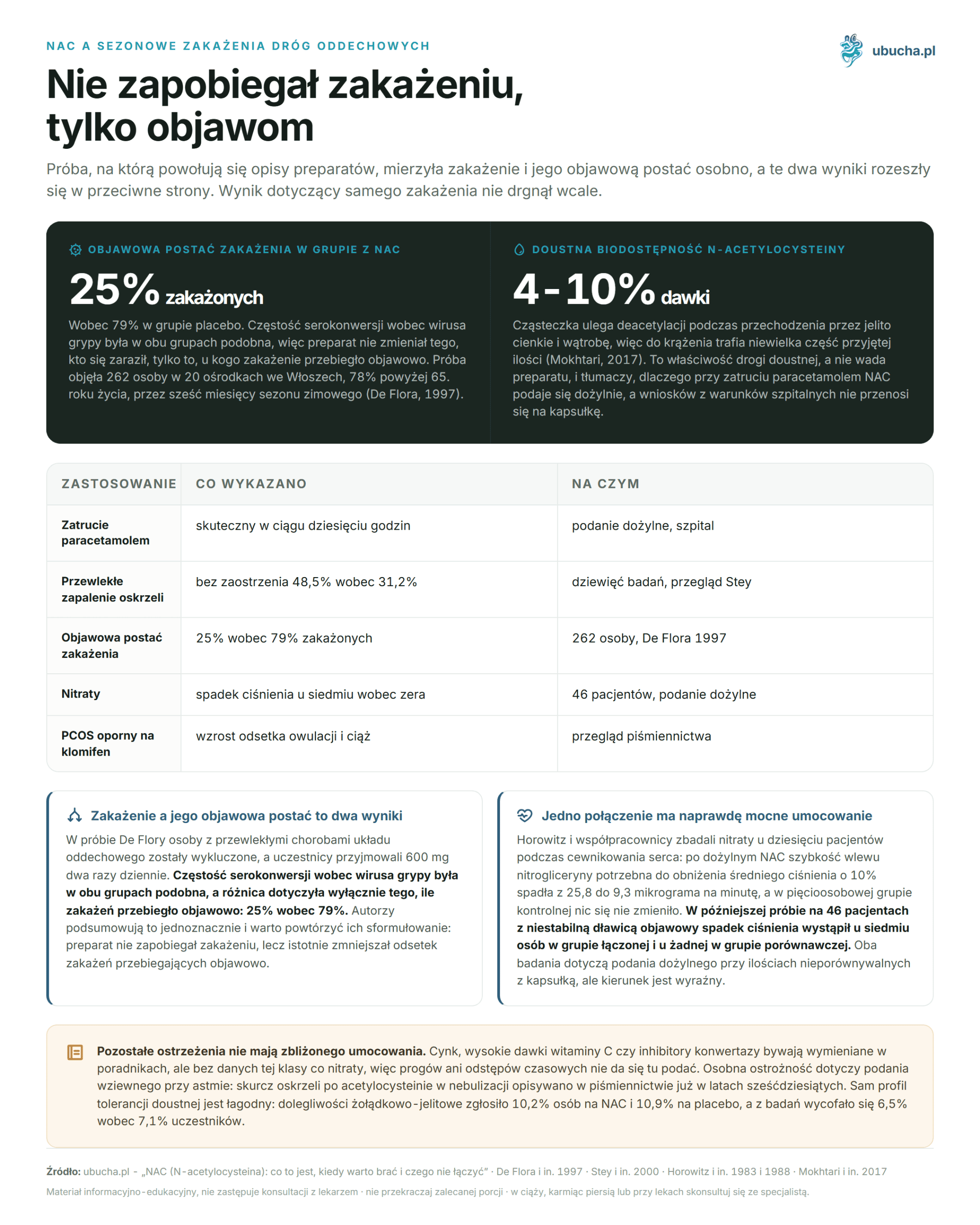
From N-acetylcysteine tablets, 4 to 10 percent of the substance reaches the bloodstream. The rest is broken down in the small intestine and liver. This figure, provided in the review by Mokhtari from 2017, rarely appears in supplement descriptions and explains more than most label claims. NAC is simultaneously a hospital drug used in paracetamol poisoning, a mucolytic drug used for decades, and a popular supplement, each of which has a different level of documentation. Below, we separate them: what specific studies have shown about the respiratory tract, liver, and polycystic ovary syndrome, where the evidence is strong, where it is not, and which combination with the drug has truly documented consequences.
KEY INFORMATION
• The bioavailability of oral N-acetylcysteine drops to 4-10% because the molecule is deacetylated in the small intestine and liver (Mokhtari, Cell Journal, 2017).
• In nine studies included in the review by Stey (European Respiratory Journal, 2000), 48.5% of those taking NAC avoided exacerbations compared to 31.2% on placebo.
• A documented consequence exists for the combination with nitrates: in a trial involving 46 individuals, symptomatic drops in blood pressure occurred in 7 patients in the NAC group and in none without it.
What is NAC and how does it work?
N-acetylcysteine is an acetylated derivative of L-cysteine, a sulfur-containing amino acid. In the body, it serves as a building block for glutathione, a tripeptide that cells use to neutralize reactive oxygen species and to detoxify toxic metabolites. The availability of cysteine limits the rate of this synthesis, so providing it externally translates into higher glutathione production.
The review by Mokhtari and colleagues (Cell Journal, 2017) describes three mechanisms at once. NAC stimulates glutathione biosynthesis, supports detoxification processes, and acts directly as a free radical scavenger, with a particular affinity for oxygen radicals. This same work notes that N-acetylcysteine does not occur in natural sources, although its parent amino acid, cysteine, is present in poultry, garlic, yogurt, and eggs.
So why supplement NAC instead of glutathione directly? Because glutathione taken orally is broken down in the digestive tract before it can be absorbed, and replenishing the cellular pool this way is unreliable. NAC is a workaround: it provides the missing substrate and leaves the synthesis to the cell. More about glutathione itself and its forms is discussed in our post glutathione: the strongest antioxidant.
How much NAC from a tablet really gets into the blood?
From 4 to 10 percent. This value is provided by the review by Mokhtari and indicates its cause: during passage through the small intestine and liver, the molecule undergoes deacetylation, so only a small part of the administered dose reaches circulation. This is not a flaw of the preparation or a matter of raw material quality, but a property of the oral route itself.
This number organizes the entire topic. It explains why NAC is administered intravenously in cases of paracetamol poisoning and not in tablets: in an emergency, there is no room for losing ninety percent of the dose. It also explains why conclusions from studies on intravenous administration do not automatically transfer to a shelf capsule.
It is worth keeping this asymmetry in mind when reading guides. A significant portion of impressive reports about NAC comes from hospital conditions and parenteral administration. Transferring them to supplementation is a leap that the data do not justify, although it is routinely made in online compilations.
This does not mean that oral NAC is useless. Studies on the respiratory tract, which we describe below, were indeed conducted on oral preparations and yielded statistically significant results. It does mean, however, that the size of the effect should be assessed based on these very trials, not on descriptions of mechanisms.
Why is NAC administered in paracetamol poisoning?
Because without glutathione, the liver has no means to detoxify the metabolite that arises from paracetamol. The review by Mokhtari describes this pathway directly: N-acetyl-p-benzoquinone imine is a strongly oxidizing metabolite of paracetamol and leads to liver damage if not reduced by glutathione.
At therapeutic doses, this mechanism works quietly and unnoticed. In cases of overdose, glutathione reserves deplete faster than the liver can rebuild them, the metabolite begins to accumulate, and it destroys hepatocytes. NAC interrupts this sequence in three ways at once: it replenishes glutathione, reduces the toxic metabolite directly, and acts hepatoprotectively through its antioxidant properties.
Timing is everything. Mokhtari states that when administered within ten hours of an overdose, NAC is commonly effective in preventing liver damage. This is a statement about an emergency procedure conducted by a medical team, not about a supplement from a pharmacy, and it should be read as such.
This same work notes that paracetamol poisoning is the most common drug overdose in pregnancy and that NAC is used in this indication at every stage. The popular conclusion that since NAC saves the liver in poisoning, it will prophylactically protect it from alcohol or drugs goes beyond what has been shown. Other plants and substances studied in this context are compared in our post natural liver support: milk thistle, artichoke, and NAC.
Does NAC work on the respiratory tract and infections?
Yes, and this is the best-documented use of oral NAC. It acts as a mucolytic: it breaks disulfide bonds between the chains of glycoproteins in mucus, making the mucus thinner and easier to cough up. The mechanism is direct and does not go through glutathione. For this reason, as noted in the work by De Flora, N-acetylcysteine has been clinically used as a mucolytic drug for over thirty years at the time of its publication.
| Study | Who was included | Result |
|---|---|---|
| Stey 2000, systematic review | 11 studies and 2011 analyzed patients with chronic bronchitis | In nine of these studies, 48.5% on NAC avoided exacerbations compared to 31.2% on placebo; NNT 5.8 |
| De Flora 1997, double-blind trial | 262 people, 78% over 65 years old, 20 centers in Italy | Symptomatic infection in 25% of those infected on NAC compared to 79% on placebo |
Two caveats change the way to read this table. The review by Stey concerns chronic bronchitis, not chronic obstructive pulmonary disease, and includes works published between 1976 and 1994. The authors also note that they found no evidence of the impact of treatment duration or total dose on effectiveness, so specific regimens repeated in guides do not stem from this work.
In the trial by De Flora, participants took 600 mg twice daily for six months, and individuals with chronic respiratory diseases were excluded. The seroconversion rate against the flu virus was similar in both groups, which the authors summarize unequivocally: NAC did not prevent infection but significantly reduced the rate of symptomatic infections. We describe this trial more broadly in our post NAC for the flu and respiratory infections.
What should not be combined with NAC?
One combination has really strong backing: nitrates. Horowitz and colleagues (Circulation, 1983) studied this in ten patients during cardiac catheterization. After intravenous administration of NAC at a dose of 100 mg per kilogram of body weight, the rate of nitroglycerin infusion needed to lower mean arterial pressure by 10% dropped from 25.8 to 9.3 micrograms per minute. In a five-person control group without NAC, nothing changed.
The practical consequence is visible in the second work of this team. In a double-blind study (Circulation, 1988), 46 patients with severe unstable angina received nitroglycerin alone or together with NAC. The combined group had fewer heart attacks, three cases versus ten, but symptomatic drops in blood pressure occurred in seven individuals compared to zero in the control group.
Keep proportions in mind. Both studies concern intravenous administration in hospital conditions, with doses incomparable to a supplement capsule. They do not prove that oral NAC will cause a drop in blood pressure for you, but they show the direction of the effect clearly enough that when treating with nitrates, the decision about supplementation is best left to a cardiologist.
Separate caution applies to asthma with inhalation. Bronchospasm after acetylcysteine in nebulization has been described in the literature since the 1960s and 1970s, and this is why this route of administration requires supervision in asthmatics. Other combinations mentioned in guides, such as zinc, high doses of vitamin C, or ACE inhibitors, do not have backing even close to that of nitrates, so we do not provide thresholds or time intervals here.
What does NAC have to do with polycystic ovary syndrome?
More than its mucolytic reputation suggests, and it is this part of the literature that stands behind the review by Mokhtari. Polycystic ovary syndrome affects 5-10% of women of reproductive age and is the most common cause of infertility related to anovulation. NAC has insulin-sensitizing properties and for this reason has been studied as an adjunct therapy.
The starting point was a specific clinical problem. Clomiphene citrate, used for inducing ovulation, does not work in up to 40% of patients with this syndrome. Mokhtari describes that NAC has been successfully used as an adjunct therapy specifically in this group, and studies on the combination of both substances showed a significant increase in the rate of ovulation and pregnancies.
The authors point to two interactions that may contribute to this. The first is mucolytic and does not concern the lungs at all: clomiphene worsens the quality of cervical mucus, creating an environment unfriendly to fertilization, and NAC reverses this effect. The second is the improvement of insulin sensitivity, which in patients with hyperinsulinemia translated into better carbohydrate metabolism parameters.
These are findings from a literature review, not from a single large trial, and concern procedures conducted by a gynecologist. They are not a basis for self-supplementation when trying to conceive.
How much NAC was used in studies?
We will not provide a portion to measure, as NAC is in some discussed applications a drug, not a dietary supplement, and the amount taken should be determined by a doctor. However, it makes sense to show the amounts used in the trials described above, as this allows for assessing what their results refer to.
In the trial by De Flora, 262 participants were randomly assigned to tablets of 600 mg twice a day or to placebo, for six months during the winter season. In the review by Stey, the total dose varied among the eleven included studies, and treatment lasted from 12 to 24 weeks; the authors found no evidence that any of these variables affected effectiveness. This is an unusual result and worth noting, as it undermines the sense of precisely tailoring a regimen in this indication.
It is also worth comparing this with the tolerance profile from the review by Stey. Gastrointestinal complaints were reported by 10.2% of those taking NAC and 10.9% of those on placebo, and due to adverse effects, 6.5% and 7.1% of participants withdrew from the studies, respectively. The differences are therefore at the level of noise.
Nausea remains the most common practical complaint, and taking the preparation with food can be a sufficient solution. Individuals on regular medications, pregnant and breastfeeding women, and those with asthma should have the decision to start supplementation confirmed by a doctor. Another antioxidant with a similar reputation is discussed in our post alpha-lipoic acid ALA.
Frequently Asked Questions
What is NAC (N-acetylcysteine)?
It is an acetylated derivative of the amino acid L-cysteine, providing cells with a substrate for glutathione synthesis. It does not occur in natural sources, although cysteine is present in poultry, garlic, yogurt, and eggs. In medicine, it is used as a mucolytic and as an antidote for paracetamol poisoning.
How much NAC from a tablet is absorbed?
From 4 to 10 percent, because the molecule undergoes deacetylation while passing through the small intestine and liver. This is stated in the review by Mokhtari from 2017 in Cell Journal. Therefore, in cases of paracetamol poisoning, NAC is administered intravenously, and conclusions from hospital studies cannot be directly transferred to a capsule.
Does NAC work on the respiratory tract?
Yes, as a mucolytic that breaks disulfide bonds in the glycoproteins of mucus. In nine studies included in the review by Stey from 2000, concerning chronic bronchitis, 48.5% of those taking NAC avoided exacerbations compared to 31.2% on placebo. The authors did not show any impact of treatment duration or total dose on effectiveness.
Does NAC protect against the flu?
Not against infection, but against its symptomatic form. In the study by De Flora from 1997, the seroconversion rate was similar in both groups, but symptoms developed in 25% of infected individuals taking NAC compared to 79% in the placebo group. Participants took 600 mg twice daily for six months.
What should not be combined with NAC?
Nitrates. In a trial from 1988 involving 46 patients with unstable angina, symptomatic drops in blood pressure occurred in seven individuals receiving NAC with nitroglycerin and in none in the control group. Both studies involved intravenous administration, but when treating with nitrates, supplementation should be discussed with a cardiologist.
Does NAC help with polycystic ovary syndrome?
The review by Mokhtari describes NAC as an adjunct therapy for patients resistant to clomiphene citrate, thus in up to 40% of patients. Studies on the combination of both substances showed an increase in the rate of ovulation and pregnancies. This is a procedure conducted by a gynecologist, not a basis for self-supplementation.
Is NAC safe?
In the review by Stey, gastrointestinal complaints were reported by 10.2% of those on NAC and 10.9% on placebo, and the withdrawal rate due to adverse effects was 6.5% versus 7.1%. In asthma, inhalation requires caution. Pregnant and breastfeeding women and those on regular medications should consult a doctor.
This article is for informational and educational purposes and does not constitute medical advice. Before starting supplementation, consult a doctor, especially if you are on regular medications, pregnant, breastfeeding, or have chronic illnesses.
Author: Michał Waluk · Published: 2026-06-22 · Updated: 2026-08-16