
Gummy Vitamins (Melatonin, B12, C, D3): What Are the Differences and What to Choose
What are the differences between gummies with melatonin, B12, vitamin C, and D3? Content versus label, absorption, sugar, acidity, and risks for children in studies.
In an analysis published in JAMA, 25 brands of melatonin gummies were tested. The hormone content was within 10 percent of the label claim in only three products, while in the others it ranged from 74 to 347 percent of what the label promised. This clearly illustrates the problem with the entire gummy shelf: the form is convenient and tasty, but there can be a gap between the promise on the package and the actual content. Melatonin, vitamin B12, vitamin C, and vitamin D3 differ in everything that matters: their role in the body, whether they can be overdosed, and how they withstand a few months in a jar. We gathered what can be verified in studies and what is worth checking on the label before you buy a package.
KEY INFORMATION
• 22 out of 25 melatonin gummies had content inconsistent with the label, ranging from 74 to 347 percent (Cohen et al., JAMA, 2023).
• Vitamin C from gummies and tablets is absorbed the same (Evans et al., 2020).
• Gummies with vitamin D3 performed better than tablets (Wagner et al., 2019).
• Melatonin leads in pediatric reports to poison control centers in the USA.
What Are the Differences Between Melatonin, B12, Vitamin C, and D3 Gummies?
They differ in what they actually do in the body. Melatonin is a hormone signaling sleep time. B12 is a vitamin found almost exclusively in animal products. Vitamin C is water-soluble, and its excess is excreted in urine. D3 is a prohormone that the body stores.
This difference translates into risk. With vitamin C and B12, the body has a simple emergency mechanism in the form of the kidneys, so excess rarely causes harm. With D3, storage means that errors accumulate over weeks, and symptoms appear late. Melatonin is neither of these: it is a time signal whose effect depends not only on the dose but also on the timing of administration.
| Ingredient | What It Is | Reference Point from Studies and Guidelines | What to Check on the Label |
|---|---|---|---|
| Melatonin | hormone, not a vitamin | falling asleep was noted with 0.3 and 1 mg (Zhdanova et al., 1995) | mg per piece and whether the manufacturer publishes batch testing |
| Vitamin B12 | vitamin from animal products | EFSA states adequate intake of 4 mcg per day for adults | form of cobalamin and mcg per piece |
| Vitamin C | water-soluble, excess excreted | EFSA: 110 mg for men, 95 mg for women | mg per piece and number of pieces in a serving |
| Vitamin D3 | prohormone stored in the body | guidelines for Poland from 2023 consider a concentration of 30-50 ng/ml 25(OH)D optimal (Płudowski et al., Nutrients) | IU per piece and whether there is a second source of D3 at home |
Is there as much ingredient in a gummy as the label claims?
Often not. Pieter Cohen and his team purchased 25 brands of melatonin gummies available in the USA and measured the content. Only 3 products showed compliance within 10 percent of the label claim. In the others, the content ranged from 74 to 347 percent of the label, and one product contained no detectable melatonin but 31.3 mg of cannabidiol (Cohen et al., JAMA, 2023).
Why such a discrepancy? A gummy is not a compressed tablet made from powder. It is a gel mass that needs to be heated, mixed, poured into molds, and dried. The ingredient may degrade during production or may be unevenly distributed among pieces from the same batch. Manufacturers compensate for this with an excess at the start, which, with good mixing, gives a result close to the declaration, and with poor mixing, three times the amount.
The practical conclusion is simple: the declaration on the front of the package is a marketing promise, not a measurement. The value only comes from a certificate of analysis for a specific batch.
Is absorption from gummies less than from tablets?
There is no evidence for this, and for the two vitamins studied, it is actually the opposite. Thirty healthy individuals took 1000 mg of vitamin C in a crossover design, once in a commercial gummy and once in a comparative tablet. The area under the plasma concentration curve over 24 hours did not differ, nor did urinary excretion, and the authors considered both products bioequivalent (Evans et al., 2020). The tablet produced a significantly higher peak concentration, but the difference was numerically small. The study was conducted in a blinded manner and on one specific commercial product, so it speaks to that formulation, not to gummies as a category.
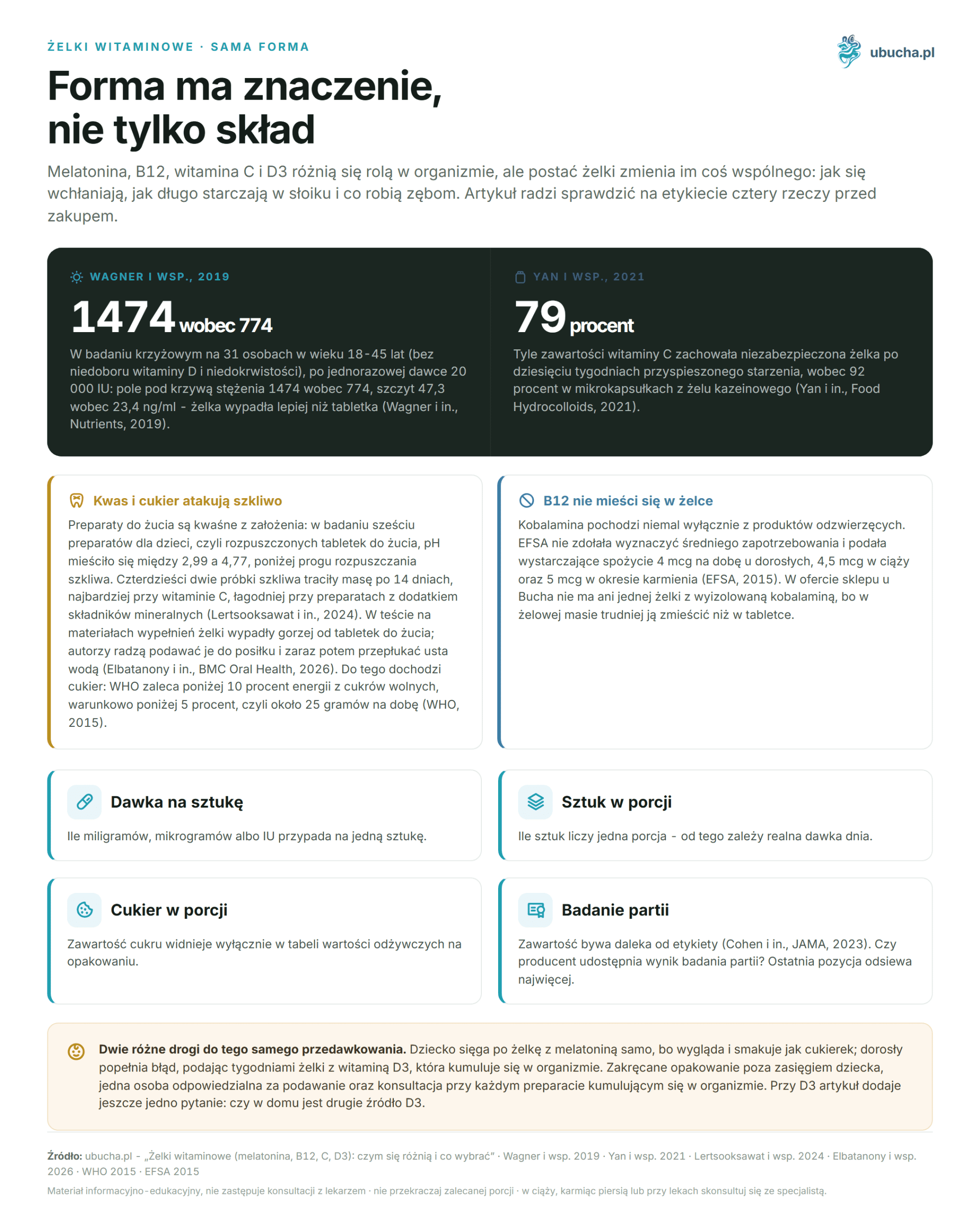
For vitamin D3, the result was even more surprising. In a crossover study of 31 individuals aged 18-45 years, without vitamin D deficiency and without anemia, after a single dose of 20,000 IU, the area under the curve was 1474 compared to 774 for the tablet, and the peak concentration was 47.3 compared to 23.4 ng/ml (Wagner et al., Nutrients, 2019). An earlier pilot trial on nine individuals showed the same direction. This reverses the popular belief that a gummy without a fat carrier loses to an oil capsule.
We noticed while organizing this topic that the argument about worse absorption of gummies is repeated in Polish internet without any reference, while the two available bioequivalence studies say the opposite. The real problem with gummies is not absorption, but how much of the ingredient is actually in them and what else needs to be eaten along with them.
Who benefits from B12 gummies?
People who do not eat animal products and those whose absorption of this vitamin is impaired. Cobalamin is produced in nature solely by microorganisms and reaches the human diet almost exclusively from animal products. A plant-based diet without supplementation leads to a deficiency that develops slowly and may be recognized late.
EFSA was unable to set an average requirement due to limited data and provided an adequate intake level of 4 mcg per day for adults, 4.5 mcg during pregnancy, and 5 mcg during breastfeeding (EFSA, 2015). Average intake in several EU countries ranges from 4.2 to 8.6 mcg per day, so a person eating animal products usually does not have a problem here. It looks different on an exclusion diet.
B12 itself is less commonly found in gummies than marketing would suggest. While browsing the store’s assortment at Bucha, we found not a single gummy with isolated cobalamin: it appears in complexes with B vitamins in tablets and liquid preparations. This is typical for the entire market, as the amounts found in supplements are easier to fit into a tablet than into a gel mass. Symptoms of deficiency can also be misleading, so we outlined them separately in the post B12 Deficiency and Energy.
How much vitamin C do the guidelines predict and can it be overdosed?
EFSA states a reference intake of 110 mg per day for adult men and 95 mg for women, with an average requirement of 90 and 80 mg respectively (EFSA, 2013). The dietary guidelines for the Polish population from 2020 are slightly lower: 90 mg for men and 75 mg for women (NIZP-PZH).
No upper tolerable intake level for vitamin C has been established, as the data were deemed insufficient. The evaluating panel simultaneously concluded that about 1000 mg per day above the usual diet is not associated with undesirable gastrointestinal symptoms, while acute symptoms were reported at 3 to 4 grams per day (EFSA, 2004). Absorption saturates at high doses, so above a gram per day, the risk increases mainly, not the vitamin content in tissues.
Regarding the common cold, a Cochrane review gathered 29 comparisons and 11,306 participants for the risk of illness and 31 comparisons and 9745 episodes for duration. Regular supplementation did not reduce the incidence of illness in the general population, but it shortened the duration of the cold by 8 percent in adults and 14 percent in children. One subgroup performed differently: among marathon runners, skiers, and soldiers exercising in subarctic conditions, the risk of illness was halved. Vitamin C given only after symptoms appeared did not yield a consistent effect (Hemilä and Chalker, Cochrane, 2013). We outlined the topic separately in the post Vitamin C in Gummies.
What amount of melatonin corresponds to physiology?
Significantly less than suggested by the store shelf. In a polysomnographic study from 1995, oral doses of 0.3 and 1.0 mg given in the evening shortened the time to fall asleep and the time to the second stage of sleep, without suppressing REM sleep and without leaving morning grogginess (Zhdanova et al., 1995). The same researchers previously demonstrated that similarly small amounts raise melatonin levels in the blood to values naturally occurring at night.
The scale of the effect is moderate. A meta-analysis of 19 studies involving 1683 people showed a shortening of sleep onset time by an average of 7.06 minutes and an increase in sleep duration by 8.25 minutes compared to placebo, with improvement in subjective sleep quality (Ferracioli-Oda et al., PLoS ONE, 2013). This is a real but small result, much weaker than sleeping pills.
However, this same meta-analysis brings a result that contradicts the simple conclusion “less means better”: studies with higher doses and longer duration of administration yielded greater effects on sleep onset and sleep length. For subjective sleep quality, neither dose nor duration of the study had an impact. Physiological 0.3 mg is therefore not automatically a more effective version, just the version closest to what the body secretes itself.
Meanwhile, the melatonin gummies in Cohen’s study contained amounts that, according to the authors, could expose a child to 40 to 130 times more melatonin than 0.1 to 0.3 mg, which are the doses sufficient to raise blood levels to the nighttime range in young adults. The discrepancy between physiology and the content of the package is the largest among all four discussed ingredients. We gathered more numbers in the post Gummies with Melatonin and Sleep.
What do sugar and acidity of gummies do to teeth?
More than the “supplement” category suggests. Chewable vitamin products are acidic by design, as citric and ascorbic acids provide flavor. In a laboratory study of six such products for children, i.e., dissolved chewable tablets, the pH ranged from 2.99 to 4.77, which is below the threshold at which enamel begins to dissolve. Forty-two samples of human enamel lost mass after 14 days of alternating immersions in the product and artificial saliva, most notably in groups with vitamin C, and electron microscopy showed damaged surfaces. Products containing mineral ingredients performed more gently (Lertsooksawat et al., 2024).
The form matters here. In a test simulating six months of daily contact, gummies and chewable tablets were immersed in artificial saliva along with samples of materials used for fillings. Both products reduced surface hardness and increased roughness, but gummies performed worse than tablets in most tested combinations of material plus product (Elbatanony et al., BMC Oral Health, 2026). The authors recommend administering such supplements with meals and rinsing the mouth with water immediately afterward.
Additionally, there is sugar. WHO recommends limiting free sugars to below 10 percent of energy, and conditionally below 5 percent, which is about 25 grams per day for adults (WHO, 2015). How much of this limit one piece contains is stated solely in the nutritional value table on the package, as the mass of the gummy and the sugar content vary between products. Check it before you add several pieces daily from different jars, consumed in a sticky and sour form, which is the worst for teeth.
Do vitamins in gummies lose potency during storage?
Yes, and vitamin C does this the fastest. It degrades under the influence of oxygen, moisture, and heat, while light and pH fluctuations accelerate this process. All these factors occur both during the production of gummies and later in an opened jar. In an accelerated aging test, unprotected vitamin C in a gummy retained 79 percent of its content after ten weeks, while the same vitamin enclosed in casein gel microcapsules retained 92 percent (Yan et al., Food Hydrocolloids, 2021).
A loss of about one-fifth in two and a half months changes the product’s profile. A gummy at the end of its shelf life may realistically provide significantly less vitamin C than the label states, regardless of whether the manufacturer hit the declaration on the day of production. This explains the industry practice of starting with an excess, which also accounts for some of the results above 100 percent in Cohen’s study.
Our observations from comparing packages: gummies most often sit in the kitchen, next to the kettle or on the windowsill, i.e., in heat and light. A tablet in a blister withstands this much better than a moist gel mass in a repeatedly opened jar. If you choose gummies, storing them in a cool and dark place has a greater impact on the result than the choice of brand.
Why do gummies require extra caution around children?
Because they look and taste like candy, and a child cannot distinguish one from the other. American poison control centers reported a total of 260,435 pediatric exposures to melatonin from 2012 to 2021, with a 530 percent increase in annual reports. In 2021, they accounted for 4.9 percent of all pediatric reports compared to 0.6 percent in 2012. Five children required mechanical ventilation, and two died (Lelak et al., MMWR, 2022). The increase was mainly driven by accidental exposures in children under 5 years old.
A separate risk is vitamin D3, as it accumulates in the body. In a case report, a twenty-month-old girl was admitted to the intensive care unit with a calcium level of 20.7 mg/dl after she had been receiving calcium and vitamin D3 gummies several times a day for many weeks, possibly months. Her mother administered them, and the authors describe this case as neglect in a family affected by severe mental illness of the parent, not as the child independently reaching for the jar. The hospitalization was long and complicated (Doyle et al., Pediatric Emergency Care, 2021).
These two descriptions lead to overdose in two different ways: through accidental reaching for the package and through an adult’s error in administration. The practical conclusion therefore encompasses both. A screw-top container out of reach of the child, one person responsible for administration, and consultation for every accumulating preparation in the body. We write more about this in the text Supplements for Children.
When do gummies make sense, and when is it better to reach for a tablet?
Gummies win when the problem is regularity, not dosage. If tablets end up untouched in a drawer, the form you actually reach for is worth more than the ideal composition on paper. Additionally, there are difficulties with swallowing capsules and situations while traveling where a gummy does not require water.
A tablet or capsule performs better in diabetes and calorie counting, with a tendency to cavities, and when you need a high content without eating several pieces. The price per milligram of the ingredient also matters, usually several times lower outside of the gel form.
Before you buy a package, check four things on the label:
- how many milligrams, micrograms, or IU are in one piece,
- how many pieces are in one serving,
- what the sugar content is in a serving,
- whether the manufacturer provides the results of batch testing.
The last item filters out the most. In the store at Bucha, gummies available in the gummy section are mainly herbal and vitamin preparations, including sugar-free versions and gummies with vitamin C and D for children. Single vitamins in capsules and tablets, including D3, K2, and B complex, can be found in the supplements section.
Frequently Asked Questions
Do gummy vitamins work the same as tablets?
For vitamin C, yes. In a crossover study of 30 people, a gummy and a tablet of 1000 mg provided comparable area under the curve for plasma concentration and comparable urinary excretion, and the authors considered them bioequivalent (Evans et al., 2020). For vitamin D3, gummies performed even better than tablets (Wagner et al., 2019).
Does the ingredient content in a gummy match the label?
Not always. In an analysis of 25 brands of melatonin gummies sold in the USA, only 3 products were within 10 percent of the label claim, and the measured content ranged from 74 to 347 percent (Cohen et al., JAMA, 2023). One product contained no detectable melatonin.
How much vitamin C do dietary guidelines recommend?
EFSA states a reference intake of 110 mg per day for men and 95 mg for women. The dietary guidelines for the Polish population from 2020 recommend 90 mg and 75 mg. No upper tolerable intake level for vitamin C has been established, as the data were deemed insufficient.
Do gummies damage enamel?
Chewable vitamin products are acidic. In a laboratory study, six chewable tablets for children had a pH ranging from 2.99 to 4.77, and samples of human enamel lost mass after 14 days of immersion cycles, most notably in groups with vitamin C (Lertsooksawat et al., 2024). In a separate test on filling materials, gummies performed worse than chewable tablets.
Do vitamins in gummies lose potency during storage?
Yes, especially vitamin C. In an accelerated aging test, unprotected vitamin C in a gummy retained 79 percent of its content after ten weeks, while the same vitamin enclosed in casein gel microcapsules retained 92 percent (Yan et al., 2021). Coolness and darkness delay this process.
Why are gummies risky in a home with a small child?
They look like candy. American poison control centers reported 260,435 pediatric exposures to melatonin from 2012 to 2021, with a 530 percent increase in annual reports, mainly accidental in children under 5 years old (Lelak et al., MMWR, 2022). Two children died.
If you are looking for specific products, browse the gummy section or the supplements section in the store at Bucha.
This article is for informational and educational purposes only and does not constitute medical advice. Before starting supplementation, consult with a doctor, especially if you are taking medications regularly, are pregnant or breastfeeding, or have chronic illnesses.
Author: Michał Waluk · Published: 2026-05-22 · Updated: 2026-08-15