
Glutathione, the strongest antioxidant: dosage and forms (table)
Glutathione in capsules, liposomal or NAC? What has really been measured in humans: Witschi 1992, Richie 2015, Sinha 2018, Sekhar 2011. No empty promises.
Glutathione is often advertised as the “main antioxidant of the body,” while at the same time as a supplement that does nothing when swallowed. Both claims are supported by research and both are incomplete. A single oral dose does not raise blood levels, but daily intake for six months does. The difference arises from how quickly the intestine breaks down this molecule, and that tissue stores fill up slowly. This article organizes what has been measured in humans: which forms were studied, at what doses, for how long, and with what results. Separately, we describe what has not been studied, as most promises on labels sit precisely in this gap.
KEY INFORMATION
• A single dose of about 3 g of oral glutathione did not raise its concentration in plasma in seven volunteers (Witschi et al., Eur J Clin Pharmacol, 1992).
• Daily intake for 6 months raised glutathione stores by 30-35% in red blood cells, plasma, and lymphocytes in 54 individuals (Richie et al., Eur J Nutr, 2015).
• There is no study that compared the liposomal form with the regular one in the same individuals, so the advantage of the liposome remains a manufacturer’s claim.
• In older individuals, glutathione levels in red blood cells were nearly half lower than in younger ones, and two weeks of cysteine and glycine supplementation restored them (Sekhar et al., Am J Clin Nutr, 2011).
What is glutathione and what does it do in the cell?
Glutathione is a tripeptide composed of glycine, cysteine, and glutamic acid, present in every cell of the body. It works thanks to the central amino acid: cysteine carries a free thiol group that donates an electron to reactive oxygen species, thereby neutralizing them. The molecule oxidizes to the form GSSG, and glutathione reductase restores it to its active form. This cycle is the fundamental mechanism of antioxidant defense within the cell.
The second function is detoxification. Glutathione transferases conjugate glutathione with electrophilic drug metabolites and toxins, creating water-soluble compounds that the kidneys or bile can eliminate. The third concerns immunity: lymphocytes require high intracellular glutathione levels to divide and mature.
In the brain, disturbances in glutathione metabolism accompany neuronal loss in aging and in Parkinson’s and Alzheimer’s diseases. Authors of a review in Molecules also note that the exact mechanisms by which glutathione regulates brain metabolism are still not well understood (Iskusnykh et al., Molecules, 2022). This distinction has practical significance: the relationship between low glutathione and disease is documented, but the causal direction is not.
Does glutathione in capsules absorb at all?
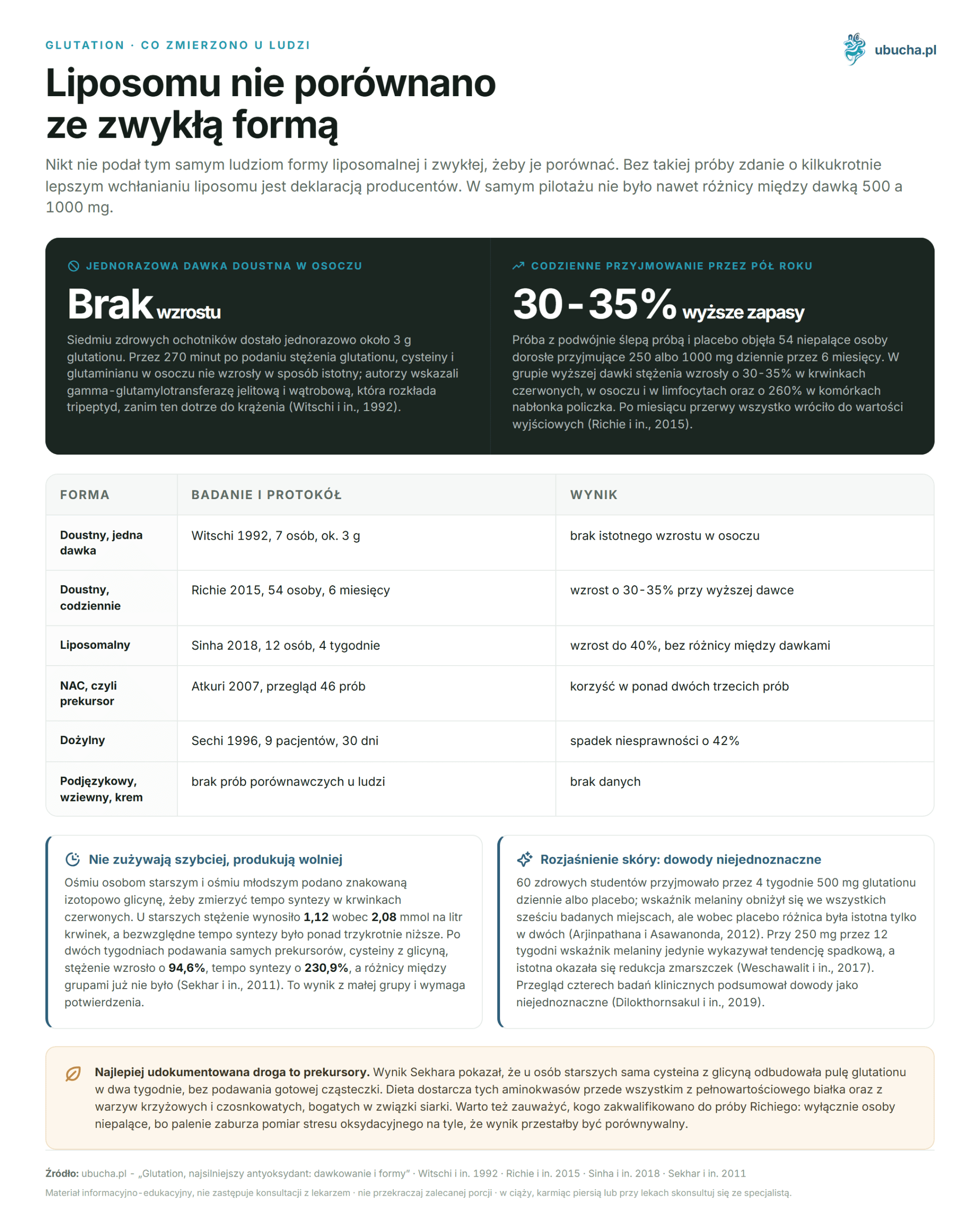
The answer depends on whether we are talking about a single dose or several months. In a study from European Journal of Clinical Pharmacology, seven healthy volunteers received a single dose of about 3 g of glutathione. For 270 minutes after administration, glutathione, cysteine, and glutamate levels in plasma did not significantly increase. The authors pointed to the culprit: gamma-glutamyltransferase in the intestine and liver, which breaks down the tripeptide before it reaches circulation (Witschi et al., 1992).
Twenty years later, the same problem was studied in a long-term perspective. A six-month double-blind placebo trial involved 54 non-smoking adults who took 250 or 1000 mg of glutathione daily. After six months, in the higher dose group, levels increased by 30-35% in red blood cells, plasma, and lymphocytes, and by 260% in buccal epithelial cells. In the lower dose group, the increase was 17% in whole blood and 29% in red blood cells. After a month break, everything returned to baseline values (Richie et al., Eur J Nutr, 2015).
These two results are not contradictory: a single dose is lost in the intestine, while regular administration gradually fills tissue stores. However, the effect disappears after discontinuation, so glutathione does not build a lasting reserve.
Which forms of glutathione have been studied in humans?
Manufacturers usually list five forms, but the number of clinical studies for each varies greatly. The table summarizes only what has been measured in humans. The doses in the protocol column describe the course of the study, not a recommendation for the reader.
| Form | Study | Protocol | Result |
|---|---|---|---|
| Oral, single dose | Witschi 1992, 7 healthy individuals | approx. 3 g once, measurement for 270 minutes | No significant increase in plasma |
| Oral, daily | Richie 2015, 54 individuals, placebo trial | 250 or 1000 mg per day for 6 months | Increase of 30-35% in red blood cells, plasma, and lymphocytes at higher dose |
| Liposomal | Sinha 2018, 12 individuals, pilot study | 500 or 1000 mg per day for 4 weeks | Increase up to 40% in whole blood after 2 weeks, no difference between doses |
| NAC, i.e. precursor | Atkuri 2007, review of 46 placebo trials | Orally, protocols varied | Benefit in over two-thirds of trials; recognized antidote for paracetamol poisoning |
| Intravenous | Sechi 1996, 9 patients, open trial | 600 mg twice daily for 30 days | Decrease in disability by 42%, effect lasted 2-4 months |
| Sublingual, inhaled, in cream | No comparative trials in humans | Not applicable | No comparative data |
The summary leads to a conclusion that you will not see on the label: no one has given the same individuals both the liposomal and regular forms to compare. Without such a trial, the statement “liposome absorbs several times better” is a marketing claim. In Sinha’s pilot study, there was not even a difference between the 500 and 1000 mg doses (Sinha et al., Eur J Clin Nutr, 2018).
Does NAC raise glutathione more effectively than glutathione itself?
N-acetylcysteine works differently: it does not provide ready-made glutathione, but cysteine, which is the amino acid usually lacking for its synthesis. A review in Current Opinion in Pharmacology describes it as a safe and well-tolerated antidote for cysteine and glutathione deficiency, used in HIV infection and chronic obstructive pulmonary disease. Of the 46 placebo trials with oral NAC, over two-thirds showed benefit, measured either by trial endpoints or overall improvement in patient well-being (Atkuri et al., 2007).
Does this mean that NAC beats glutathione? The honest answer is: it is unknown, as no one has directly compared them. NAC has significantly more clinical trials and broader medical applications, while oral glutathione is mainly based on one large six-month study. This is an argument from the number of evidence, not from a mechanistic advantage.
Both substances enter the body at different points in the pathway. Glutathione must be transported through the intestine intact, while NAC only provides the missing raw material and allows the cell to build the molecule at its own pace. In cases of impaired synthesis, the precursor may be more effective; when synthesis is functioning well, the difference may be negligible. Interactions and contraindications of NAC itself are described separately in the article on N-acetylcysteine.
Why does glutathione decrease with age?
Not because cells use it faster, but because they produce it more slowly. Researchers administered isotopically labeled glycine to eight older and eight younger individuals to measure the rate of glutathione synthesis in red blood cells. In older individuals, the concentration was 1.12 compared to 2.08 mmol per liter of blood in younger ones, and the absolute synthesis rate was more than three times lower. The concentrations of both precursors, glycine and cysteine, were also lower.
The most interesting part came afterward. After two weeks of administering only the precursors, glutathione levels in older individuals increased by 94.6%, the synthesis rate by 230.9%, and markers of oxidative stress decreased. After supplementation, there was no longer a difference between the older and younger groups (Sekhar et al., Am J Clin Nutr, 2011).
This result comes from a small group and requires confirmation, but it well explains why a strategy based on precursors makes biological sense. If the bottleneck is the raw material, providing the raw material unlocks production. We write about another antioxidant whose supply decreases with age in the article on carnosine.
What does glutathione have to do with the liver and Parkinson’s disease?
The liver uses glutathione to conjugate reactive metabolites that arise from the breakdown of drugs and alcohol. The best-documented example is paracetamol: in overdose, its toxic metabolite depletes glutathione stores in hepatocytes, and the antidote is N-acetylcysteine, which rebuilds that reserve. This application is so well established that authors of a review primarily describe NAC as a drug for paracetamol poisoning. We write more broadly about plant support for the liver in a separate article on milk thistle and artichoke.
In neurology, the situation is different. An Italian team administered glutathione intravenously to nine patients with early untreated Parkinson’s disease, 600 mg twice daily for 30 days. All significantly improved, with a 42% decrease in disability, and the effect lasted for 2-4 months after discontinuation (Sechi et al., Prog Neuropsychopharmacol Biol Psychiatry, 1996).
However, it should be added immediately what was not present in this trial. The authors conducted it in an open-label design, without a control group, and nine individuals are too few to distinguish the drug’s effect from the placebo effect. The administration was intravenous, so the result says nothing about capsules.
Does glutathione lighten the skin?
A little, but weaker and less reliably than supplement descriptions suggest. At a university hospital in Bangkok, 60 healthy medical students took 500 mg of glutathione in two daily doses or placebo for 4 weeks. The melanin index decreased in all six studied areas, but compared to placebo, the difference was significant only in two: on the right side of the face and on the sun-exposed left forearm (Arjinpathana and Asawanonda, J Dermatolog Treat, 2012).
Five years later, the same center checked a dose half as low, in three groups: 250 mg of reduced glutathione, 250 mg of the oxidized form, or placebo for 12 weeks. This time, the melanin index and the number of sun spots only showed a downward trend, and significant in some measurements was the reduction of wrinkles (Weschawalit et al., Clin Cosmet Investig Dermatol, 2017).
A systematic review that gathered these works found a total of four clinical studies and summarized them cautiously: the evidence remains ambiguous due to the quality of the studies and divergent results (Dilokthornsakul et al., J Cosmet Dermatol, 2019). The authors of the Thai trial added that long-term safety has not been established.
What else raises glutathione levels?
The best-documented way is to provide precursors, i.e. sulfur-containing amino acids. Sekhar’s result showed that in older individuals, cysteine alone with glycine rebuilt the glutathione pool in two weeks, without administering the ready molecule. The diet provides these amino acids primarily from high-quality protein and from cruciferous and allium vegetables, rich in sulfur compounds.
A network of related antioxidants works around glutathione itself. Vitamin C and vitamin E regenerate each other’s oxidized forms, selenium is part of glutathione peroxidase, and alpha-lipoic acid participates in the regeneration of both. None of them replace glutathione, and none work in isolation from the others; we write more broadly about one of them in the article on alpha-lipoic acid.
Besides diet, what burdens the system matters. It is no coincidence that Richie’s 2015 trial only included non-smoking individuals: smoking disturbs the measurement of oxidative stress to such an extent that the result would no longer be comparable. Before you pay extra for exotic forms of glutathione, check if you are not maintaining a habit that consumes it faster than the supplement can replenish.
Frequently asked questions
Does regular glutathione in capsules make sense?
It does, but not immediately. A single dose of about 3 g did not raise plasma levels in seven volunteers (Witschi 1992), but daily intake of 250 or 1000 mg for six months increased stores in red blood cells, plasma, and lymphocytes by 30-35% in 54 individuals. After a month break, values returned to baseline.
Does the liposomal form absorb better than the regular one?
This cannot be determined today. The study of liposomal glutathione involved 12 people over 4 weeks and showed an increase of up to 40% in whole blood, but did not compare it with the regular form. There is no trial in which the same individuals received both forms, so the percentage figures given for liposomes lack data support.
Is NAC a better choice than glutathione?
NAC provides cysteine, which is the amino acid limiting glutathione synthesis, and has significantly broader documentation: over two-thirds of 46 placebo trials showed benefit (Atkuri 2007). However, no one has directly compared both substances in the same individuals, so this is an argument from the number of studies, not from a mechanistic advantage.
Does glutathione help in Parkinson’s disease?
The most frequently cited trial involved nine patients, was open-label and without a control group, and glutathione was administered intravenously for 30 days. Disability decreased by 42%, and the effect lasted 2-4 months (Sechi 1996). With such a small number of participants and lack of blinding, this is a preliminary observation, not proof of efficacy.
Does glutathione lighten the skin and smooth wrinkles?
A review of four clinical studies found the evidence to be ambiguous (Dilokthornsakul 2019). At 500 mg daily for 4 weeks, the melanin index significantly decreased only in two of the six studied areas, and at 250 mg for 12 weeks, significant reduction in wrinkles was observed, not lightening.
We have gathered vitamin C and other antioxidant supplements in the supplements category; our offer does not include glutathione or NAC.
This article is for informational and educational purposes only and does not constitute medical advice. Before starting supplementation, consult your doctor, especially if you are taking medications regularly, are pregnant or breastfeeding, or have a chronic illness.
Author: Michał Waluk · Published: 2026-07-31 · Updated: 2026-08-16