
Maca properties: what studies show about libido, menopause, and energy
Maca does not change testosterone, estradiol, LH, or FSH levels. We check what trials in humans say about libido, menopause, energy, and safety.
Maca (Lepidium meyenii) grows on the Junín plateau in the Peruvian Andes, at an altitude of 4000-4500 m above sea level. It is sold as a root that regulates hormonal balance. Research says something different and, in our opinion, more interesting: in human trials measuring testosterone, estradiol, LH, and FSH, maca did not change any of these parameters. Yet some participants reported increased sexual desire and better mood. This article separates two things that marketing combines into one: what maca does in the body and what is merely attributed to it. We will go through specific trials with participant numbers, doses, and duration, what has not yet been checked, and unanswered safety questions.
KEY INFORMATION
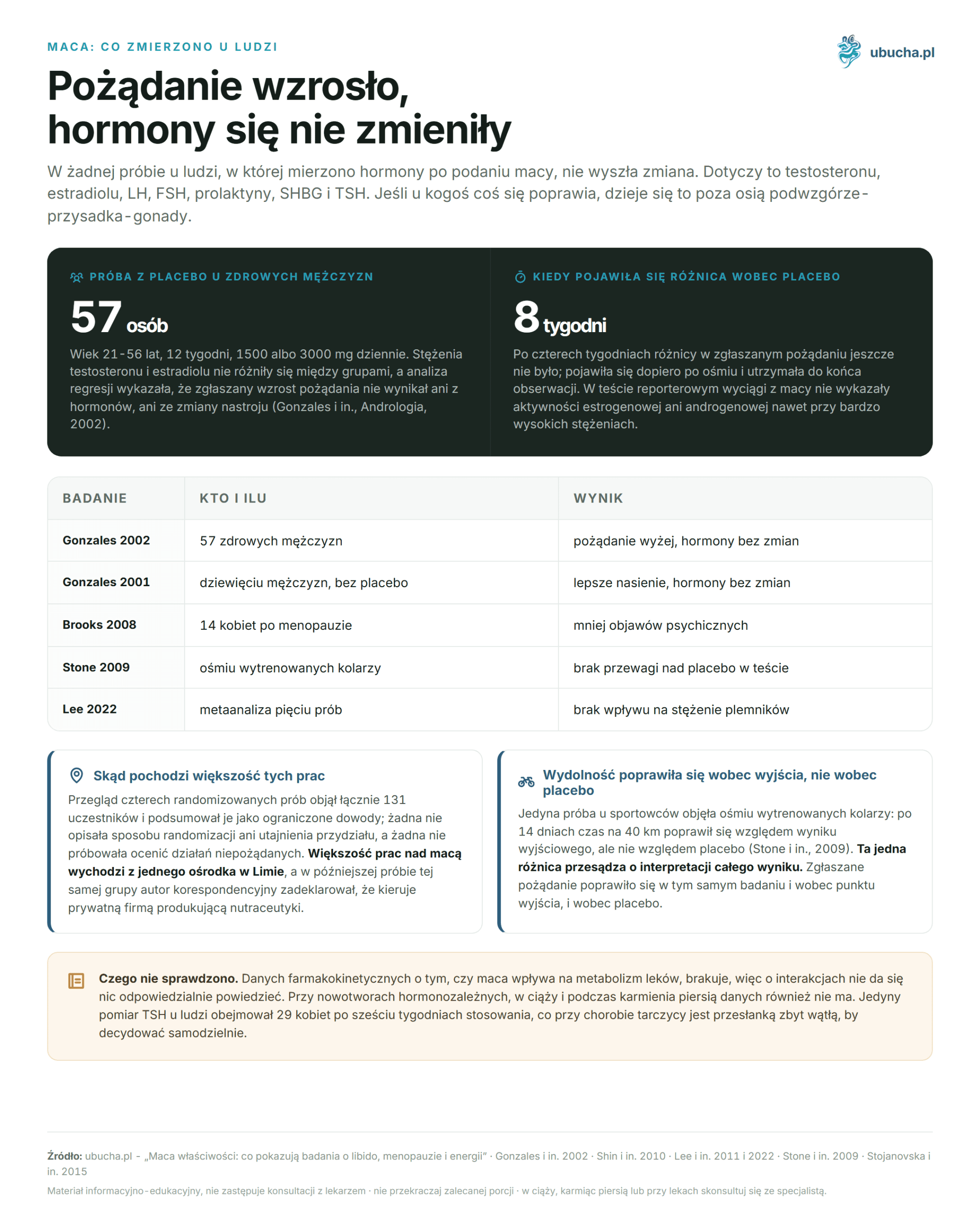
• In 57 healthy men, testosterone and estradiol did not differ from placebo, although desire increased from the 8th week (Gonzales et al., Andrologia, 2002).
• A review of four randomized trials included a total of 131 people and speaks of limited evidence (Shin et al., BMC CAM, 2010).
• A meta-analysis of five trials did not confirm the effect of maca on sperm concentration (Lee et al., Frontiers in Pharmacology, 2022).
• A significant portion of the research comes from one center in Lima, and in some works, the authors declare ties to manufacturers.
What is maca and what does it contain?
Maca is a swollen root of a plant from the cabbage family, related to radishes and cress, grown in the central Andes of Peru above 4000 m above sea level. The edible part is the hypocotyl, usually dried and ground into powder. Besides its nutritional value, maca contains two groups of compounds, which are recognized in chemical analysis: macamides and macaenes.
Dried hypocotyls contain 13-16% protein rich in essential amino acids, as well as iron, calcium, copper, zinc, and potassium (Ulloa Del Carpio et al., Frontiers in Pharmacology, 2024). They also contain glucosinolates, just like broccoli or cabbage, and this component later comes back in questions about the thyroid. Maca has been cultivated on the Junín plateau for hundreds of years, initially as food, not as a supplement.
Macamides are N-benzylamides of long-chain fatty acids. They are formed only during the drying of the root, from macaenes and other derivatives of fatty acids, and macaenes are also found in wormwood, eggplant calyxes, and tomato fruits. In in vitro studies, macamides inhibit FAAH, the enzyme that breaks down anandamide, which is why they are described as indirect modulators of the endocannabinoid system (Vera-López et al., Neurology International, 2024). This is a hypothesis from cell and animal models. No human trial has shown that this is the pathway through which the effect reported in surveys occurs.
Does maca change hormone levels?
No. In no human trial measuring hormones after maca administration was there a change. This applies to testosterone, estradiol, LH, FSH, prolactin, SHBG, and TSH. The claim of supporting hormones, with which maca is sold in stores, has no backing in these measurements.
The strongest single result comes from the work of Gonzales et al. (Andrologia, 2002): 57 healthy men aged 21-56 years, 12 weeks, 1500 or 3000 mg daily. Testosterone and estradiol levels did not differ between groups, and regression analysis showed that the reported increase in desire was not due to hormones or mood changes. In postmenopausal women, Brooks et al. (Menopause, 2008) went a step further: they tested maca extracts in a yeast reporter assay and found no estrogenic or androgenic activity even at very high concentrations.
The conclusion is twofold. Maca is not a phytoestrogen or testosterone booster, so it will not replicate the effects sought with those substances. However, if something improves for someone, it happens outside the hypothalamic-pituitary-gonadal axis.
| Study | Participants | Dose and duration | Outcome |
|---|---|---|---|
| Gonzales et al., 2002 | 57 healthy men | 1500 or 3000 mg, 12 weeks | Increase in desire from the 8th week, testosterone and estradiol unchanged |
| Gonzales et al., 2001 | 9 men, no placebo | 1500 or 3000 mg, 4 months | Better semen parameters, hormones unchanged |
| Brooks et al., 2008 | 14 postmenopausal women | 3.5 g, 6 weeks, crossover | Fewer psychological symptoms on the Greene scale, hormones unchanged |
| Stone et al., 2009 | 8 trained cyclists | 2 g, 14 days | Time for 40 km better than baseline, but not better than placebo |
| Stojanovska et al., 2015 | 29 postmenopausal women | 3.3 g, 6 weeks, crossover | Lower diastolic pressure and fewer depression symptoms |
| Dording et al., 2015 | 45 women after SSRI or SNRI | 3 g, 12 weeks | Higher remission rate than placebo, differences in a few percentage points |
Does maca improve libido?
Probably yes, but the evidence is weak and comes from small trials. In a 12-week placebo study with healthy men, the difference in reported desire appeared after eight weeks, and there was none after four weeks, and it persisted until the end of the observation.
A systematic review by Shin et al. (BMC Complementary and Alternative Medicine, 2010) gathered all randomized trials that existed at that time. There were four, totaling 131 participants, and the largest of them included 57 people. Two were favorable, the third in fifty men with mild erectile dysfunction also, and the fourth, with eight cyclists, did not show an advantage over placebo. The authors summarized this as limited evidence and noted that none of the trials described the method of randomization or allocation concealment. None also attempted to assess the adverse effects of maca.
There is also a thread that product descriptions are silent about. Most of the work on maca comes from one center in Lima, Universidad Peruana Cayetano Heredia, and in a later trial of the same group, the corresponding author declared that he runs a private company producing nutraceuticals (Gonzales-Arimborgo et al., Pharmaceuticals, 2016). This does not invalidate the results, but explains why independent replications are so needed.
Does maca help with sexual dysfunction after antidepressants?
This has been checked twice, and the results are weak, although they go in the same direction. In a larger trial, 45 women with sexual dysfunction caused by SSRI or SNRI medications took 3 g of maca daily for 12 weeks. The remission rates were higher than with placebo, but the differences were in single percentage points.
The numbers from the work of Dording et al. (Evidence-Based Complementary and Alternative Medicine, 2015) look like this: remission on the ASEX scale in 9.5% of women taking maca versus 4.8% on placebo, and in the MGH-SFQ questionnaire in 30% versus 20%. The authors themselves noted that the higher remission rate was associated with postmenopausal status, and 42 participants were included in the analysis, of which 12 were postmenopausal. An earlier study by this team (CNS Neuroscience and Therapeutics, 2008) compared only two doses, 1.5 and 3 g, without a placebo arm, and was completed by 10 out of 20 participants.
This is still the only area where maca has data in patients taking medications. Too little to treat it as a way to address the side effects of antidepressants. Sufficient to mention it to your attending physician if the problem concerns you and you are considering changing treatment.
Does maca alleviate menopause symptoms?
The evidence is insufficient to confirm this. A review by Lee et al. (Maturitas, 2011) included four randomized trials, and although all were favorable in the Kupperman and Greene scales, the authors wrote that the material is too small for conclusions, and the safety of maca has not been demonstrated.
The core consists of two trials. Brooks et al. administered 3.5 g daily to fourteen postmenopausal women in a crossover design for 6 weeks and noted a decrease in the severity of psychological symptoms, including anxiety and depression, with unchanged estradiol, FSH, LH, and SHBG. Stojanovska et al. (Climacteric, 2015) repeated this scheme in 29 women in Hong Kong with 3.3 g daily: diastolic pressure decreased and depression scores dropped, while estradiol, FSH, TSH, SHBG, lipids, and glucose remained unchanged.
Both were small, and the review by Lee et al. concludes that the efficacy and safety of maca need to be verified in larger studies. The authors of the work from Hong Kong themselves noted that the way climacteric symptoms are reported may vary culturally, which with 29 participants realistically weighs on the outcome. For women who cannot use hormone therapy, maca remains an unresolved option, not a proven alternative.
Does maca add energy and improve endurance?
There is no evidence for sports performance. The only trial with athletes involved eight trained cyclists: after 14 days of supplementation, the time for 40 km improved compared to the baseline, but not compared to placebo (Stone et al., Journal of Ethnopharmacology, 2009). This one difference determines the interpretation of the entire result.
Interestingly, what came out in the same study beyond endurance. Reported sexual desire improved both compared to baseline and compared to placebo. The largest of the discussed trials in humans included 175 people living in the lowlands and in the Andes, administered 3 g of extract from black or red maca for 12 weeks, and showed improvements in mood, energy, and quality of life.
Subjective energy is, however, not the same as measured endurance. The well-being questionnaire responds to the expectations of the participant, and the study from the Andes mainly measured such endpoints. It is worth noting the second result of this work: in individuals with excessively high hemoglobin at high altitude, the extract lowered its concentration, while in lowland residents, it did not change it at all. Some effects of maca therefore reveal themselves only under specific conditions.
Does maca affect male fertility?
A meta-analysis from 2022 did not confirm this. After gathering five randomized trials, maca did not increase sperm concentration compared to placebo, and the authors described its effect on semen parameters as unclear (Lee et al., Frontiers in Pharmacology, 2022).
So where does the reputation of maca as a fertility agent come from? From the work of Gonzales et al. (Asian Journal of Andrology, 2001), in which nine men took 1500 or 3000 mg daily for four months. Semen volume, sperm count, and motility increased, while LH, FSH, prolactin, testosterone, and estradiol did not change. The problem is that the study had no placebo group or randomization, and nine people is too few to distinguish the effect of the preparation from the natural variability of semen parameters.
The Andean tradition indeed associates maca with fertility, also in livestock. Science has not yet replicated this under controlled conditions. If, after andrological diagnostics, semen parameters are low, the starting point remains to determine the cause, not a supplement. More about choosing preparations for specific purposes is discussed in our post about starting supplements.
Is maca safe and what can it interact with?
Maca is a traditional food and has performed well in clinical trials in terms of tolerance, but well-tolerated is not the same as tested. A systematic review from 2011 stated outright that the safety of maca has not been demonstrated, and since then, no large trials have emerged.
What is known. A review from 2024 (Ulloa Del Carpio et al., Frontiers in Pharmacology) summarizes that adverse effects are rare, and toxicity in preclinical models is low. In a trial with 175 people conducted for 12 weeks, no serious adverse events were reported. On the other hand, Shin and his team noted that none of the four previous randomized trials even attempted to systematically collect such data.
What is not known. There is a lack of pharmacokinetic data on whether maca affects drug metabolism, so nothing can be responsibly said about interactions. In hormone-dependent cancers, there is a lack of data: the absence of estrogenic activity in the yeast test is an argument, but not a safety study in patients. During pregnancy and breastfeeding, there is also a lack of data. The only TSH measurement in humans comes from the trial by Stojanovska, and after six weeks of 3.3 g daily, it did not change in 29 women, which in thyroid disease is too weak a premise to decide independently.
We also noticed another thread that appears almost nowhere in product descriptions. In maca samples from areas of the Junín province affected by mining activities, the average concentrations of cadmium (0.32 mg/kg) and lead (0.20 mg/kg) exceeded FAO and WHO values, and the estimated cancer risk for arsenic and cadmium was above the tolerance threshold (Orellana Mendoza et al., Toxicology Reports, 2021). This is an argument for buying maca with heavy metal testing, not for giving it up. Similar questions are raised with other preparations for women in the text about supplementation after forty.
Frequently asked questions
Does maca raise testosterone?
No. In a 12-week placebo trial with 57 healthy men, testosterone and estradiol levels did not differ between maca and placebo (Gonzales et al., Andrologia, 2002). Earlier work by the same team also did not show changes in LH, FSH, or prolactin after four months of use.
Which maca is better: yellow, red, or black?
Color comparisons were mainly conducted on animals. Black performed best in a hidden learning test in mice after ovariectomy (Rubio et al., BMC Complementary and Alternative Medicine, 2006), and red was the only one that reduced prostate size in rats (Gonzales et al., Reproductive Biology and Endocrinology, 2005). In humans, both were compared in one trial with 175 participants.
How much maca was used in studies?
In human trials, doses ranged from 1500 mg to 3500 mg of powdered root or extract daily, most often around 3 g for 6 to 12 weeks. This is a description of what was studied, not a recommendation. None of these regimens has been established as a therapeutic dose.
After how long did effects appear in studies?
In the work of Gonzales et al. (Andrologia, 2002), the difference from placebo in reported desire appeared only after 8 weeks, and there was none after 4 weeks. The trial with cyclists lasted 14 days and did not show an advantage over placebo in the performance test.
Can maca be combined with medications?
There is a lack of pharmacokinetic data on the effect of maca on drug metabolism, so nothing can be responsibly said about interactions. The absence of data is not the same as the absence of risk. If you are taking medications regularly, inform your doctor or pharmacist about supplementation.
Who should not use maca?
There is a lack of safety data during pregnancy and breastfeeding, as well as with hormone-dependent cancers. The review by Lee et al. (Maturitas, 2011) explicitly stated that the safety of maca has not been demonstrated. In cases of thyroid disease and ongoing treatment, make the decision together with your doctor.
If you are looking for herbal preparations, check the supplements section. Check the composition, source of raw material, and contamination studies on the specific product card.
This article is for informational and educational purposes and does not constitute medical advice. Before starting supplementation, consult your doctor, especially if you are taking medications regularly, are pregnant or breastfeeding, or have a chronic illness.
Author: Michał Waluk · Published: 2026-06-22 · Updated: 2026-08-14