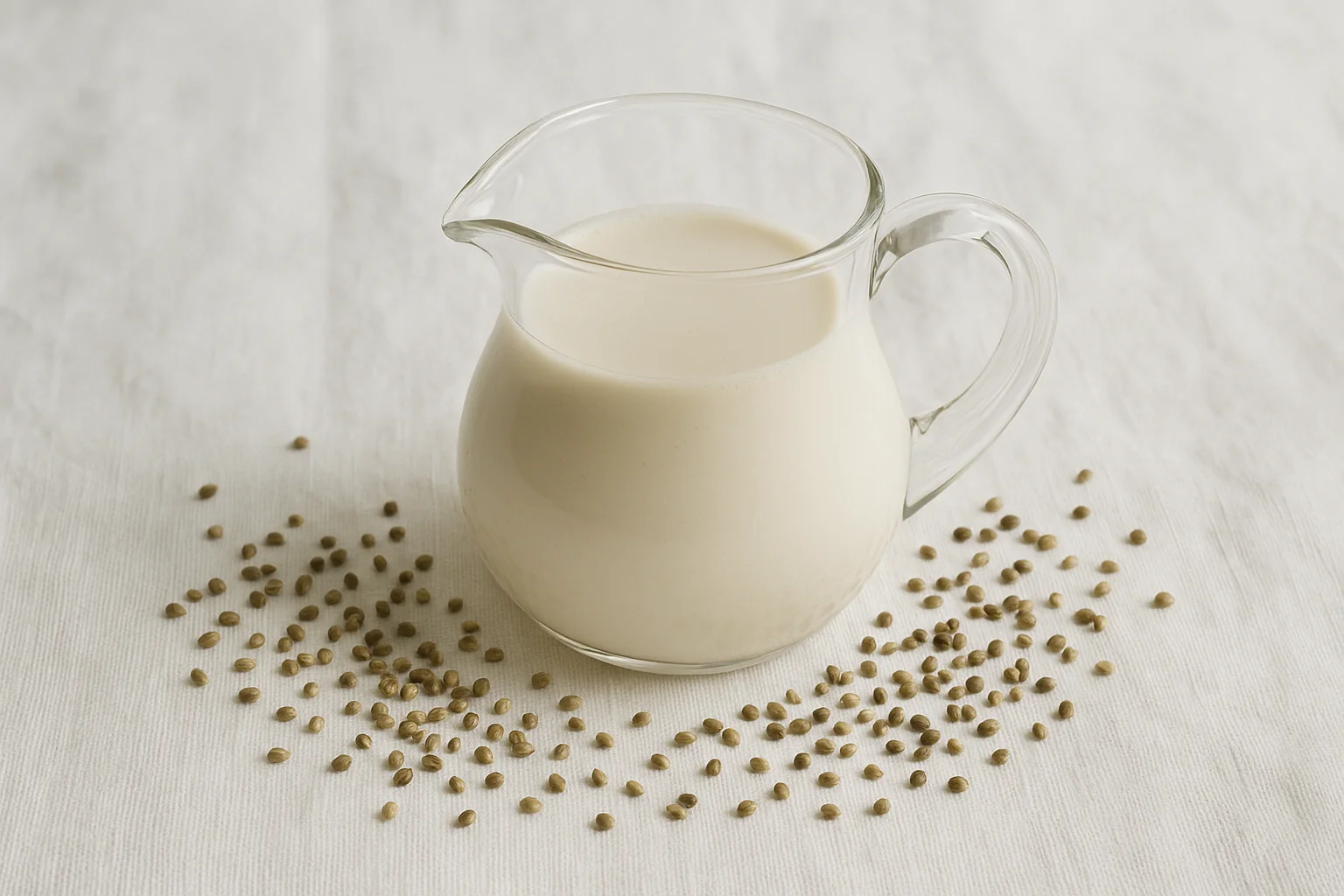

Homemade hemp milk: how to make it from hemp seeds step by step
How to make hemp milk from hulled hemp seeds: proportions, blending, straining, and what to do with the okara. No soaking, ready in a few minutes.
Hemp milk requires less than two minutes of blender work and does not need soaking the seeds overnight. Among seed and nut milks, it is the only one that blends directly from dry raw material, as hulled hemp seeds do not have a hard shell to soften. The result is creamy, slightly nutty, lactose-free, and gluten-free. Below you will find proportions for a light version and a thick creamer for coffee, a straining method that does not extract bitterness, and an idea for the okara left in the cheesecloth. I also show what studies really measure in hemp seed composition, as there are many unsupported numbers circulating around this raw material, and I explain why seeds are legal food while hemp flower is not.
KEY INFORMATION
• Hulled hemp seeds contain an average of 35.9% protein and 46.7% fat (House et al., J Agric Food Chem, 2010).
• Soaking is unnecessary, as the seed coat has already been mechanically removed.
• The omega-6 to omega-3 ratio in seeds ranges from 2:1 to 4:1 depending on the variety.
• Homemade milk lasts 3-5 days in the fridge, as it contains no preservatives or stabilizers.
Why does hemp milk make faster than almond milk?
Because there is nothing to soften. Almonds and cashews are soaked for several hours to loosen the compact structure of the shell and protein. Hulled hemp seeds go into the blender without a shell, and their interior is soft and oily, so it breaks down in just a few seconds.
The difference is evident in the raw material composition. House et al. examined thirty samples of hemp products from Western Canada and measured how much changes with the removal of the hull: whole seeds contained an average of 24.0% protein and 30.4% fat, while hulled seeds contained 35.9% protein and 46.7% fat. The hull is mainly fiber, so after its removal, more of what creates a creamy emulsion remains in the same mass.
The practical conclusion is simple: for milk, use hulled seeds, not whole ones. Whole seeds will give a sandy and bitter drink, as the hard hull will not blend smoothly, and with stronger squeezing through the cheesecloth, bitterness will pass into the milk.
What is really in the seeds you make milk from?
Primarily fat and protein, with few carbohydrates. Callaway in a 2004 review describes the hemp seed as a nut containing over 30% oil and about 25% protein, with the oil being over 80% composed of polyunsaturated fatty acids. The two main proteins in the seed, edestin and albumin, contain all essential amino acids.
It is important to be precise here, as popular texts turn this into “complete protein” in a sense that studies do not confirm. House et al. measured the quality of this protein using the PDCAAS method and obtained 49-53% for whole seeds and 63-66% for hulled seeds. The limiting amino acid in all tested products was lysine. Therefore, the presence of all essential amino acids is different from a quality comparable to egg or cow’s milk protein.
The fat profile is stronger. Siano et al. broke down the Fedora variety and measured 56.4% linoleic acid (omega-6), 14.6% alpha-linolenic acid (omega-3), and 3.0% gamma-linolenic acid. Polyunsaturated acids made up about 75% of all fatty acids. The omega-6 to omega-3 ratio in this variety came out close to 4:1, while Callaway reports a range of 2:1 to 3:1 for hemp seeds. The variation comes from the variety and growing conditions, so one number for all hemp would be an oversimplification.
We noticed in tests that the character of the milk is determined by the ratio of seeds to water, not the blending time. Three tablespoons per 500 ml give a light drink, good for oatmeal and tea. Six tablespoons per 500 ml yield a thick creamer that mixes with coffee without added oil. Extending blending beyond two minutes does not improve anything and only heats the drink.
Are hemp seeds legal food?
Yes, and this follows directly from the statutory definition. Hemp other than fiber is any part of the plant above ground excluding seeds, containing more than 0.3% of the sum of delta-9-THC and THCA. Seeds are excluded from this definition, so neither they nor products made from them are subject to the regime provided for the herb.
Basis: Article 4 point 37 of the Act of July 29, 2005 on counteracting drug addiction (Journal of Laws 2023 item 1939), as amended by the Act of March 24, 2022 (Journal of Laws 2022 item 763). Note that the threshold is counted as the sum of delta-9-THC and THCA, not just delta-9-THC.
Separately, there are limits on THC contamination in the food itself, expressed in milligrams per kilogram, not in percentages. These are introduced by Commission Regulation (EU) 2023/915, applicable from May 25, 2023:
| Product | Maximum allowable level |
|---|---|
| Hemp seeds | 3.0 mg/kg |
| Ground seeds and other seed products | 3.0 mg/kg |
| Hemp seed oil | 7.5 mg/kg |
The level refers to the sum of delta-9-THC and delta-9-THCA expressed as delta-9-THC. The food producer must comply with this, and you will recognize the food raw material by the packaging label.
Safety: Use only hulled hemp seeds from a certified food source, described as “hulled hemp seeds” or “hemp hearts” for the milk. Hemp flower and hemp buds are not food raw materials and are not suitable for blending as food.
What do you need for hemp milk?
Two ingredients and one device. The rest of the list are enhancements that the recipe will also work without.
- 3-6 tablespoons of hulled hemp seeds (45-90 g), depending on the desired thickness
- 500 ml of cold, filtered water
- A blender with a minimum power of 600 W, the stronger the better for smoother milk
- A fine strainer lined with cheesecloth or a nut milk bag
- A glass bottle or jar with a tight lid
- Optional: a pinch of sea salt, a teaspoon of honey or maple syrup, a quarter teaspoon of vanilla extract
- Optional: a pinch of cinnamon, cardamom, or turmeric for spiced versions
Buy seeds in small packages and keep them in the fridge. Polyunsaturated fats make up about three-quarters of their fat, and such fats go rancid faster than saturated ones. Rancid seeds can be recognized by a sharp, paint-like smell right after opening the bag. Fresh seeds smell nutty and mild.
How much of this ends up in the finished drink depends on how hard you squeeze the cheesecloth. Providing nutritional values for the milk to the gram would be a fabrication, as some protein and fat remain in the okara, and everyone squeezes differently.
How to make homemade hemp milk step by step?
Active work time is about five minutes, plus an hour of chilling. Chilling is optional, but cold hemp milk has a more pronounced flavor and thicker consistency than lukewarm.
- Measure 3 tablespoons (about 45 g) of hulled hemp seeds directly into the blender jug. For thicker milk, use 4-5 tablespoons. Add the seeds dry, without soaking.
- Pour in 500 ml of cold, filtered water and blend for 60-90 seconds on the highest speed. The milk should become creamy-white and uniform. If you see seed pieces, blend for an additional 30 seconds.
- Line a strainer with double-layered cheesecloth or place a nut milk bag over a jug. Pour slowly, and when it starts to drip, gently squeeze. Over-squeezing will release bitterness into the milk.
- Keep the okara, which is the creamy paste left in the cheesecloth. You can add it to oatmeal, mix it into pancake batter, or roll it with cocoa and honey into energy balls.
- Taste the base milk and season. A pinch of salt enhances the flavor, a teaspoon of honey or vanilla rounds it out. Whisk or pulse briefly with the blender.
- Pour into a clean glass bottle and chill for at least an hour. Shake well before each use, as the drink naturally separates. A layer of fat on top is normal, not a sign of spoilage.
The milk lasts 3-5 days in the fridge. Signs of spoilage include a sour smell, color change, or visible mold.
How to modify the basic recipe?
The base is neutral and slightly nutty, so it tolerates strong additions without flavor conflicts. Three directions we tested in the kitchen.
The golden version is made by adding a quarter teaspoon of turmeric, a pinch of black pepper, and half a teaspoon of cinnamon to the blender, with honey added after blending. This results in a base for an evening latte, related to golden milk for the evening.
The chocolate version requires a tablespoon of raw cocoa and a tablespoon of maple syrup added together with the seeds. You get chocolate milk without refined sugars, good for overnight oats. If you prefer a green and slightly grassy flavor, the same base works for matcha latte with hemp milk.
The coffee version requires an even thicker concentration than the creamer: six tablespoons of seeds per 300 ml of water. The fats in the seeds create a creamy emulsion with coffee when shaken, so the creamer does not need added oil. It still will not froth for lattes, as there are no caseins in the seeds responsible for stable foam. A broader nutritional context can be found in the sister text about hemp milk from hemp seeds.
Frequently asked questions
Do you have to strain hemp milk?
No, straining is optional. Unstrained milk has a slightly grainy texture and retains more solid parts from the seeds. Strained through cheesecloth or a nut milk bag, it is smooth and resembles store-bought milk more. It is not worth straining for smoothies, while a smooth version is more convenient for coffee and tea.
How much protein do the seeds you make milk from have?
Hulled hemp seeds contain an average of 35.9% protein and 46.7% fat, while whole seeds contain 24.0% and 30.4% (House et al., J Agric Food Chem, 2010). How much of this ends up in the drink depends on the strength of the cheesecloth squeezing, as some solids remain in the okara.
How long does hemp milk stay fresh?
In a sealed glass bottle, it lasts 3-5 days in the fridge. Without preservatives, it spoils faster than store-bought versions. Signs of spoilage include a sour smell, color change, or mold. Make batches of 500 ml, as that is about two days of drinking for one person.
Does hemp milk have a good omega-6 to omega-3 ratio?
It depends on the seed variety. Callaway reports a range of 2:1 to 3:1 for hemp seeds, while Siano and colleagues measured a ratio close to 4:1 in the Fedora variety. There is no universal number for all hemp, as the composition changes with variety and growing conditions.
Is hemp milk suitable for cooking?
Yes, it works well in oatmeal, creamy soups, sauces, and as a smoothie base. It will not froth for lattes, as it lacks the caseins that create stable foam. The nutty flavor pairs well with grains, pumpkin, and mushrooms, and it replaces cow’s milk in pancake batter.
Hemp milk pairs well with infusions with a strong profile. In the hemp food category, you will find hemp teas that you can brew as a base for the spiced version. We do not carry hemp seeds in the store.
This article is for informational and educational purposes and does not replace consultation with a doctor. If you are pregnant, breastfeeding, taking medications, or have chronic conditions, consult the use of supplements or herbs with a specialist.
Author: Michał Waluk · Published: 2026-05-29 · Updated: 2026-08-16