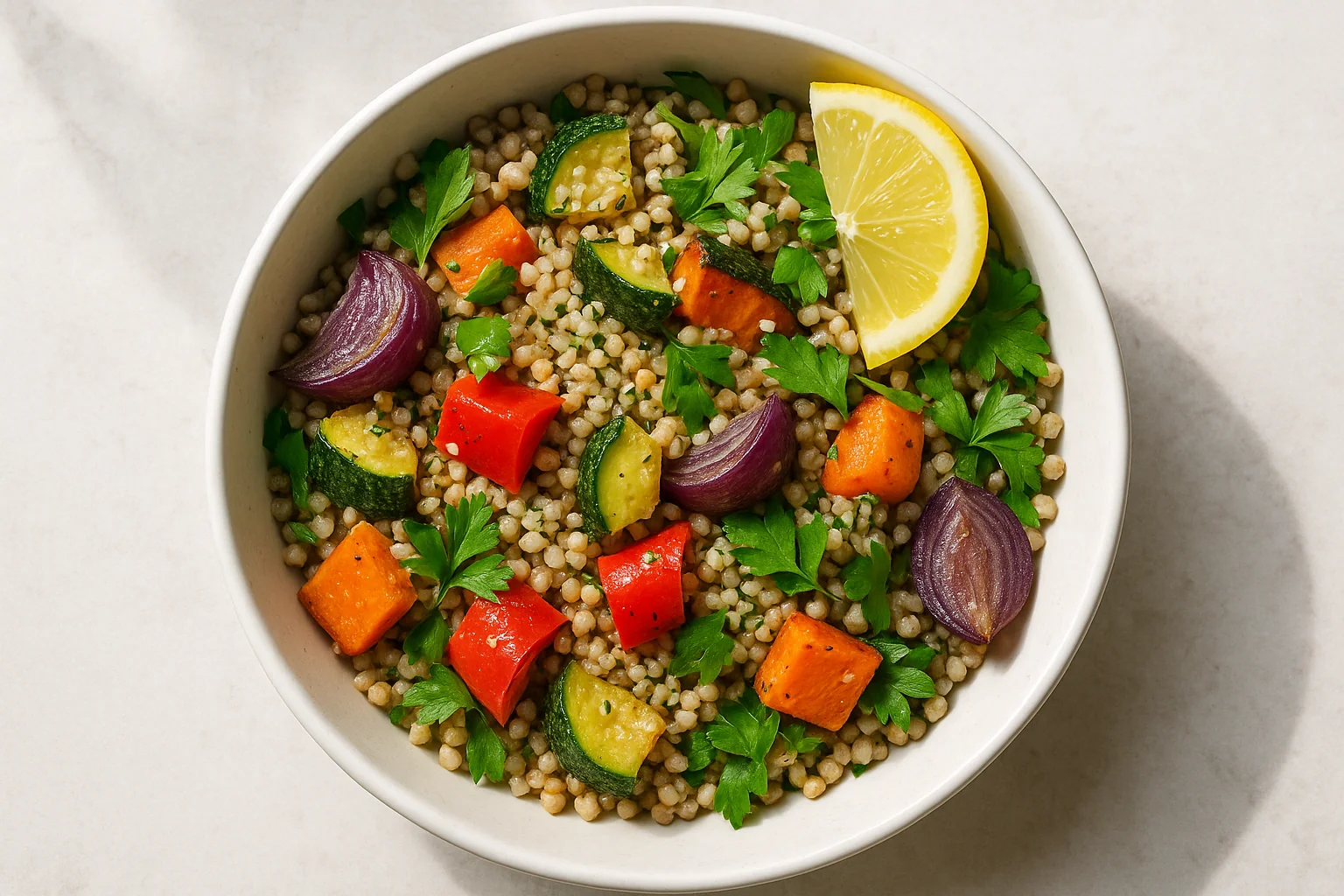

Buckwheat Salad with Hemp Seeds
Buckwheat salad with roasted vegetables and hemp seeds. Recipe for 2 servings, nutritional values calculated from USDA tables, and tips for fluffy buckwheat.
Buckwheat gives the salad what other bases do not: it fills, holds the dressing, and does not become mushy after an hour in the fridge. Hulled hemp seeds added on the plate provide crunch and a portion of protein with a different amino acid profile than the grain itself. The salad is gluten-free, ready in 35 minutes, and lasts three days in the fridge, as long as you keep the dressing and seeds separate. Below you will find proportions for two servings, nutritional values calculated from USDA tables, and three things that determine whether the buckwheat will be fluffy or clump together. Along the way, we also clarify a claim that has circulated in recipes with hemp seeds for years: that hemp complements the missing lysine in buckwheat. Measurements tell something exactly the opposite and show what this combination really gains.
KEY INFORMATION
• Hulled hemp seeds contain 31.6 g of protein per 100 g, while buckwheat contains 13.2 g per 100 g of dry grain (USDA FoodData Central, records 170148 and 170286).
• Lysine is the limiting amino acid in all studied hemp seed products, so buckwheat brings it to this dish, not the seeds (House et al., 2010).
• Hemp seeds compensate with methionine: about 30 mg per gram of protein compared to about 13 mg in buckwheat, according to the same USDA tables.
• Use hemp oil only cold: polyunsaturated fatty acids make up almost 80 percent of the fat in hemp seeds (USDA FoodData Central, record 170148).
What do hemp seeds add to buckwheat salad?
They add protein and change its profile, but not in the way that most recipes repeat. Dry buckwheat has 13.2 g of protein per 100 g, while hulled hemp seeds have 31.6 g per 100 g. Two tablespoons of seeds, or about 20 g, add just over 6 g of protein to the serving. Both values come from the USDA FoodData Central database, from records 170286 and 170148.
The qualitative difference runs contrary to the shorthand about the complete amino acid profile of hemp. House, Neufeld, and Leson examined thirty commercial hemp seed products and found that lysine was the limiting amino acid in all of them (Journal of Agricultural and Food Chemistry, 2010). The USDA table calculations give the same picture: per gram of protein, hemp seeds provide about 41 mg of lysine, while buckwheat provides about 51 mg. Therefore, the grain brings the lysine, not the sprinkle.
Hemp seeds compensate in the other direction. The same calculation from the USDA tables gives for methionine about 30 mg per gram of protein in hemp seeds compared to about 13 mg per gram of protein in buckwheat, which is more than twice as much. Therefore, the supplementation is real, but it runs contrary to the popular description. This same work also shows why the hull is removed: the PDCAAS index of whole seeds was 49-53 percent, while hulled seeds were 63-66 percent.
How much protein and calories are in one serving?
A serving is half the recipe, which is 75 g of dry buckwheat, two tablespoons of hemp seeds, roasted vegetables, and half the dressing. From the USDA tables, it comes out to about 600 kcal and about 19 g of protein per serving, and with the addition of feta, approximately 23 g of protein. The largest share of calories comes from the fats in the dressing and the oil for roasting, not the buckwheat. This is a calculation from the composition tables, not a measurement of the finished dish, so treat it as an approximation of the order of magnitude.
Compared to other seeds that end up in salads, hemp ranks high in protein but low in fiber: hulled seeds have only 4 g per 100 g, as the fiber is mainly in the removed hull. The fiber in this salad comes from the buckwheat and vegetables.
What do you need for this salad?
The proportions are for two servings. Cooking the buckwheat takes 15 minutes, roasting the vegetables takes 15-18 minutes, and assembling takes 5 minutes. Use unroasted buckwheat, as roasted has a stronger, distinctly bitter taste and will dominate the dressing. The hemp oil must be cold-pressed and stored in the fridge.
- 150 g of unroasted buckwheat
- 1 zucchini, about 200 g
- 1 red bell pepper, about 150 g
- 4 tablespoons of hulled hemp seeds
- 2 handfuls of arugula or baby spinach, about 60 g
- a small bunch of parsley
- 2 tablespoons of cold-pressed hemp oil
- 1 tablespoon of lemon juice
- 1 teaspoon of Dijon mustard
- 1 teaspoon of honey or maple syrup
- 1 tablespoon of oil for roasting vegetables
- salt, pepper, oregano
- optional: 60 g of feta or one avocado
Honey and mustard are not just decorations for the recipe. Mustard emulsifies the dressing, so the oil does not separate on the plate, and a bit of sweetness balances the acidity of the lemon with the distinctly herbal flavor of the oil. Treat feta and avocado interchangeably, not together: both add fat, and the serving mainly stands on it. If the salad is to be a takeout dish, pack the dressing in a separate jar.
How to prepare the salad step by step?
The buckwheat and vegetables go parallel. Start the oven and put the water on at the same minute, and both stages will finish roughly together. The rest is assembling cold.
- Cook the buckwheat. Add 150 g of buckwheat to a pot, pour in 300 ml of cold water, and add a pinch of salt. Bring to a boil, reduce the heat, and cook covered for 12-15 minutes until the water is absorbed. Remove from heat and let it sit covered for 5 minutes, then spread it out on a large plate to cool. In the pot, steam condenses back onto the grains and the buckwheat clumps together.
- Roast the vegetables. Preheat the oven to 200 degrees. Cut the zucchini and bell pepper into about 2 cm cubes, transfer to a baking sheet, drizzle with a tablespoon of oil, sprinkle with salt and pepper, and finally add a pinch of oregano. Bake for 15-18 minutes until the edges are browned. Cool for at least 10 minutes before adding to the buckwheat.
- Make the dressing. In a jar, pour in 2 tablespoons of hemp oil, add lemon juice, mustard, honey, salt, and pepper. Close the jar and shake for about 20 seconds until the liquid thickens and stops separating.
- Prepare the greens. Rinse and dry the arugula, chop the parsley. Crumble the feta with your fingers into irregular pieces, and cut the avocado just before serving to prevent browning.
- Assemble the salad. In a large bowl, combine the cooled buckwheat, vegetables, arugula, and parsley. Drizzle with the dressing and mix gently, lifting the mixture from the bottom instead of stirring in circles. Transfer to plates and top with feta or avocado.
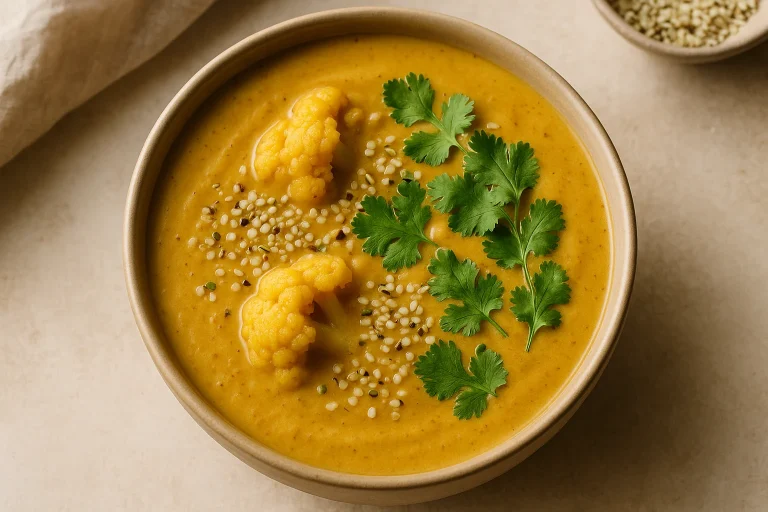
- Sprinkle with seeds on the plate. Just before serving, sprinkle each portion with two tablespoons of hulled hemp seeds. Hemp seeds do not have a hard shell, so they quickly soften in the moist dressing and lose the purpose for which you add them.
How to modify the recipe for the season and diet?
The buckwheat base tolerates almost any vegetable swap, as long as you keep the grain to the rest in roughly a half-and-half ratio. In autumn, instead of zucchini and bell pepper, use 200 g of diced hokkaido pumpkin, roasted for 20-22 minutes at 200 degrees. Pumpkin is sweeter and better withstands the nutty flavor of the seeds than sour vegetables. In winter, the same role is played by roasted parsley root.
For a version with more protein, add roasted chickpeas, a hard-boiled egg, or grilled salmon. Hemp seeds remain regardless of the choice, as they complement sulfur amino acids even when the main protein comes from meat or fish. Similarly structured is our recipe for chicken salad with hemp seeds, where the base is meat, not grain.
In summer, a fruit variant works well, where roasted vegetables give way to citrus fruits, as in orange salad with hemp seeds. If you prefer another grain, the same assembly principle works in quinoa bowl with hemp seeds. The most common mistake is always the same: mixing warm buckwheat with dressing. Warm grain absorbs the oil instead of carrying it, and the buckwheat continues to steam and clumps together.
Frequently Asked Questions
How much protein is in one serving of this salad?
About 19 g, and with feta approximately 23 g. This consists of 75 g of dry buckwheat, which is close to 10 g of protein, two tablespoons of hulled hemp seeds, which is over 6 g, and vegetables and greens. The calculation comes from the USDA FoodData Central tables, not from measuring the finished dish.
Do hemp seeds complement the amino acids of buckwheat?
Yes, but through methionine, not lysine. House and colleagues showed that lysine is the limiting amino acid in all studied hemp seed products. Buckwheat has more lysine per gram of protein than the seeds. Hemp adds methionine, which buckwheat has more than twice less per gram of protein.
Is buckwheat gluten-free?
Yes, buckwheat is not a grain and does not contain gluten, just like hulled hemp seeds. If you have celiac disease, choose buckwheat with a gluten-free certification, as the risk does not lie in the grain itself, but in cross-contamination in the mill and packaging facility.
How long can you store this salad?
Keep the buckwheat with vegetables in the fridge for no longer than three days, and the dressing in a sealed jar for up to five days. Add the seeds and dressing just before serving. A salad prepared in advance does not spoil faster, but the grain absorbs the liquid and loses its structure.
Why should hemp oil not be heated?
Because almost 80 percent of the fat in hemp seeds, from which the oil is pressed, consists of polyunsaturated fatty acids, which have several double bonds in the chain. The more such bonds, the easier the fat oxidizes under heat. Therefore, hemp oil is suitable for dressings and spreads, but not for frying.
This article is for informational and educational purposes and does not replace consultation with a doctor. If you are pregnant, breastfeeding, taking medications, or have chronic conditions, consult the use of supplements or herbs with a specialist.
Author: Michał Waluk · Published: 2026-06-22 · Updated: 2026-08-15