
Medicinal Mushrooms: Bioactive Compounds, Applications, and Clinical Studies - Complete Guide 2026
Reishi, Lion's Mane, Cordyceps, Chaga, Maitake, Shiitake, and Turkey Tail: we check what exactly was measured in human studies and what is missing.
Medicinal mushrooms are today sold as coffee powders, gummies, and capsules, with labels promising memory, immunity, and energy. When you move from marketing to research, the picture becomes much more cautious. Some claims are supported by randomized human studies. Others rely solely on cell cultures or a single report from twenty years ago. This guide reviews the seven most commonly sold species and shows for each what exactly was measured, on how many people, and for how long. It also points out numbers circulating on the Polish internet that are not found in the cited studies at all. At the end, you get a checklist for labels and a list of contraindications.
KEY INFORMATION
• The Cochrane review (Jin et al., 2016) found only five randomized studies on Reishi in oncology and advises against its use as first-line treatment.
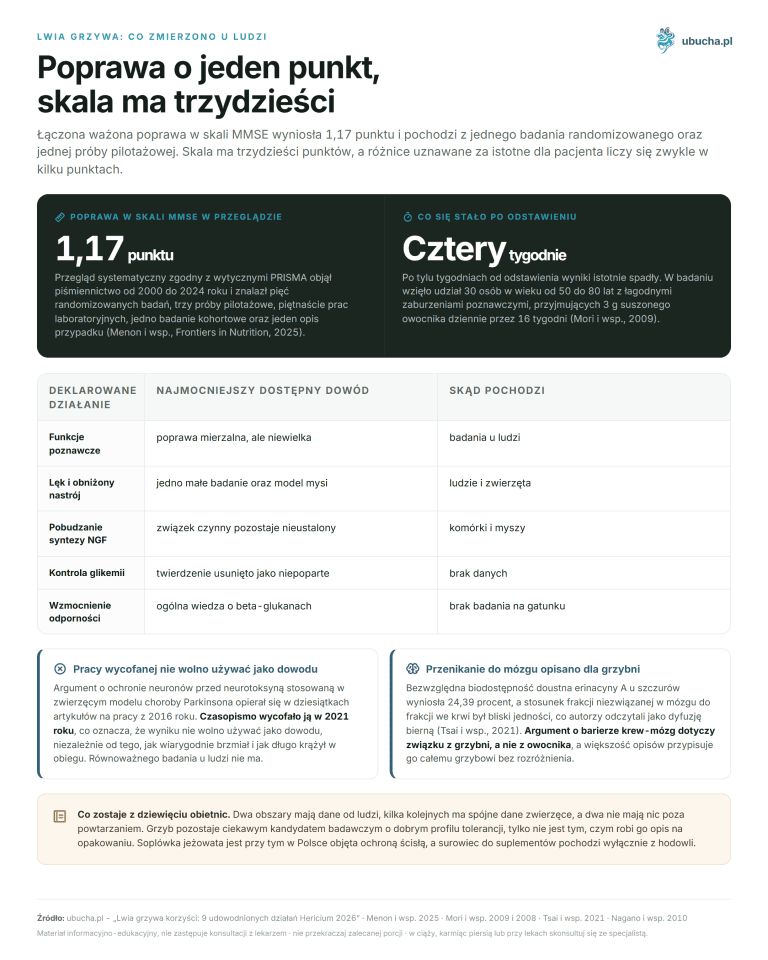
• In the study by Mori et al. (2009), 3 g of Lion’s Mane daily for 16 weeks improved HDS-R scores in 30 people with mild cognitive impairment.
• Chen et al. (2010) did not observe an increase in VO2max after Cordyceps, although the ventilatory threshold increased by 8.5%.
• Kwon et al. (2022) described acute kidney injury after 10-15 g of Chaga daily for three months.
What are medicinal mushrooms and what really works in them?
Medicinal mushrooms are species studied for pharmacologically active compounds: cell wall polysaccharides, triterpenoids, and nucleoside derivatives. The review Venturella et al., International Journal of Molecular Sciences 2021 describes a broad spectrum of pharmacological activities and simultaneously calls on the scientific community to expand clinical research and offer preparations with defined origin and genetic purity.
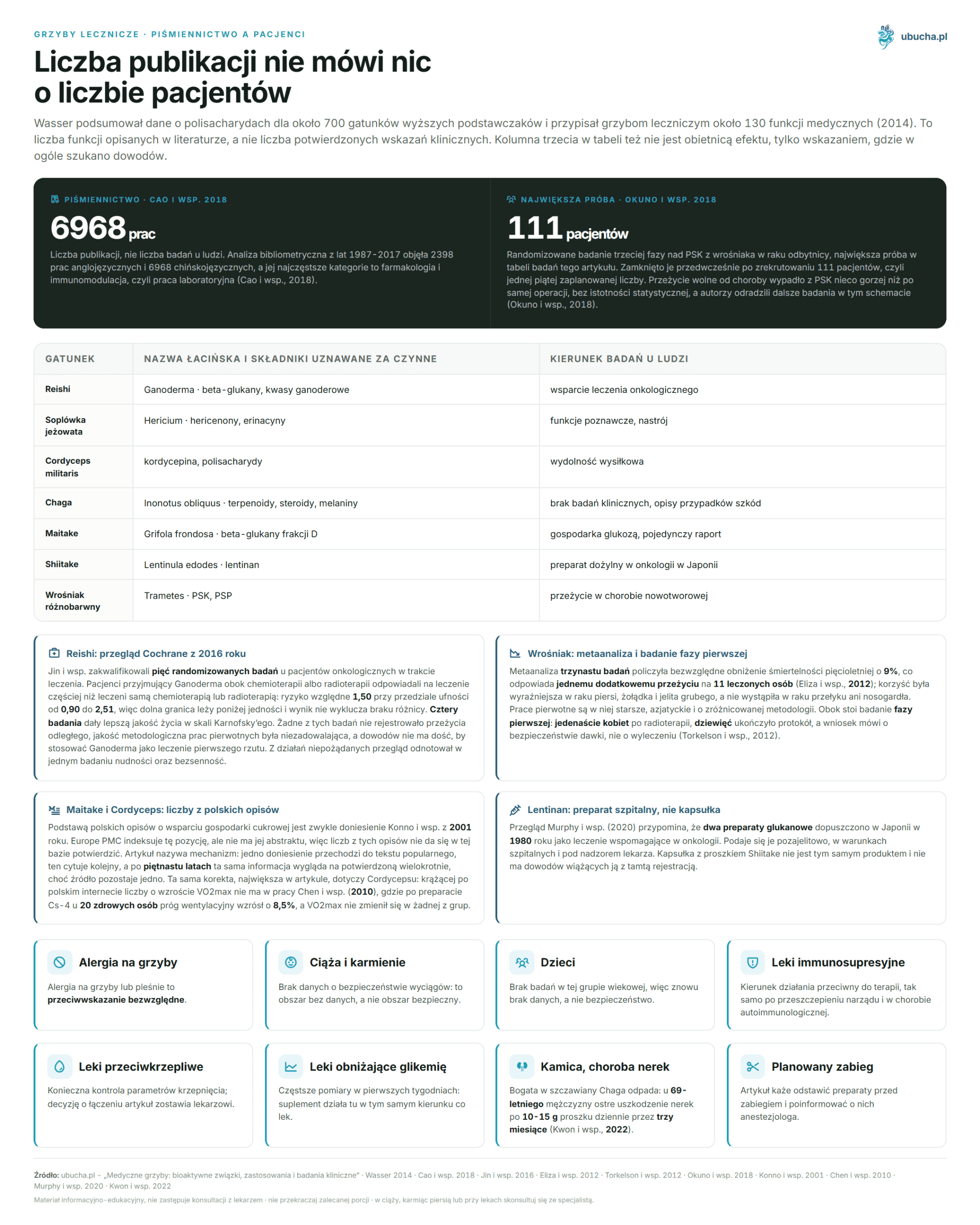
The literature volume can be misleading. Wasser summarized in Biomedical Journal (2014) data on polysaccharides for about 700 species of higher basidiomycetes and attributed about 130 medical functions to medicinal mushrooms. This is the number of functions described in literature, not the number of confirmed clinical indications. This difference recurs throughout the article and is the main reason why labels sound more confident than the scientific work they cite.
The term “medicinal mushrooms” is neither a legal nor pharmacological term. It is a commercial term covering edible species used for millennia, inedible species brewed as infusions, and isolated preparations administered parenterally in hospitals. These three very different things fall under one label, causing most misunderstandings in store descriptions. A capsule with powder and a registered drug share the species name but differ in dose, administration route, and evidence.
Seven species repeat in Polish stores. The table below shows the active ingredient considered in each and the direction of human research. The third column is not a promise of effect but an indication of where evidence was sought.
| Species | Active Ingredients | Human Research Focus |
|---|---|---|
| Reishi (Ganoderma) | beta-glucans, ganoderic acids | oncology support |
| Lion’s Mane (Hericium) | hericenones, erinacines | cognitive function, mood |
| Cordyceps militaris | cordycepin, polysaccharides | exercise performance |
| Chaga (Inonotus obliquus) | terpenoids, steroids, melanins | no clinical studies, case reports of harm |
| Maitake (Grifola frondosa) | beta-glucans fraction D | glucose metabolism, single report |
| Shiitake (Lentinula edodes) | lentinan | intravenous oncology preparation in Japan |
| Turkey Tail (Trametes) | PSK, PSP | cancer survival |
How do beta-glucans interact with the immune system?
Beta-glucans are fungal cell wall polysaccharides indigestible by humans but recognized by the immune system. The dectin-1 receptor, present in small amounts on macrophages and abundantly on dendritic cells, binds beta-glucan-containing particles and cooperates with Toll-like receptors. Gantner et al. showed in Journal of Experimental Medicine (2003) that this cooperation increases NF-kB activation and synergistically enhances interleukin 12 and TNF-alpha secretion, also triggering reactive oxygen species production.
This mechanism was described in cells, not as a health effect measured in humans. The review Vetvicka et al., Molecules 2019 states that biological activity of glucans was assessed in over eighty clinical trials and considers their transition from supplement to drug a matter of time. This is the authors’ opinion, not the EU registration status.
The most practical note comes from the review Murphy et al., Journal of Fungi 2020. Two glucan preparations were approved in Japan in 1980 as adjunct cancer therapies, yet mechanisms remain incompletely understood. The authors point out something directly relevant to purchases: seemingly similar beta-glucan preparations act differently, likely due to raw material source and extraction procedure. The species name on the package does not guarantee content.
It is also worth separating two areas often mixed in store descriptions. The same review lists two distinct beta-glucan research paths: metabolic-gut, involving microbiota, lipids, and glucose metabolism; and immunologic, testing glucans as adjuvants in cancer and inflammation. Beta-glucans occur not only in mushrooms but also in plants and cereal foods. The phrase “beta-glucans boost immunity” is a shorthand losing information about the raw material source and the pathway studied.
What do studies on Reishi in oncology really show?
Reishi has its own Cochrane review, the most honest source for discussion. Jin et al. (Cochrane Database of Systematic Reviews, 2016) included five randomized trials. Patients receiving Ganoderma alongside chemotherapy or radiotherapy responded more often than those with chemo or radiotherapy alone: relative risk 1.50 with confidence interval 0.90 to 2.51.
Note the confidence interval includes 1, so the result does not exclude no difference. The review also noted increased lymphocyte percentages: CD3 by 3.91%, CD4 by 3.05%, and CD8 by 2.02%. Four studies showed better quality of life measured by Karnofsky scale in the Ganoderma group. No study recorded long-term survival.
The authors’ conclusion is clear and rarely appears on labels. Evidence is insufficient to use Ganoderma as first-line treatment; primary studies had unsatisfactory methodological quality. The mushroom may serve as an adjunct to conventional treatment, and its use should be cautious. The impression of abundant research comes from a bibliometric analysis Cao et al., Frontiers in Pharmacology 2018 covering 2398 English and 6968 Chinese papers from 1987-2017, mostly pharmacology and immunomodulation, i.e., lab work. Publication count does not indicate patient studies.
Two practical notes follow. First, the Cochrane review concerns oncology patients during treatment, not healthy people seeking immune support, so applying results to prevention lacks basis. Second, one study reported nausea and insomnia as adverse effects and found no significant hematologic or liver toxicity. This is the full safety information from the review, much more modest than label claims.
Does Lion’s Mane improve memory in humans?
Lion’s Mane has two human studies worth detailed knowledge as they differ. The first is Mori et al., Phytotherapy Research 2009: 30 people aged 50-80 with mild cognitive impairment, double-blind placebo-controlled, four 250 mg tablets three times daily for 16 weeks. HDS-R scores rose at weeks 8, 12, and 16, then dropped significantly four weeks after stopping.
The second study involved healthy young adults. Docherty et al., Nutrients 2023 gave 1.8 g Lion’s Mane to 41 people aged 18-45. Stroop test speed improved one hour after a single dose, not after a month. After 28 days, only a trend toward lower subjective stress was seen, borderline significant. Authors caution due to small sample.
Other evidence is preclinical. Ratto et al., Nutrients 2019 showed two-month supplementation reversed recognition memory decline and increased neurogenesis markers in aging mice. Lai et al., International Journal of Medicinal Mushrooms 2013 found aqueous extract increased neurite growth by 60.6% with nerve growth factor but did not protect cells from oxidative stress. Species details are in the Lion’s Mane entry.
These four items together show a picture not visible in a single product description: one trial in cognitively impaired people, one in healthy people with acute effect, one animal model, and one cell culture. This is too little to claim neuron regeneration in humans but enough to consider this species the best-studied cognitive direction among the seven described here.
What is the difference between hericenones and erinacines?
This distinction determines whether a product description is reliable. Hericenones are associated in literature with the fruiting body, erinacines with mycelium; both groups are described as compounds influencing nerve growth factor synthesis. The review Li et al., Behavioural Neurology 2018 draws a boundary: among all active compounds in Lion’s Mane, only erinacine A has confirmed pharmacological activity in the central nervous system, and that in rats.
Authors also collected preclinical material for erinacine-enriched mycelium, listing ischemic stroke, Parkinson’s, Alzheimer’s, and depression as areas with observed improvement in animal studies. They state clinical translation is difficult and discuss species safety separately.
What does this mean for purchase? The review cited by most sales descriptions concerns erinacine-enriched mycelium, not any Lion’s Mane preparation. A producer advertising CNS effects should specify which part of the mushroom the product contains and whether erinacine content is declared. This does not mean the fruiting body is ineffective, only that the cited study concerned something else, a difference worth checking before spending a hundred zlotys.
There is one more gap to name honestly. The Mori et al. study abstract mentions powdered mushroom tablets, Docherty et al. the 1.8 g dose. Neither specifies fruiting body or mycelium. Determining this requires full-text access, which we did not do, so we record this as missing, not guessing, as guessing caused previous erroneous numbers in this article.
How much does Cordyceps really improve performance?
This is where the biggest correction lies, as a number circulating on the Polish internet is not in the source paper. Chen et al., Journal of Alternative and Complementary Medicine 2010 gave 20 healthy people aged 50-75 Cs-4 preparation at 333 mg three times daily for 12 weeks. Metabolic threshold rose by 10.5%, ventilatory threshold by 8.5%. Authors state VO2max did not change in any group.
The phrase “Cordyceps increases VO2max by 7%” does not come from this paper. The dose is also different from most Polish descriptions: about 1 g daily, not 3 g.
The second study involved younger people. Hirsch et al., Journal of Dietary Supplements 2017 gave 28 people 4 g of a mushroom blend containing Cordyceps militaris. After one week, no significant difference versus placebo. Ten volunteers extended supplementation, and after three weeks VO2max increased by 4.8 ml/kg/min, and time to exhaustion by nearly 70 seconds. This is a result from ten people and a multi-species blend, not pure Cordyceps. The review Phull et al., Microorganisms 2022 additionally summarizes anti-inflammatory effects but based on in vitro and in vivo models. Numbers from both studies are compared in the Cordyceps and VO2max entry.
What remains for a training person? A cautious hypothesis, not a promise. Ventilatory and metabolic thresholds change by a few percent, noticeable in longer effort, but measured in twenty people over fifty, not athletes. The second study involved younger people but a blend and a group reduced to ten. If someone sells Cordyceps with a performance claim, ask which result they mean.
Is Chaga safe for daily drinking?
Chaga ranks lowest in evidence and highest in warnings here. The review Fordjour et al., Frontiers in Pharmacology 2023 describes steroids, terpenoids, and other secondary metabolites, listing antioxidant, anti-inflammatory, antiviral, and anticancer activity shown in lab studies. Authors say the species’ potential remains largely untapped as chemical composition is only partially known.
The popular ORAC number, cited as proof of “world’s strongest antioxidant,” comes from commercial lab materials, not peer-reviewed work. We removed it here as it cannot be verified at source. ORAC measures test tube reactions and says nothing about what happens in the body after drinking an infusion.
Real risk is documented. Kwon et al., Medicine 2022 described a 69-year-old man who took 10-15 g of Chaga powder daily with 500 mg vitamin C for three months. He developed acute kidney injury with nephrotic syndrome; biopsy showed calcium oxalate deposits in tubules. Treatment required dialysis and high-dose steroids; kidney function returned after a month. Chaga is rich in oxalates, so it is contraindicated in oxalate stones and kidney disease. More in the birch mushroom entry.
A case report is the weakest evidence type for efficacy but different for harm. One well-documented case with biopsy suffices to consider the mechanism real, showing such a reaction occurs in humans. For Chaga, the best-documented clinical phenomenon is adverse effect, not benefit. This does not mean the infusion harms everyone, only that dose and duration matter, and people with kidney disease should avoid it.
What is known about Maitake and glucose levels?
Maitake is sold in Poland with claims of supporting sugar metabolism, usually based on one source: Konno et al. published in Diabetic Medicine in 2001. Europe PMC indexes it but lacks an abstract, so numbers cited in Polish descriptions cannot be confirmed there. We removed them here along with the glycemia reduction percentage previously circulating.
What remains after correction? Mechanisms studied in animal models and cultures. The review Friedman, Foods 2016 discusses fungal polysaccharides in obesity, diabetes, anticancer, and antibacterial contexts, mainly preclinical. The review Murphy et al. (2020) lists beta-glucan effects on lipid and glucose metabolism as an area studied, not resolved.
The practical conclusion is simple. If you take metformin, sulfonylureas, or insulin, adding Maitake is not neutral, as the theoretical direction matches the drug. This argues for more frequent glucose monitoring in the first weeks and consultation with your doctor, not replacing medication with a supplement.
It is worth noting how efficacy belief forms. One 2001 report passes into a popular article, which cites another, and after fifteen years the same info looks multiply confirmed though the source remains one. This mechanism applies here to at least three numbers we removed. Verification always involves counting independent studies, not pages describing them.
Shiitake: what does eating it provide versus extract?
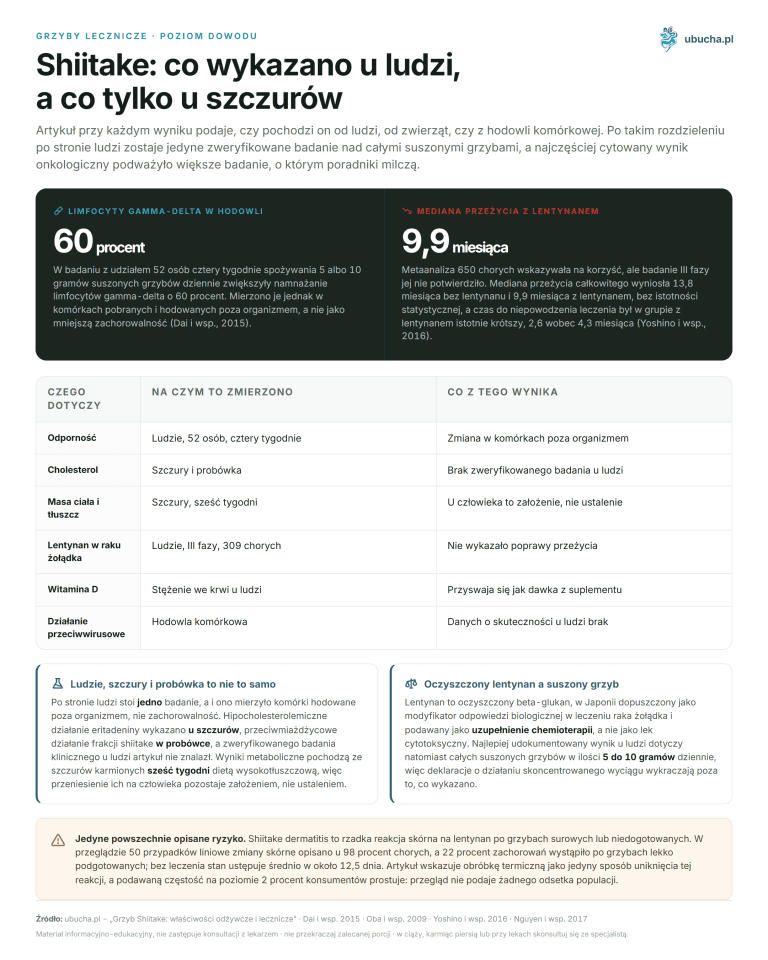
Shiitake is the only species among these seven normally eaten in cuisine, changing dose thinking. Culinary mushroom provides protein, fiber, and flavor compounds, and its consumption requires no pharmacological justification. A separate story is lentinan, its isolated beta-glucan.
Lentinan is not a supplement. The review Murphy et al. (2020) reminds that two glucan preparations were approved in Japan in 1980 as adjunct cancer treatments, administered parenterally in hospitals under medical supervision. A Shiitake powder capsule is not the same product and lacks evidence linking it to that registration.
From a consumer perspective, two sentences make sense. First, eat Shiitake like any edible mushroom without expecting medicinal effect. Second, Shiitake extract makes sense only if the producer states beta-glucan content measured by laboratory method, as without this number you do not know what you buy.
The same applies to drying. Shiitake is advertised as a vitamin D source because mushrooms contain ergosterol, which converts to vitamin D2 under UV light. Amount depends on whether and how long the mushroom was irradiated; average dried Shiitake on the shelf has no such declaration. Without a label number, it cannot be treated as a vitamin source, only a possibility.
Why does Turkey Tail have the most oncology data?
Turkey Tail (Trametes versicolor) is the only species here with a meta-analysis of survival. Eliza et al. (Recent Patents on Inflammation and Allergy Drug Discovery, 2012) collected 13 clinical studies and calculated an absolute 5-year mortality reduction of 9%, corresponding to one additional survivor per 11 treated. Benefit was clearer in breast, stomach, and colon cancer, absent in esophageal and nasopharyngeal cancer.
Alongside is a small clinical trial often presented in Polish descriptions as proof of efficacy. Torkelson et al., ISRN Oncology 2012 was a phase 1 safety and dose tolerance study. Eleven women post-radiotherapy for breast cancer were recruited; nine completed six weeks. Doses were 3, 6, or 9 g daily. Trends included higher lymphocyte counts at 6 and 9 g and higher NK cell activity at 6 g. Authors concluded dose was tolerated, not cured.
The most instructive is a study not previously cited. Okuno et al., Cancer Chemotherapy and Pharmacology 2018 was a phase 3 randomized trial with PSK in stage II rectal cancer. It was closed early after recruiting 111 patients (one-fifth planned). Disease-free survival was slightly worse in the PSK arm than surgery alone. The difference was not statistically significant, but authors discouraged further research in this scheme. Species context is in the Turkey Tail entry.
These three items explain why Turkey Tail looks both best and least documented. The 2012 meta-analysis shows a real survival benefit but relies on older Asian studies with varied methodology. The newer study designed from scratch did not confirm benefit. This is evidence maturation and the material labels never summarize.
What doses were really used in studies?
Labels state daily portions but not their origin. The table below collects doses, duration, and group sizes from studies cited here. All come from abstracts linked in previous sections and were individually checked for this edition.
| Study | Dose and Duration | Participants | Outcome |
|---|---|---|---|
| Mori 2009, Lion’s Mane | 3 g daily, 16 weeks | 30 people aged 50-80 | HDS-R improvement, loss after 4 weeks off |
| Docherty 2023, Lion’s Mane | 1.8 g single dose and 28 days | 41 healthy people aged 18-45 | faster Stroop test 1 hour post-dose |
| Chen 2010, Cordyceps Cs-4 | 333 mg three times daily, 12 weeks | 20 healthy people aged 50-75 | metabolic threshold +10.5%, VO2max unchanged |
| Hirsch 2017, mushroom blend | 4 g daily, 1 and 3 weeks | 28 people, 10 by week 3 | VO2max +4.8 ml/kg/min after 3 weeks |
| Torkelson 2012, Turkey Tail | 3, 6, or 9 g daily, 6 weeks | 11 women post-radiotherapy, 9 completed | dose tolerated, lymphocyte trends |
| Okuno 2018, PSK from Turkey Tail | PSK with tegafur and uracil post-surgery | 111 patients, study closed early | no disease-free survival benefit |
Two things stand out. The largest sample is 111, the smallest nine, so these are small studies even by supplement standards. Also, each used different preparations, forms, and protocols, so comparing them requires caution.
How to distinguish fruiting body extract from grain powder?
This is where consumers lose most money and have the only real control tools. Mycelium grown on grain cannot be separated from substrate, so powder contains starch. The fruiting body is the part from which literature-described compounds come. Producers not stating what was powdered usually have a reason.
DNA analysis shows the problem is broader than mushroom part. Gunnels et al., PLOS ONE 2020 remind that up to 60% of dietary supplements may contain substituted ingredients, then tested seven Reishi products by DNA barcoding. Results were good: all seven contained Ganoderma lingzhi genetic material. The method is cheap and repeatable, so lack of such testing by a producer is a choice, not necessity.
Another trap lies in the word “polysaccharides.” Producers sometimes state total polysaccharide content instead of beta-glucans, which are different numbers. Starch from grain substrate is also a polysaccharide, so “40% polysaccharides” may mostly describe the grain on which mycelium grew. Beta-glucans are measured by a separate enzymatic method, and only that number informs about the fungal raw material.
The table below lists questions to ask a label before purchase. None require chemical knowledge.
| Question for the label | Answer that should raise concern |
|---|---|
| Fruiting body or mycelium? | no information or “biomass” |
| How much beta-glucans in percent? | polysaccharide content given instead of beta-glucans |
| What method was used? | method not stated |
| Is there a batch analytical certificate? | certificate “on request” without publication |
| Is species genetically confirmed? | only trade name, no Latin name |
Why are mushroom study results so hard to compare?
Short answer: two products with the same name may not be the same. The review Murphy et al. (2020) calls this a main obstacle to translating beta-glucan research into clinical practice. Seemingly similar preparations yield different effects, linked to raw material source and extraction procedure, though the phenomenon remains poorly understood.
Also, species identity matters. Gunnels et al. (2020) cite data that up to 60% of supplements may contain substituted ingredients and show ITS region sequencing resolves this cheaply and reliably. Since the method exists, lack of its use is information about the producer.
The third layer is how literature grows. Wasser collected 2014 data on polysaccharides for about 700 species; Money wrote two years later that clinical efficacy evidence is still lacking. Both are true: the first refers to lab work, the second to patient studies. Store descriptions almost always cite the first and omit the second. If you want one control question for any medicinal mushroom description, it is: how many people received it and for how many weeks.
This also explains why narrative reviews can mislead. A paper listing twenty species properties usually mixes cell culture, rodent studies, and single human observations, as its goal is to show the field state. Readers seeing a long activity list in the abstract interpret it as confirmed effects. We added material type notes to each citation here, and that distinction is more important than the number.
Who should avoid medicinal mushrooms?
Let’s start with a voice never heard in sales materials. Money stated in Fungal Biology (2016) that despite long tradition of dried mushrooms and extracts in Chinese medicine, scientific evidence for efficacy in human disease treatment is lacking. He recommends consumers critically evaluate producer promises and notes possible harm as a separate caution.
This caution has specific targets. Allergy to mushrooms is an obvious contraindication; pregnancy, breastfeeding, and childhood lack safety data, not safety. Another group is drug interactions where supplement and drug act in the same direction.
| Situation | Implication |
|---|---|
| Allergy to mushrooms or molds | absolute contraindication |
| Pregnancy and breastfeeding | no safety data on extracts |
| Children | no studies in this age group |
| Immunosuppressive drugs | action opposite to therapy |
| Anticoagulants | need coagulation parameter monitoring |
| Glucose-lowering drugs | more frequent glucose checks initially |
| Oxalate stones, kidney disease | Chaga contraindicated, see Kwon 2022 case |
| Planned surgery | stop supplements and inform anesthesiologist |
Autoimmune diseases require separate discussion with your doctor. Mushroom preparations are described as modulating innate response, which is problematic in autoimmunity, not deficient. The same applies to transplant patients, where treatment aims to suppress immune response.
One more note on what is missing here and why. There is no adverse effect rate, though such numbers circulate in Polish descriptions. The paper cited as source is critical of the whole category and contains no such rate. We removed the number rather than find another citation, as an unmeasured claim remains unsubstantiated regardless of wording.
What does Polish law say about mushroom supplements?
Mushroom extracts are sold in Poland as dietary supplements, i.e., food products, not medicinal products. The basis is the Food Safety and Nutrition Act of August 25, 2006, and product introduction requires notification to the Chief Sanitary Inspectorate. Notification is not marketing authorization under pharmaceutical law and does not mean anyone checked product efficacy.
This status defines what producers may write. Packaging may include composition, form, usage, and recommended daily portion. It cannot claim to treat, prevent, or diagnose disease. Health claims are allowed only as approved by the EU after EFSA evaluation.
The practical consequence is that phrases like “supports immunity” have a different legal weight than treatment claims. If you see therapeutic promises on a store page, it is a legal violation, not a better-studied product. The same applies to descriptions attributing supplement effects to intravenous hospital preparations.
Supplement status also affects price comparison. Since no efficacy study is required before marketing, price does not indicate quality. A more expensive product may be better documented but not necessarily; the only verifiable signal is what the producer states on the label and batch certificate. Therefore, the questions in the previous section are worth more than price comparisons.
Can medicinal mushrooms be combined with CBD?
This question recurs often as both products share shelf space and marketing suggests synergy. No evidence exists. We found no human study administering mushroom extract and cannabidiol together, so any statement about mutual enhancement is a mechanistic inference, not measurement.
What is known separately? The review Maroon and Bost, Surgical Neurology International 2018 lists neurological uses of phytocannabinoids, from refractory epilepsy to neuropathic pain, describing neuroprotective, anti-inflammatory, and immunomodulatory effects. Fungal beta-glucans are described as stimulating innate response, acting at a different immune point.
If you still want to combine both, a sensible rule is to introduce one product at a time and wait several weeks to know what worked or harmed. For anticoagulants, immunosuppressants, and glucose-lowering drugs, decide on combination with your doctor, as both categories report interactions in these areas.
Also note the cognitive cost of this decision. Starting two products simultaneously and feeling better after a month leaves you unsure which caused the change; if symptoms recur, you don’t know which to stop. Clinical trials test single interventions versus placebo; the same logic applies at home, just without a control group. Record start date and dose, and after eight weeks assess if the effect justifies further expense.
One last note on what we will not write. You will not find a table of species sets for sleep, energy, or memory here, as none have human studies. Such sets circulate online and sound mechanistically plausible, but mechanism is a hypothesis, not a result.
What remains in practice?
After reviewing all citations, the picture is narrower than packaging suggests but not empty. The strongest evidence concerns Turkey Tail, where a meta-analysis of thirteen studies showed a 9% absolute 5-year mortality reduction, and Lion’s Mane, where one randomized trial in mild cognitive impairment showed improvement only during intake.
The weakest evidence concerns Chaga and Maitake. For Chaga, the best-documented clinical fact is harm, not benefit. For Maitake, Polish descriptions rely on one report over twenty years old, whose content cannot be confirmed in open databases. Reishi has a Cochrane review concluding long-term survival impact is uncertain, and Cordyceps has two studies, neither confirming the most popular number on the Polish internet.
It is worth knowing the origin of this edition. Of nineteen identifiers previously carried by the article, two led to the declared paper, and even one had distorted numbers. Three pointed to true papers on the topic but signed with wrong authors and journals. Fourteen led to publications in unrelated fields, from propoxyphene pharmacokinetics to dog mammary gland morphology. Therefore, we provide author, year, and abstract link for each number here.
The practical rule is: buy a species for a specific expectation, check fruiting body declaration and beta-glucan content, and treat any treatment claim as a warning sign. Medicinal mushrooms can supplement diet but do not replace treatment. If you have chronic illness or take medications regularly, consulting a doctor is cheaper than a year of supplementation unlikely to work.
Frequently Asked Questions
Are medicinal mushrooms safe for everyone?
No. People allergic to mushrooms are excluded, and there is a lack of safety data on extracts during pregnancy, breastfeeding, and in children. Caution is required with anticoagulant, immunosuppressive, and glucose-lowering drugs. Kwon et al. (2022) described acute kidney injury after three months of drinking Chaga.
How long does it take to see the effect of supplementation?
It depends on the species and what you measure. In the study by Mori et al. (2009), cognitive test scores increased at weeks 8, 12, and 16, then dropped four weeks after discontinuation. In the study by Docherty et al. (2023), faster Stroop test results appeared just one hour after a single dose.
Fruiting body or mycelium on grain: which to choose?
Fruiting body if you care about the compounds described in the literature. Mycelium grown on grain cannot be separated from the substrate, so the powder also contains starch. A label that does not specify which part was powdered does not allow you to assess what you are buying, and that alone is information.
Is one species enough, or is a blend better?
There is no study comparing a single species with a blend in humans. However, Murphy et al. (2020) review shows that seemingly similar beta-glucan preparations act differently depending on the raw material and extraction method. A blend therefore complicates the assessment of what worked.
Can Chaga be drunk daily instead of coffee?
It is not a neutral beverage. Chaga is rich in oxalates, and Kwon et al. (2022) described acute kidney injury in a man drinking 10-15 g of powder daily for three months. It is contraindicated in oxalate kidney stones and kidney disease; with healthy kidneys, moderation and dose control apply.
Can medicinal mushrooms be combined with medications?
Only after consulting your attending physician. The greatest risk concerns anticoagulants, immunosuppressants, and glucose-lowering drugs, as the supplement may act in the same direction as the therapy. Discontinue preparations before planned surgery and inform the anesthesiologist.
Do medicinal mushrooms cure cancer?
No. The Cochrane review (Jin et al., 2016) found insufficient evidence to use Reishi as first-line treatment. The randomized study by Okuno et al. (2018) with PSK in rectal cancer was closed early, and disease-free survival was slightly worse in the preparation arm.
You can find preparations with species described in this article in the adaptogens category. Check composition and declared ingredient content on the specific product page.
This article is for informational and educational purposes and does not replace consultation with a physician. If you are pregnant, breastfeeding, taking medications, or have chronic conditions, consult a specialist before using supplements or herbs.
Author: Michał Waluk · Published: 2026-05-11 · Updated: 2026-08-10