
Shiitake Mushroom: Nutritional and Medicinal Properties - A Complete Guide Based on Clinical Research
What has really been demonstrated for shiitake mushroom: immunity, cholesterol, lentinan in oncology, and shiitake dermatitis, based solely on verified studies.
Shiitake, or Lentinula edodes, is one of the best-researched edible mushrooms, but the gap between what is written about it and what has actually been demonstrated is particularly large in this area. Some repeated figures do not come from any study, some come from research on rats or in vitro and have been misrepresented as results in humans, and one of the most frequently cited oncological findings was later contradicted by a larger study that guides remain silent about. This text is based solely on works verified for identity and content, and each result indicates whether it comes from a study on humans, animals, or cell cultures. Where there is no evidence, it is stated directly, instead of filling the gap with cautious phrasing.
KEY INFORMATION
- Shiitake is the second most efficient cultivated mushroom in the world (Yu et al., 2022).
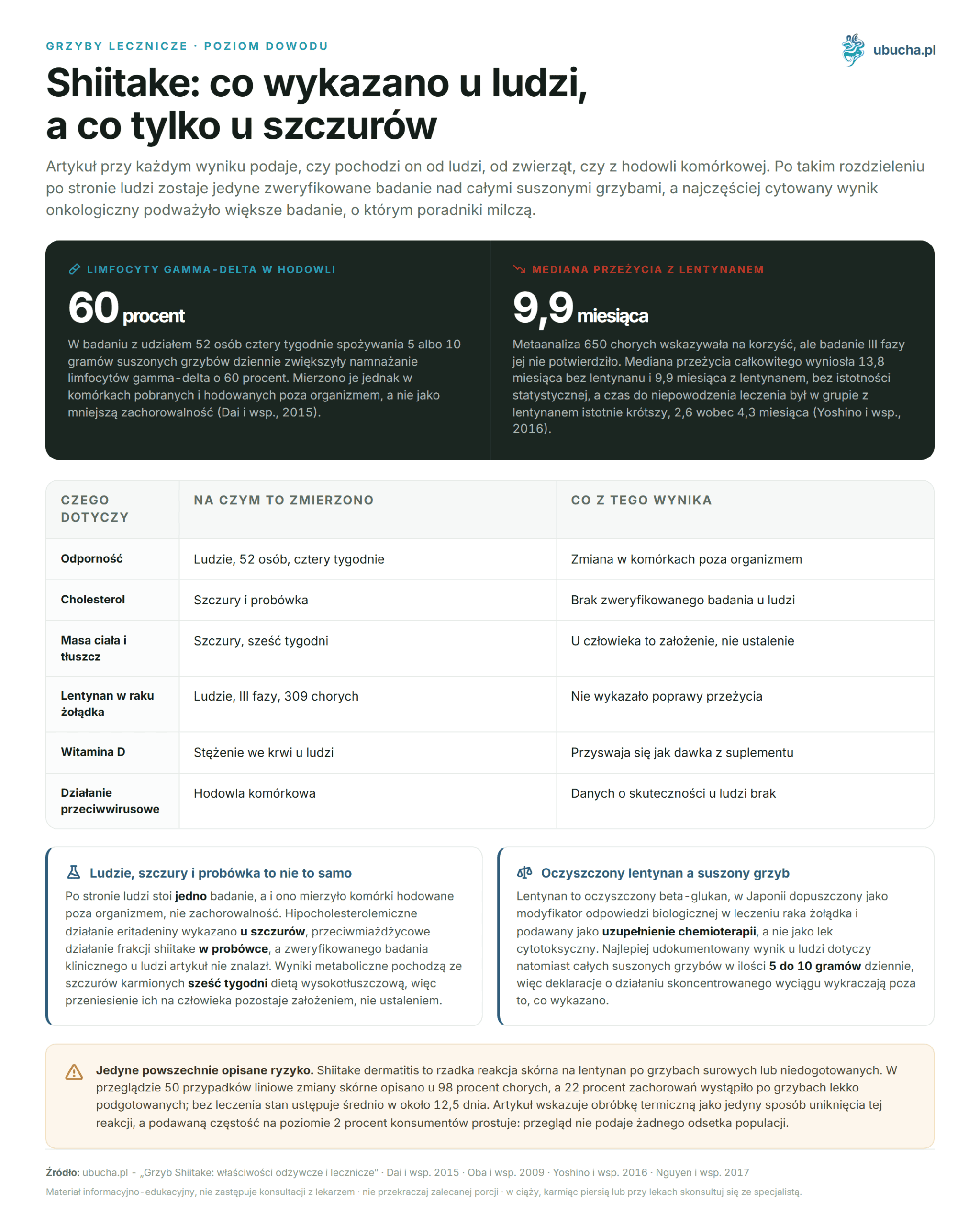
- In a study involving 52 people, four weeks of consuming 5 or 10 g of dried mushrooms daily increased gamma-delta lymphocyte proliferation by 60 percent in vitro and reduced C-reactive protein (Dai et al., 2015).
- A meta-analysis of 650 patients indicated a benefit from lentinan in stomach cancer, but a later phase III study on 309 patients did not confirm it at all, and the time to treatment failure was significantly shorter in the lentinan group (Oba et al., 2009; Yoshino et al., 2016).
- The hypocholesterolemic effect of eritadenine was demonstrated in rats, and the anti-atherosclerotic fractions of shiitake in vitro; there is no verified clinical study in humans (Sugiyama et al., 1995; Rahman et al., 2018).
- Shiitake dermatitis is a rare skin reaction after raw or undercooked mushrooms, resolving on average in about 12.5 days without treatment (Nguyen et al., 2017).
- Mushrooms differ in their ability to accumulate cadmium, making the origin of the raw material a real selection criterion (Yu et al., 2022).
What is shiitake and where does it come from?
Shiitake is the fruiting body of the species Lentinula edodes, a fungus that decomposes dead hardwood, cultivated in East Asia for centuries and now produced on an industrial scale worldwide. The Polish common name is twardnik japoński. The Japanese name combines the word for mushroom with the name of the tree on which the species grows in nature.
Shiitake’s position in food production is confirmed by a work dedicated to its genome. Yu et al. (PMC8832684, 2022) opens with the statement that Lentinula edodes is the second most efficient cultivated mushroom in the world. This is the only part of popular production rankings that has been confirmed in the peer-reviewed literature; circulating figures about millions of tons per year and the percentage share of individual countries have no basis in it and therefore are not included here.
This same work provides insight into the origin of cultivated varieties, which is useful in assessing the raw material. The authors assembled a genome of 45.87 megabases, anchoring 99 percent of the sequences on ten chromosomes and predicting 9853 protein-coding genes. They then resequenced 34 wild strains and 65 commercial varieties from China, Japan, the United States, and Australia.
The result of this population analysis is specific. The wild Chinese population turned out to be clearly diverse and split into branches corresponding to the main geographical areas of occurrence, and the varieties cultivated in China primarily derive from wild strains from China and Northeast Asia. The history of breeding this species can thus be reconstructed at the molecular level, which is significant because differences between strains translate into the composition of the fruiting body, as discussed later in the text.
What does shiitake bring to the diet?
It primarily brings two rare sulfur antioxidants and a precursor of vitamin D, the content of which depends on what happened to the mushroom after harvest. Nutritional values provided in guides with precision to tenths of a milligram should be treated with caution, as the composition changes with the strain, drying method, and exposure to light.
The best-documented peculiarity of the composition is ergothioneine. Kalaras et al. (PMID 28530594, 2017) measured its content and the content of glutathione in various species of edible mushrooms. The level of ergothioneine ranged from 0.15 to 7.27 milligrams per gram of dry weight, and glutathione from 0.11 to 2.41 milligrams per gram of dry weight, with both indicators being strongly correlated. The range of over fortyfold between species shows why generalizations about mushrooms as a group say little.
From the same work comes an observation useful in the kitchen: both antioxidants accumulate in higher concentrations in the cap than in the stem. The authors also noted that mushrooms harvested in the third flush contained more than those from the first, which they attribute to increased oxidative stress in the mycelium. Thus, the composition of the fruiting body is not a fixed feature of the species, but a result of cultivation conditions.
What I did not find in the verified literature, despite it circulating in texts about shiitake: the number stating that this species contains five to ten times more ergothioneine than the common mushroom. Kalaras’s work provides ranges for many species but does not formulate such a comparison, and its finding about the third flush of common mushrooms rather contradicts it. Therefore, instead of a superiority index, measured ranges are provided here.
Where does vitamin D in mushrooms come from and how much is there really?
From ergosterol in cell membranes, which under ultraviolet radiation is converted into vitamin D2. Mushrooms are one of the few non-animal sources of this vitamin, and the content in a specific fruiting body depends on how much light reached it, making it a controllable feature rather than a given.
Keegan et al. (PMC3897585, 2013) described this transformation step by step. Provitamin D2 under ultraviolet light is converted into previtamin D2, and this isomerizes to vitamin D2 in a manner analogous to the transformation of previtamin D3 in human skin. Further exposure leads to the formation of lumisterol2 and tachysterol2, with the concentration of the latter rapidly decreasing and becoming undetectable after a day.
Two observations from this work directly concern shiitake. First, this species produces not only vitamin D2 but also D3 and D4, which distinguishes it from many other edible mushrooms. Second, and this is the most important practical finding, the intake of 2000 units of vitamin D2 in the form of mushrooms proved equally effective in raising and maintaining the level of 25-hydroxyvitamin D in the blood as the same dose in a supplement with vitamin D2 or D3.
This last sentence closes the doubt that often arises with mushrooms, namely whether vitamin D from this source is even absorbable. It is absorbed to a degree comparable to that of a supplement. However, it is worth remembering that this refers to the response measured by the level of 25-hydroxyvitamin D, not to hard endpoints concerning bone health or immunity.
Which compounds in shiitake are biologically active?
Two groups: cell wall polysaccharides, among which lentinan is the best described, and eritadenine, a derivative of adenine present in this species in significant amounts. The first group is responsible for the studied immunomodulatory effects, while the second is responsible for the studied effects on lipid metabolism.
Roszczyk et al. (PMC9409024, 2022) dedicated a separate review to polysaccharides from Lentinula edodes and formulated a caveat that invalidates most comparisons between preparations. The biological activity of these compounds depends on the extraction method, as the method determines the composition of simple sugars, molecular weight, branching degree, and helical conformation. Two preparations from the same raw material can therefore differ in action if they were produced through different processes.
Eritadenine is a separate case, as its content depends on the strain to a degree that is not visible from the appearance of the mushroom. Enman et al. (PMID 17256958, 2007) developed a chromatographic method and quantified this compound in the fruiting bodies of four shiitake strains. The studied strains contained it up to ten times more than previously reported values for other strains of this species.
It should be clearly stated what this work is not, as it is sometimes cited as a clinical study. It is an analytical work: it measures the content of the compound in mushrooms, not its effect on humans. Not a single subject suffering from hypercholesterolemia participated in it, and no daily dose or duration of supplementation was provided. The authors’ conclusions concern the potential to deliver therapeutic amounts of eritadenine from extracts or dried concentrates, indicating directions for further research rather than their results.
Does shiitake boost immunity?
One study involving humans showed changes in immune parameters after four weeks of eating shiitake, but they were measured in cells taken and cultured outside the body, not as reduced morbidity. This distinction determines how far the conclusion can be drawn.
Dai et al. (PMID 25866155, 2015) conducted a four-week parallel group study involving 52 healthy individuals aged 21 to 41 who consumed 5 or 10 grams of dried mushrooms daily. Blood was collected before and after the study, and peripheral blood mononuclear cells were cultured in autologous serum and assessed by flow cytometry.
| Parameter | Change after 4 weeks | Type of measurement |
|---|---|---|
| Gamma-delta lymphocyte proliferation | Increased by 60 percent | In vitro, cultured |
| NK-T cell proliferation | Twofold increase | In vitro, cultured |
| Secretory immunoglobulin A in saliva | Increase | Material from subjects |
| C-reactive protein in serum | Decrease | Material from subjects |
| Interleukins 6 and 1-beta, interferon gamma | No change | Material from subjects |
Two clarifications regarding the version circulating in guides. The twofold increase concerned NK-T cells, not NK cells, and is sometimes misreported as a 2 percent increase, which misrepresents the result by two orders of magnitude. Additionally, the profile of secreted cytokines changed: interleukin 4, interleukin 10, tumor necrosis factor alpha, and interleukin 1-alpha increased, while interleukins 6 and 17 and interferon gamma remained unchanged.
The authors’ conclusion is cautious and worth repeating in their wording: regular consumption improved immune indicators, and changes in cytokines and C-reactive protein suggest that they occurred in less inflammatory conditions than before the intervention. No statement was made about less frequent infections. We dedicated a separate text to the topic of immunity regarding shiitake and maitake for immunity.
What happens to beta-glucans after swallowing?
They are not digested, but they also do not pass without a trace. Chan et al. (PMC2704234, 2009) described their fate after oral administration in animal studies, and the results show a more complex picture than simple absorption or lack thereof.
The linear skeleton with beta-1,3 bonds is not digested in the gastrointestinal tract. Most molecules reach the proximal part of the small intestine, where some are taken up by macrophages. These cells internalize and break them down within themselves, then transport them to the bone marrow and the reticuloendothelial system. The resulting fragments are then released by macrophages and taken up by other immune cells, triggering further responses.
At the receptor level, beta-glucans act through Dectin-1, complement receptor CR3, and TLR-2 and TLR-6 receptors, stimulating macrophages, neutrophils, monocytes, NK cells, and dendritic cells. However, the authors note that beta-glucans of different molecular sizes and branching patterns may have significantly different strengths of action, leading again to the conclusion that one preparation is not equivalent to another.
This same work contains a statement that is worth quoting in every discussion about medicinal mushrooms. The authors state directly that the presumed anti-cancer activity of most plant extracts is based mainly on studies in vitro or in animals. This is not the opinion of an external skeptic but a caveat from a review dedicated to beta-glucans themselves.
Does shiitake lower cholesterol?
This has been demonstrated in rats and in vitro, but I did not find a verified clinical study in humans. This is one of the places where the gap between popular messaging and the literature is the largest, as the repeated percentage figures come from works that do not contain them.
The mechanism is solidly described, just not in humans. Sugiyama et al. (PMID 7643248, 1995) demonstrated that the hypocholesterolemic effect of eritadenine in rats occurs through changes in phospholipid metabolism in the liver. The animal model allows for the biochemical pathway to be described, but does not indicate what dose and duration would yield an effect in humans.
The second pillar of evidence comes from cell cultures. Rahman et al. (PMC6302894, 2018) separated the shiitake extract into fractions and studied their antioxidant and anti-atherosclerotic effects in laboratory conditions. The hexane fraction turned out to be the most active: it quenched the DPPH radical by 67.38 percent at a concentration of 1 mg per milliliter, inhibited lipid peroxidation by 67.07 percent, and limited the oxidation of low-density lipoproteins and HMG-CoA reductase activity. Analysis showed the presence of alpha-tocopherol, oleic acid, linoleic acid, ergosterol, and butyric acid in it.
Two caveats should be made here. Rahman’s work is an assessment in vitro, which the authors signal in the title, yet it is sometimes cited as a meta-analysis of several clinical studies with specific percentages of total cholesterol and LDL fraction reduction. Such a meta-analysis does not exist. The inhibition of HMG-CoA reductase by the hexane fraction is interesting in that it is the same enzyme that statins act on, so the widespread thesis of a completely different mechanism is also not confirmed here.
Does lentinan help in cancer disease?
Older data indicated a benefit, but the largest and best-designed study did not confirm it. This section requires the most cautious wording in the entire text, as it concerns individuals who may make treatment decisions based on it.
Lentinan, a purified beta-glucan from shiitake, is approved in Japan as a biological response modifier in the treatment of stomach cancer, as described in a review by Ina et al. (PMC3664515, 2013). It is administered as an adjunct to chemotherapy, not as a cytotoxic drug.
The basis for optimism was a meta-analysis of individual data. Oba et al. (PMID 19596954, 2009) collected data from 650 patients from five randomized studies and demonstrated a significant extension of overall survival, with a hazard ratio of 0.80 with a confidence interval from 0.68 to 0.95. It is worth noting that this is a hazard ratio, not an extension of median survival by a specific number of months, which is sometimes attributed to this study.
However, a later phase III study changed the picture. Yoshino et al. (PMID 27501505, 2016) randomly assigned 154 patients to treatment with S-1 alone and 155 to treatment with S-1 plus lentinan. The median overall survival was 13.8 months without lentinan and 9.9 months with lentinan, with no statistical significance, while the time to treatment failure was significantly shorter in the lentinan group, 2.6 versus 4.3 months. The authors’ conclusion is clear: the study did not demonstrate the efficacy of lentinan in combination with S-1.
Alongside this, there is a modest but reliable result. Hazama et al. (PMID 19596936, 2009) administered oral lentinan in the form of super-fine dispersion to 80 patients with advanced colorectal cancer and among 48 individuals assessed for quality of life, found a significant improvement in those who had low scores before treatment. They noted four adverse events of grade two. This result concerns quality of life, not survival, and should be read as such.
What is known about the effect of shiitake on metabolism?
A lot is known, but from rats. Metabolic studies on shiitake have been conducted on an animal model with a high-fat diet, and the results are clear there, while transferring them to humans remains an assumption rather than a determination.
Handayani et al. (PMC3199106, 2011) administered powdered shiitake to rats in three doses, 7, 20, and 60 grams per kilogram of diet, for six weeks, with the diet providing half of the energy from fat. The animals in the highest dose group gained the least weight among all groups receiving the mushroom.
Two numbers from this work are often confused, so it is worth separating them. Total fat deposition was lower by 35 percent in the highest dose group than in the group on a high-fat diet alone, while the concentration of triacylglycerols in plasma was lower by 55 percent. In the version circulating in guides, the 35 percent decrease is often attributed to triglycerides, which underestimates the actual result for this parameter and simultaneously loses the second.
The authors also demonstrated negative correlations between the amount of mushroom administered and weight gain, triacylglycerol concentration, and total fat tissue mass, which supports a dose-dependent relationship. However, I emphasize again: these are rats, six weeks, and doses related to the mass of the diet, not culinary portions in humans. I did not find a verified study showing the effect of shiitake on body weight, carbohydrate metabolism, or microbiota in humans.
What is shiitake dermatitis and how to avoid it?
This is a rare skin reaction to lentinan, characterized by linear changes resembling impact marks. It occurs after eating raw or undercooked mushrooms and is the only commonly described risk associated with consuming this species.
Nguyen et al. (PMID 28054338, 2017) conducted a systematic review of case reports in the English literature, covering a total of 50 patients: 38 men and 12 women, with an average age of 44.58 years. Most cases occurred after consuming raw mushrooms, and 22 percent after consuming slightly undercooked or raw ones.
| Feature | Finding from the review of 50 cases |
|---|---|
| Linear skin changes | 98 percent of patients |
| Itching | 78 percent of patients |
| General symptoms | Fever, diarrhea, mucosal ulcers |
| Time to resolution without treatment | About 12.5 days |
| Time to resolution with treatment | From 9 to 11 days, depending on the method |
The authors note that the diagnosis is based on the clinical picture, as laboratory deviations and results from skin biopsies and patch tests are nonspecific and inconsistent. They consider symptomatic treatment, calming the patient, and avoiding re-exposure as sufficient, leaving the decision for pharmacological treatment to individual consideration, as it only shortens the course by a few days.
The practical conclusion is simple and follows directly from the exposure data: these mushrooms should be thermally processed and not added raw to salads or spreads. It is also worth correcting the often cited occurrence rate of 2 percent among consumers. Nguyen’s review describes the reaction as rare and reports 50 cases collected from the entire literature, but does not provide any percentage of the population.
How to assess the quality of mushroom extract?
By three things, none of which is price: by the declared extraction method, by the part of the mushroom used, and by information about the origin of the raw material and tests for heavy metals. All three are supported by the previously cited works.
The extraction method is first, as it determines whether the preparation will contain what is expected from it. The review by Roszczyk et al. showed that the biological activity of polysaccharides from this species depends on how they are obtained, as the method determines the molecular weight, branching degree, and spatial conformation of the molecule. A preparation without a stated method cannot be compared to anything.
The second issue is heavy metals, and here the genomic work provides an argument stronger than generalities about bioaccumulation. Yu et al. phenotypically examined 99 strains and found differences in cadmium accumulation among them, indicating significant genetic loci associated with this trait. The ability to accumulate cadmium is therefore a characteristic of the strain, not just the substrate, making the origin of the raw material and laboratory tests a real criterion, not a formality.
The third issue concerns what the producer cannot promise. Since the best-documented result in humans comes from a study on whole dried mushrooms in amounts of 5 to 10 grams daily, claims about the effects of concentrated extracts go beyond what has been demonstrated. You can find mushroom extracts in the category of herbs and plant extracts, and a broader overview of species and evidence has been gathered in the entry about medicinal mushrooms and clinical studies.
Frequently Asked Questions
Do shiitake need to be cooked before eating?
Yes. Consumption of raw or undercooked fruiting bodies causes shiitake dermatitis in some individuals, which is a skin reaction to lentinan. In a review of 50 reported cases, most occurred after raw mushrooms, and 22 percent after slightly undercooked ones. Thermal processing is the only way to avoid this reaction.
How long does shiitake dermatitis last?
About 12.5 days without any treatment. Symptomatic treatment shortens the duration to 9 to 11 days, depending on the method used. The condition resolves spontaneously, and the diagnosis is based on the clinical picture, as laboratory tests and skin biopsy yield nonspecific results.
How much shiitake should be eaten to observe any effect?
In the only verified human study, 5 or 10 grams of dried mushrooms were administered daily for four weeks. After this period, changes in immune parameters measured in cell cultures and a decrease in C-reactive protein were noted. For other applications, comparable data in humans is lacking.
Does shiitake lower cholesterol in humans?
This has not been demonstrated in a verified clinical study. The hypocholesterolemic effect of eritadenine has been described in rats, and the inhibition of lipoprotein oxidation and HMG-CoA reductase in laboratory conditions. The percentages of cholesterol reduction in humans cited in guides come from studies that do not contain such measurements.
Does lentinan treat cancer?
No. It is approved in Japan as an adjunct to chemotherapy for stomach cancer, but a phase III study involving 309 patients did not show an improvement in survival, and the time to treatment failure was significantly shorter in the lentinan group. An earlier meta-analysis indicated a benefit that this study did not confirm.
Is vitamin D from mushrooms absorbable?
Yes. The intake of 2000 units of vitamin D2 from mushrooms raised and maintained the level of 25-hydroxyvitamin D in the blood as effectively as the same dose in a supplement with vitamin D2 or D3. Shiitake additionally produces vitamins D3 and D4.
What differentiates shiitake preparations?
Primarily the extraction method, which determines the molecular weight of polysaccharides, their branching degree, and conformation, and thus their biological activity. The strain of the raw material is also significant, as strains differ in both the content of eritadenine and the ability to accumulate cadmium.
Does shiitake help with viral infections?
Studies on antiviral activity were conducted in cell cultures against poliovirus type 1 and bovine herpesvirus type 1, not against influenza viruses (Rincao et al., 2012). Extracts acted on early stages of replication but showed low virucidal activity. There is no data on effectiveness in humans.
This article is for informational and educational purposes and does not constitute medical advice. Before starting supplementation, consult your doctor, especially if you are taking medications regularly, are pregnant or breastfeeding, or have chronic illnesses.
Author: Michał Waluk · Published: 2026-05-06 · Updated: 2026-08-10