
Why Use Lion’s Mane Extract? A Comprehensive Guide to the Benefits of Lion’s Mane in 2026
Lion's Mane extract: extract types, concentration ratios, dosing, and labels. Separately what has been shown in humans and what only in the lab.
Lion’s Mane (Hericium erinaceus), most often sold under its English name Lion’s Mane, has recently joined the ranks of magnesium and vitamin D on the shelf. Along with it came a wave of promises: nerve regeneration, better memory, protection against dementia. However, when you look at the sources, the picture is much more modest. There are a few human trials, each with a few dozen participants, mostly from Japan, and the strongest results come from cell cultures and rodent studies. This does not mean the extract is pointless. It means you need to know what to expect from it. Below we break down extract types, concentration ratios, dosing, and labels, and separately show what has been demonstrated in humans versus only in the lab.
KEY INFORMATION
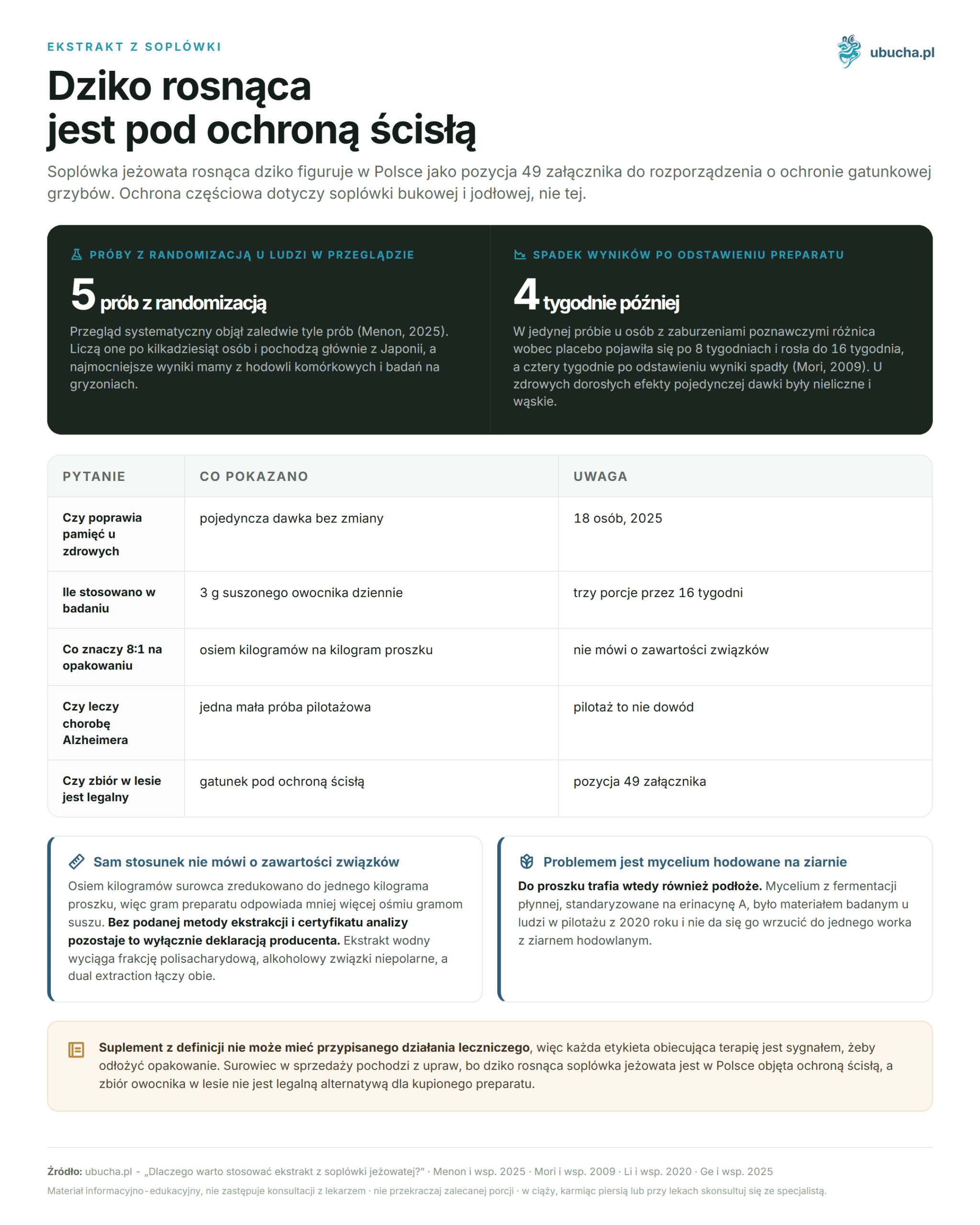
• A systematic review covered only 5 randomized human trials (Menon et al., Frontiers in Nutrition 2025).
• Hericenones C, D, and E alone did not stimulate NGF expression; only the whole extract did (Mori et al., 2008).
• In Mori 2009 trial, cognitive effect disappeared 4 weeks after stopping.
• Market standard is 8:1 fruiting body extract, dual extraction, with certificate of analysis.
How does Lion’s Mane extract differ from dried mushroom?
Extract is a concentrated preparation where the fungal cell wall is broken to release active compounds. Dried fruiting body also contains them but locked in chitin, which human enzymes cannot break down. Standard production described in the polysaccharide review involves hot water extraction and alcohol precipitation (Ge et al., Molecules 2025).
Three factors explain this difference. First is chitin itself: without heat treatment, polysaccharides remain in the cell wall matrix, and the digestive tract lacks enzymes to open it. Second is solubility. The chemical review lists hericenones and erinacines among about seventy described metabolites, alongside hericeryns and sterol compounds, and different classes behave very differently toward water and alcohol (Friedman, Journal of Agricultural and Food Chemistry 2015). A mushroom fried in a pan releases only a fraction of its composition.
The third is purely arithmetic. An 8:1 extract by definition corresponds to eight times the raw material mass, so one gram of powder replaces roughly eight grams of dried mushroom. Reproducing clinical study doses with dried mushroom alone means several grams daily, which quickly becomes uneconomical at good fruiting body prices.
We also noticed that most misunderstandings come from naming. Producers sometimes call ground fruiting body an extract for marketing, as regulations do not forbid it. Until the extraction method and ratio are stated on the package, the word “extract” says nothing about product potency. If you want an ingredient for cooking, dried and fresh fruiting body are fine. To replicate study doses, you need a preparation with a stated conversion factor.
What types of Lion’s Mane extracts are on the market?
Four formats dominate shelves: water extract, alcohol extract, dual extraction, and polysaccharide isolate. They differ in which compound fraction they extract from the fruiting body. Water extracts polysaccharides, alcohol extracts nonpolar compounds, and combining both methods yields a full-spectrum preparation (Ge et al., Molecules 2025).
| Format | What it extracts | Suitable for | Limitation |
|---|---|---|---|
| Water (hot water) | polysaccharides, including beta-glucans | immune support, cheapest form | omits water-insoluble compounds |
| Alcohol (ethanol) | hericenones, erinacines, terpenoids | tinctures and neurotropic profile preparations | practically no polysaccharide fraction |
| Dual extraction | both fractions, mixed post-extraction | default choice without a narrow goal | more expensive, requires checking declarations |
| Polysaccharide isolate | only purified polysaccharides | narrow immunological protocols | no hericenones or erinacines |
The term “dual extraction” is not a legal term or standard but a process description, so its presence on a label alone guarantees nothing. What is verifiable is whether the producer lists both methods separately and shows a lab test result.
Choice depends on your goal. For seasonal immune support, water extract makes sense, as the polysaccharide fraction is responsible for immunomodulatory, anti-inflammatory, and antioxidant effects in this review. For nervous system interest, you need a preparation containing the alcohol fraction as well. Dual extraction is a compromise that simply avoids forcing a choice. More comparisons between mushroom species are in the post about adaptogenic mushrooms.
What do extraction ratios 1:1, 4:1, 8:1, and 10:1 mean?
The extraction ratio indicates how many kilograms of raw material were used per kilogram of finished powder. An 8:1 extract was made from eight kilograms of dried mushroom, so one gram of preparation corresponds to about eight grams of fruiting body. This is a mass conversion, not a measure of specific compound content, and labels usually do not explain this difference.
| Ratio | Usually is | Typical daily dose |
|---|---|---|
| 1:1 | ground fruiting body with minimal processing, marketed as extract | 3-5 g |
| 4:1 | standard mass-market preparation, price-power compromise | 1500-2000 mg |
| 8:1 | most common standardized preparation format | 500-1500 mg |
| 10:1 and higher | premium preparations, declaration requires lab confirmation | 300-600 mg |
Numbers in the dose column reflect market practice, not doses established in studies. There are too few human trials to derive dose grids for each concentration, so producers convert from raw material mass.
The higher the ratio, the greater the temptation to misuse. A “20:1” declaration without lab test results is verifiable only by brand trust, and at high concentrations, the monthly treatment price difference often disappears because the daily dose drops proportionally. It makes more sense to compare monthly treatment cost than package price.
This calculation takes thirty seconds. Divide the package price by the number of days it lasts at the producer’s recommended dose. A more expensive product dosed at 300 mg daily looks very different than a cheaper one requiring two grams daily. The same arithmetic immediately shows whether a high extraction ratio really means savings or just a higher shelf price.
How to read a Lion’s Mane extract label?
A good label answers seven questions before you ask them, and the list below orders them by what is worth checking first. Missing even one item does not necessarily mean a bad product but shifts the entire evaluation burden onto the producer’s declaration and your brand trust.
- Species given in Latin, Hericium erinaceus, not just “Lion’s Mane mushroom”.
- Mushroom part, i.e., fruiting body or mycelium, with a note on how mycelium was grown.
- Extraction method described specifically: water, ethanol, or both.
- Extraction ratio in numeric form, e.g., 8:1.
- Beta-glucan content in percent, not total polysaccharides.
- Hericenone or erinacine content, if the producer standardizes for these compounds.
- Certificate of analysis from an independent lab, publicly available.
The fruiting body versus mycelium debate deserves separate comment because it is often oversimplified. The problem is not mycelium itself but mycelium grown on grain: the substrate also ends up in the powder, and the declared mushroom mass no longer matches reality. Mycelium from liquid fermentation is a different story. A review dedicated to such preparations notes that among described compounds only erinacine A has confirmed effects in the central nervous system of rats (Li et al., Behavioural Neurology 2018).
The same list applies beyond mushrooms, as labeling rules are common for the whole category; we break them down in the post about how to read a dietary supplement label. Percentage values should be treated as declarations, not scientifically established quality thresholds. No study has set a boundary above which an extract “works.” Beta-glucan percentage is useful for comparing products, not predicting effect.
It’s worth opening the certificate of analysis, not just noting its existence. Two things interest you: test date and batch number, because a document from four years ago describes raw material no longer on sale. The contamination section is often more important than active compound content. Mushrooms readily absorb heavy metals from substrate, so cadmium and lead test results tell you as much about the product as declared beta-glucan percentage.
What have human Lion’s Mane studies shown?
The evidence base is sparse. A systematic review registered in PROSPERO covered five randomized trials, three pilot trials, and fifteen lab studies, and a combined MMSE result from one trial and one pilot showed an increase of 1.17 points in the treatment group (Menon et al., Frontiers in Nutrition 2025).
| Study | Participants | Preparation and duration | Result |
|---|---|---|---|
| Mori et al. 2009 | 30 people aged 50-80 with mild cognitive impairment | 3 g dried fruiting body daily, 16 weeks | Higher scores on HDS-R based scale at weeks 8, 12, and 16; decline 4 weeks after stopping |
| Nagano et al. 2010 | 30 menopausal women | Lion’s Mane cookies, 4 weeks | Lower CES-D and ICI scores after treatment; difference versus placebo only in two questionnaire items |
| Saitsu et al. 2019 | Adults, randomized placebo-controlled trial | Fruiting body preparation, 12 weeks | Improvement only in MMSE; Benton and S-PA tests unchanged |
| Li et al. 2020 | Patients with mild Alzheimer’s, pilot | 3 capsules of mycelium with erinacine A daily, 49 weeks | Higher MMSE in treatment group, better contrast sensitivity |
| Docherty et al. 2023 | 41 healthy people aged 18-45 | 1.8 g daily, measurement after dose and after 28 days | Faster Stroop test 60 minutes post-dose; borderline significant stress reduction |
| Surendran et al. 2025 | 18 healthy people aged 18-35 | Single dose 3 g 10:1 fruiting body extract | No effect on overall cognitive and mood assessment; improvement in one manual test |
The simple conclusion from this set is that the best-documented group is older people with already reduced cognitive function, not healthy twenty-somethings seeking an exam edge. In healthy young adults, two trials showed point effects and inconsistent results, and one showed no difference in overall cognition and mood assessment (Surendran et al., Frontiers in Nutrition 2025).
What has been proven only in cells and rodents?
Preclinical data look much better than human data and form the basis of most marketing. The often-repeated claim that hericenones stimulate nerve growth factor production does not hold up to the source: in the 2008 study, hericenones C, D, and E did not stimulate NGF gene expression (Mori et al., Biological and Pharmaceutical Bulletin 2008).
It’s worth tracing what this study actually showed, as it is a good lesson in reading abstracts. NGF expression in human glioma cells was raised by the whole ethanol extract of Lion’s Mane, not isolated hericenones. The effect disappeared after JNK kinase inhibitor administration, indicating a signaling pathway. Mice fed for a week with 5% dried mushroom supplement showed increased NGF mRNA in the hippocampus. Authors concluded that active compounds in this model are not hericenones.
The rest of preclinical data is similar. Water extract combined with external NGF increased neurite growth in a cell line by 60.6% but did not protect the same cells from oxidative stress (Lai et al., International Journal of Medicinal Mushrooms 2013). In rats with crushed peroneal nerve, daily water extract administration accelerated limb function recovery and improved motor endplate reinnervation in the long digital extensor muscle (Wong et al., eCAM 2011). In healthy mice, supplementation improved recognition memory and strengthened synaptic transmission in the hippocampus, a functional change but not proof of new neuron formation (Brandalise et al., eCAM 2017).
None of these results automatically translate to humans. Rats get extract doses scaled to body mass, cultured cells bypass liver metabolism, and mice do not take working memory tests. Preclinical data say there is something to look for, not that it has been found.
How to dose Lion’s Mane extract?
There is no dose established by studies due to too few trials. Market practice ranges from 500 to 3000 mg of 8:1 extract daily, and human study doses were given in grams of raw material or preparation, not milligrams of standardized extract. The table below compares these.
| Situation | Amount | Source |
|---|---|---|
| Daily cognitive support | 500-1000 mg 8:1 extract in two doses | Market practice, order of magnitude matches trials |
| Reproducing protocol from MCI trial | 3 g dried mushroom daily in three doses for 16 weeks | Mori et al. 2009 |
| Healthy adults in short-term studies | 1.8 g daily for 28 days or single 3 g 10:1 extract dose | Docherty et al. 2023, Surendran et al. 2025 |
| Seasonal immune support | ~500 mg water extract once daily | Practice based on polysaccharide fraction |
Hericenones and erinacines are lipophilic compounds, so taking the dose with a fat-containing meal may improve absorption compared to fasting. Five to ten grams of fat suffice: an egg, a handful of nuts, or a tablespoon of olive oil. The polysaccharide fraction is indifferent in this regard.
Time of day has not been compared in studies, so choose the time easiest to maintain for several weeks. Morning has the advantage that the dose does not get lost in evening rush and powder goes into breakfast without extra ritual. Regularity matters more than clock time.
The question of breaks in supplementation remains unanswered. No studies have compared continuous versus cyclic use in humans. Schemes like five days on two off or eight weeks on two off come from general adaptogen habits and have not been tested for Lion’s Mane.
How soon are effects seen and do they persist?
Time frames come from one trial. In people with mild cognitive impairment, the difference versus placebo appeared after 8 weeks and deepened to 16 weeks, and four weeks after stopping, results declined (Mori et al., Phytotherapy Research 2009). The effect thus depends on continuity.
| Time window | What studies show |
|---|---|
| 60-90 minutes post-dose | Single speed tests improved; overall cognition and mood unchanged |
| First 4 weeks | In healthy adults, perceived stress reduction only borderline significant |
| 8-16 weeks | Only clear differences versus placebo, but in people with already reduced cognition |
| 4 weeks after stopping | Results return toward baseline |
Our store observations show most dropouts occur in weeks two and three, when nothing is yet visible. This is understandable but conflicts with study design: none measured effect after two weeks in healthy people, so lack of effect in this window is no information. If you decide to try, a quarter of a year is a reasonable time unit, not a week. Most memory and concentration supplements work similarly.
Separate two easily confused things. The acute effect, i.e., what happens within an hour after dose, was tested with speed tests and results are at best point effects. Effects after weeks were measured with different tools, in different people, and for a different research question. Combining them builds a more coherent picture than the data alone allow.
What to combine Lion’s Mane with and what has evidence?
Combinations with other mushrooms and supplements are popular, but none have been studied in humans as combinations. Arguments for them are mechanistic or experiential, not clinical. The table below separates one from the other to avoid mixing rationale with evidence.
| Combination | Purpose | Evidence status for combination |
|---|---|---|
| Lion’s Mane and cordyceps | Daytime energy during mental work | No studies on the combination itself |
| Lion’s Mane and reishi | Splitting by time of day, evening relaxation | No studies on the combination itself |
| Lion’s Mane and L-theanine | Calm focus, often with caffeine | Data on L-theanine alone |
| Lion’s Mane and omega-3 | Supplementing neuronal membrane fatty acids | Data on omega-3 alone |
| Lion’s Mane and bacopa | Learning and memorizing large material chunks | No studies on the combination itself |
| Lion’s Mane and hemp oil | Relaxation and daily evening ritual | No studies on the combination itself |
A practical rule is simple: add one thing at a time and keep it for several weeks. With three new preparations introduced the same day, you cannot tell which changed anything and which just raised the bill. Ready-made flavor variants, from capsules to Lion’s Mane coffee, differ mainly in convenience, not potency.
The form of preparation deserves a separate word. Capsule, powder, and ready drink deliver the same extract, so the difference is whether you remember the dose. Powder offers dosing freedom and is cheaper per gram, capsules win for travel, and functional drinks are bought mainly for taste and habit.
Is Lion’s Mane extract safe?
The safety profile looks good, though based on short trials with few participants. In a 16-week study at 3 g daily, lab tests showed no adverse effects (Mori et al., Phytotherapy Research 2009). A systematic review lists stomach complaints and headache as reported side effects.
Most reactions are mild and transient. Stomach discomfort usually appears at the start and subsides within days, especially if taken with food rather than fasting. Allergies are a separate matter: Lion’s Mane is a mushroom, so caution is justified if allergic to oyster or shiitake mushrooms.
| Situation | What to do |
|---|---|
| Mushroom allergy | Do not use |
| Pregnancy and breastfeeding | No safety data, decision only with doctor |
| Anticoagulant drugs | Consult before starting |
| Autoimmune diseases | Consult, immunomodulating preparations require supervision |
| Planned surgery | Ask surgical team about stopping in advance |
| Psychotropic and neurological drugs | Decision by attending physician, never self-substitute |
Beyond the nervous system, protective effects on the stomach have been described but in animal models: extract alleviated acute ethanol-induced mucosal damage, with mechanism linked to gut microbiota changes (Bei et al., Food Science and Nutrition 2026).
One question remains about duration. The longest human trial lasted 49 weeks, others from four to sixteen, so we know practically nothing about effects of years-long use. This is not a cause for concern but a knowledge boundary that packaging does not mention.
What Lion’s Mane will not do and how is it regulated?
Lion’s Mane does not cure neurodegenerative diseases or regenerate damaged human nervous system. The only data for Alzheimer’s come from a small pilot where after 49 weeks the group taking mycelium with erinacine A had higher MMSE than placebo group (Li et al., Frontiers in Aging Neuroscience 2020).
A pilot study serves to check if a larger study makes sense, not to prove efficacy. Until repeated in a larger group, the only honest conclusion is: the topic is worth further work. If cognitive impairment is suspected, the first address is a neurologist, not a supplement store, and no preparation replaces treatment in diagnosed disease.
Claims about nerve regeneration should be read equally cautiously. They come from a rat model with crushed nerve and daily oral extract. Translating this to diabetic neuropathy or human injury is a leap not made in any clinical trial.
Formally, the matter is simpler. In Poland, Lion’s Mane products are sold as dietary supplements, and the producer registers the product with the Chief Sanitary Inspectorate before marketing. A supplement by definition cannot have medicinal claims, so any label promising therapy is a signal to put the package down. We described the broader species context in the post about Lion’s Mane properties and dosing.
One surprise for readers thinking about wild harvesting: wild Lion’s Mane is strictly protected in Poland, listed as item 49 in Annex 1 to the Minister of Environment’s 16 October 2014 regulation on fungal species protection (Journal of Laws 2014 item 1408). Partial protection applies to beech and fir Lion’s Mane, not this species. Raw material on sale comes from cultivation, and wild fruiting body collection is not a legal alternative to purchased preparation.
Frequently Asked Questions
Does Lion’s Mane extract improve memory in healthy individuals?
The data are weak. In a trial with 18 healthy people, a single 3 g dose of 10:1 extract did not change overall cognitive or mood assessment (Surendran et al., 2025). In a pilot with 41 people, one attention test time shortened, but some results were zero.
Which Lion’s Mane extract to choose, water or dual extraction?
Water extract pulls out the polysaccharide fraction, alcohol extracts nonpolar compounds. Dual extraction combines both fractions in one preparation and is often the default choice if you don’t have a narrow goal. Water extract alone suffices if you only want immune support during infection season.
How many mg of Lion’s Mane extract is taken daily?
Market practice is 500-1000 mg of 8:1 extract daily. The only trial in people with mild cognitive impairment used 3 g dried fruiting body daily in three doses for 16 weeks (Mori et al., 2009). Studies in healthy adults used 1.8-3 g of preparation.
What does 8:1 on the extract packaging mean?
Eight kilograms of raw material were reduced to one kilogram of powder, so one gram of preparation corresponds roughly to eight grams of dried mushroom. The ratio itself says nothing about the content of specific compounds. Without the extraction method and certificate of analysis, it remains only the manufacturer’s declaration.
How long does it take for Lion’s Mane to start working?
In the only trial with people with cognitive impairment, the difference versus placebo appeared after 8 weeks and increased up to 16 weeks, and four weeks after stopping, results declined (Mori et al., 2009). In healthy adults, effects of a single dose were few and narrow.
Does Lion’s Mane cure Alzheimer’s disease?
No. There is one small pilot trial in patients with mild disease, where the group taking mycelium with erinacine A had a higher MMSE score after 49 weeks (Li et al., 2020). The pilot is not proof of efficacy and does not replace neurological treatment.
Is the fruiting body better than mycelium?
It depends on how the mycelium was produced. The problem is mycelium grown on grain, because the substrate also ends up in the powder. Mycelium from liquid fermentation, standardized for erinacine A, was the material tested in the 2020 pilot and cannot be lumped together with grain-grown mycelium.
Can Lion’s Mane be combined with antidepressant drugs?
There are no studies on such a combination in humans, so the decision is made by the attending physician. The supplement does not replace treatment and psychotropic drugs are never discontinued for it. A 2025 systematic review lists stomach complaints and headache as reported side effects.
If after this reading you want to try, choose a preparation with stated mushroom part, extraction method, and lab test result. The full selection of mushroom extracts and other preparations is in the supplements category.
This article is for informational and educational purposes and does not replace consultation with a doctor. If you are pregnant, breastfeeding, taking medications, or have chronic conditions, consult a specialist before using supplements or herbs.
Author: Michał Waluk · Published: 2026-05-11 · Updated: 2026-08-07