
Sodium Butyrate for the Gut: Dosage and Who It’s For (Table)
Sodium butyrate for the gut: what clinical studies have shown, how sodium salt differs from butyric acid, and why enema results do not transfer to capsules.
Sodium butyrate is sold today as fuel for the colon, and there are indeed numerous studies on butyric acid. The problem arises when translating them into a capsule. Some of the most frequently cited results come from enemas, not oral preparations. Some pertain to complex preparations in which butyrate is one of three ingredients. And the most publicized Polish trial, described online as evidence of effectiveness for irritable bowel syndrome, states something more cautious in its own conclusions than is often attributed to it. Below, we break this down: who studied it, how many participants there were, in what form, and what the results were. Separately, we show how much butyric acid is actually hidden behind the number on the package, as sodium salt and the acid itself have two different masses, and manufacturers sometimes declare one, sometimes the other.
KEY INFORMATION
• Butyric acid is the main source of energy for colonocytes, the epithelial cells of the colon (Wong et al., J Clin Gastroenterol 2006).
• The Polish trial with 66 patients showed a decrease in the frequency of selected irritable bowel syndrome symptoms, but the reduction of abdominal pain, bloating, and bowel disorders was not statistically significant.
• The most frequently cited study on ulcerative colitis involved rectal enemas in ten people, not capsules.
• Sodium butyrate is a salt: about 80% of its mass corresponds to the butyric acid residue, so milligrams of salt and milligrams of acid are two different numbers.
• The most frequently referenced review in this field itself notes that there is still little data from human studies.
What is sodium butyrate and where does butyric acid come from?
Sodium butyrate is the sodium salt of butyric acid, a short-chain fatty acid with four carbon atoms. In the colon, it is produced naturally as the main end product of dietary fiber fermentation by bacteria. A review dedicated to its role states that butyric acid is the main source of energy for colonocytes (Wong et al., J Clin Gastroenterol 2006).
The action does not end with energy. A comprehensive review from 2008 describes the inhibition of inflammation and carcinogenesis, strengthening the components of the gut’s protective barrier, and reducing oxidative stress, with two main mechanisms being the inhibition of NF-kappa B activation and histone deacetylation (Hamer et al., Aliment Pharmacol Ther 2008).
This same review concludes with a statement that is never found in commercial summaries: the observed effects largely depend on the concentrations and research models used, and there is still little data from human studies. The authors state directly that more research in humans is needed to understand the impact of butyrate on colonic function. This is the foundation on which this category of products stands, and it is worth knowing it precisely in this wording.
What human studies really support sodium butyrate?
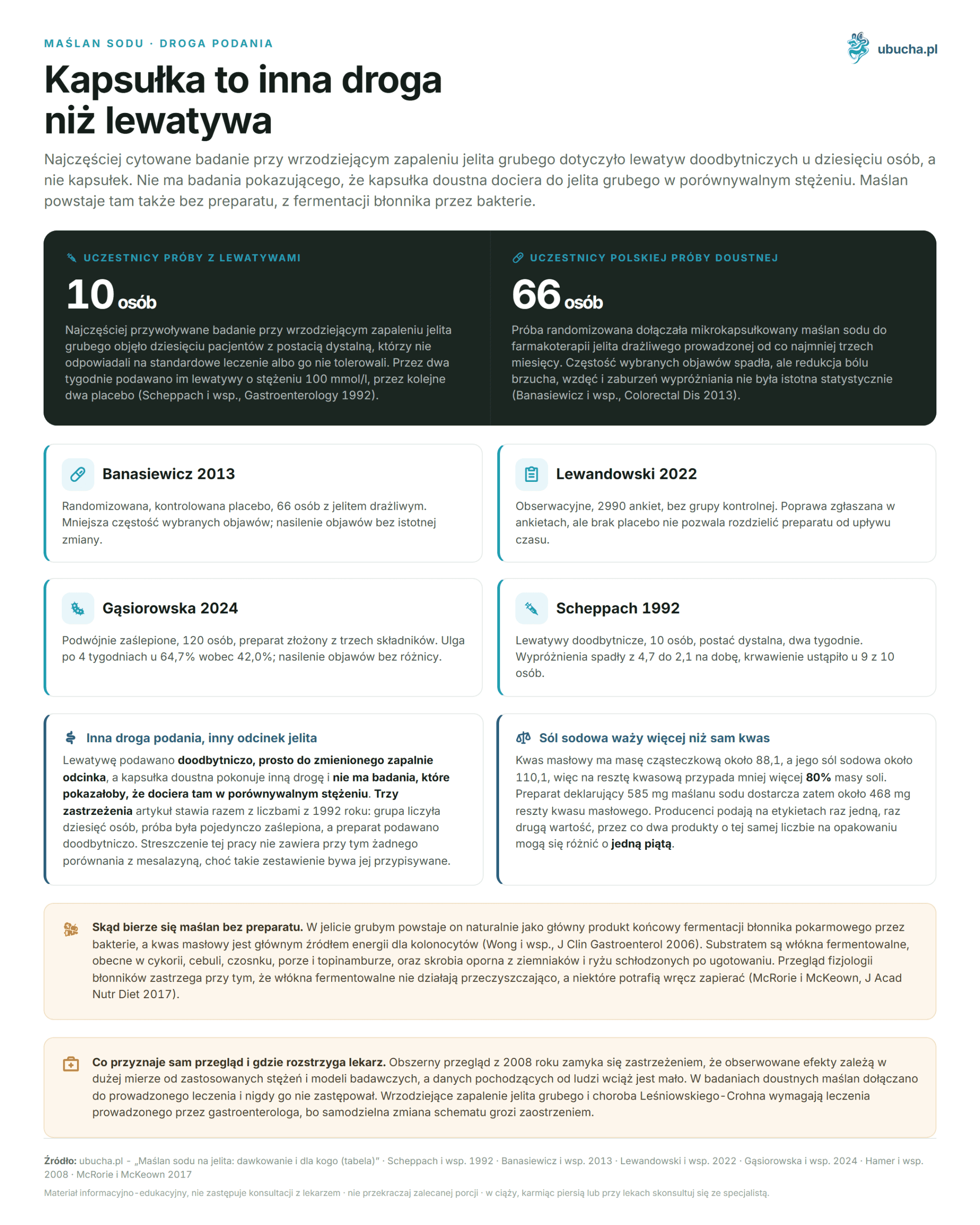
Three, and none say what is usually attributed to them. The most frequently cited is a randomized Polish trial with 66 patients who had been treated for at least three months with standard pharmacotherapy for irritable bowel syndrome. Sodium butyrate in microencapsulated form was added to the ongoing treatment or a placebo was given, and the assessment was conducted after 4 and 12 weeks.
The result is nuanced. After four weeks, pain during bowel movements significantly decreased, and after twelve weeks, urgency and bowel rhythm improved. However, the reduction of abdominal pain, bloating, and bowel disorders did not reach statistical significance, and the authors summarized that the preparation may reduce the frequency of selected symptoms without significantly affecting their severity (Banasiewicz et al., Colorectal Dis 2013).
| Study | Design and Participants | What was given | Result |
|---|---|---|---|
| Banasiewicz 2013 | randomized, placebo-controlled, 66 people with irritable bowel syndrome, 12 weeks | microencapsulated sodium butyrate as an adjunct to standard therapy | reduced frequency of selected symptoms; severity of symptoms without significant change |
| Lewandowski 2022 | multicenter, observational, no control group, 2990 surveys, 12 weeks | sodium butyrate in a triglyceride matrix | improvement reported in surveys; lack of placebo prevents separation of the effect of the preparation and the passage of time |
| Gąsiorowska 2024 | randomized, double-blind, 120 people, 12 weeks | composite preparation: microencapsulated butyrate in a mixture with five probiotic strains and fructooligosaccharides | relief after 4 weeks in 64.7% vs 42.0%; no difference in symptom severity scale and quality of life |
| Scheppach 1992 | single-blind, crossover, 10 people with distal ulcerative colitis | enemas with sodium butyrate 100 mmol/l, two weeks vs two weeks placebo | number of bowel movements decreased from 4.7 to 2.1 daily, bleeding ceased in 9 out of 10, endoscopic index decreased from 6.5 to 3.8 |
The second and third entries in this table are separate traps. The 2022 study includes as many as 2990 completed surveys, but there is no control group, so it does not determine how much of the improvement was due to the preparation (Lewandowski et al., Prz Gastroenterol 2022). The trial from 2024 is properly blinded, but studies a mixture of three ingredients, so the effect cannot be attributed solely to butyrate, and it did not show a difference in symptom severity scale and quality of life (Gąsiorowska et al., J Clin Med 2024).
Why do enema results not transfer to capsules?
Because it is a different route of administration and a different section of the intestine. The most frequently cited study on ulcerative colitis involved ten patients with distal forms who did not respond to standard treatment or could not tolerate it. They were given sodium butyrate enemas at a concentration of 100 mmol/l for two weeks, followed by two weeks of placebo, in random order (Scheppach et al., Gastroenterology 1992).
The results were clear: the number of bowel movements decreased from 4.7 to 2.1 per day, bleeding ceased in nine out of ten people, the endoscopic index decreased from 6.5 to 3.8, and the histological degree of inflammation from 2.4 to 1.5. During placebo, none of these parameters changed. The authors considered this an argument that butyrate deficiency may play a role in the pathogenesis of the distal form of the disease.
However, three caveats must be made alongside these numbers. The group consisted of ten people, the trial was single-blind, and the preparation was administered rectally, directly to the inflamed area. An oral capsule takes a different route, and there is no study showing that it reaches there in comparable concentrations. The summary of this work does not contain any comparison with mesalazine, although such a comparison is sometimes attributed to this study.
What is the difference between sodium salt and butyric acid?
Mass. Butyric acid has a molecular weight of about 88.1, and its sodium salt about 110.1, so the acid residue accounts for about 80% of the salt’s mass. A preparation declaring 585 mg of sodium butyrate thus provides about 468 mg of butyric acid residue. Manufacturers list one value or the other on labels, so two products with the same number on the package may differ by one-fifth.
The second difference concerns form. All three oral studies described above used coated forms: microencapsulated or embedded in a triglyceride matrix. This does not mean that uncoated forms do not work; it means that they have not been studied in this way, and transferring results from a coated preparation to regular powder is a conclusion that these works do not support.
The third difference is practical and concerns smell. Free butyric acid is responsible for the smell of rancid butter, and coated forms also serve to prevent it from being smelled. However, this is a technological feature of the preparation, not proof that the substance reaches where it needs to go.
Where does butyrate come from without supplementation?
From the fermentation of fibers that bacteria can break down. A review of fiber physiology divides them into fermentable, such as inulin, fructooligosaccharides, and wheat dextrin, and those that resist fermentation, such as psyllium and wheat bran (McRorie and McKeown, J Acad Nutr Diet 2017). The substrate for butyrate production is the first group.
This distinction has direct consequences for the choice of preparation and is often confused. The same review states that fermentable fibers do not have a laxative effect, and some can even cause constipation. The opposite is true for gelling psyllium, which acts on bowel movements precisely because it reaches the colon intact; we described this separately in the post about psyllium and the gut and cholesterol. Fiber good for feeding bacteria and fiber good for constipation are usually two different fibers.
This has also been measured directly. In two placebo-controlled trials involving eight healthy volunteers and sixteen people with constipation, psyllium increased the number of bacterial types known for butyrate production, but the changes in concentrations concerned acetate and propionate (Jalanka et al., Int J Mol Sci 2019). We have gathered more about the substrates and strains in the post about prebiotics and probiotics.
Is sodium butyrate enough for inflammatory bowel diseases?
No, and none of the studies described suggest that. The study with enemas involved people who could not tolerate or did not respond to standard treatment, and the preparation was given as an adjunct in controlled conditions. Ulcerative colitis and Crohn’s disease require treatment conducted by a gastroenterologist, and self-changing the regimen risks exacerbation.
The situation is similar with irritable bowel syndrome. The Polish trial added butyrate to pharmacotherapy that had been ongoing for at least three months, not replacing it. Bowel symptoms can also be the first signal of diseases requiring completely different management, so a persistent change in bowel rhythm, blood in the stool, weight loss, or nighttime pain are reasons for diagnostics, not supplementation.
What can be done without a prescription and without risk concerns diet. Substrates for butyrate production, that is, fermentable fibers, can be found in chicory, onions, garlic, leeks, and Jerusalem artichokes, and resistant starch in cooled cooked potatoes and rice. This route does not require any preparation, and Hamer’s review describes it as a natural source of butyrate in the gut.
Frequently Asked Questions
What did the Polish trial with sodium butyrate for irritable bowel syndrome show?
That the preparation reduces the frequency of selected symptoms, but not their severity. In a randomized trial with 66 patients, after four weeks, pain during bowel movements decreased, and after twelve weeks, urgency and bowel rhythm improved, while the reduction of abdominal pain, bloating, and bowel disorders was not statistically significant (Banasiewicz et al. 2013).
Does the study with enemas prove the effectiveness of capsules?
No. The 1992 study involved ten people with distal ulcerative colitis and administered butyrate rectally, directly to the affected area. The results were clear, but they pertain to a different route of administration. There is no study showing that an oral capsule reaches there in comparable concentrations.
How much butyric acid is in sodium butyrate?
About 80% of the salt’s mass. Butyric acid has a molecular weight of about 88.1, and sodium butyrate about 110.1, so a preparation declaring 585 mg of salt provides approximately 468 mg of the acid residue. Labels sometimes provide one value, sometimes the other, so when comparing products, check which number the manufacturer has listed.
Does sodium butyrate have an unpleasant smell?
Free butyric acid is responsible for the smell of rancid butter. The preparations used in studies were in microencapsulated form or embedded in a triglyceride matrix, which limits contact with the substance. However, the coating is a technological feature and does not in itself prove that the substance reaches the colon.
What foods increase butyrate production in the gut?
Fermentable fibers and resistant starch. Inulin and fructooligosaccharides are found in chicory, onions, garlic, leeks, and Jerusalem artichokes, while resistant starch is formed in potatoes and rice cooled after cooking. A review of fiber physiology notes that fermentable fibers do not act as laxatives, and some can even cause constipation (McRorie and McKeown 2017).
Can sodium butyrate be used in inflammatory bowel disease?
Only as an adjunct agreed upon with a gastroenterologist. In oral studies, butyrate was added to ongoing treatment, never replacing it. Ulcerative colitis and Crohn’s disease require specialist supervision, as self-changing the treatment regimen risks exacerbating the disease.
Preparations with sodium butyrate are available in the store at Bucha in the supplements category; store offer status as of August 8, 2026. The topic of rebuilding the microbiota after treatment is discussed more broadly in the post about supplements after antibiotics.
This article is for informational and educational purposes and does not constitute medical advice. Before starting supplementation, consult your doctor, especially if you are taking medications regularly, are pregnant or breastfeeding, or have a chronic illness.
Author: Michał Waluk · Published: 2026-08-09 · Updated: 2026-08-16