
CBD Oil: Reviews and How to Distinguish a Good Oil from a Poor One (2026)
How to distinguish a good CBD oil from a poor one: CoA certificate, spectrum, carrier oil, and price per milligram. What studies and the WHO report from 2018 really say.
When researchers purchased 84 CBD oils online and tested their content, they found label compliance in only 26 of them. The rest had more or less CBD than declared by the manufacturer. This one sentence explains why reviews of CBD oils often contradict each other: two people evaluating a product with the same concentration on the label may have taken completely different doses. Below you will find a method by which we compare oils, the difference between full spectrum and isolate, how to calculate the price per milligram instead of per bottle, and what the WHO report from 2018 established about the safety of CBD. Finally, we return to the threshold of 0.3%, which is sometimes incorrectly stated in product descriptions.
KEY INFORMATION
• Of the 84 CBD oils purchased online, 30.95% showed label compliance; 42.85% contained more CBD, and 26.19% less than declared by the manufacturer (Bonn-Miller et al., JAMA, 2017).
• THC was detected in 18 of these 84 samples, up to 6.43 mg/ml.
• CBD is generally well tolerated according to WHO and has a good safety profile, showing no signs of addictive potential in humans (WHO, 2018).
• The bioavailability of CBD after oral administration is estimated by WHO to be about 6% due to the first-pass effect through the liver.
How did we evaluate CBD oils?
According to five criteria with assigned weights, not according to taste impressions or packaging appearance. The greatest weight is given to the certificate of analysis, as it is the only criterion that can be verified by a document rather than a seller’s declaration. The rest is arranged according to how strongly it affects what actually enters the body.
| Criterion | Weight | What we check |
|---|---|---|
| CoA certificate from an independent laboratory | 30% | Whether the report is available and whether it includes the cannabinoid profile, heavy metals, and pesticide residues |
| Concentration and spectrum | 25% | Isolate, broad-spectrum or full spectrum, and what other cannabinoids the report shows |
| Source of raw material | 20% | Growing region, certification, and whether the manufacturer even states the origin of the extract |
| Carrier oil | 15% | MCT, olive oil or hemp seed oil, and whether the composition is stated directly |
| Price per milligram of CBD | 10% | Price divided by total CBD content, not the price of the bottle |
The weights are not arbitrary. They arise from the fact that in the absence of a certificate, all other criteria rely solely on the manufacturer’s word, and the study from JAMA shows how often that word does not hold true.
What distinguishes a good CBD oil from a poor one?
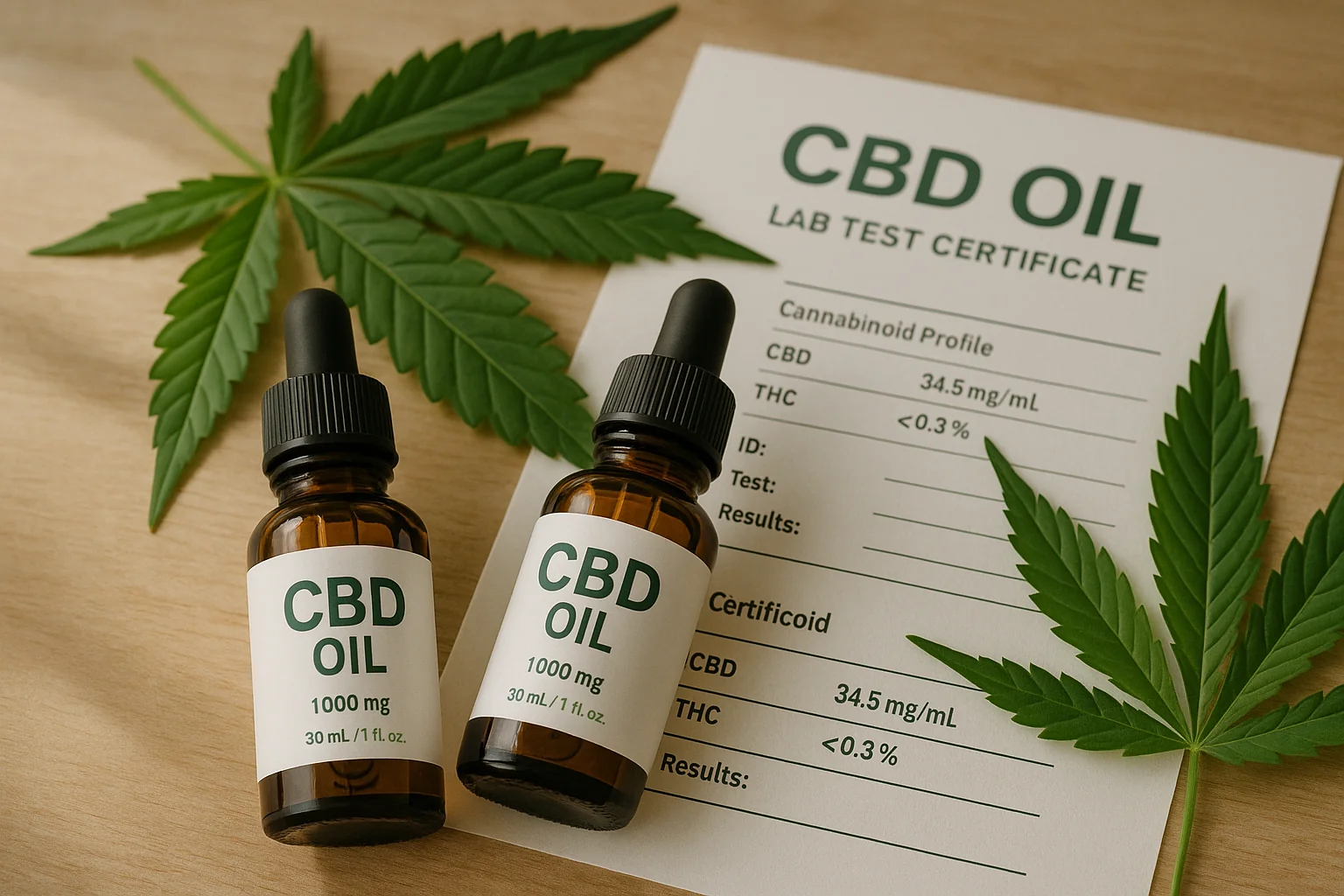
Documentation, not the description on the bottle. A good manufacturer publishes a certificate of analysis from an independent laboratory for a specific batch and provides the cannabinoid profile, heavy metals, and pesticide residues. The absence of such a report is the strongest single warning signal that can be detected before purchase.
The scale of the problem was measured by the Bonn-Miller team, who purchased 84 CBD products from 31 companies online and tested their actual composition. Label compliance, understood as a deviation of up to 10%, was found in 30.95% of samples. In 42.85%, there was more CBD than declared, and in 26.19%, less. Separately, researchers detected THC in 18 samples, at concentrations up to 6.43 mg/ml, although the labels did not indicate it.
This second result has practical implications for anyone subject to drug testing. A product described as “THC-free” without a laboratory report is a declaration, not a fact.
We noticed that people asking about oils for the first time almost never ask about the certificate, only about the percentage on the label. Meanwhile, the percentage without a report describes the manufacturer’s intent, not the content of the bottle, and it is this difference that underlies most of the conflicting opinions online.
Full spectrum, broad-spectrum or isolate?
The difference concerns what besides CBD remains in the extract, and translates into the presence of THC. Full spectrum retains other cannabinoids, terpenes, and flavonoids, broad-spectrum removes THC from this set, and isolate is purified CBD without any accompanying compounds. The same percentage on the label thus means three different products.
| Type | What it contains besides CBD | When it makes sense |
|---|---|---|
| Full spectrum | Other cannabinoids, terpenes, flavonoids, trace THC | When you care about the whole plant profile and are not subject to THC testing |
| Broad-spectrum | Other cannabinoids and terpenes, THC removed | When you want accompanying compounds but without THC |
| Isolate | Nothing, just purified cannabidiol | When you need a product without plant taste or are undergoing testing |
The argument for full spectrum is sometimes presented more strongly than the literature allows. Ethan Russo in a review from Frontiers in Plant Science considers the arguments for the synergy of cannabis components strong enough that a single molecule likely cannot match the potential of the whole plant. This is a thesis about the direction of research, not a measured comparison of doses. No one has shown how many milligrams of isolate would need to be more to match full spectrum. A separate and often confused issue is whether the extract has undergone decarboxylation; we described it in the text about RAW and decarboxylated oils.
Which carrier oil works best?
One that provides fat, because CBD is lipophilic and absorbs poorly without fat. A pharmacokinetic review of CBD in humans states directly that maximum blood concentration increases after a meal and with lipid formulations. This is an argument for MCT and olive oil, and against water-based products.
This same review, however, tempers expectations regarding the numbers circulating in product descriptions. The only route of administration for which absolute bioavailability has been measured in humans is the inhalation route, and it was 31%. For oral and sublingual administration, the authors found no such data, so percentage tables comparing these routes have no basis in measurements.
Practically, this means that you choose the carrier based on tolerance and taste, not based on the promised absorption multiplier. MCT is neutral in taste and remains liquid in the fridge, olive oil brings its own bitter note, which some people like and some mask with a drop of juice. Hemp seed oil is sometimes advertised as a more noble carrier, although it contains virtually no cannabidiol itself; we detailed the difference between it and CBD oil in a separate text about hemp oil and CBD oil.
How to properly use CBD oil?
Starting with a small dose and gradually increasing it, because the absorption of CBD from the gastrointestinal tract is irregular. WHO describes it as erratic and estimates the bioavailability after oral administration at about 6% due to the first-pass effect. The same dose in two people can therefore yield distinctly different blood concentrations.
The WHO report lists sublingual and nasal administration as possible routes alongside capsules and oil solutions, but does not assign any of them a numerical advantage. It is worth remembering this when a product description promises a specific percentage of faster absorption under the tongue. If you prefer a ready dose instead of counting drops, you can find a comparison of forms in the text about CBD capsules.
One thing changes the outcome more than the route of administration: the presence of fat. In a pharmacokinetic study of eight patients with drug-resistant epilepsy, the same capsule taken after a fatty meal produced four times higher area under the concentration curve and fourteen times higher maximum concentration than on an empty stomach. The group was small, and the product was pure CBD in a capsule, so do not directly transfer the numbers to drops, but the direction is clear.
As for the time of day, the data is much weaker than product descriptions suggest. In a retrospective case series by Shannon and colleagues involving 72 people, anxiety scores improved in the first month for 79.2% of patients and were maintained, while sleep scores improved for 66.7% and fluctuated over time. This is a case series without a control group, so it speaks to clinical observation, not efficacy.
How much does a good CBD oil cost?
The price per milligram determines it, not the price of the bottle. Divide the amount by the total CBD content stated on the packaging, and bottles of different sizes and concentrations will become comparable in one number. This one operation eliminates most pricing traps, as the cheapest bottle on the shelf can often be the most expensive per milligram.
In the category of oils in the store at Bucha, prices per milligram of CBD as of August 10, 2026, range approximately from 0.10 to 0.13 PLN. We provide a range for the entire category and with a date because the catalog changes faster than the article, and the price of a single product transcribed into the text becomes outdated within weeks.
The price consists of costs that are not visible on the label. Cultivation in a farm under phytosanitary supervision costs more than raw material from a region without such supervision. Laboratory testing done twice, at the extract stage and on the finished product, is an expense for each batch. A manufacturer who publishes this documentation includes its cost in the price; a manufacturer who does not have it may be cheaper, but then transfers the risk to the buyer.
How much THC can CBD oil contain?
The threshold of 0.3%, repeated in product descriptions, does not apply to the oil but to the plant. According to Article 4 point 5 of the Act on Counteracting Drug Addiction, as amended by the Act of March 24, 2022 (Journal of Laws 2022, item 763), industrial hemp is defined as plants in which the sum of delta-9-THC and tetrahydrocannabinolic acid does not exceed 0.3% when calculated on a dry mass basis, rounded to one decimal place.
Two details from this regulation are often lost in commercial texts. The threshold is calculated as the sum of delta-9-THC and THCA, not just delta-9-THC, which changes the result of laboratory testing. Additionally, the national threshold corresponds to the EU threshold from Regulation 2021/2115, but it does not derive from it: these are two separate regulations with the same numerical value.
Pure cannabidiol does not appear in any list of controlled substances. A separate issue is its food status: the European Food Safety Authority stated in 2022 that the safety of CBD as a novel food cannot currently be established, and pointed out data gaps regarding the liver, gastrointestinal tract, hormonal, nervous, and reproductive systems. One reason is that studies have been conducted on products with varying compositions, whose other post-extraction components are rarely described.
Frequently Asked Questions
Five questions that come up most often when choosing an oil.
How to check if CBD oil is of good quality?
Ask for a certificate of analysis from an independent laboratory for a specific batch and check if it includes the cannabinoid profile, heavy metals, and pesticide residues. In the Bonn-Miller study and others from 2017, only 30.95% of 84 products purchased online had CBD content consistent with the label. The absence of a report means you are buying a declaration.
What strength of CBD oil is good for beginners?
No institution has announced an official starting dose for supplements; WHO only notes that in the literature, oral doses most often ranged between 100 and 800 mg per day in research applications. With lower concentrations, it is easier to dose in small steps, so the beginning usually looks like a choice between 5 and 10%.
Is full-spectrum oil better than isolate?
The arguments for the synergy of cannabis components are considered strong enough by Russo in a 2019 review to suggest that a single molecule cannot match the whole plant. However, no one has measured how much higher the dose of isolate would need to be. Isolate has an advantage when you want to avoid THC.
How long does CBD oil taken sublingually last?
The literature does not establish exact time frames. A pharmacokinetic review in humans states that the time to maximum concentration is between zero and four hours and the half-life is from 1.4 to 10.9 hours after aerosol administration to the mucous membrane. The authors themselves describe the available data as sparse and inconsistent.
Can CBD oil be used together with medications?
Without consultation, it is better not to. WHO notes the possibility of interactions by inhibiting certain cytochrome P450 enzymes, cautioning that it is unclear whether they occur at physiological concentrations. For anticoagulants, antiepileptic drugs, and statins, the decision should be made by a doctor or pharmacist.
If you are considering the concentration itself and not the type of extract, you can find a comparison of strengths from 5 to 30% in the text about choosing the concentration of CBD oil.
This article is for informational and educational purposes. It contains internal links to product categories available in the store at Bucha. Prices and specifications may change: check the current data on the product page before purchasing.
Author: Michał Waluk · Published: 2026-08-09 · Updated: 2026-08-10