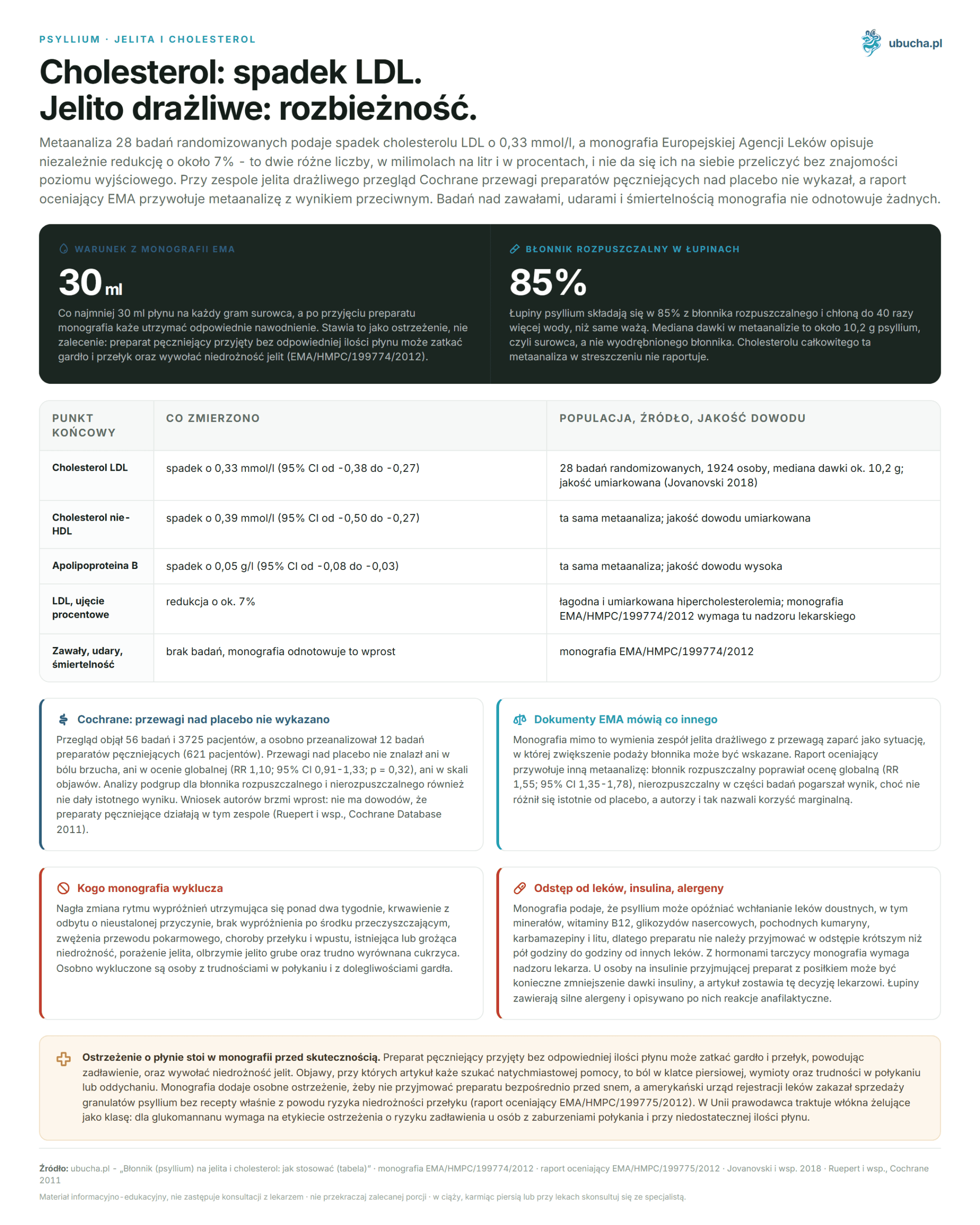

Psyllium (psyllium) for intestines and cholesterol: how to use (table)
Psyllium husks and cholesterol and intestines: what studies have shown, what LDL reduction the EMA monograph reports, and why drinking liquid is a safety condition.
Psyllium husks, commonly referred to as psyllium, have the status of a medicinal raw material in the EU, not just a dietary supplement. The European Medicines Agency described them in a separate monograph: it provided the composition, mechanism, indications, and a list of situations in which this raw material should not be taken. This is rare among ingredients sold as supplements and a good starting point, as it allows separating what has been measured from what marketing has added. Below you will find what studies have really shown about cholesterol, glycemia, and irritable bowel syndrome, as well as one warning that is often omitted in most guides but is at the forefront of regulatory documents. You will also see why the number given in percentages and the number given in millimoles per liter describe the same result in completely different ways, and the size of the effect depends on which one someone chose.
KEY INFORMATION
• The EMA monograph states that psyllium husks consist of 85% soluble fiber and can absorb up to 40 times their weight in water (EMA/HMPC/199774/2012).
• The same monograph mentions a reduction in LDL of about 7% in mild and moderate hypercholesterolemia and adds that there is a lack of studies on cardiovascular events and mortality.
• A meta-analysis of 28 studies involving 1924 people reports a decrease in LDL of 0.33 mmol/l, not a percentage value.
• Taken without sufficient fluid, bulking agents can block the throat and esophagus and cause intestinal obstruction. This is a warning from the monograph, not a precautionary note from the editorial team.
• The Cochrane review from 2011 cannot be cited as evidence of effectiveness for irritable bowel syndrome: it found no evidence of the action of bulking agents.
What are psyllium husks and how do they differ from bran?
Psyllium is the husk of the seeds of Plantago ovata. The European Medicines Agency monograph states that they consist of 85% soluble fiber, absorb up to 40 times their weight in water, and act by hydrating intestinal contents (EMA/HMPC/199774/2012). Wheat bran works differently: it mechanically irritates the intestinal wall.
The difference is not cosmetic. A review of the physiology of dietary fibers separates two purgative mechanisms: large, coarse particles of insoluble fiber stimulate the mucosa to secrete water and mucus, while gel-forming soluble fiber retains water and resists its withdrawal. Both require one condition: the fiber must survive fermentation and reach the large intestine intact (McRorie and McKeown, J Acad Nutr Diet 2017).
Hence comes a statement that sounds paradoxical. Inulin and fructooligosaccharides, fibers marketed as prebiotic, are fermentable and according to the same review do not provide a purgative effect. Psyllium does provide it because it resists fermentation. The EMA monograph provides a hard number: under in vitro conditions, 72% of the raw material remains unfermented. If you are interested in the topic of butyrate and gut bacteria, we have described it separately in the post about sodium butyrate, where the substrates are indeed fermentable fibers.
How much liquid should be consumed and why is this not a cosmetic guideline?
The EMA monograph formulates this as a warning, not a recommendation: taken without an adequate amount of liquid, bulking agents can block the throat and esophagus, causing choking, and lead to intestinal obstruction. Symptoms that require immediate help include chest pain, vomiting, and difficulty swallowing or breathing.
The required ratio is stated directly: at least 30 ml of liquid for each gram of raw material. The monograph adds a separate warning not to take the preparation directly before sleep, as this promotes blockage. The American drug registration agency went further and banned the sale of psyllium granules over the counter, requiring an approved registration application for them, precisely due to the risk of esophageal obstruction (EMA/HMPC/199775/2012 assessment report).
The monograph also lists conditions in which psyllium is contraindicated: a sudden change in bowel habits lasting more than two weeks, rectal bleeding of unknown cause, lack of bowel movement after a laxative, strictures of the gastrointestinal tract, esophageal and cardia diseases, existing or threatened obstruction, intestinal paralysis, megacolon, and poorly controlled diabetes. Individuals with swallowing difficulties and throat ailments are also separately excluded.
Does psyllium really lower cholesterol?
Yes, and the size of the effect is known. A meta-analysis of 28 randomized studies involving 1924 people, with a median dose of about 10.2 g of psyllium, showed a decrease in LDL cholesterol of 0.33 mmol/l (95% CI from -0.38 to -0.27), non-HDL cholesterol by 0.39 mmol/l, and apolipoprotein B by 0.05 g/l (Jovanovski et al., Am J Clin Nutr 2018). The quality of evidence was rated as moderate for LDL and high for apoB.
Note that the work reports the result in millimoles per liter, not in percentages. These are two different numbers and cannot be converted without knowing the baseline level. Separate values for LDL, non-HDL cholesterol, and apoB are also three different endpoints, not three ways of describing the same thing. Total cholesterol is not reported in the summary of this meta-analysis.
| Endpoint | What was measured | Population and source |
|---|---|---|
| LDL Cholesterol | decrease of 0.33 mmol/l (95% CI from -0.38 to -0.27); quality of evidence moderate | 28 randomized studies, 1924 people, median dose approx. 10.2 g; Jovanovski 2018 |
| Non-HDL Cholesterol | decrease of 0.39 mmol/l (95% CI from -0.50 to -0.27) | the same meta-analysis; quality of evidence moderate |
| Apolipoprotein B | decrease of 0.05 g/l (95% CI from -0.08 to -0.03); quality of evidence high | the same meta-analysis |
| LDL Cholesterol, percentage view | reduction of approx. 7% | mild and moderate hypercholesterolemia; EMA/HMPC/199774/2012 monograph |
| Heart attacks, strokes, mortality | no studies, the monograph notes this directly | EMA/HMPC/199774/2012 monograph |
The EMA monograph states independently that in mild and moderate hypercholesterolemia, a reduction in LDL of about 7% has been described, and immediately adds a sentence that guides do not copy: there are no studies evaluating the impact of psyllium husks on the frequency of cardiovascular events and overall mortality. The same monograph stipulates that the use of psyllium as a dietary supplement in hypercholesterolemia requires medical supervision. If you are looking for a comparison with another raw material of this profile, we have compiled the data in the text about flaxseed and cholesterol.
Is it allowed in the EU to state on the label that psyllium lowers cholesterol?
No. We checked the list of permitted health claims from regulation 432/2012 as of August 2026: there is neither psyllium nor Plantago ovata. Therefore, a food producer cannot legally state on the packaging that this raw material maintains normal cholesterol levels, even if clinical studies say otherwise.
In comparison, in the same list, two other fibers have such authorization. Beta-glucans from oats and barley have a claim for maintaining normal cholesterol levels with a daily intake of 3 g and a minimum of 1 g per serving. Glucomannan has a similar claim at 4 g per day, but with an additional condition: the label must include a warning about the risk of choking in individuals with swallowing disorders and with insufficient fluid intake.
This condition shows how the legislator treats gel-forming fibers as a class. It is not that psyllium is worse than beta-glucan. It is that the allowance of a claim is a separate administrative decision, and its absence is not evidence of ineffectiveness nor is its presence evidence of safety. Anyone citing the authority should specify which decision and from what year.
What does psyllium do to blood sugar levels?
The effect depends on how much glycemic control is already impaired. A meta-analysis covering 35 randomized studies from three decades reports that in individuals treated for type 2 diabetes, psyllium taken before meals lowered fasting glucose by 37.0 mg/dl and hemoglobin A1c by 0.97 percentage points. No significant decrease was noted in individuals with normal glycemia; in those with prediabetes, the improvement was moderate (Gibb et al., Am J Clin Nutr 2015).
The reader has the right to know who calculated this. The search included, besides the literature database, clinical documentation held by Procter and Gamble, and this information is stated in the summary of the work. The author of the cited review of fiber physiology is a full-time employee of the same company, who declares this in the article directly: “The author is a full-time employee of the Procter and Gamble Company, which markets a fiber product” (McRorie, Nutrition Today 2015). This does not invalidate the results, but it changes how they are weighed.
The practical consequence is in the EMA monograph, not in guides. If a preparation is taken by a person on insulin with a meal, it may be necessary to reduce the insulin dose. Poorly controlled diabetes is, however, a contraindication. Both of these pieces of information require a conversation with a doctor, not self-correction.
Does psyllium help with irritable bowel syndrome?
Here the evidence diverges, and it is fair to show this. A meta-analysis of 80 populations encompassing a total of 260,960 people estimates the prevalence of irritable bowel syndrome at 11.2% (95% CI 9.8-12.8), with a huge variation between countries, from 1.1% to 45.0% (Lovell and Ford, Clin Gastroenterol Hepatol 2012). The scale of the problem is therefore real.
The Cochrane review covering 56 studies and 3725 patients analyzed separately 12 studies of bulking agents (621 patients) and found no advantage over placebo: neither in abdominal pain nor in global assessment (RR 1.10; 95% CI 0.91-1.33; p = 0.32), nor in symptom scale. Subgroup analyses for soluble and insoluble fiber also did not yield significant results. The authors’ conclusion is straightforward: there is no evidence that bulking agents work in this syndrome (Ruepert et al., Cochrane Database 2011, CD003460.pub3).
Despite this, the EMA monograph mentions irritable bowel syndrome with a predominance of constipation as a situation where increasing fiber intake may be indicated. The assessment report explains this discrepancy: in another meta-analysis, soluble fiber improved global assessment (RR 1.55; 95% CI 1.35-1.78), while insoluble fiber in some studies worsened the outcome, although it did not differ significantly from placebo, and the authors still called the benefit marginal. This is a real state of knowledge, not a compliant chorus. The topic of irritable bowel syndrome from another angle is discussed in our post about irritable bowel syndrome and the microbiome.
Where do bloating from psyllium come from?
Not from fermentation, contrary to the most common explanation. The EMA assessment report cites studies in which psyllium passes through the upper gastrointestinal tract and reaches the large intestine in a highly polymerized form, where it ferments to a limited extent. The concentration of short-chain fatty acids in the stool increases, but no increase in bacterial mass, gas production, or exhaled methane and hydrogen was observed.
Bloating itself is mentioned in the monograph as an adverse effect that usually resolves during use. However, the explanation and resulting advice change. Since it is not about gas production by bacteria, the argument “wait for the microbiome to adapt” has no basis in what has been measured, and the feeling of fullness mainly comes from the volume of the hydrated gel.
Separately, it is worth knowing two interactions that guides remain silent about. The monograph states that psyllium may delay the absorption of orally taken medications, including minerals, vitamin B12, cardiac glycosides, coumarin derivatives, carbamazepine, and lithium, so the preparation should not be taken within half an hour to an hour of other medications. Using it together with thyroid hormones requires medical supervision, as their dose may need adjustment. The husks also contain strong allergens and have been reported as a cause of anaphylactic reactions.
Frequently Asked Questions
How much liquid is required for one serving of psyllium?
The EMA monograph states the ratio: at least 30 ml of water or other liquid for each gram of raw material, and after taking the preparation, proper hydration must be maintained. Without this, the bulking agent can block the throat and esophagus and cause intestinal obstruction. Immediate help is needed in case of chest pain, vomiting, or difficulty swallowing or breathing.
When should psyllium not be taken?
The monograph contains a separate warning not to take the preparation directly before sleep. The assessment report links this to the risk of esophageal blockage and obstruction, which occurs with insufficient fluid intake. Additionally, psyllium should be separated from other medications by at least half an hour to an hour, as it delays their absorption.
By how much does psyllium lower LDL cholesterol?
A meta-analysis of 28 studies involving 1924 people reports a decrease in LDL of 0.33 mmol/l at a median dose of about 10.2 g (Jovanovski et al. 2018). The EMA monograph mentions a reduction of about 7% in mild and moderate hypercholesterolemia. The monograph does not record any studies on the impact on heart attacks, strokes, and mortality.
Does the EU allow a health claim for psyllium?
No. In the list of permitted health claims from regulation 432/2012, as of August 2026, there is no entry for psyllium or for Plantago ovata. However, beta-glucans from oats and barley are allowed to make a cholesterol claim at 3 g per day and glucomannan at 4 g per day.
Who should not use psyllium?
The EMA monograph excludes individuals with a sudden change in bowel habits lasting more than two weeks, with rectal bleeding of unknown cause, with strictures of the gastrointestinal tract, esophageal and cardia diseases, obstruction or risk of obstruction, intestinal paralysis, megacolon, poorly controlled diabetes, and those with swallowing difficulties and throat ailments.
Does psyllium feed butyrate-producing bacteria?
To a limited extent. The EMA monograph states that under in vitro conditions, 72% of the raw material remains unfermented. A study involving eight healthy volunteers and sixteen individuals with constipation showed an increase in the number of butyrate-producing genera, but the measured changes concerned acetate and propionate (Jalanka et al., Int J Mol Sci 2019).
The store u Bucha does not offer either psyllium husks or any other fiber preparation; we reviewed the entire store’s offer as of August 8, 2026.
This article is for informational and educational purposes and does not constitute medical advice. Before starting supplementation, consult a doctor, especially if you are taking medications regularly, are pregnant or breastfeeding, or have a chronic illness.
Author: Michał Waluk · Published: 2026-08-09 · Updated: 2026-08-16