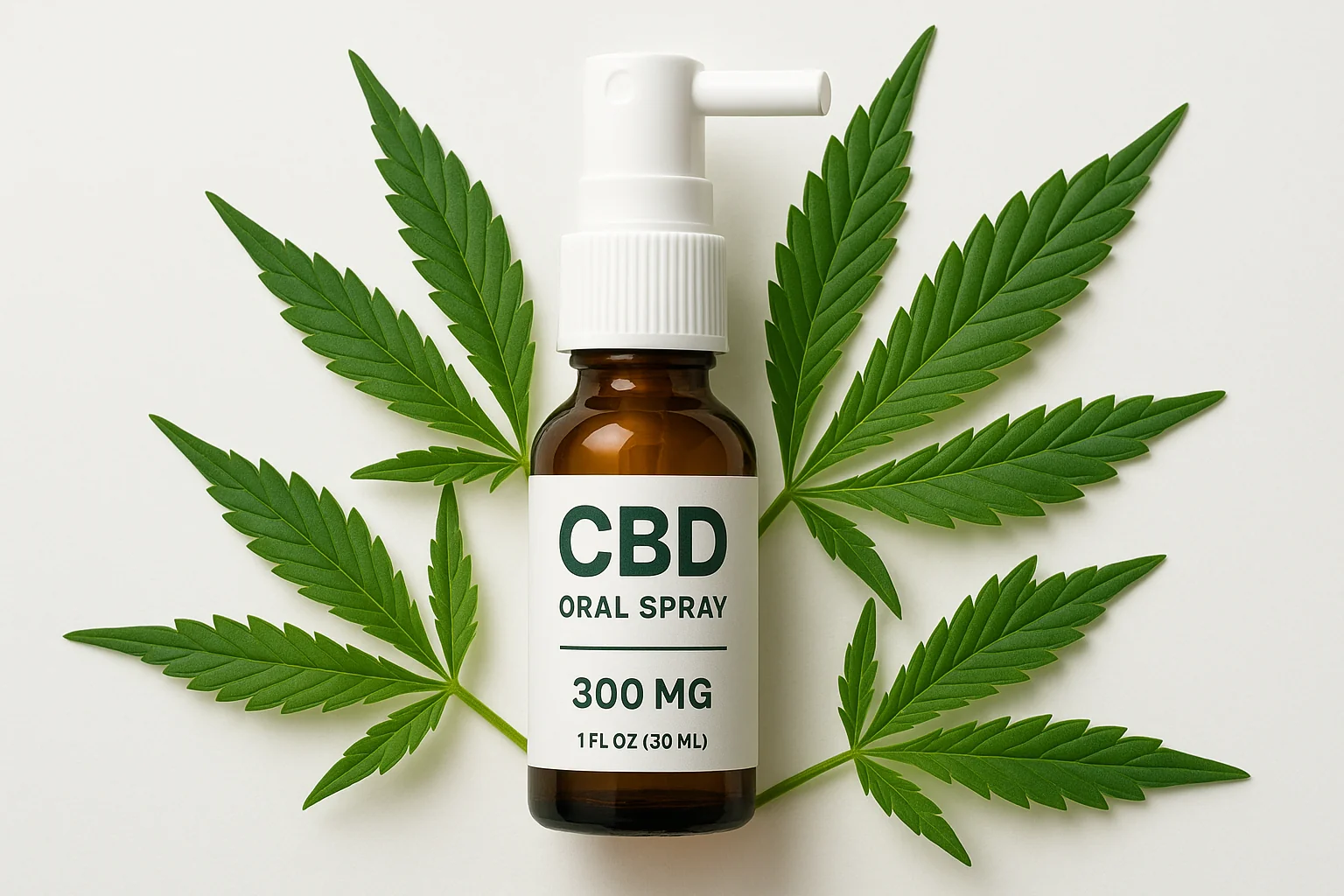

CBD Oral Spray: Uses and Dosage (FAQ)
CBD oral spray: how it differs from oil, how to use it, what pharmacokinetics says about absorption through the mucosa, and what THC threshold applies in Poland.
Oral spray is one of the more convenient forms of cannabidiol: it delivers a measured dose with one press, without counting drops and without a pipette. However, a lot of numbers have accumulated around this form that have no basis in research, especially regarding bioavailability and duration of action. Below, I separate what results from the pharmacokinetics of cannabidiol in humans from what is a convention of use transferred from leaflets. You will find a comparison with sublingual oil, application techniques, criteria for choosing a preparation, and the current legal status of the THC threshold in Poland. The article does not provide a dosage for use. The most misunderstandings concern two things: how much substance actually reaches the bloodstream through the mucosa and how long it stays there. The answers to both questions are much less definitive than suggested by store descriptions, and that is where I begin.
KEY INFORMATION
• Spray and sublingual oil act through the same route, through the oral mucosa; they differ in the method of measuring doses, not in the mechanism.
• Absolute bioavailability of cannabidiol in humans has been measured only for the inhalation route, where it was 31%; for mucosal administration, no such measurement exists.
• After administration on the oral mucosa, the half-life of cannabidiol ranges from 1.4 to 10.9 hours, with the maximum concentration reached within the first four hours.
• The THC threshold in Poland is 0.3% and is calculated as the sum of delta-9-THC and THCA; the value of 0.2% was in effect until May 6, 2022.
• EFSA (2026): the provisional safe dose of cannabidiol is about 2 mg per day for a person weighing 70 kg; safety cannot be established for individuals under 25 years of age, pregnant or breastfeeding women, and those taking medications.
What is CBD oral spray and how does it work?
It is an atomizer that sprays a measured dose of cannabidiol solution onto the oral mucosa with one press, most often under the tongue or on the inner cheek. The amount of substance per press is provided by the manufacturer on the packaging and varies between preparations.
The absorption mechanism is the same as with sublingual oil. Part of the substance penetrates through the mucosal epithelium directly into the bloodstream, bypassing the liver, while the rest is swallowed with saliva and enters the digestive tract. The proportion between them has not been measured in humans, and it determines how much of the amount declared on the packaging actually bypasses the liver.
This is where caution regarding the numbers circulating online comes from. A systematic review of pharmacokinetic studies states directly that the absolute bioavailability of cannabidiol in humans has been determined only after inhalation, where it was 31%, and for other routes of administration, no study has undertaken such a trial (Millar et al., Frontiers in Pharmacology, 2018). Values provided in spray descriptions of several percent do not come from measurements in humans.
How does spray differ from sublingual oil?
Primarily by the method of measuring doses, not by the absorption route. Both forms reach the same mucosa and both are divided into a locally absorbed part and a part swallowed with saliva. The claim that one has higher bioavailability has no basis in measurements in humans.
| Feature | Spray | Sublingual Oil |
|---|---|---|
| Dose Measurement | Fixed dose per press | Fluid adjustment by number of drops |
| Absorption Route | Oral mucosa and part swallowed | Oral mucosa and part swallowed |
| On the Go | Convenient, small format, no pipette | More difficult, pipette can be leaky |
| Auxiliary Ingredients | More often flavors, sometimes ethanol or propylene glycol | Usually just the fat carrier |
| Change in Dose Size | Stepwise, by a whole press | Fine, by a single drop |
The practical difference reveals itself when fine-tuning. The spray changes the dose in steps, by a whole press, so fine adjustments are impossible. The oil allows for changes by a single drop, which is important when gradually reaching a dose. The reverse works for repeatability: the dose from the atomizer is always the same, while the size of the drop depends on the dropper. The choice thus comes down to what is more important in a specific situation, which is discussed more broadly in the guide to choosing cannabidiol products.
How to use CBD spray step by step?
The technique boils down to one thing: keeping the preparation on the mucosa instead of swallowing it immediately. Aim the applicator under the tongue or on the inner cheek, press according to the manufacturer’s instructions, and do not swallow for about a minute, or as long as you can if that is difficult.
The recommendation not to eat or drink immediately before application is a convention of use, not a result of research. It is based on the reasonable assumption that a layer of food on the mucosa hinders contact, but no one has measured this for cannabidiol.
What has been measured, however, is the impact of a fatty meal on the swallowed part. In a study of eight adults, the same dose of cannabidiol in capsules, thus swallowed whole, given after a meal of about 850 kilocalories resulted in a maximum concentration fourteen times higher and total exposure four times higher than on an empty stomach (Birnbaum et al., Epilepsia, 2019). This leads to something more practical than counting seconds under the tongue: the timing of administration relative to meals influences the outcome more strongly than minor differences in technique, so it is worth stabilizing it. This topic is further developed in the text about taking cannabidiol before or after a meal, while the sublingual technique is described in a separate guide.
How long does cannabidiol last after administration on the mucosa?
Less than product descriptions suggest. A systematic review of studies in humans reports that after administration on the oral mucosa, the half-life of cannabidiol ranges from 1.4 to 10.9 hours, with the maximum concentration reached within the first four hours after intake (Millar et al., 2018).
The range of this interval is more important than the numbers themselves. The difference between 1.4 and 10.9 hours is nearly eightfold, and it arises from different preparations, protocols, and study groups in individual works. The authors of the review summarize this state as a lack of data and discrepancies in results, despite the widespread use of cannabidiol.
Therefore, the precise ranges provided in spray descriptions, such as effects lasting from fifteen minutes to six hours, should be read as a marketing promise, not as a measurement result. A more sensible expectation is this: the onset of action occurs within the first hours, and how long it lasts varies among individuals to such an extent that checking it for yourself replaces any number on the label. If the reason for reaching for the preparation is illness or you are taking medications regularly, determining the dose is the responsibility of a doctor, as this article cannot resolve that.
What to pay attention to when choosing a preparation?
To four things, none of which concern promises from the product description. The first is the spectrum of the extract. Full spectrum contains, in addition to cannabidiol, other phytocannabinoids and terpenes, broad spectrum is the same composition with THC removed, and isolate is pure cannabidiol, predictable in composition and devoid of other compounds.
The second is the carrier and auxiliary composition, which is more significant for sprays than for oils. The base can be oil or water with emulsifiers, and some preparations may contain ethanol or propylene glycol. With daily contact with the mucosa, these additives can irritate, so it is worth reading the composition to the end, especially if a burning sensation occurs in the mouth after the first days of use.
The third is a certificate of analysis from an independent, accredited laboratory. It should confirm the actual content of cannabidiol, THC content within the threshold, and the absence of pesticides and heavy metals. An additional condition, which is easy to forget: the certificate must pertain to a specific batch marked with a number, not the entire product line, because only then does it say anything about the item in your hand. The fourth is the manufacturer’s willingness to provide this document without asking.
Is CBD spray legal in Poland?
cannabidiol is not a controlled substance in Poland, but two issues require clarification, as they return in incorrect forms in store descriptions.
The first is the THC content threshold. It is 0.3%, not 0.2%, and is calculated as the sum of delta-9-THC and tetrahydrocannabinolic acid THCA, rounded to one decimal place. The basis is Article 4 point 5 of the Act of July 29, 2005 on Counteracting Drug Addiction as amended by the Act of March 24, 2022 (Journal of Laws 2022 item 763), which has been in effect since May 7, 2022. The value of 0.2% was in effect until May 6, 2022, so its presence in the product description indicates outdated information. The method of calculation has practical significance, as the result of a test covering only delta-9-THC differs from the result for the sum of both compounds.
The second issue concerns the food status. Cannabidiol remains under evaluation as a novel food in the European Union, and this assessment has not been closed. The EFSA position from 2026 is a safety assessment subject to conditions, not a market authorization (EFSA, EFSA Journal, 2026). A sanitary notification is not an authorization of novel food, and the status of the ingredient does not change. You can find products for comparison with the spray form in the oils category.
Frequently Asked Questions
How does CBD spray differ from sublingual oil?
By the method of measuring doses, not by the absorption route. The spray delivers a fixed amount with one press, while the oil allows for adjustments by a single drop. Both forms reach the same mucosa, and the claim of higher bioavailability for either has no basis in measurements in humans.
What is the bioavailability of CBD spray?
It has not been measured. A systematic review of pharmacokinetic studies in humans reports absolute bioavailability only for the inhalation route, which was 31%, and states that no such trials have been conducted for other routes of administration (Millar et al., 2018).
How long does cannabidiol last after administration on the mucosa?
The half-life after administration on the oral mucosa ranges from 1.4 to 10.9 hours, with the maximum concentration reached within the first four hours. The range results from differences between preparations and study protocols, so precise ranges from labels are simplifications.
How to properly use oral spray?
Aim the applicator under the tongue or on the inner cheek, press according to the manufacturer’s instructions, and try not to swallow for about a minute. The recommendation not to eat or drink just before application is a convention of use, not a conclusion from research.
How much cannabidiol should be taken in spray form?
This article does not provide a dosage. EFSA derived a provisional safe dose in 2026 of about 2 mg per day for a person weighing 70 kilograms and stated that safety cannot be established for individuals taking medications. Determining the dose is the responsibility of a doctor.
What is the THC threshold in Poland?
The threshold is 0.3% and is calculated as the sum of delta-9-THC and THCA, rounded to one decimal place. The basis is Article 4 point 5 of the Act on Counteracting Drug Addiction as amended by Journal of Laws 2022 item 763, effective from May 7, 2022. Previously, the threshold was 0.2%.
This article is for informational and educational purposes and does not constitute medical advice. Before starting to use cannabis or CBD for therapeutic purposes, consult a doctor, especially if you are taking other medications, are pregnant, or breastfeeding.
Author: Michał Waluk · Published: 2026-08-09 · Updated: 2026-08-11