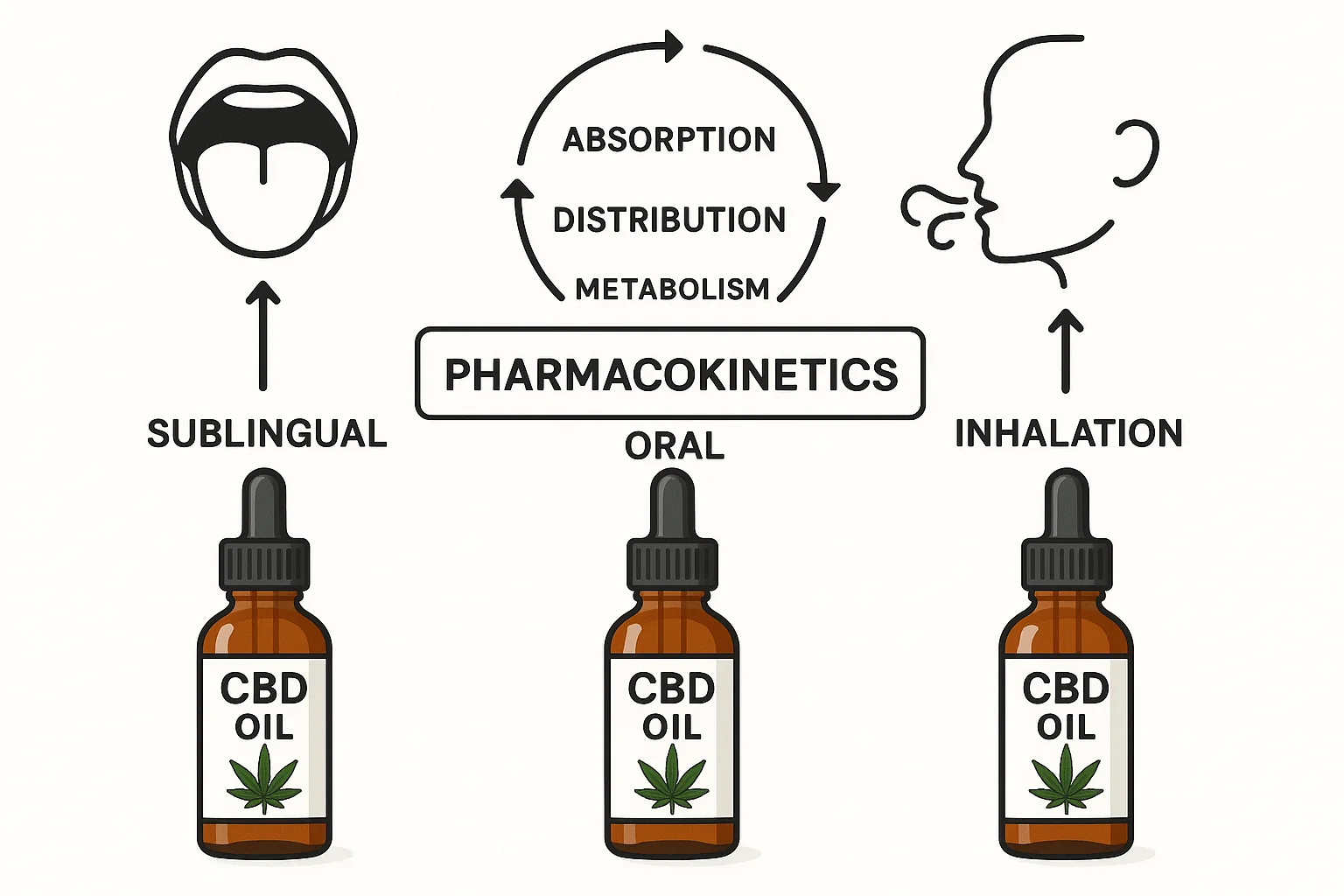

CBD Bioavailability: Why Sublingual, Oral, and Inhalation Work Differently (Table)
The bioavailability of CBD has only been measured in humans for one route of administration and was 31%. Check where the popular percentage tables come from and what the studies say.
A table with three percentages for three routes of CBD administration looks solid: the percentages are specific, and usually, a name and year are next to them. The problem is that the systematic review that such tables refer to states exactly the opposite: the absolute bioavailability of CBD in humans was measured once, for one route of administration, and it was 31% after smoking. No one has published such a measurement for any other route, even though intravenous preparations were available (Millar et al., Frontiers in Pharmacology, 2018). Differences between routes of administration exist and are clear, but no one has expressed them as a percentage of the dose. This article shows what is really known about CBD absorption, where the circulating numbers come from, and how to use this knowledge when choosing a product.
KEY INFORMATION
• The absolute bioavailability of CBD has only been measured in humans after smoking: 31% (Millar et al., 2018).
• There is no such measurement for the oral and sublingual routes.
• A fatty meal increased CBD exposure fourfold in eight patients (Birnbaum et al., 2019).
• The popular “13-19%” comes from animal studies, not from measurements in humans.
What is bioavailability and why is it so difficult to state for CBD?
Bioavailability is the percentage of the administered dose that reaches the systemic circulation unchanged. To calculate it, one must compare the concentration after administration via the studied route with the concentration after intravenous administration in the same individuals. Without an intravenous arm, relative bioavailability results, which is a comparison of two preparations, not a percentage of the dose.
This is where most of the numbers associated with CBD stumble. Millar and colleagues’ review searched the PubMed and EMBASE databases, extracted 792 records, and selected 24 studies with pharmacokinetic parameters of CBD in humans. The authors state directly that only one study provided the bioavailability of CBD in humans, and it was 31% after smoking (Millar et al., Frontiers in Pharmacology, 2018).
The material on which this review is based is thinner than the number 24 suggests. Only eight studies provided CBD alone, the rest in combination with THC or with the whole hemp extract. One study concerned intravenous administration, eight smoking, and twenty-one aerosol on the oral mucosa. The authors summarize this state with the English word paucity, meaning a lack of data.
The consequence for the reader is simple. The percentage assigned to the oral or sublingual route does not come from measurements in humans. This does not mean that there are no differences between routes of administration. It only means that we do not have them expressed as a percentage of the dose, and that any table that provides them adds certainty that was not present in the source.
What is the actual bioavailability of CBD for each route of administration?
One value has been measured and published: 31% after smoking, from Ohlsson’s study from 1986. For the oral, sublingual, and inhalation routes using a vaporizer, Millar’s review found not a single study providing absolute bioavailability in humans. The table below summarizes what is known for sure from the same review.
| Route of Administration | Absolute Bioavailability in Humans | Half-Life | Time to Peak Concentration |
|---|---|---|---|
| Intravenous | 100% by definition | 24 hours | not applicable |
| Inhalation (smoking) | 31%, the only published measurement | 31 hours | 3 minutes to peak 110 ng/ml |
| Aerosol on the oral mucosa | not measured | 1.4-10.9 hours | 1.6-4.2 hours |
| Sublingual Drops | not measured | no data | 1.7-2.2 hours |
| Oral (capsules, swallowed oil) | not measured | 2-5 days with chronic administration | 1.1-3.2 hours |
All values come from Millar’s review. The range of half-life after aerosol, from 1.4 to 10.9 hours, is a compilation of several different studies, not a range from a single measurement. The extension to 2-5 days with chronic oral administration results from the accumulation of CBD in fatty tissue and its slow release from it.
Where did the popular percentage table come from?
The number “13-19%” actually appears in Millar’s work, just in a different place and about something else. It appears in the introduction as a statement about earlier studies: oral bioavailability of CBD was found to be very low, 13-19%, with the authors pointing to Mechoulam’s work from 2002 and noting that it concerns studies involving animals.
In circulating compilations, the same number is placed next to the sublingual position, while a lower range is entered under oral. This results in a table that looks coherent, although one of its values is assigned to the wrong route of administration, and the others have no source at all.
This is a good moment to be cautious about any percentage number related to CBD. If a table does not state in which study, with how many people, and against what reference point the percentage of the dose was measured, there is probably no measurement behind it. Millar’s review concludes that the lack of such studies complicates the interpretation of all other pharmacokinetic parameters of CBD. The authors emphasize that this gap especially concerns routes other than oral, and closing it would require standardized comparative preparations.
Why does less CBD reach the blood after swallowing?
Swallowed CBD is absorbed in the intestine and goes through the portal vein to the liver before reaching the systemic circulation. Some molecules are transformed there before they can act. This stage is called the first-pass effect, and we described it separately in the post about what happens to swallowed CBD oil.
The enzymes involved are known from studies on interactions. Millar’s review refers to works that recommended caution when using CBD simultaneously with drugs metabolized by the CYP3A4 pathway and by the CYP2C19 enzyme, as well as with substrates of the UGT1A9 and UGT2B7 glucuronosyltransferases. For the same reason, a person taking medications regularly should consult a doctor before reaching for CBD.
At the measurement level, the difference between routes of administration is not visible in the percentage of the dose, but in the rate. The review states that the area under the concentration curve and peak concentration increase with the dose and are reached faster after smoking or inhalation than after oral administration or on the oral mucosa. The time to peak concentration falls between zero and four hours and does not depend on the dose size.
Does a fatty meal change CBD absorption?
Yes, and this is the best-documented practical conclusion from the entire pharmacokinetics of CBD. Eight adults with drug-resistant epilepsy took a single dose of a 99% pure CBD capsule once on an empty stomach and once after a meal worth 840-860 kilocalories and high in fat. The peak concentration was on average fourteen times higher after the meal, and total exposure was four times higher (Birnbaum et al., Epilepsia, 2019).
The group was small, so the authors provided a confidence interval instead of just the average: for total exposure, the ratio of values after the meal to values on an empty stomach fell within the range of 3.4 to 7.8. Even the lower limit of this range indicates more than a threefold difference resulting solely from whether the capsule was taken with food.
A second study confirms the direction with another preparation. In Stott’s 2013 study, referenced in Millar’s review, twelve men received a single dose of 10 mg of CBD in an aerosol on the oral mucosa, which also contained THC. After a meal, total exposure was five times, and peak concentration was three times higher than on an empty stomach, with the peak shifting from 1.4 to 4 hours. The type of fat in the preparation itself also matters, and we compared it in the post about MCT and olive oil carriers.
What is the benefit of holding oil under the tongue?
The honest answer is: it is unknown how much more CBD reaches the blood this way, as no one has measured it in humans. However, concentrations are known. Sublingual drops yielded peak concentrations of 2.05 and 2.58 ng/ml, achieved after 2.17 and 1.67 hours. Aerosols administered under the tongue, on the cheek, or to the throat yielded 2.5-3.3 ng/ml after 1.64-4.2 hours.
These values are similar regardless of where in the oral cavity the preparation was placed. The mechanism cited by most guides, which is absorption through the thin epithelium of the floor of the mouth bypassing the liver, is physiologically credible. However, there is no human study that translates it into a percentage of the dose, so the recommendation “hold for 60 seconds, because it will absorb 19% instead of 6%” is based on numbers that no one has measured.
What does this mean practically? Holding the oil under the tongue for several seconds costs nothing and is consistent with how preparations on the oral mucosa were studied. Treat it as a reasonable habit, not as a way to multiply the dose. A habit with a measured effect is rather taking CBD with a fatty meal.
Do nanoemulsions and lipid preparations increase bioavailability?
They increase blood concentration compared to the comparative preparation, and this has been measured, but the comparison did not involve regular MCT oil. Nine healthy men on an empty stomach received a crossover capsule with CBD, THC, and piperine in a nanolipid carrier or an equivalent dose of Sativex aerosol. The nanolipid preparation yielded a peak CBD concentration four times higher and total exposure 2.2 times higher, with the peak coming after one hour instead of three (Cherniakov et al., Journal of Controlled Release, 2017).
Nine people and one administration is too few to speak of a rule. However, the result shows the direction in which drug formulation research is heading. Cherniakov’s team later developed self-emulsifying preparations and reported a similar effect, and Millar’s 2020 review lists low bioavailability, poor water solubility, and variable pharmacokinetic profiles as three obstacles that new formulations aim to eliminate (Millar et al., Pharmaceuticals, 2020).
For the buyer, this means: the terms nano and liposomal on the label are not empty, but refer to studies on nine or a dozen people conducted on pharmaceutical preparations, not on a product from the shelf. How large the difference is between a specific water-soluble preparation and regular oil is discussed in a separate post about CBD nanoemulsions.
How to read this data when choosing a product
From the pharmacokinetics of CBD, three certain things and one uncertain thing emerge today. Certain: smoking provides the fastest increase in concentration, taking with fat clearly increases exposure after swallowing, and with chronic oral administration, CBD accumulates in the body for days, not hours. Uncertain is everything else, including the percentage of the dose for each route other than smoking.
Therefore, comparing products based on declared bioavailability leads nowhere. However, other things can be verified: the CBD content confirmed by a certificate of analysis from an independent laboratory, the presence of a study on heavy metals and solvent residues, and whether the manufacturer provides the carrier composition. A certificate issued by a laboratory linked to the manufacturer has less value than an external one.
Variability between individuals is greater than the difference between preparations. In Birnbaum’s study, the meal itself changed exposure several times in the same individuals. Body weight, time of day, fat content in the diet, and medications taken create an individual profile that no label can predict. A consistent usage pattern and observation of one’s own reaction provide more than switching to a more expensive product.
Frequently Asked Questions
What is the bioavailability of CBD?
In humans, it has been measured once: 31% after smoking a cigarette with 19.2 mg of labeled CBD. For the oral, sublingual, and inhalation routes using a vaporizer, no study has provided absolute bioavailability, even though intravenous preparations allowing such measurement were available (Millar et al., Frontiers in Pharmacology, 2018).
Why is oral CBD absorbed less effectively?
After swallowing, CBD goes through the portal vein to the liver before reaching the systemic circulation, and part of the dose is already transformed at this stage. Millar’s review does not state what percentage of the dose is lost in humans because no such measurement has been made. However, a slower increase in concentration is observed compared to inhalation.
Does a fatty meal really increase CBD absorption?
Yes. In eight adults with drug-resistant epilepsy, the same capsule taken after a high-fat meal resulted in a peak concentration fourteen times higher and total exposure four times higher than on an empty stomach (Birnbaum et al., Epilepsia, 2019). The confidence interval for exposure ranged from 3.4 to 7.8.
How long should I hold the oil under my tongue?
There is no study in humans that compared the holding time with the amount of CBD in the blood. Known concentrations after sublingual drops and after aerosols on the oral mucosa are similar. Holding for several seconds is a reasonable habit consistent with how these preparations were studied, but it is not a way to multiply the dose.
How long does CBD stay in the body?
The half-life depends on the route of administration and whether the administration is single. Millar’s review states 1.4-10.9 hours after aerosol on the oral mucosa, 24 hours after intravenous administration, 31 hours after smoking, and 2-5 days with chronic oral administration.
Which route of CBD administration is best?
There is no data to rank them by the amount of absorbed CBD. It is known, however, that inhalation provides the fastest increase in concentration, and with oral administration, it is most beneficial to take the preparation with a fatty meal. Therefore, choose based on the speed of action and convenience, not the declared percentage.
We have gathered hemp oils in several concentrations in the oils category.
This article is for informational and educational purposes only and does not constitute medical advice. Before starting to use cannabis or CBD for therapeutic purposes, consult your doctor, especially if you are taking other medications, are pregnant, or breastfeeding.
Author: Michał Waluk · Published: 2026-08-05 · Updated: 2026-08-15