
Kief: what it is and how to use it (definition)
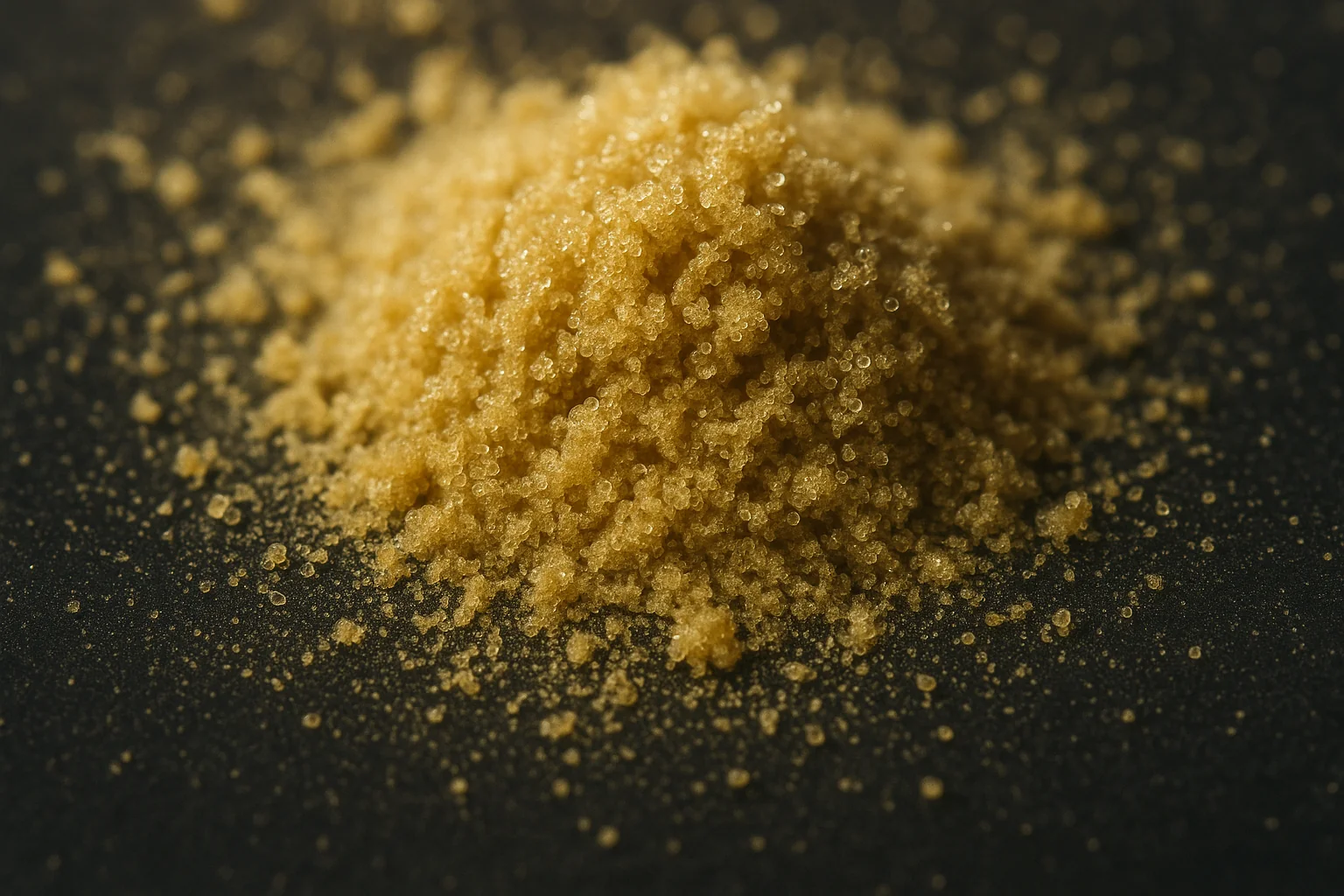
Kief is powdered trichomes from the bottom of the grinder. We explain how many cannabinoids it really has, how to collect it, at what temperature to vaporize, and what the law says.
At the bottom of the grinder, after a few weeks of grinding, a light, powdery sediment collects. This is not crumbs or dirt, but kief: trichomes detached from the material, which are exactly the structures in which the plant synthesizes cannabinoids and terpenes. Most users throw it away with the leftovers because they do not know what it is, and guides provide numbers that no one has ever measured. In this text, you will find what can be verified at the source: how many cannabinoids the concentrate from trichomes contains according to published measurements, how to collect the sift without additional equipment, at what temperature vaporization actually occurs, and where in Polish law the boundary lies between legal fiber hemp and material that cannot be collected.
KEY INFORMATION
• Cannabinoids are produced exclusively in glandular trichomes of the flower, so sifting trichomes concentrates them without any chemicals (Xie et al., Horticulture Research 2023).
• The closest measured reference point for trichome concentrate is hand-collected resin: in 58 samples from the Himalayas, the average total THC content was 40% (Chauhan et al., Journal of Forensic Sciences 2024).
• Vaporizers tested in laboratory conditions operated at 210 degrees and delivered from 55 to 83% total THC, without burning the material (Lanz et al., PLoS One 2016).
• Legal hemp in Poland is fiber hemp: the sum of delta-9-THC and THCA in the tops does not exceed 0.3% dry weight (art. 4 point 5 of the Act on Counteracting Drug Addiction).
• Kief degrades faster than dry material because trichomes lose the protective plant mass.
What is kief and where does it come from?
Kief, also spelled keef or kif, is the common name for powdered trichomes of cannabis. Trichomes are microscopic glandular protrusions covering the flowers and adjacent leaves. Under a magnifying glass, they look like little mushrooms: a round head mounted on a thin stalk.
The head is the essence of the matter. A review of cannabinoid biosynthesis published in 2023 in Horticulture Research describes it as the place where cannabinoids are produced; the biosynthetic pathway is specific to trichomes in the plant. This same structure produces terpenes responsible for the aroma and flavor of the strain. Besides the heads, there are practically no cannabinoids, and the stem and fan leaves carry as much as has accidentally settled on the surface. Sifting only the heads is therefore a purely mechanical concentration: you add nothing and transform nothing.
When you grind the material, some heads break off from the plant material. If the grinder has a screen, the particles pass through it and settle in the lower chamber. This is the entire mechanism: mechanical sifting, without solvents, pressure, and heating. The color of the finished kief can range from creamy to golden brown, and a darker color usually indicates a greater admixture of crushed plant material.
How many cannabinoids are really in kief?
No one has measured this for kief from a home grinder, and no reliable number exists for it, as the purity of the sift depends on the screen and how many leaves fell in with the heads. The closest reference point is hand-collected resin. Chauhan and colleagues examined in 2024 in Journal of Forensic Sciences 58 samples from twenty regions of the northwestern Himalayas using HPLC. The average delta-9-THC content was 26%, THCA 15%, and total THC 40%.
This same work shows how wide the range is: within one region, the difference between the weakest and strongest resin reached an average of 27 percentage points. The conclusion for the reader is the opposite of the marketing one. The concentrate from trichomes can be many times stronger than the starting material, but the number on the store label or in the guide says nothing about what you have in your grinder.
| Feature | Kief | Hash | Extract |
|---|---|---|---|
| Form | Loose powder | Compressed mass | Oil or wax |
| Method of obtaining | Dry sifting | Pressing kief or collecting resin | Solvent or CO2 extraction |
| Solvents | None | Usually none | Yes |
| Equipment | Grinder with a screen | Press or hands | Laboratory installation |
| Status in Polish law | Depends on the starting material | Processing raw material above the threshold is subject to art. 53 | Depends on the raw material and cannabinoid |
How to collect kief at home?
All you need is a grinder with a screen and patience, as kief collects itself during regular grinding. The condition is the construction: only three- and four-piece models have a chamber for sifting, where a mesh is located between the grinding chamber and the bottom. A two-piece grinder does not sift anything, so trichomes remain on the material. The differences between constructions are outlined separately in the text about how to choose a grinder. When buying a grinder in our grinder category or anywhere else, check the number of parts first, as it determines the sifting.
Collecting is accelerated by cold. Chilled trichomes become brittle and break off more easily from the plant mass, so briefly cooling the closed grinder before grinding increases the sift. After removing, it is worth grinding immediately before the device has time to cover itself with condensed moisture.
The third method is dry sifting through separate screens of varying mesh density, which is the method used in hash production. The denser the screen, the cleaner and lighter the sift, as only the heads pass through finer meshes, not fragments of leaves. This method yields more material but also requires significantly more starting material.
We have noticed a thing that guides rarely mention: kief from the bottom of the grinder is almost never a pure sift of trichomes. Along with the heads, plant dust falls, and its share increases the finer you grind. Light color is the only simple indicator of purity you have at hand without a laboratory.
Is collecting kief legal in Poland?
The answer depends solely on what you are collecting, not on what you are doing. Polish law sets the boundary on the plant: fiber hemp is Cannabis sativa L. plants, in which the sum of delta-9-THC and tetrahydrocannabinolic acid in the flowering or fruiting tops, from which the resin has not been removed, does not exceed 0.3% when calculated on dry weight, rounded to one decimal place. The basis is art. 4 point 5 of the Act on Counteracting Drug Addiction as amended by the Act of March 24, 2022.
Two things in this sentence have practical significance. First, the threshold describes the plant, not the product from it, so it is not a limit for the powder in your grinder. Second, the law sums delta-9-THC and THCA directly, while the “Total THC” position on the analysis certificate converts THCA with a coefficient of 0.877. For the same sample, the statutory number thus comes out higher than the certified one, and this distinction can determine the outcome of a test.
Material that exceeds this threshold is cannabis other than fiber hemp within the meaning of art. 4 point 37 of the same Act. Giving such raw material a new form, including pressing the sift into hash, falls within the statutory definition of processing from art. 4 point 20 and is subject to art. 53. Home pressing of kief from legal fiber hemp is a completely different legal situation than the same action on material above the threshold, although the action looks identical and is performed with the same gesture.
At what temperature does kief vaporize?
Higher than most guides repeat. Lanz and colleagues checked in 2016 in PLoS One five vaporizers on THC and CBD type material; all electric devices were set to 210 degrees Celsius. The vapor contained from 54.6 to 82.7% total THC and from 45.9 to 70.0% total CBD, depending on the model.
The effectiveness of decarboxylation, or the transition of inactive cannabinoid acids to active forms, was at least 97.3% for THC and at least 94.6% for CBD in the same study. The authors emphasize that the reaction depends on temperature and occurs above 180 degrees, and they cite an earlier measurement in which the best ratio of cannabinoids to by-products occurred at 230 degrees. Burning of the material was observed only in the gas device, whose temperatures could not be set or measured.
The practical conclusion is that setting 160 degrees is not a safer option, just a different one: below 180 degrees, a significant portion of cannabinoid acids will not have time to transform into active forms. The temperature is therefore chosen according to the goal, not to the belief that less always means better; we have elaborated on this in the guide on how to choose a vaporization temperature. It is also worth mixing kief with a bit of material, as the loose powder clumps in the chamber and blocks airflow.
How to use and store kief?
The simplest application is a pinch sprinkled on top of the material in the vaporizer chamber or in a pipe. Kief can also be pressed: under pressure and warmth of the hands or a small press, the heads stick together into a compact mass, which is homemade hash. The third way leads to the kitchen, but requires prior heating of the material, as in fresh sift, cannabinoids mainly occur as acids.
Wang and colleagues studied this transformation in 2016 in Cannabis and Cannabinoid Research, heating extracts in a vacuum dryer at five temperatures from 80 to 145 degrees for up to an hour. The reaction follows first-order kinetics, and the rate constants for THCA acid were twice as high as for CBDA acid. Therefore, CBD-rich material needs significantly more time or higher temperature for the same transformation than THC-rich material, which, when treated the same way, yields different results.
Storage follows a simple rule: trichomes lacking the protective plant mass have a larger surface area in contact with oxygen, so they oxidize faster than dry material. Heat and light accelerate both the breakdown of acids and the transition of THC to cannabinol. In Himalayan resin, the proportion of cannabinol to THC, CBD, and CBN was from 4 to 8 parts per hundred, showing how far this aging can go in material stored without safeguards. A tight glass container in a dark and cool place is sufficient; the same principles apply as with dry material, which we have outlined in the text on how to store dry material. Avoid plastic for a mundane reason: static charge attracts the powder to the walls, and part of the supply remains in the container.
Frequently Asked Questions
What is the difference between kief and hash?
By the degree of processing, not by composition. Kief is a loose sieve of trichomes straight from the screen, hash is made from it by pressing, sometimes with heating. The starting material is the same, so the cannabinoid profile can be similar; hash is just more convenient to store and less prone to spilling.
Where does the word kief come from?
From Arabic, where it means pleasure or well-being. The name traveled to Europe along with descriptions of hashish production in North Africa and has been adopted in Western languages in several spelling variants: kief, keef, and kif. In Polish industry texts, the form kief is mainly used today.
Will a two-piece grinder collect kief?
No. Sifting requires a screen separating the grinding chamber from the lower chamber, and only three- and four-piece grinders have such a solution. In a two-piece model, trichomes remain on the ground material, which in itself is not a loss, as you use them together with the material.
How many cannabinoids does kief contain?
No one has measured this for home-sifted kief. The closest data pertains to hand-collected resin: in 58 Himalayan samples, the average total THC content was 40%, with a range reaching 27 percentage points in one region. Your kief also contains plant dust, so it will be weaker.
Does kief need to be decarboxylated before use in cooking?
Yes, because in fresh sift, cannabinoids mainly occur as acids. Wang and colleagues showed in 2016 that the transformation occurs at temperatures from 80 to 145 degrees and follows first-order kinetics, with CBDA acid reacting about twice as slowly as THCA.
Why does kief darken?
For two reasons at once. Fresh sift darkens over time due to oxidation, as trichomes lacking the protective plant mass have a large contact with air. The second reason is the admixture of crushed plant material, which increases with fine grinding and is immediately visible after collection.
Tight glass containers and humidity regulators can be found in the storage category.
This article is for informational and educational purposes and does not replace consultation with a doctor. If you are pregnant, breastfeeding, taking medications, or have chronic conditions, consult the use of supplements or herbs with a specialist.
Author: Michał Waluk · Published: 2026-08-09 · Updated: 2026-08-16