
Ashwagandha for Subclinical Hypothyroidism: Normalization of TSH
One pilot study on 50 individuals, lowering TSH and all the other questions unanswered. We check what can be read from this and what cannot.
A TSH result slightly above normal, and free T4 is fine. The doctor suggests observation, you feel tired and are looking for something to speed things up. This is where ashwagandha appears in the search engine, usually along with the promise of normalizing TSH. The basis for this promise is one pilot study from 2018, conducted on fifty individuals in one hospital in India. This text shows what exactly was measured in it, what was not measured, and why simply lowering TSH is not yet evidence that anyone feels better. It also shows when ashwagandha can be dangerous in thyroid disease, as this part of the description is often lost in most discussions. We have verified every number in the summary or in the full text of the cited work.
KEY INFORMATION
• The only study of ashwagandha for this diagnosis is a pilot study on 50 individuals, eight weeks, one center (Sharma et al., Journal of Alternative and Complementary Medicine, 2018).
• A review in JAMA states that most patients can be observed without treatment, and there is no evidence of benefit from levothyroxine in individuals over 65 years of age (Biondi et al., JAMA, 2019).
• Cases of thyrotoxicosis after ashwagandha and a series of five cases of drug-induced liver injury have been reported.
• The EMA committee has not established a monograph for the root of Withania somnifera, so there is no officially described indication or quality of the extract.
What is subclinical hypothyroidism and who does it affect?
This is an elevated level of thyrotropin (TSH) with normal free thyroxine levels. A review published in JAMA estimates that this condition affects up to 10% of the adult population, with the most common cause being autoimmune thyroiditis of the Hashimoto type (Biondi et al., JAMA, 2019). In individuals with circulating antibodies against thyroid peroxidase, the risk of progressing to overt hypothyroidism is higher.
The same review contains a caveat that usually disappears in popular discussions. TSH levels increase with age even in people without thyroid disease, and in patients over seventy, it can exceed the upper limit of the traditional reference range, which is 4 to 5 mU/l. The authors state directly that this phenomenon has likely led to an overestimation of the actual frequency of diagnosis in older age groups. In other words: some results that look like a disease at the age of sixty-something are simply a result of aging.
The symptoms attributed to this condition are nonspecific. The review lists cognitive disturbances, fatigue, and mood changes in middle-aged individuals, but the same set of symptoms fits iron deficiency, insomnia, or depression. Therefore, the diagnosis is made based on blood test results, not well-being, and that is why mere fatigue is not an indication to reach for anything.
What did the only study of ashwagandha for this diagnosis really show?
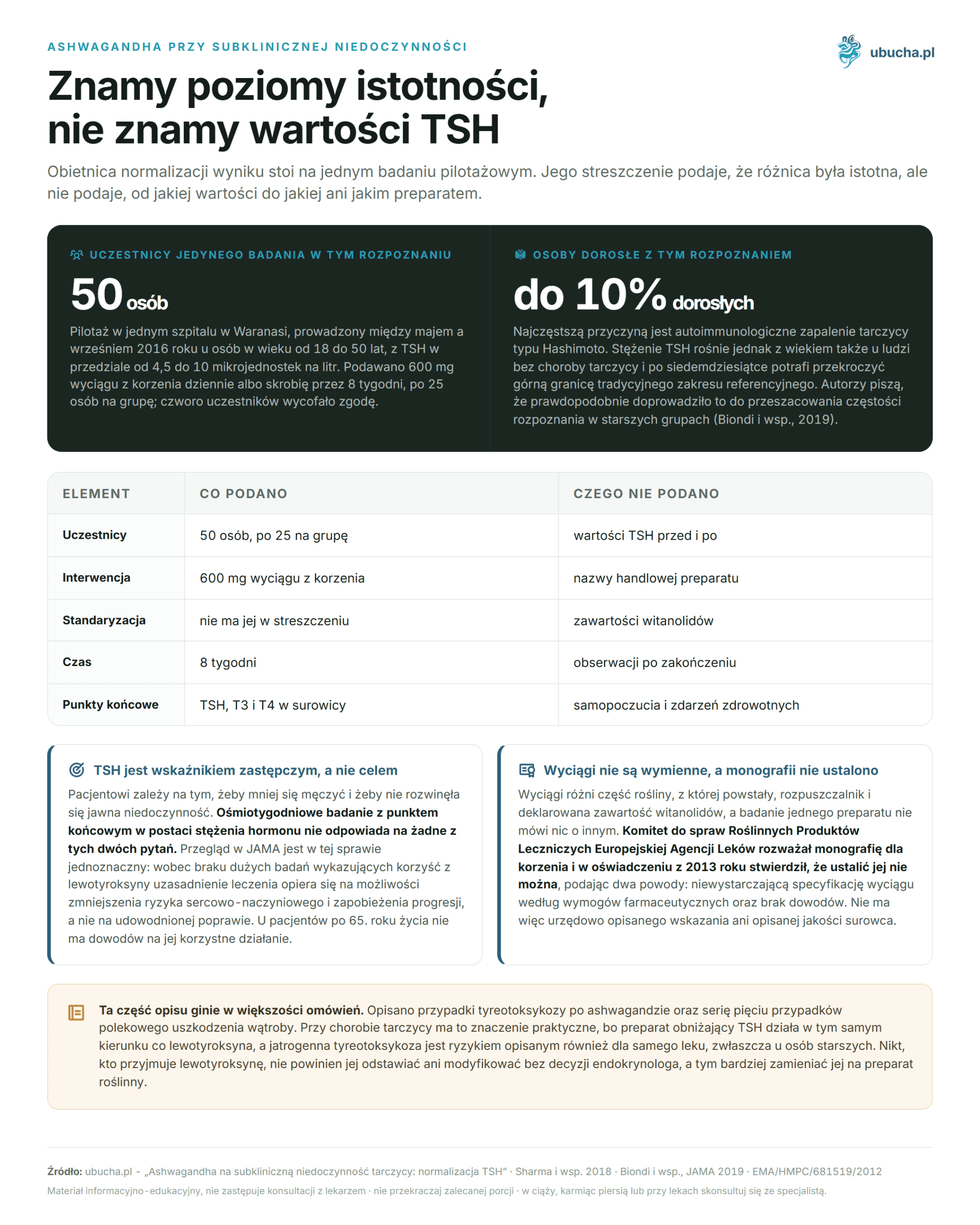
The work of Sharma and colleagues from 2018 is a prospective, randomized, double-blind study with a placebo control, described by the authors themselves as pilot (Sharma et al., Journal of Alternative and Complementary Medicine, 2018). It was conducted in one hospital in Varanasi, India, between May and September 2016, on fifty individuals aged 18 to 50, with TSH levels ranging from 4.5 to 10 microIU/ml.
| Study Element | What was stated in the publication |
|---|---|
| Participants | 50 individuals, 25 on extract and 25 on placebo; four withdrew consent |
| Intervention | 600 mg of root extract daily or starch as placebo |
| Duration | 8 weeks |
| Endpoints | Serum levels of TSH, T3, and T4 |
| Result vs placebo | TSH p below 0.001; T3 p equal to 0.0031; T4 p equal to 0.0096 |
| Adverse events | mild and transient in 4 out of 50: one on extract and three on placebo |
The summary does not provide the trade name of the preparation, the declared content of withanolides, or the TSH values before and after the intervention. It only provides significance levels. The authors’ conclusion is cautious: treatment with ashwagandha may be beneficial for normalizing thyroid indicators in patients with this diagnosis. It does not mention well-being or health events.
Does lowering TSH mean a health benefit?
No. TSH is a surrogate marker, meaning a number that correlates with the state of the thyroid, but is not what the patient cares about. The patient cares about feeling less tired and not developing overt hypothyroidism. An eight-week study with an endpoint of hormone levels does not answer either of those two questions.
A review in JAMA is unequivocal on this matter. In the absence of large randomized studies showing benefit from levothyroxine, the justification for treatment is based on the possibility of reducing cardiovascular risk and preventing progression to overt hypothyroidism, not on proven improvement. The authors add that levothyroxine itself can cause iatrogenic thyrotoxicosis, especially in older individuals, and that there is no evidence of its beneficial effect in patients over 65. The final conclusion is that most individuals with this diagnosis can be observed without treatment.
If even a drug with an established mechanism and decades of clinical use does not have a certain justification here, then lowering TSH through a supplement after eight weeks is even less evidence of benefit. This finding works both ways. No one taking levothyroxine should discontinue or modify it without the decision of an endocrinologist, let alone replace it with a herbal preparation.
Are ashwagandha extracts interchangeable and who studies them?
No, they are not. Extracts differ in the part of the plant from which they are derived, solvent, and declared content of withanolides, and studying one preparation says nothing about another. The Committee on Herbal Medicinal Products of the European Medicines Agency considered a monograph for the root of Withania somnifera and stated in a statement adopted on July 9, 2013, that it cannot be established (EMA/HMPC/681519/2012). Two reasons were given: insufficient specification of the extract according to pharmaceutical requirements and lack of evidence for thirty years of medicinal use, including fifteen years in the European Union.
The practical consequence is that there is no official description of what an ashwagandha extract should be. The most frequently cited publications on this topic studied one specific preparation. In the stress study of 64 individuals, it was the KSM-66 extract provided by the manufacturer, made exclusively from the root and standardized to at least 5% withanolides by HPLC (Chandrasekhar et al., Indian Journal of Psychological Medicine, 2012). The authors declared no funding and no conflicts of interest, but the raw material studied came from its manufacturer. The same was true in the study on muscle strength, where the acknowledgments directly indicated two companies supplying this extract (Wankhede et al., Journal of the International Society of Sports Nutrition, 2015).
In the stress study, cortisol decreased in the extract group by 27.9% from baseline, compared to 7.9% in the placebo group. This is the result of one trial in individuals with chronic stress, and not a repeatable range confirmed by multiple studies, and does not concern patients with thyroid disease.
Who can ashwagandha harm in thyroid diseases?
The direction of action described in the Sharma study is significant here: the extract raised T3 and T4. In a person taking levothyroxine or with hyperthyroidism, this action adds to what is happening in the body, rather than balancing it. The risk is therefore not undertreatment, but hormone overdose.
Case reports confirm this. In 2005, a case of thyrotoxicosis was published in a healthy 32-year-old woman who took ashwagandha extract capsules for chronic fatigue; symptoms resolved spontaneously after discontinuation, and results returned to normal (van der Hooft et al., Nederlands Tijdschrift voor Geneeskunde, 2005). In 2022, a 73-year-old patient with supraventricular tachycardia and very low TSH was described after two years of self-administering the extract for hypothyroidism (Kamal et al., Cureus, 2022).
A separate signal is the liver. A series of five cases from Iceland and the American monitoring network for drug-induced liver injury describes jaundice appearing after 2 to 12 weeks of taking ashwagandha supplements, of a cholestatic or mixed nature, with prolonged itching and normalization of results after 1 to 5 months (Björnsson et al., Liver International, 2020). A safety review from 2026 indicates pregnant women, patients with thyroid diseases, and individuals with liver or kidney failure as high-risk groups and advocates for limiting the use of ashwagandha in food (Li et al., Phytotherapy Research, 2026).
Another factor affecting the result of the measurement is biotin. A dose of 10 mg daily for eight days altered TSH, free T4, and total T3 readings on some laboratory platforms, most strongly two hours after ingestion (Ylli et al., Thyroid, 2021). If you are supplementing biotin, inform your doctor before blood collection. A separate, better-documented pathway of support for autoimmune thyroiditis is selenium, whose supplementation is associated with a decrease in the level of antibodies against peroxidase (Ventura et al., International Journal of Endocrinology, 2017); we develop this topic in the post about selen and iodine for the thyroid.
Frequently Asked Questions
Does ashwagandha normalize TSH?
One pilot study with a placebo control showed significant changes in TSH, T3, and T4 after eight weeks of taking root extract in 50 individuals with elevated TSH. This is one center and a small sample, so the result needs to be repeated in larger studies before it can be the basis for any recommendations.
Does lower TSH mean I will feel better?
Not necessarily. TSH is a surrogate marker, and the ashwagandha study measured only hormone levels, not well-being or health events. A review in JAMA reminds us that even for levothyroxine, there is a lack of large studies showing benefit for this diagnosis.
Can I replace levothyroxine with ashwagandha?
No. Ashwagandha is not a medication and does not replace hormonal therapy. The study included only individuals with elevated TSH and normal peripheral hormones, without pharmacological treatment. The decision to discontinue or change the dose of levothyroxine is solely up to the attending endocrinologist.
Is ashwagandha safe for thyroid disease?
Cases of thyrotoxicosis have been reported after taking the extract, even in healthy individuals. A safety review from 2026 lists patients with thyroid diseases among high-risk groups. In cases of Hashimoto’s, Graves’ disease, or hormonal treatment, the decision is made by a doctor, not the reader of the article.
Do ashwagandha extracts differ from each other?
Yes, and to the extent that the result of one cannot be transferred to another. They differ in the part of the plant, solvent, and content of withanolides. The European Medicines Agency concluded in 2013 that the specification of extracts is insufficient to establish a monograph for the root of this plant.
Does ashwagandha lower cortisol by 25 to 30 percent?
Such a range is not supported. In a study of 64 individuals with chronic stress, cortisol decreased by 27.9% from baseline, compared to 7.9% in the placebo group. This is a single measurement in one trial, in a different population than patients with thyroid diagnosis.
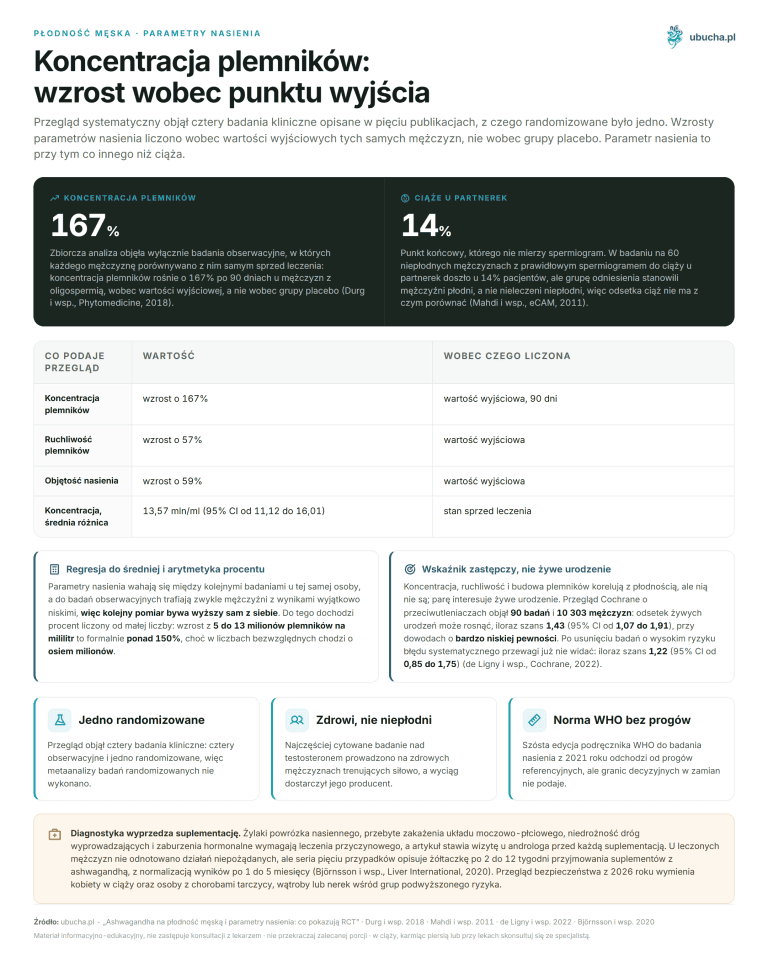
The same raw material is also described in the context of male fertility, where the set of studies and their limitations look different: we break them down in the post about ashwagandha and semen parameters, and the question of combining with other preparations is discussed in the text about combining CBD with ashwagandha. The raw material in herbal form can be found in the herbs category.
This article is for informational and educational purposes and does not constitute medical advice. Before starting supplementation, consult your doctor, especially if you are taking medications regularly, are pregnant or breastfeeding, or have a chronic illness.
Author: Michał Waluk · Published: 2026-08-09 · Updated: 2026-08-16