
CBD for Hashimoto’s and the Thyroid: What the Research Says and Is It Safe
There is not a single clinical trial of CBD in Hashimoto's disease. We check what is really known about CBD, the thyroid, and safety with levothyroxine.
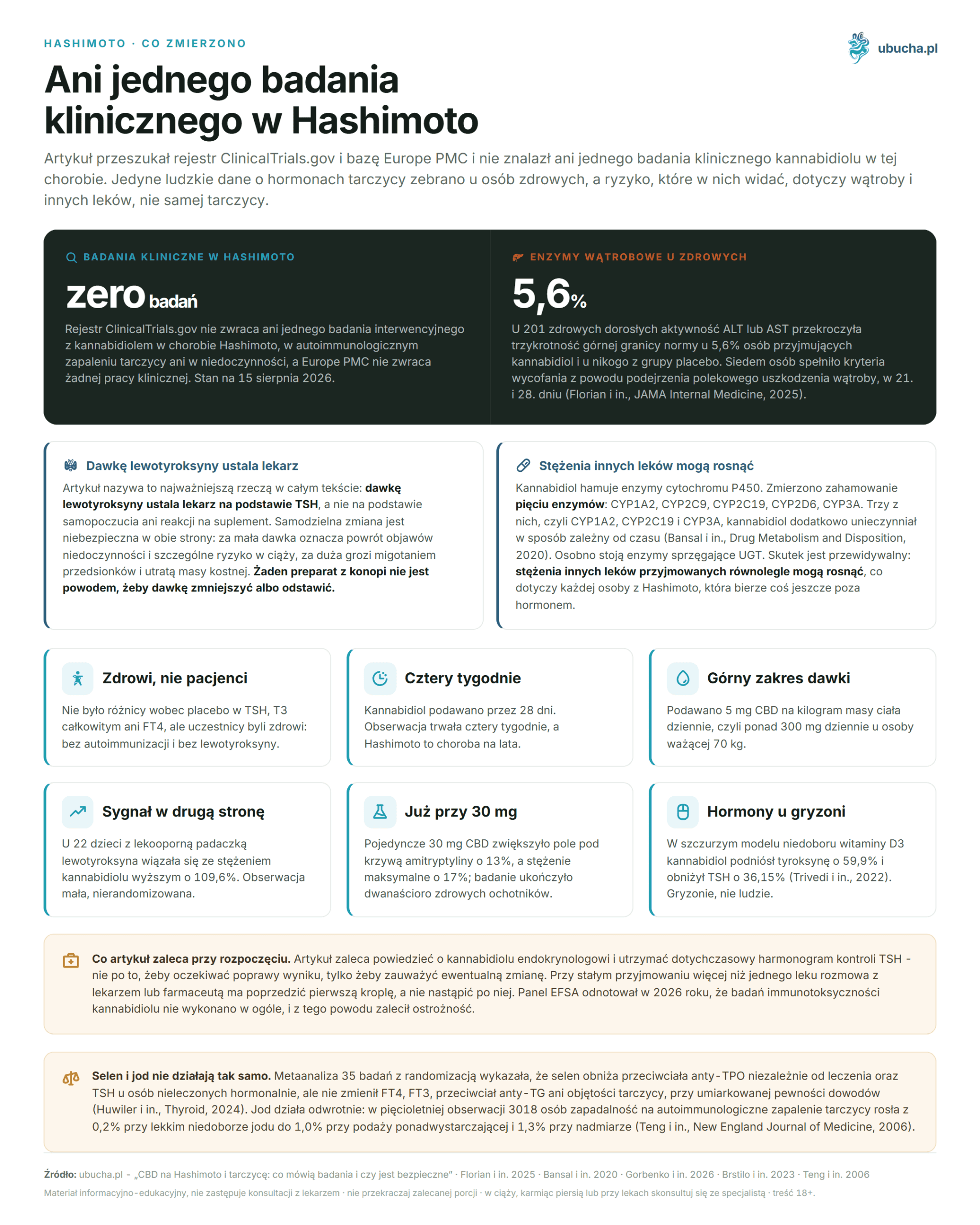
Let’s start with the answer, as it is short, and few people state it directly. There is not a single clinical trial that has tested cannabidiol for Hashimoto’s disease. Neither randomized, nor open, nor even registered and ongoing. We checked this again on August 15, 2026, in the ClinicalTrials.gov registry and in the Europe PMC database, entering all variants of queries about cannabidiol, thyroid, thyroiditis, and hypothyroidism. Result: zero. This is not a trivial matter, as the entire narrative about CBD in this diagnosis is based on premises gathered from completely different diseases. The rest of the article explains what is actually known, why these premises are insufficient to consider cannabidiol as support in Hashimoto’s, and where the real risks lie, which guides remain silent about. It concerns levothyroxine, liver enzymes, and iodine supplements.
KEY INFORMATION
• Zero clinical trials of CBD in Hashimoto’s and any other thyroid disease (ClinicalTrials.gov, Europe PMC, August 2026).
• In 201 healthy adults, CBD did not change TSH, T3, or FT4, but in 5.6% it raised ALT or AST more than three times above normal (Florian et al., JAMA Internal Medicine, 2025).
• The dose of levothyroxine is determined by the doctor based on TSH. CBD is not a reason to change it.
• Selenium lowers anti-TPO antibodies, excess iodine may exacerbate thyroid autoimmunization.
Is there any clinical trial of CBD in Hashimoto’s disease?
No. There is not a single interventional study with cannabidiol for Hashimoto’s disease, autoimmune thyroiditis, hypothyroidism, or Graves’ disease in the ClinicalTrials.gov registry. Europe PMC does not return any clinical work on this topic. Status as of August 15, 2026.
The query “cannabidiol thyroid” returns three studies in the registry, none of which concern a diseased thyroid. Two describe pharmacokinetics in healthy volunteers, and the third examines the effect of CBD on liver enzymes. The thyroid appears in them only as one of the measured safety parameters, not as a treatment subject. We describe this third study later in the text, as it provides the only human data on thyroid hormones with cannabidiol that we have at all.
This is not an oversight of a single database. The EFSA panel on nutrition in an updated position on the safety of cannabidiol (2026) searched the literature up to June 2024 and confirmed that the data gaps from 2022 have not been closed. Among them, it explicitly mentions the endocrine system. This is a safety review, not an efficacy one, so it does not determine anything by itself. However, it goes in the same direction as the research registry: there is nothing to summarize on the thyroid side.
We noticed a recurring pattern in texts that promise “regulation of the thyroid” through CBD. None of them cites a study involving people with Hashimoto’s, as such a study does not exist. They cite works on other diseases, cell cultures, or rodents, and the conclusion is added at the end. Lack of evidence does not mean evidence of lack of effect, but it means that no one has grounds to promise anything.
What is Hashimoto’s and where did the interest in CBD come from?
Hashimoto’s is a chronic autoimmune thyroiditis in which the immune system produces anti-TPO and anti-TG antibodies against its own gland. Over time, this leads to a loss of active tissue and hypothyroidism. In areas with sufficient iodine supply, it is the most common cause of hypothyroidism.
It is necessary to separate two concepts that are conflated in guides. Hashimoto’s is a specific autoimmune disease. Hypothyroidism is a hormonal state that can have other causes: a past surgery, treatment with radioactive iodine, iodine deficiency, certain medications. A study conducted in drug-induced hypothyroidism says nothing about Hashimoto’s and vice versa.
Simply having a positive antibody titer is not yet a disease. A meta-analysis of 48 studies estimated the global prevalence of Hashimoto’s at 7.5%, with a confidence interval from 5.7 to 9.6%, and in high-income countries at 8.4% (Hu et al., Frontiers in Public Health, 2022). The two largest projects in this set included over 22 million participants from 19 countries. Women are affected about four times more often according to this work. There is a lack of population data for Poland itself, so the percentages circulating in Polish guides have no source.
The interest in CBD arises from the list of symptoms, not from the disease mechanism. Fatigue, poor sleep, anxiety, low mood, and musculoskeletal pain persist in some patients even with normal TSH. These are exactly the areas where CBD has the most publications, although none of them concern the thyroid.
Do cannabinoid receptors in the thyroid prove that CBD works?
No. The presence of a receptor in tissue is a description of anatomy, not proof of drug action. CB1 receptors have indeed been detected in the thyroid, but they have also been found in the liver and adipose tissue. The mere fact that something is there does not imply that influencing it will improve the course of an autoimmune disease.
The work that such texts refer to is Porcella et al., European Journal of Endocrinology, 2002. It demonstrated an active CB1 receptor in the rat thyroid. A study on rodents, over two decades old, without CBD as a drug and without reference to autoimmunization.
There is one more detail that gets lost in guides. CBD has low affinity for CB1 and CB2 receptors and does not act on them like a classic agonist. The argument “cannabinoid receptors are in the thyroid, so cannabidiol will act on it” is therefore based on confusing CBD with other cannabinoids.
| Claim | Strongest Available Evidence | What This Means |
|---|---|---|
| CB1 receptors are in the thyroid | Study on rats, 2002 | Anatomical description, not proof of action in humans |
| CBD changes thyroid hormones | Rat model with vitamin D3 deficiency, 2022 | Effect in rodents, unconfirmed in humans |
| CBD does not change TSH, T3, and FT4 | RCT, 201 healthy adults, 28 days, 2025 | Concerns healthy individuals, not those with Hashimoto’s |
| CBD helps in Hashimoto’s disease | Lack of any study | Claim without support |
Do data from other autoimmune diseases transfer to Hashimoto’s?
No, to an extent that would allow for any promises. A review by Pellati et al. (BioMed Research International, 2018) describes a decrease in the production of inflammatory cytokines after cannabidiol in human keratinocyte cultures, and the inhibition of TNF-alpha and interleukin secretion in monocytes is attributed to the stimulation of the CB2 receptor. The anti-proliferative thread of this work concerns cancer cells, and its entire experimental layer consists of cell cultures and animals.
The reasoning “CBD modulates the immune system, so it should help in autoimmunization” has a serious gap. Modulation is not the same as suppressing a specific reaction against thyroid peroxidase. In autoimmune disease, shifting the immunological balance can work both ways, and no one has measured which way it goes in Hashimoto’s. The EFSA panel noted in 2026 that no immunotoxicity studies of cannabidiol have been conducted at all, and for this reason recommended caution.
Separately, the often-repeated abbreviation regarding multiple sclerosis needs to be corrected. The registration data there concern nabiximols, a preparation combining THC with CBD, and the endpoint was spasticity, not the course of autoimmunization. This is not a study of CBD alone and says nothing about the destruction of the thyroid by lymphocytes.
A fair summary is as follows: the mechanism is interesting, the premises are coherent, and the translation to a patient with Hashimoto’s remains a hypothesis. A hypothesis is not a reason to change anything in treatment.
Does CBD change TSH, FT3, and FT4 levels?
In the only study that measured this in humans, it did not change. In a randomized double-blind study, 201 healthy adults took 5 mg of CBD per kilogram of body weight daily for 28 days. No difference was noted compared to placebo in TSH, total T3, or FT4 (Florian et al., JAMA Internal Medicine, 2025).
This is good news, but with three caveats. The participants were healthy, so they had neither autoimmunization nor levothyroxine in their bodies. The observation lasted four weeks, while Hashimoto’s is a disease that lasts for years. The dose was high, equating to over 300 mg daily for a person weighing 70 kg, so the conclusions concern rather the upper range of exposure than a typical portion of oil.
Data from animals are less reassuring. EFSA noted in toxicological materials hormonal disturbances involving altered thyroid hormone levels. In a rat model of vitamin D3 deficiency, cannabidiol raised thyroxine by 59.9% and lowered TSH by 36.15% (Trivedi et al., Journal of Food Science and Technology, 2022). It must be added that the authors interpreted this as an improvement in thyroid function and themselves proposed cannabidiol for hypothyroidism. For someone who already has a well-adjusted dose of levothyroxine, the same change means something different than for a rat with a deficiency: it shifts the result on which the doctor bases treatment. In any case, we are talking about rodents, not humans.
The practical conclusion is simple. If you start CBD, inform your endocrinologist and maintain your current TSH monitoring schedule. Not to expect an improvement in the result, but to notice any potential change.
Can CBD be combined with levothyroxine?
No pharmacokinetic interaction between CBD and levothyroxine has been described. Levothyroxine is eliminated by deiodination and conjugation with glucuronic acid, not by CYP enzymes that cannabidiol inhibits. Therefore, the main mechanism of drug interactions of CBD here does not apply. Theoretical transition remains with UGT enzymes, which CBD inhibits, but no one has measured this in humans.
The most important thing in this article concerns the dose of the medication. The dose of levothyroxine is determined by the doctor based on TSH, not based on feelings, an article on the internet, or reactions to a supplement. Self-changing the dose is dangerous in both directions. A too low dose means a return of hypothyroid symptoms and particular risk in pregnancy. A too high dose risks atrial fibrillation and loss of bone mass. No cannabis product is a reason to reduce or discontinue the dose. The only published signal in this pair actually goes the other way: in 22 children treated with cannabidiol for drug-resistant epilepsy, concurrent levothyroxine was associated with a CBD concentration 109.6% higher (Brstilo et al., Pharmaceutics, 2023). A small, non-randomized observation, thus a hypothesis to be tested.
There is still the issue of absorption, as levothyroxine is particularly sensitive in this regard. It is taken in the morning on an empty stomach, at least half an hour before eating, away from calcium and iron preparations, proton pump inhibitors, and coffee. CBD behaves exactly the opposite: after a fatty meal, its maximum concentration was 14 times, and the area under the curve 4 times higher than on an empty stomach, although the study involved only eight adults with drug-resistant epilepsy (Birnbaum et al., Epilepsia, 2019). Therefore, both substances spread out over time: the medication in the morning on an empty stomach, the oil with a meal later in the day. You can find more about absorption in the post about CBD bioavailability.
How does CBD affect liver enzymes and the metabolism of other drugs?
cannabidiol inhibits cytochrome P450 enzymes. Measurements adjusted for binding to proteins and laboratory vessels showed inhibition of five enzymes: CYP1A2, CYP2C9, CYP2C19, CYP2D6, CYP3A. Three of them, namely CYP1A2, CYP2C19, CYP3A, cannabidiol additionally inactivated in a time-dependent manner (Bansal et al., Drug Metabolism and Disposition, 2020). Conjugating enzymes UGT stand separately. The effect is predictable: concentrations of other drugs taken concurrently may increase. This concerns every person with Hashimoto’s who takes something else besides the hormone.
This effect appears even with over-the-counter doses. A study completed by twelve healthy volunteers found that a single 30 mg of CBD increased the area under the curve of amitriptyline by 13% and the maximum concentration by 17% (Gorbenko et al., British Journal of Clinical Pharmacology, 2026). A review for doctors and pharmacists by Graham et al. (Expert Review of Clinical Pharmacology, 2022) collects ranges of doses at which interactions become probable.
The second thread is the liver itself. In the aforementioned study on 201 healthy adults, ALT or AST activity exceeded three times the upper limit of normal in 5.6% of those taking CBD and in no one from the placebo group. Seven people met the criteria for withdrawal from the study due to suspected drug-induced liver injury, detected on days 21 and 28. They were healthy individuals, without chronic diseases and without medications.
Hence, a simple practical rule. If you are permanently taking more than one medication, a conversation with a doctor or pharmacist should precede the first drop, not occur after it.
Do selenium and iodine support the thyroid in Hashimoto’s?
Selenium has real data, iodine can work against you. This distinction gets lost in guides that lump both elements into one bag labeled “natural thyroid support.” The difference is fundamental and worth knowing before purchasing anything.
A meta-analysis of 35 randomized studies showed that selenium supplementation lowers TSH in individuals not receiving hormonal treatment and lowers anti-TPO antibodies regardless of treatment. However, it did not change FT4, FT3, anti-TG antibodies, or thyroid volume, and adverse effects were comparable to the control group. The certainty of evidence was generally rated as moderate (Huwiler et al., Thyroid, 2024). Note what is not there: a decrease in antibody titer is a laboratory result, not proof that the patient feels better or less frequently requires hormonal treatment.
With iodine, the situation is the opposite. In a five-year observation of 3018 individuals from three Chinese regions with varying iodine supply, the five-year incidence of autoimmune thyroiditis rose from 0.2% with slight iodine deficiency to 1.0% with sufficient intake and 1.3% with excess (Teng et al., New England Journal of Medicine, 2006). Subclinical hypothyroidism behaved the same way. Therefore, with Hashimoto’s, high-dose iodine preparations and dried seaweeds like kelp are a bad idea without medical supervision. Selenium also has an upper intake limit, which can easily be exceeded when combining several preparations, as we discuss in the text about upper limits of supplements.
Frequently Asked Questions
Does CBD help with Hashimoto’s?
It is unknown, as no one has checked this. There is not a single clinical trial of cannabidiol for Hashimoto’s in the ClinicalTrials.gov registry or the Europe PMC database. Guides that discuss the effectiveness of CBD for this diagnosis rely on studies of other diseases or cell cultures.
Does CBD affect TSH, T3, and T4 levels?
In the only study that measured this, it did not have an effect. In 201 healthy adults taking 5 mg of CBD per kilogram of body weight for 28 days, there was no difference compared to placebo in TSH, total T3, or FT4 (Florian et al., JAMA Internal Medicine, 2025). This data is from healthy individuals, not from patients with Hashimoto’s.
Can CBD be taken with levothyroxine?
No pharmacokinetic interaction has been described, as levothyroxine is not primarily metabolized by CYP enzymes. However, inform your endocrinologist before starting. The medication is taken in the morning on an empty stomach, while CBD is absorbed much better with a fatty meal, so both substances naturally spread out over time.
What is the dose of CBD for Hashimoto’s?
Such a dose does not exist. The dose is determined in studies on specific diagnoses, and there are no studies on CBD for Hashimoto’s, so any range of milligrams provided online for this disease is fabricated. EFSA calculated a temporary safe dose of 0.0275 mg per kilogram of body weight per day, which is about 2 mg for a person weighing 70 kg.
Can CBD be harmful in autoimmune disease?
This cannot be ruled out. The argument that CBD modulates immunity, thus helping in autoimmunization, works both ways: modulation is not the same as suppressing the reaction against the thyroid. EFSA noted in 2026 that no immunotoxicity studies of cannabidiol have been conducted at all, and recommended caution.
Does selenium and iodine help with Hashimoto’s?
Selenium lowers anti-TPO antibodies and TSH in individuals without hormonal treatment, with moderate certainty of evidence (Huwiler et al., Thyroid, 2024). Iodine works the opposite way: in a five-year observation of 3018 individuals, higher iodine intake was associated with more frequent autoimmune thyroiditis (Teng et al., NEJM, 2006).
If after talking to your doctor you want to try CBD as symptomatic support, we have gathered products from this group in the hemp oil category.
This article is for informational and educational purposes and does not constitute medical advice. Before starting to use cannabis or CBD for therapeutic purposes, consult your doctor, especially if you are taking other medications, are pregnant, or breastfeeding.
Author: Michał Waluk · Published: 2026-06-02 · Updated: 2026-08-15