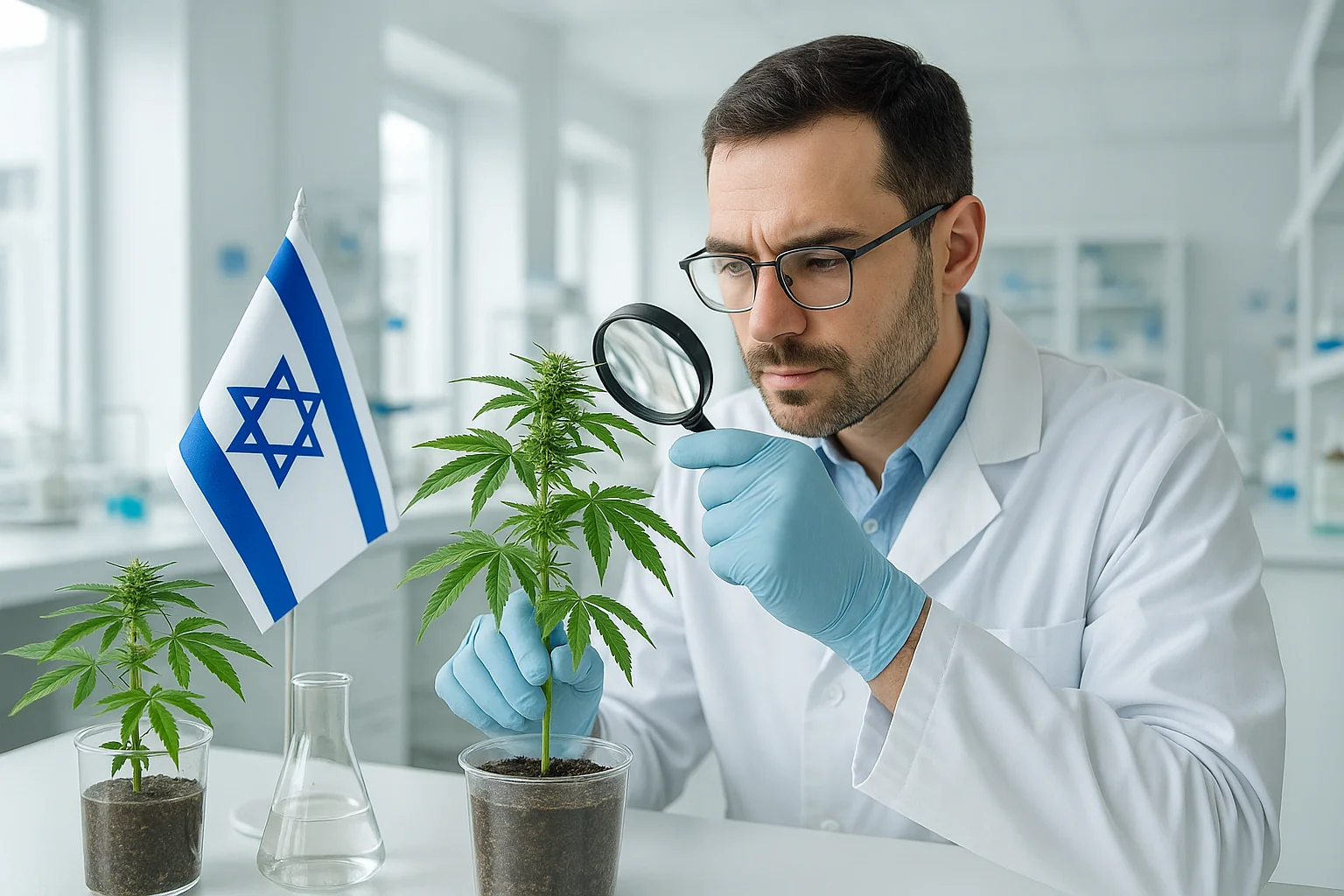

Israel: A Pioneer of Medical Marijuana in the World (FAQ)
The Israeli medical marijuana program: over 137 thousand patients, beginnings in the 90s, research results on chronic pain, and decriminalization rules.
Israel is often referred to as the world’s cannabis laboratory, and in this case, the term is not an exaggeration. It is from there that the work describing the structure of the main cannabinoids originated, which later led to the discovery of the endocannabinoid system. The Israeli government allowed the medical use of cannabis as early as the 1990s, and today the program includes over 137 thousand patients and is the largest medical cannabis market in the world per capita. This article gathers verified numbers, describes what Israeli studies have actually shown regarding chronic pain, and clarifies the legal status of recreational cannabis. Several claims circulating in Polish discussions of the Israeli model, including alleged estimates of export value and the attribution of Israel to the European drug monitoring system, have not been confirmed by any source and have been removed from the text.
KEY INFORMATION
• The Israeli Ministry of Health reported in March 2024 that there were over 137 thousand patients with a license for medical cannabis, compared to about 30 thousand at the beginning of 2019.
• The first approvals for the medical use of cannabis were issued in Israel in the 1990s for cancer patients and those with pain-related conditions.
• In an Israeli cohort of 1045 patients with chronic pain, the average pain intensity decreased by 20 percent after one year, and the daily opioid dose converted to morphine decreased by 42 percent (Aviram et al., European Journal of Pain 2021).
• Recreational cannabis remains illegal in Israel. Since 2019, possession of small amounts in public has been punishable by a fine, and criminal proceedings are initiated only for subsequent violations.
• Data on the program and regulations change rapidly. The article is not legal advice.
Why is Israel considered a pioneer in cannabis research?
Because foundational work was done there, on which the entire field stands. The review by Mechoulam et al. in Nature Reviews Neuroscience describes this sequence: the isolation and determination of the structure of most major cannabinoids, including delta-9-tetrahydrocannabinol as the main psychoactive molecule of hemp, occurred in the 1960s and 1970s (Mechoulam et al., Nature Reviews Neuroscience 2014).
The continuation of this story unfolded in two steps. In the 1980s and early 1990s, two cannabinoid receptors were identified, and soon after, the endocannabinoids themselves, which are molecules produced by the body that act on these receptors. The authors summarize that since then, the understanding of the endocannabinoid system and its functions in the brain has advanced significantly, revealing potential therapeutic targets across a wide range of neurological and psychiatric disorders.
It is worth noting who wrote this review. One of the co-authors is Lumír Hanuš, a chemist working in Israel and co-discoverer of the first endocannabinoid. This is a work written by participants in the described events, which makes it a good starting point, but also a source that inevitably views its own achievements favorably.
How large is the Israeli medical program today?
It is the largest in the world per capita. Data from the Israeli Ministry of Health cited in early March 2024 indicated over 137 thousand patients with a valid license, while at the beginning of 2019, about 30 thousand people were registered (The Times of Israel, 2024). The program was then adding about three thousand patients monthly.
This same material describes to whom licenses are issued. The largest portion is for chronic pain, and besides that, cancer diseases and chemotherapy side effects, post-traumatic stress disorder, psychiatric disorders, neurological diseases, and gastrointestinal conditions are mentioned. Access is regulated by the medical cannabis unit in the Ministry of Health, which issues individual licenses to patients.
| Element | Status | Source |
|---|---|---|
| Number of patients with a license | over 137 thousand, March 2024 | data from the Ministry of Health via The Times of Israel |
| Number of patients at the beginning of 2019 | about 30 thousand | The Times of Israel |
| Start of the program | 1990s, originally for cancer patients and those with pain | The Times of Israel |
| First commercial export | December 2020, delivery to Germany | The Jerusalem Post |
| Recreational cannabis | illegal; possession in public punished by a fine since 2019 | regulations effective from April 1, 2019 |
What do Israeli studies on chronic pain show?
They show a moderate improvement, not a spectacular one. A multi-center prospective study by Aviram et al. included 1045 patients with chronic pain who had a license for medical cannabis in Israel and started treatment; 551 completed a twelve-month observation (Aviram et al., European Journal of Pain 2021).
After one year, the average pain intensity decreased by 20 percent, or 1.97 points with a 95 percent confidence interval from minus 2.13 to minus 1.81. Other measured parameters improved by 10 to 30 percent. However, the strongest single result concerns medications: the daily opioid dose converted to morphine equivalent decreased by 42 percent, or 27 milligrams. Adverse effects were common but mostly mild.
The second Israeli work by the same author, with monthly observations over six months, provides a complementary and somewhat contradictory picture. Pain intensity did not change at all, while the percentage of people taking pain medications decreased from 46 to 28 percent, and the percentage of those rating their quality of life as good increased from 49 to 62 percent (Aviram et al., Frontiers in Pharmacology 2021). However, the number of participants dropped from 429 to 82, which with such a drop makes the final percentages very cautious.
Is recreational marijuana legal in Israel?
No, it is not. Sale and possession outside the medical system remain prohibited, but the state’s response to possession of small amounts has changed. The policy change announced in 2017 concerned amounts up to 15 grams and provided for a fine of one thousand shekels for the first offense, without a criminal record entry.
The regulations that came into effect on April 1, 2019, have a graduated shape. An adult caught in a public place with a small amount of cannabis pays a fine of about 275 dollars for the first offense and about 550 dollars for the second. Criminal proceedings are initiated only for a third offense committed within seven years. Smoking in public places remains prohibited regardless of the amount.
Two things in this arrangement can easily be confused. A fine does not mean state approval, but rather a waiver of criminal proceedings for the first and second offenses, and the violation counter runs for seven years. Sale outside the medical system remains outside this mechanism and is treated as before. The long-promised full recreational legalization has not been introduced in Israel, and the fact that possession practically ends with a fine does not change the status of the substance itself.
The difference between this model and full legalization is fundamental and is often blurred in Polish discussions. We have outlined it separately in a text about the differences between decriminalization and legalization, and we have gathered an overview of the situation in other countries in the map of cannabis legality.
What do Israeli data not resolve?
They do not resolve questions about effectiveness, as both discussed studies on pain are observational. Patients self-reported symptom severity, no one received a placebo, and only those who applied for and received a license were included in the study. The authors of the first study summarize their results as a mild to moderate improvement over the long term, and this formulation is binding here.
They also do not resolve questions about export, around which the most exaggeration has grown. The government issued an export permit, but the first commercial shipment of Israeli medical products arrived in Germany only in December 2020 (The Jerusalem Post, 2020). The hundreds of millions of dollars in annual exports previously mentioned in this article are not supported by any available source and have been removed.
Finally, the Israeli program says nothing about what is allowed in Poland. These are two separate legal systems, and products available in Polish stores are not medical marijuana as defined by the Israeli program. We described the Polish realities in a text about medical marijuana in Poland.
Frequently Asked Questions
Why is Israel considered a pioneer in cannabis research?
Because foundational work was done there. In the 1960s and 1970s, the structure of most major cannabinoids, including delta-9-tetrahydrocannabinol, was isolated and described. In the 1980s and early 1990s, two cannabinoid receptors were identified, and soon after, endocannabinoids produced by the body were discovered.
How many patients are in the Israeli medical program today?
Data from the Israeli Ministry of Health cited in March 2024 indicated over 137 thousand people with a valid license, compared to about 30 thousand at the beginning of 2019. The program was then adding about three thousand patients monthly and was the largest medical cannabis market in the world per capita.
When did Israel allow the medical use of cannabis?
The first approvals for the medical use of cannabis were issued in Israel in the 1990s, initially for cancer patients and those with pain-related conditions. Today, licenses cover chronic pain, chemotherapy side effects, post-traumatic stress disorder, psychiatric disorders, neurological diseases, and gastrointestinal conditions.
What did Israeli studies on chronic pain show?
In a cohort of 1045 patients, of which 551 completed a year-long observation, the average pain intensity decreased by 20 percent, and the daily opioid dose converted to morphine equivalent decreased by 42 percent. The authors describe this as a mild to moderate improvement. The study was observational, without a placebo group.
Is recreational marijuana legal in Israel?
No. Sale and possession outside the medical system remain prohibited. Since April 1, 2019, an adult caught in a public place with a small amount pays a fine of about 275 dollars for the first offense and about 550 dollars for the second, and criminal proceedings are initiated for a third offense within seven years.
Does Israel export medical cannabis?
Export is permitted, but its scale is often exaggerated. The first commercial shipment of Israeli medical cannabis arrived in Germany in December 2020. Figures circulating online claiming hundreds of millions of dollars in annual exports are not supported by available sources and have not been repeated in this article.
Do Israeli regulations say anything about the situation in Poland?
No, they do not. These are two separate legal systems, and products available in Polish stores are not medical marijuana as defined by the Israeli program. The Israeli model is sometimes referenced in Polish discussions as a point of reference, but it does not change the existing rules in Poland regarding prescriptions or access to treatment.
This article is for informational and educational purposes and does not constitute legal advice. The legal status described in the article is valid as of the publication date, and regulations regarding cannabis may change. Before making decisions, consult a lawyer or current legal acts.
Author: Michał Waluk · Published: 2026-08-09 · Updated: 2026-08-11