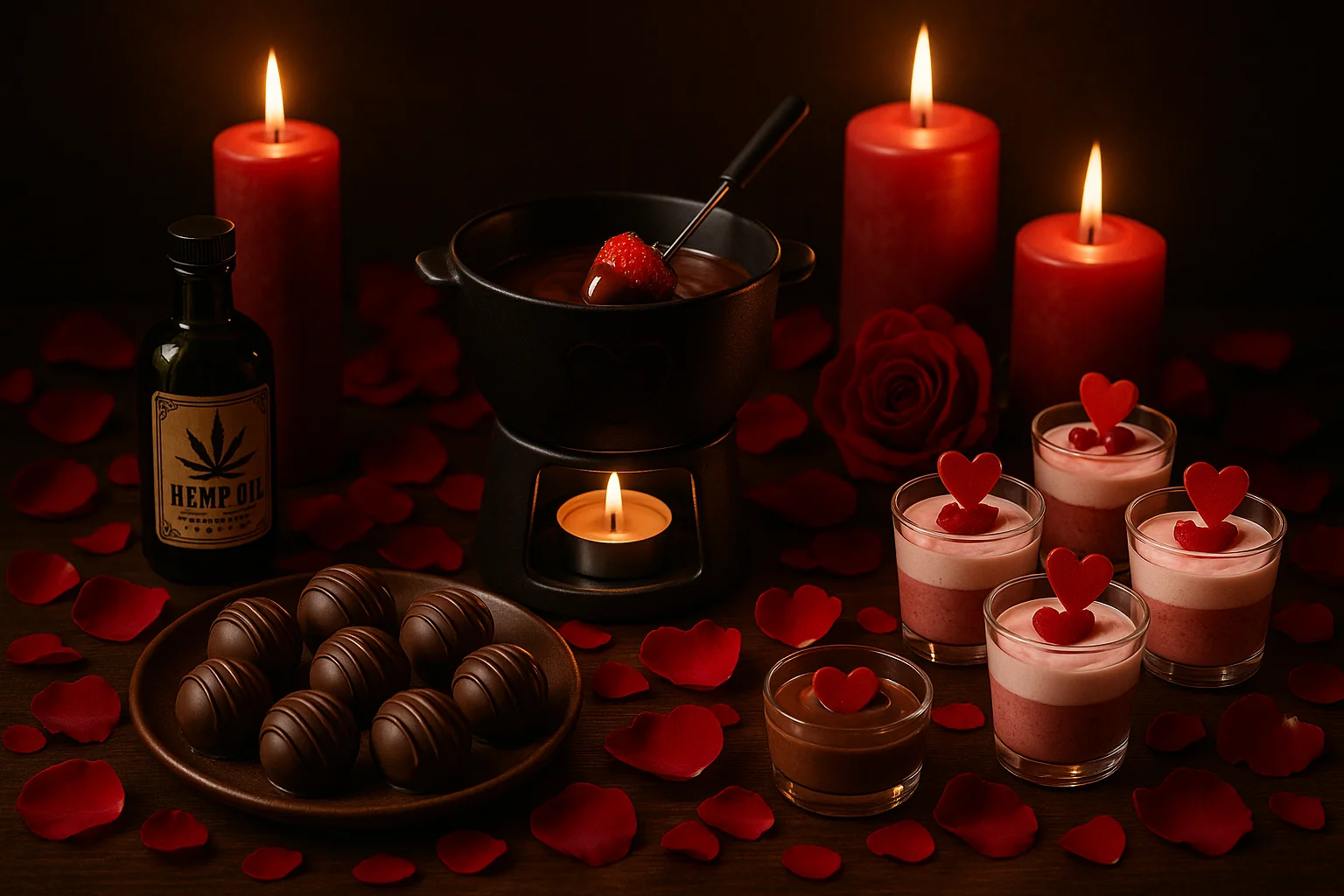

Valentine’s Day Desserts with CBD - 5 Ideas for a Romantic Evening
Five Valentine's Day desserts with CBD oil: truffles, mousse, panna cotta, fondue, and brownie. When to add the oil so as not to destroy it, and how to count a serving.
A Valentine’s Day dessert with hemp oil is not just a matter of taste. The fatty base, such as chocolate, cream, or mascarpone, changes how much cannabidiol actually enters the bloodstream. In a Phase I study, a high-fat meal increased the maximum concentration of CBD in plasma by 4.85 times compared to fasting. The same number of drops in ganache and the same number of drops swallowed in the morning on an empty stomach are thus two completely different exposures. Below you will find five recipes that can be made in a home kitchen, as well as answers to two questions that frequently appear in culinary guides on the internet: when to add the oil so as not to destroy it, and how to calculate how much is actually in one serving from the label.
KEY INFORMATION
• A high-fat meal increased the maximum concentration of CBD by 4.85 times and total exposure by 4.2 times (Taylor et al., CNS Drugs, 2018).
• The oil is added to the mixture taken off the heat or to the finished, cooled dessert. Never into the oven.
• EFSA set a temporary safe level of CBD consumption in 2026: about 2 mg per day for a person weighing 70 kg. You can calculate the content per serving from the label, but that is a calculation, not a recommendation.
• The number of drops in a milliliter can vary: the manufacturer states 300 drops in 10 ml, while a conversion of 200 is also in circulation.
Why does the same number of drops in dessert work differently than on an empty stomach?
Because the fat in the meal changes the absorption of CBD, and by an order of magnitude. In a Phase I study involving healthy volunteers, a high-fat meal increased the maximum concentration in plasma by 4.85 times and total exposure by 4.2 times compared to fasting (Taylor et al., CNS Drugs, 2018). A dessert is, by definition, a fatty meal.
Three independent studies on humans measured the same phenomenon with different forms of the preparation and different amounts of CBD.
| Study | Form and amount of CBD | Increase in maximum concentration | Increase in exposure |
|---|---|---|---|
| Taylor et al., 2018 | oral solution, 1500 mg, healthy volunteers | 4.85 times | 4.2 times |
| Birnbaum et al., 2019 | capsules, eight patients with drug-resistant epilepsy | 14 times | 4 times |
| Saals et al., 2025 | 70 mg from hemp extract, healthy volunteers | 17.4 times | 9.7 times |
The closest to a home dessert is the last one: 70 mg of CBD from hemp extract, eleven participants in a crossover design, standardized high-fat meal (Saals et al., Scientific Reports, 2025). The multipliers have wide confidence intervals: for maximum concentration from 12.4 to 24.2, for exposure from 7.7 to 12.3. They thus speak of an order of magnitude and are not meant to serve as a conversion. The mechanism was previously studied in animals: the administration of lipids increased the exposure of rats to CBD threefold, and over 30 percent of cannabinoids passed into the micellar fraction after lipolysis, indicating transport via the lymphatic route (Zgair et al., American Journal of Translational Research, 2016).
For an evening at home, this leads to one conclusion. Dessert amplifies the effect of the oil more than anything you could add to it. If you have an understanding of how you react to the oil taken sublingually, it will behave differently in truffles.
How to calculate the CBD content from the label for one serving?
Divide the declared content of the bottle by the number of drops, then multiply by the number of drops you poured, and divide by the number of servings. This is an informational calculation, not a recommendation. The only number worth extracting from it is the ceiling: the EFSA panel set a temporary safe level of cannabidiol consumption in 2026 at 0.0275 mg per kilogram of body weight per day, or about 2 mg per day for a person weighing 70 kg (EFSA Journal, 2026).
This value must be supplemented with caveats, without which it is misleading. It was derived using the benchmark dose method with an uncertainty factor of 400 and applies only to supplements with a purity of cannabidiol of at least 98 percent. Safety cannot be established for individuals under 25 years of age, for pregnant and breastfeeding women, and for those taking medications simultaneously. The oil mixed into dessert is not what the panel assessed, as the assessment concerned supplements. Therefore, treat the calculation from the label as information about what you have eaten, not as a portion to be measured.
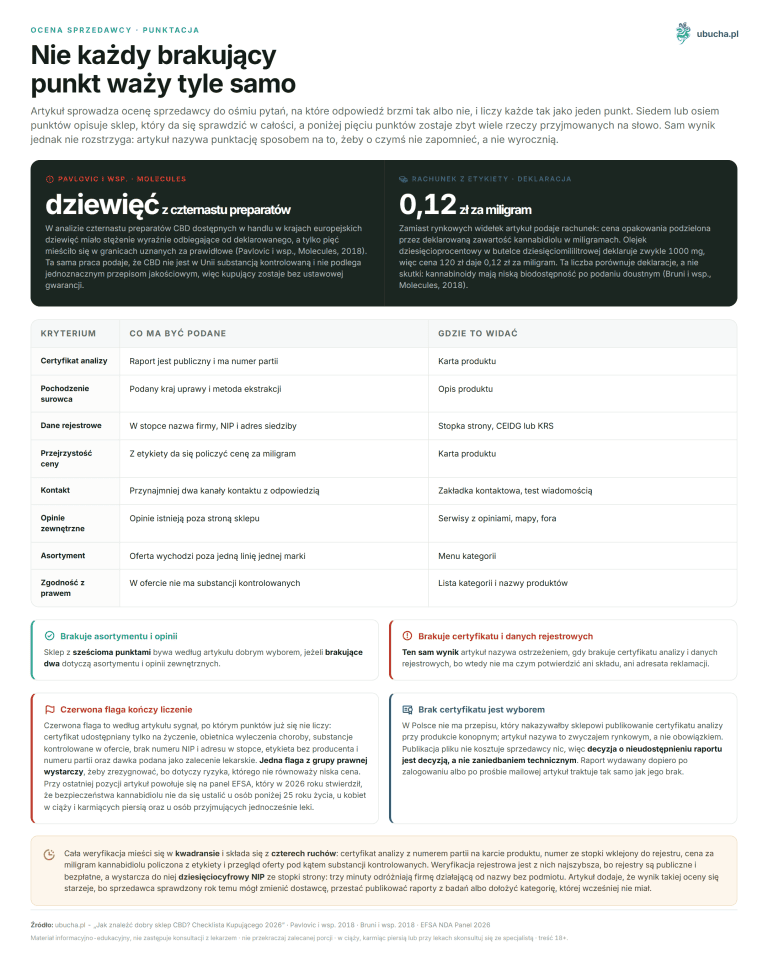
An example for a 10 ml bottle with a declaration of 500 mg, which is a five percent oil. The manufacturer of CANNOVA oils available at ubucha.pl states on the label 1.67 mg of CBD per drop, which corresponds to approximately 300 drops in the bottle. In culinary guides, you will more often encounter a conversion of 200 drops in 10 ml, where the same bottle gives 2.5 mg per drop. The difference can reach half the result, and it arises from the fact that a drop is not a unit of measurement. Its volume depends on the diameter of the dropper, the viscosity of the carrier oil, the temperature, and the angle at which you hold the bottle.
If you care about the number, measure one milliliter with a syringe and count how many drops come out of it. This measurement takes a minute and pertains to your bottle, not an average.
There is also a second trap that guides are silent about. Dividing by the number of servings makes sense only if the mass has been mixed thoroughly and divided evenly. In ganache and panna cotta, this is realistic because both masses are poured into molds. In fondue, which you scoop with a spoon from one vessel throughout the evening, an equal portion does not exist.
When to add the oil so as not to destroy it?
Add it to the mixture taken off the heat or to the finished, cooled dessert. CBD oil should not be baked or boiled. Cannabidiol is chemically unstable: it breaks down under the influence of heat, light, and oxygen, and the products of this breakdown can be psychoactive (Bazzo and Stulzer, Drug Development and Industrial Pharmacy, 2026). The oven operates at 170-180 degrees, which is well above the conditions under which this instability was measured.
It must be honestly added how much of this was measured and how much is caution. The closest work we could find studied cannabinoids in breads with hemp seeds, thus in material with content measured in micrograms per kilogram. Temperature and baking time significantly changed the cannabinoid profile there, mainly due to decarboxylation, and the change in delta-9-THC content ranged between minus 7 and plus 53 percent; the result was more determined by the variability of the raw material than by the baking conditions (Lindekamp et al., Food Chemistry, 2025). There is no work in Europe PMC that would repeat this measurement for oil mixed into dough, so the rule “not into the oven” is a precaution based on chemistry, not a number from a study.
The rule is simple and does not require a thermometer. As long as steam is rising from the mixture, it is too hot. Ganache after pouring hot cream over chocolate needs several minutes to cool to a temperature where the oil does not hit the heat. Panna cotta after being taken off the heat needs a similar time. If the mixture has started to set, gently reheat it in a water bath instead of placing the pot back on the burner.
The same condition applies to serving. Fondue sits over a candle warming it throughout the evening, so the oil mixed in at the beginning spends an hour in the heat. This is the only dessert from this five that does not have stable conditions, and therefore we treat it as an idea for atmosphere, not for content. You can find more about the behavior of oil in dishes in the text CBD in food.
How to make truffles and chocolate mousse?
Both desserts are based on ganache, which is chocolate combined with cream. This is the most convenient base for hemp oil because cocoa fat distributes it evenly, and the bitterness of chocolate masks the earthy taste of the oil. Both are cooled in the fridge, so you can prepare them a day in advance.
Truffles yield about sixteen pieces. You need 150 g of 70 percent dark chocolate, 80 ml of 36 percent cream, 20 g of butter, and cocoa or shelled hemp seeds for coating.
- Heat the cream until the first bubbles and remove from heat.
- Pour it over the chopped chocolate, wait a minute, and mix until smooth.
- Mix in the butter, set aside for 15-20 minutes to cool.
- Add the hemp oil and mix, then chill for 2 hours.
- Form balls with a teaspoon and coat in cocoa or seeds.
The mousse for two servings requires 100 g of 70 percent dark chocolate, 2 egg yolks, a tablespoon of sugar, 200 ml of 36 percent cream, and a pinch of salt. Melt the chocolate in a water bath, remove from the water, and set aside for 10 minutes. Whisk the yolks with sugar until light, whip the cream until stiff. Mix the oil into the cooled chocolate, then the yolks, and finally gently fold in the whipped cream. Pour into glasses and chill for at least 2 hours. A complete recipe in an extended version is described in the text about chocolate truffles with hemp oil.
How to prepare panna cotta and fondue for two people?
Panna cotta is the most forgiving dessert from this five because you take the mixture off the heat long before pouring it into molds. Fondue is the opposite: it stays warm all evening. Both are made from the same two ingredients, namely cream and chocolate or gelatin.
For two servings of panna cotta, take 250 ml of 36 percent cream, 50 ml of milk, 30 g of sugar, 2 g of gelatin sheets, and a teaspoon of vanilla extract. For the sauce, prepare 150 g of blackberries, 2 tablespoons of sugar, and the juice of half a lemon.
- Soak the gelatin in cold water for 5 minutes.
- Heat the cream with milk and sugar to 70 degrees, do not boil.
- Remove from heat, dissolve the drained gelatin, and set aside for 10 minutes.
- Add the vanilla and hemp oil, mix, and pour into glasses.
- Chill for 4 hours. Cook the blackberries with sugar and juice for 5 minutes, strain through a sieve, cool, and pour over the dessert before serving.
Fondue for two people consists of 200 g of 60 percent chocolate, 100 ml of 36 percent cream, and a pinch of cinnamon. Heat the cream, pour it over the chopped chocolate, mix until smooth, and set aside until the mixture is warm instead of hot. Only then mix in the cinnamon and oil, and move the vessel over the warmer. For dipping, cut strawberries and bananas, add dried apricots and biscuits.
How to bake brownie so that the oil does not go into the oven?
The oil is added to the topping applied after baking, never to the raw batter. Brownies are baked at 175 degrees for over 20 minutes, and cannabidiol does not survive that without losses. The topping applied to the cold cake removes the problem and also looks better.
For a 20 by 20 cm pan, which yields 9 pieces, you need 150 g of 70 percent chocolate, 100 g of butter, 2 eggs, 130 g of brown sugar, 70 g of wheat flour, 30 g of hemp flour, and a pinch of salt. Melt the chocolate with the butter, cool, mix in the eggs beaten with sugar, and finally add both flours with salt. Bake for 20-22 minutes at 175 degrees and cool in the pan.
Make the topping from 80 g of 70 percent chocolate melted and cooled to a temperature that does not burn a finger. Mix in the oil, pour over the cold cake, and sprinkle with shelled hemp seeds. Hemp flour absorbs a lot of moisture, so above one-third of the batter, the cake becomes dry. We have detailed the proportions and substitutes in the text about hemp flour in baking.
Frequently Asked Questions
Can CBD oil be heated with the cake?
No. Cannabidiol breaks down under the influence of heat, light, and oxygen, and the oven operates at 170-180 degrees. Add the oil to the mixture taken off the heat or to the finished, cooled dessert. In brownie, this means the topping applied after baking, never the batter before placing it in the oven.
How many drops of oil are in a 10 ml bottle?
It depends on the dropper and the oil’s density. The manufacturer of CANNOVA oils available at ubucha.pl states on the label 1.67 mg of CBD per drop with 500 mg in the bottle, which is approximately 300 drops in 10 ml. There is also a conversion of 200 drops in circulation. If you want to be sure, count the drops from one milliliter.
Why does the same dessert work stronger sometimes and weaker at other times?
Because the absorption of CBD from the digestive tract is very variable. In patients taking capsules with a high-fat meal, the 90% confidence interval for the increase in maximum concentration ranged from 7.47 to 31.86 times (Birnbaum et al., Epilepsia, 2019). The fat content of the dessert and what you ate earlier change the result.
What can mask the taste of oil in dessert?
Bitter chocolate from 70 percent cocoa, pure cocoa, vanilla, and cinnamon work best. The earthy taste of hemp oil disappears in a dark, fatty base, and comes to the fore in light fruit desserts and in white creams without a strong flavor background.
Should you inform guests that there is CBD oil in the dessert?
Yes, always. Cannabidiol inhibits liver enzymes that metabolize many medications, so a person taking medications regularly should know what they are eating. Pregnant and breastfeeding women, as well as those driving that evening, should also be informed. Serving a dessert without information takes away their choice.
How to store dessert with CBD oil?
Just like any dessert based on cream: in the fridge, in a closed container, for up to two days. The oil itself should be kept outside the fridge, in a dark place, and in a tightly sealed bottle, as light and oxygen break down cannabinoids faster than cold protects them.
Hemp oils for cooking can be found in the oils category, and a comparison of methods of consumption in the text about CBD bioavailability.
This article is for informational and educational purposes and does not replace consultation with a doctor. If you are pregnant, breastfeeding, taking medications, or have chronic conditions, consult the use of supplements or herbs with a specialist.
Author: Michał Waluk · Published: 2026-05-20 · Updated: 2026-08-15