Natural solution for stress - which CBD oil to choose? Complete guide 2026
Concentration, spectrum, carrier, and COA certificate. What do studies really show about CBD and anxiety, how to dose, and what drug interactions to avoid.
Cannabidiol reached retail sales faster than science could describe it. A systematic review published in 2020 found eight studies meeting the inclusion criteria for anxiety disorders: six small randomized studies, one case series, and one case report (Skelley et al., Journal of the American Pharmacists Association, 2020). Eight studies are too few for a dosing table, but enough to know what we are talking about. This guide shows what exactly follows from them, how to choose the concentration and spectrum, how to read the COA certificate, and what drug interactions to avoid. We checked every number at the source, and those whose source did not confirm were removed from the text along with the sentence carrying them.
KEY INFORMATION
• Preclinical evidence strongly supports the anxiolytic effect of CBD, but data in humans are limited to acute doses, and there are few studies on chronic dosing (Blessing et al., Neurotherapeutics, 2015).
• In a study of 60 healthy individuals, the dose-response curve had an inverted U-shape: 300 mg worked, while 100 mg and 900 mg did not (Zuardi et al., Frontiers in Pharmacology, 2017).
• A beginner usually reaches for a 5% concentration, for moderate tension 10%, and 15-20% is left for users who know their reaction.
• The label is not evidence: it is the COA certificate from an independent laboratory that tells what is really in the bottle.
• CBD affects cytochromes CYP3A4 and CYP2C19, so a doctor’s consultation is required with prescription medications.
How does CBD affect the brain in stressful situations?
Not through one mechanism, but through several at once, and this is both its advantage and its problem. A review of preclinical, experimental, and epidemiological evidence states that animal data strongly support the role of CBD in generalized anxiety disorder, panic disorder, social phobia, obsessive-compulsive disorder, and post-traumatic stress disorder with acute administration, and human data also support the anxiolytic effect, but also only with acute administration (Blessing et al., Neurotherapeutics, 2015).
Three pathways are best described. The table below summarizes what exactly the study attributed to each of them.
| Pathway | What was shown | Source |
|---|---|---|
| 5-HT1A serotonin receptor | Blocking this receptor abolished the anxiolytic effect of CBD administered to the periaqueductal gray in rats | Campos and Guimaraes, Psychopharmacology, 2008 |
| TRPV1 vanilloid receptor | CBD stimulates TRPV1 with a strength similar to capsaicin and then desensitizes it | Bisogno et al., British Journal of Pharmacology, 2001 |
| Anandamide and FABP transport proteins | CBD inhibits the uptake of anandamide and competes for FABP proteins; it does not inhibit the human enzyme FAAH, yet in patients, CBD treatment raised serum anandamide levels | Bisogno 2001; Elmes, J Biol Chem, 2015; Leweke et al., Translational Psychiatry, 2012 |
It is worth setting proportions right away. Leweke’s work concerned schizophrenia, not stress: researchers compared CBD with amisulpride and observed that the increase in anandamide levels was associated with clinical improvement (Leweke et al., Translational Psychiatry, 2012). The increase in concentration is therefore documented, but the pathway through which it occurs leads through FABP transport proteins, not through the human enzyme FAAH, and translating this into daily tension remains an inference, not a determination.
What do clinical studies say about CBD and anxiety?
They say that a signal exists, trials are small, and doses vary by two orders of magnitude. In the aforementioned 2020 review, fixed doses ranged from 6 mg to 400 mg per serving, none of the included studies concerned panic disorder or obsessive-compulsive disorder, and CBD was generally well tolerated, with drowsiness and fatigue as the most common side effects (Skelley et al., 2020).
| Study | Who it included | Outcome |
|---|---|---|
| Bergamaschi et al., Neuropsychopharmacology, 2011 | 24 untreated individuals with social phobia, single dose of 600 mg | Reduced anxiety, discomfort, and cognitive function impairment during simulated public speaking |
| Crippa et al., Journal of Psychopharmacology, 2011 | 10 untreated individuals with social phobia, 400 mg, SPECT imaging | Reduced subjective anxiety and change in perfusion in limbic and paralimbic areas |
| Elms et al., Journal of Alternative and Complementary Medicine, 2019 | 11 PTSD patients, 8 weeks, open dosing | 91% experienced a decrease in symptom severity, average PCL-5 score decreased from 51.82 to 37.14 |
| Shannon et al., The Permanente Journal, 2019 | 72 adults from a psychiatric clinic, retrospective chart review | Anxiety decreased in the first month for 79.2% of patients, sleep improved for 66.7% |
None of these studies is a large randomized double-blind trial conducted in a clinical population over many months. The last two are retrospective observations without a control group. The summary of the state of knowledge formulated by the Brazilian research team remains cautious and indicates the need for further research before transferring conclusions to practice (Crippa et al., Frontiers in Immunology, 2018). Therefore, treat CBD as a support with preliminarily documented effects, not as therapy.
What concentration of CBD oil to choose for stress?
Start with the lowest concentration that allows you to comfortably measure the dose. Concentration itself says nothing about the strength of action; it only indicates how many milligrams one drop carries. The table below converts this for you for a 10 ml bottle.
| Concentration | CBD in the bottle | Approximately per drop | For whom |
|---|---|---|---|
| 5% | 500 mg | 2.5 mg | First contact, checking tolerance |
| 10% | 1000 mg | 5 mg | Moderate tension, trouble falling asleep |
| 15% | 1500 mg | Known reaction, doses above 50 mg per day | |
| 20% | 2000 mg | 10 mg | Long-term use, fewer drops for the same dose |
There is a strong reason not to start from the top. In a study involving 60 healthy individuals divided into five groups, who received placebo, clonazepam 1 mg, or CBD at doses of 100, 300, or 900 mg before a real public speaking event, anxiety decreased only in the 300 mg group. Neither 100 mg nor 900 mg differed from placebo (Zuardi et al., Frontiers in Pharmacology, 2017). The curve has an inverted U-shape, so increasing the dose can weaken rather than strengthen the effect.
The practical conclusion is that concentration is chosen for dosing convenience, not for the expected strength of effect. If you want to compare individual strengths, we have outlined this separately in the text about which concentration of oil to choose.
What is the difference between full spectrum, broad spectrum, and isolate?
The difference is how much plant companionship remains with cannabidiol. Full spectrum retains the full matrix of the plant along with trace THC: other cannabinoids, cannabinoid acids, terpenes, flavonoids. Broad spectrum retains the matrix, but THC has been removed to an undetectable level. Isolate is pure cannabidiol in crystalline form, without the rest.
The argument for a fuller matrix is the so-called entourage effect. A review dedicated to cannabis terpenoids describes how limonene, myrcene, alpha-pinene, linalool, and beta-caryophyllene can modify the effects of cannabinoids and proposes ways to test this in future experiments (Russo, British Journal of Pharmacology, 2011). The author formulates this as a hypothesis worth investigating, not as an established fact, and it is worth reading it that way on the label.
| Type | Composition | THC | For whom |
|---|---|---|---|
| Full spectrum | Cannabinoids, terpenes, flavonoids | trace, within the legal threshold | Individuals without substance testing |
| Broad spectrum | Cannabinoids, terpenes, flavonoids | undetectable level | Professional drivers, athletes, uniformed services |
| Isolate | Pure cannabidiol, without the rest of the matrix | none | Precise dosing, sensitivity to the taste of cannabis |
Isolate is also a choice for those who are bothered by the herbal taste of full extract. How isolate differs from distillate and why these two words are not synonyms is explained in a separate comparison of distillate and isolate.
What carrier and extraction matter?
The carrier determines how much CBD will actually reach the bloodstream, and knowledge on this topic is more limited than product descriptions suggest. A systematic review of the pharmacokinetics of cannabidiol in humans included 24 studies and stated directly that absolute bioavailability was measured only for the inhalation route, where it was 31%. For other routes of administration, no study provided this information (Millar et al., Frontiers in Pharmacology, 2018).
The numbers circulating in descriptions of oils regarding sublingual absorption have no support in this review, and you will not find them in this text. However, what the review confirms is practical: maximum blood concentration increases after a meal and with fat formulations, and the time to reach it ranges from zero to four hours.
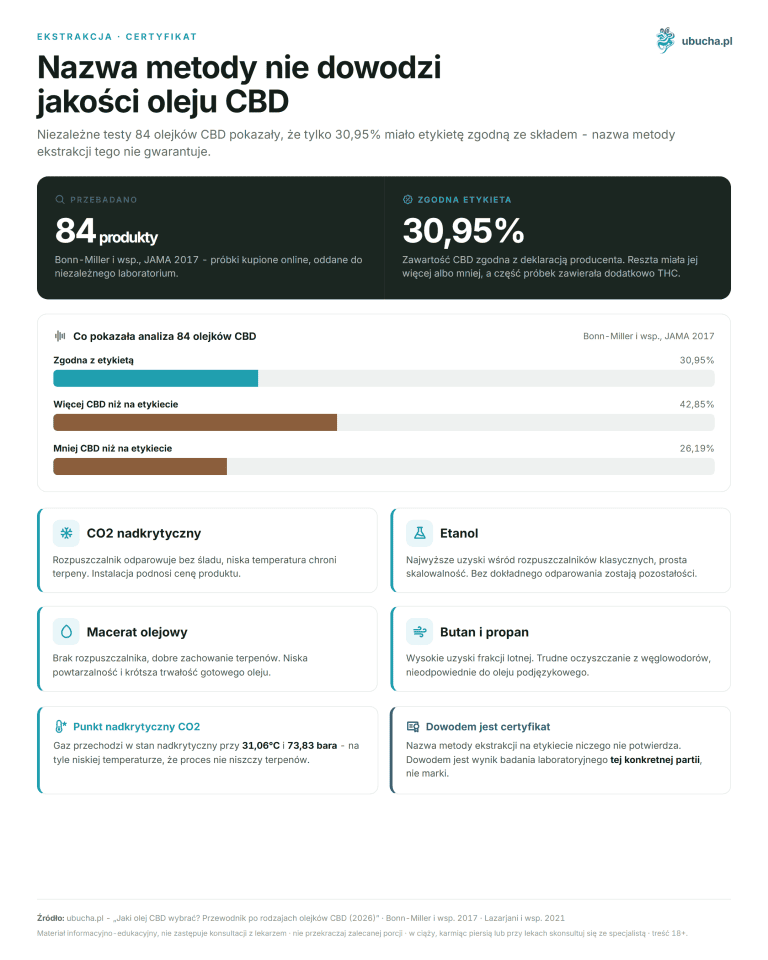
This is where the advantage of fatty carriers comes from. MCT oil usually comes from coconut, is neutral in taste, and does not oxidize quickly. Hemp seed oil brings its own nutritional profile and nutty flavor, while olive oil was a carrier in some classic clinical studies, although it retains freshness for a shorter time after opening. Supercritical CO2 extraction allows working at low temperatures and leaves no solvent, while ethanol extraction is cheaper but requires careful evaporation. Which variant fits what we outlined in the guide on types of CBD oils.
How to read the COA certificate and oil label?
Assuming the label tells the truth, you would choose blindly. A study published in JAMA compared the ingredients declared on the labels of CBD extracts sold online with the actual composition determined in laboratory analysis (Bonn-Miller et al., JAMA, 2017). The practical conclusion from this work is not a specific number, but a principle: the document that confirms anything is the laboratory report, not the writing on the bottle.
The certificate of analysis is issued by an external laboratory to the manufacturer. It should include the following items.
- Cannabinoid profile with amounts in mg/ml, including CBD, CBG, CBN, CBDA, and THC and THCA.
- Terpene profile, at least myrcene, limonene, linalool, beta-caryophyllene.
- Testing for heavy metals: lead, cadmium, arsenic, and mercury.
- Testing for pesticide residues.
- Testing for residual solvents, particularly important with ethanol extraction.
- Microbiological testing and testing for mycotoxins.
- Batch number matching the number on the bottle.
- Testing date not older than one year.
The batch number is the item that is easiest to overlook and which means the most. It happens that the QR code on the packaging leads to one report linked to multiple batches, making it an advertising document rather than a control one. A separate trap concerns naming: the term “hemp oil” can be hemp seed oil, which does not contain cannabidiol at all. More on what to look for before purchasing is gathered in the guide on natural CBD supplements.
How to dose CBD oil step by step?
By the method of small steps, because there is no study determining a single effective dose for stress. Start with 5-10 mg per day divided into two doses, assess sleep, tension, and concentration after three to five days, and if there is no change, increase by 5-10 mg. Repeat until you find the lowest dose that makes a difference.
The method of administration matters and is the element that most often goes wrong. Release drops under the tongue and hold them there for several seconds before swallowing. Taking them with a meal containing fat significantly changes pharmacokinetics: in a study of eight patients with drug-resistant epilepsy who took a capsule of pure CBD on an empty stomach and after a high-fat meal, the maximum concentration was on average 14 times higher in the fed state, and the area under the curve was four times larger (Birnbaum et al., Epilepsia, 2019).
The same dose taken on an empty stomach and after lunch is therefore two different absorbed doses. If you want to compare subsequent weeks, always take the oil in the same arrangement relative to meals. Allow yourself two to four weeks to assess the effect with chronic tension. The acute effect may be felt sooner, but maximum blood concentration is reached within zero to four hours after administration, so expecting immediate action after a few minutes has no pharmacological basis.
What are the interactions of CBD with medications?
Real and more frequent than the image of CBD as a wellness product suggests. An analysis of information on medicinal products containing cannabidiol found that nearly half of individuals using CBD experienced dose-dependent adverse effects. The most common included increased aminotransferase activity, drowsiness, sleep disturbances, infections, and anemia (Brown and Winterstein, Journal of Clinical Medicine, 2019).
The reason for interactions is that CBD targets the same proteins that handle the metabolism and excretion of many drugs: cytochromes CYP3A4 and CYP2C19, as well as P-glycoprotein. The authors emphasize that CBD can be both the affected party and the perpetrator in interactions, and recommend considering reducing the dose of the medication, monitoring for adverse effects, or alternative therapy.
| Drug group | What to watch out for |
|---|---|
| Anticoagulants, especially warfarin | A case was described requiring a dose reduction and constant monitoring of INR |
| Antidepressants from the SSRI and SNRI groups | Never discontinue them on your own; discuss combinations with a psychiatrist |
| Statins, calcium channel blockers, immunosuppressants | Metabolized by CYP3A4, possible accumulation |
| Benzodiazepines and other sedatives | Risk of increased drowsiness, especially while driving |
The case referred to in the line about warfarin documents an interaction in a patient treated with CBD and indicates monitoring of INR as mandatory after introducing cannabinoids (Grayson et al., Epilepsy and Behavior Case Reports, 2018). One person is too few for a rule, but enough to not start supplementation without talking to your doctor.
How much THC can legal CBD oil contain in Poland?
The threshold is 0.3% and is calculated as the sum of delta-9-THC and tetrahydrocannabinolic acid, rounded to one decimal place. The definition is included in Article 4 point 5 of the Act of July 29, 2005 on Counteracting Drug Addiction as amended by the Act of March 24, 2022 (Journal of Laws 2022, item 763), effective from May 7, 2022. Previously, the national threshold was 0.20%.
This distinction is not a formality, as it changes the result of laboratory testing. An analysis measuring only delta-9-THC will show a lower value than an analysis summing it with THCA, and it is this sum that determines the status of the raw material. The threshold applies to flowering or fruiting tops of plants from which resin has not been removed, meaning to the raw material, not to the finished oil.
Separately, it is worth sorting out two things that often merge in texts about CBD. The EU threshold of 0.3% is introduced by Regulation 2021/2115, effective from January 1, 2023; previously, it was 0.2% based on the repealed Regulation 1307/2013. The Polish threshold corresponds to the EU one in value, but does not derive from it, as it is a separate national regulation. Pure cannabidiol, however, does not appear in any of the controlled substance lists (Regulation of the Minister of Health, Journal of Laws 2024, item 1139). The situation is different for HHC, which remains a controlled substance in Poland, so you will not find products containing it in legal retail sales.
What other methods support stress reduction?
The best-documented alternative remains mindfulness training. A meta-analysis covering 47 randomized studies and 3515 participants found moderate quality evidence for improvement in anxiety, with an effect size of 0.38 after eight weeks and 0.22 after three to six months. For depressive symptoms, the effect size was 0.30, and for pain, it was 0.33 (Goyal et al., JAMA Internal Medicine, 2014).
This same work contains a sentence that usually falls out in popular summaries. The authors found no evidence that meditation programs perform better than any active treatment, including medications, physical exercise, and other behavioral therapies. Mindfulness is therefore not a method better than movement or psychotherapy, just one of several with comparable strength.
The practical conclusion for someone reaching for oil is that the foundation is built on sleep, movement, and diet, and CBD can only be an addition to that foundation. Regular aerobic activity several times a week, a consistent sleep schedule, and limiting screens before bed are changes that cost nothing and work independently of supplementation.
There are also situations where supplementation is the answer to the wrong question. Panic attacks more frequent than once a week, anxiety hindering work or relationships, insomnia lasting more than a month, and avoiding social contacts are reasons to visit a doctor, not to change the concentration of oil. In cases of suicidal thoughts or a sudden increase in symptoms, use the free 24-hour help at 116 123 or call the emergency number 112.
Frequently asked questions
Can CBD replace anxiety medications?
No. A systematic review from 2020 found only eight studies meeting the inclusion criteria: six small randomized studies, one case series, and one case report (Skelley et al., Journal of the American Pharmacists Association, 2020). The first line of treatment for anxiety disorders remains cognitive-behavioral therapy and medications prescribed by a doctor.
How many drops of CBD oil daily for stress?
A typical starting dose is 10 mg per day, which is about four drops of 5% oil or two drops of 10% oil. Increase it by 5-10 mg every three to five days and monitor sleep and tension. There is no study determining a single effective dose for stress, so titration replaces a ready-made table.
Is CBD addictive?
The WHO Expert Committee on Drug Dependence stated in 2018 that pure cannabidiol does not exhibit psychoactive properties and does not create potential for abuse or dependence, and recommended not to include it in international control (WHO). This distinguishes it from benzodiazepines, which cause tolerance and physical dependence.
Will CBD oil show up on a drug test?
Isolate and broad spectrum do not contain detectable THC, so they should not yield a positive result on their own. Full spectrum contains THC within the legal threshold, so with very high daily doses, the risk of a positive result is not zero. Professional drivers are safer with broad spectrum with a COA certificate.
Is CBD legal in Poland?
Cannabidiol is not listed in any controlled substance lists, so it is not a prohibited substance (Regulation of the Minister of Health, Journal of Laws 2024, item 1139). However, the product must come from industrial hemp, meaning that the total delta-9-THC and THCA does not exceed 0.3% in dry weight.
How long should I use CBD oil?
For acute stress, two to four weeks of regular dosing is usually sufficient, while for chronic tension and sleep problems, two to three months with evaluation every four weeks. Research on chronic dosing of CBD is limited, and a 2015 review directly points out this gap as a major limitation of the available evidence.
Can CBD be combined with alcohol?
In a 1979 study, ten volunteers received alcohol at a dose of 1 g/kg, CBD at a dose of 200 mg, both substances together, or a placebo. The combination resulted in significantly lower blood alcohol concentration than alcohol alone, but motor impairment was similar in both conditions (Consroe et al., Psychopharmacology, 1979). A lower reading does not mean less intoxication.
What are the interactions of CBD with medications?
CBD interacts with cytochromes CYP3A4 and CYP2C19 and with P-glycoprotein, which are proteins responsible for the metabolism and excretion of many drugs (Brown and Winterstein, Journal of Clinical Medicine, 2019). A case was described where the introduction of CBD required a reduction in the dose of warfarin and monitoring of INR. Consult your doctor before combining.
How to choose CBD oil for stress and what to remember?
The decision breaks down into four questions. Do you have experience with cannabinoids: for first contact 5%, for known reaction 10% or more. Do you need to avoid THC: if so, choose broad spectrum. Have you seen a COA certificate with a batch number matching the bottle. Are you taking medications metabolized by CYP3A4 or CYP2C19: then first visit a doctor, then purchase.
It is also worth remembering what the evidence base looks like. Studies indicating the anxiolytic effect included a dozen to several dozen individuals, concerned acute doses, and measured the effect in experimental conditions, not in everyday stress. The dose-response curve is not linear, so raising the dose on your own can be a step in the wrong direction.
Start low, change slowly, keep a simple record of sleep and tension, and give yourself a few weeks. If after this time nothing changes, the problem is not the concentration in the bottle, but that you are reaching for the wrong tool. In that case, a conversation with a doctor or psychotherapist will yield more than a stronger oil.
The oils mentioned in this text can be found in the oils category.
This article is for informational and educational purposes and does not constitute medical advice. Before starting to use cannabis or CBD for therapeutic purposes, consult your doctor, especially if you are taking other medications, are pregnant, or breastfeeding.
Author: Michał Waluk · Published: 2026-05-06 · Updated: 2026-08-17