
Psychedelic-Assisted Therapies: Treatment of Mental Disorders with MDMA and Psilocybin
MDMA and psilocybin in psychiatry: what phase III studies really showed, why FDA refused registration in 2024, and the legal status in Poland.
The American FDA refused registration of the first MDMA-assisted therapy on August 9, 2024, and demanded an additional phase III trial. This single decision says more about psychedelic psychiatry than a decade of enthusiastic headlines: registration trial data are strong, yet still insufficient. In Poland, MDMA and psilocybin remain group I-P psychotropic substances, and no national center currently conducts phase II or III trials on their therapeutic use. Below, we break down what the MAPP2 and COMP001 studies actually showed, where popular summaries diverge from the papers’ content, which contraindications are absolute, and what Polish patients can realistically expect in the coming years. Each figure is referenced to its source, as half of the circulating data lack support in cited sources.
KEY INFORMATION
• MDMA in PTSD: in the phase III MAPP2 study, 37 of 52 participants (71.2%) no longer met PTSD criteria versus 20 of 42 (47.6%) in the placebo group receiving the same therapy (Mitchell et al., Nature Medicine, 2023).
• Psilocybin in treatment-resistant depression: a 25 mg dose reduced MADRS score by 6.6 points more than a 1 mg dose after three weeks (Goodwin et al., NEJM, 2022, n=233).
• FDA refused MDMA registration on August 9, 2024, and requested an additional phase III trial.
• In Poland, MDMA (item 65) and psilocybin (item 86) are listed in group I-P of the psychotropic substances schedule (Dz.U. 2024 item 1139).
• Australia since July 1, 2023, allows authorized psychiatrists to prescribe both substances for strictly defined indications (TGA).
What is psychedelic-assisted psychotherapy?
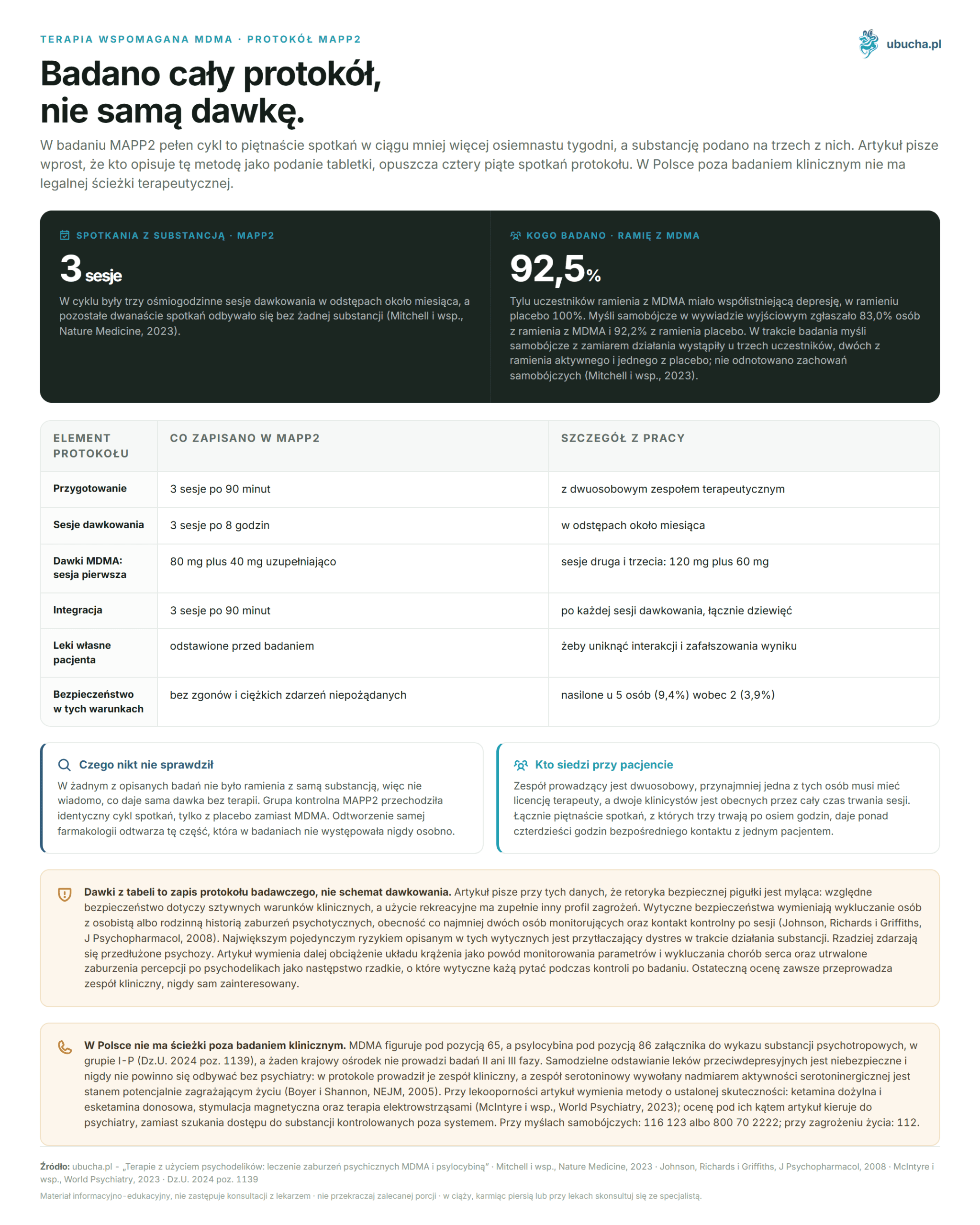
It is a clinical protocol in which a psychoactive substance is administered in a clinic, in the presence of a trained team, and the session itself is only one of three treatment phases. In the MAPP2 study, the full cycle included three 90-minute preparatory sessions, three eight-hour dosing sessions spaced about a month apart, and nine integration sessions, totaling fifteen meetings over roughly eighteen weeks (Mitchell et al., Nature Medicine, 2023).
It is important to separate two concepts often conflated in the media. The substance is not a daily medication but a catalyst for the psychotherapeutic process occurring around it. Without the preparatory phase, the patient enters a multi-hour, intense experience without a set intention and without trust in the people present. Without the integration phase, what happened during the session remains a memory rather than a behavioral change.
The dosing phase looks different than imagination suggests. The patient usually lies with an eye mask and headphones, and two clinicians are present throughout the session, with minimal verbal interventions. The presence of at least two monitors is not a comfort issue: safety guidelines for classical psychedelic studies list it as a safeguard alongside excluding individuals with a history of psychosis (Johnson, Richards, and Griffiths, J Psychopharmacol, 2008).
The conducting team in this protocol is two-person, and at least one must hold a therapist license. This detail seems organizational but determines scale: fifteen meetings, three lasting eight hours each, sum to over forty hours of direct contact with one patient. Two specialists usually devote that much time to a dozen or so people.
We have noticed, following recent reports, that media almost exclusively cover hours under the influence. The largest part of clinical work lies outside them: in MAPP2, one dosing session corresponded to four meetings without any substance. So if someone describes this method as just taking a pill, they omit four-fifths of the protocol.
Why are antidepressants alone insufficient?
Because a large portion of patients do not achieve remission. The largest clinical trial evaluating subsequent depression treatments, STAR*D, showed remission in 36.8% of patients after the first drug, 30.6% after the second, and 13.7% and 13.0% after the third and fourth. The cumulative remission rate after four steps was 67%, and those requiring more steps more often relapsed during one-year follow-up (Rush et al., Am J Psychiatry, 2006).
This does not mean antidepressants do not work. A network meta-analysis of 522 studies involving 116,477 people showed all 21 analyzed drugs were more effective than placebo, with odds ratios from 1.37 for reboxetine to 2.13 for amitriptyline (Cipriani et al., Lancet, 2018). The problem is not zero efficacy but the size of the group still ill after two rigorous trials.
This group is described by the term treatment-resistant depression. The definition adopted by FDA and EMA refers to insufficient response to at least two antidepressants used at adequate dose and duration. It is estimated that at least 30% of people with depression meet this criterion, some apparently resistant due to too short therapy or nonadherence (McIntyre et al., World Psychiatry, 2023).
A similar problem concerns post-traumatic stress disorder. Cognitive-behavioral therapy and prolonged exposure therapy have solid efficacy evidence but require patients to repeatedly revisit traumatic material. For some, this burden is so great they discontinue treatment. These two populations, treatment-resistant depression and PTSD unresponsive to first-line treatment, are the main targets of psychedelic therapy research today.
Note what these data do not imply. They do not imply psychedelics should replace antidepressants or psychotherapy, as none of the studies below tested such a scenario. They tested whether, in a group where previous methods failed, several intensive sessions bring greater change than the same therapy without substance. This is a much narrower question and the cited figures answer only it.
Which substances are currently studied in psychedelic therapy?
Clinical programs concern several substances at very different stages of development. The most advanced are two: MDMA in post-traumatic stress disorder and psilocybin in treatment-resistant depression. Others are at earlier stages or preclinical phases, with reports more often from company press releases than peer-reviewed publications.
| Substance | Action Characteristic | Research Stage |
|---|---|---|
| MDMA | entactogen, reduces anxiety and increases trust, without strong perceptual changes | phase III trials completed, registration application rejected in 2024 |
| Psilocybin | classic serotonergic psychedelic, partial 5-HT2A receptor agonist | phase II completed, phase III program ongoing |
| LSD | classic psychedelic with long, several-hour duration | early clinical phases, mainly anxiety disorders |
| DMT and 5-MeO-DMT | very short action, reducing cost per session | early clinical phases |
| Ibogaine | marked cardiotoxicity, mainly studied in opioid addiction | niche studies, outside main registration stream |
MDMA is sometimes called a psychedelic shorthand. Pharmacologically, it belongs to entactogens: it does not cause the typical psilocybin blurring of ego boundaries but increases release of serotonin, dopamine, and oxytocin. This profile has practical significance, allowing the patient to revisit traumatic memories without immediate defensive reaction. The hypothesized mechanism is emotional memory reconsolidation and fear extinction (Feduccia and Mithoefer, Prog Neuropsychopharmacol Biol Psychiatry, 2018).
Psilocybin acts differently. In the body, it converts to psilocin, which stimulates the 5-HT2A serotonin receptor as a partial agonist. The experience after a full dose includes clear changes in perception and sense of self-boundaries, not observed with MDMA. The clinically studied dose in treatment-resistant depression was 25 mg, a multiple of amounts used in microdosing.
For other substances in the table, caution is advised when reading reports. Information on LSD and tryptamine derivatives largely comes from biotech company press releases, not peer-reviewed publications, and reports preliminary results without full data. Until the work is published with methodology description, the number in the release is a declaration, not evidence.
What did the MDMA study in PTSD show?
The MAPP2 study included 104 people with moderate to severe PTSD, randomly assigned to MDMA-assisted therapy (53 people) or identical therapy with placebo (51 people). The mean change in CAPS-5 score was minus 23.7 points in the MDMA group versus minus 14.8 points in placebo, with significance below 0.001 and effect size d = 0.7 (Mitchell et al., Nature Medicine, 2023).
The most frequently cited figure comes from the full text, not the abstract. PTSD criteria per DSM-5 ceased to be met by 37 of 52 active group participants (71.2%) versus 20 of 42 (47.6%) in the placebo group with therapy. Popular summaries attribute these percentages to two studies combined and a sample of 194 people. This is false: both values come exclusively from MAPP2.
| MAPP2 Protocol Element | Details |
|---|---|
| Preparation | 3 sessions of 90 minutes with a two-person therapeutic team |
| Dosing sessions | 3 sessions of 8 hours, about a month apart |
| Doses | first session 80 mg plus 40 mg supplemental, second and third sessions 120 mg plus 60 mg |
| Integration | 3 sessions of 90 minutes after each dosing session, nine total |
| Patient’s own medications | discontinued before study to avoid interactions and bias |
| Safety | no deaths or serious adverse events; increased events in 5 people (9.4%) vs 2 (3.9%) |
The study group was not mild. Comorbid depression was present in 92.5% of the MDMA arm and 100% of placebo arm, and suicidal thoughts at baseline were reported by 83.0% and 92.2%, respectively. During the study, suicidal ideation with intent occurred in three participants, two in the active arm and one in placebo; no suicidal behaviors were recorded.
The rhetoric of a safe pill is misleading here. Relative safety applies to strict clinical conditions: two therapists, parameter monitoring, discontinued own medications, exclusion of risk groups. Recreational use has a completely different risk profile.
How does psilocybin perform in treatment-resistant depression?
In the COMP001 study, a single dose of synthetic psilocybin reduced depression severity significantly more than the control dose, but the effect must be read cautiously. After three weeks, mean MADRS change was minus 12.0 points for 25 mg, minus 7.9 for 10 mg, and minus 5.4 for the 1 mg control dose. The difference between 25 mg and 1 mg was 6.6 points, and between 10 mg and 1 mg was not significant (Goodwin et al., NEJM, 2022).
The same paper provides limits to enthusiasm. Adverse events occurred in 179 of 233 participants (77%), and suicidal thoughts or behaviors and self-harm were noted in all dosing groups. Maintenance of response to week twelve did not confirm the primary endpoint. More data from this program are collected in a separate text on psilocybin depression study results.
| Study | Design | Result |
|---|---|---|
| Goodwin et al., NEJM 2022 | 25 mg, 10 mg, or 1 mg, n=233 | MADRS at 3 weeks: minus 12.0 vs minus 5.4; advantage 6.6 points |
| Carhart-Harris et al., NEJM 2021 | two 25 mg doses vs escitalopram for 6 weeks, n=59 | no significant difference on primary endpoint (p=0.17); remission 57% vs 28% |
| Davis et al., JAMA Psychiatry 2021 | two sessions, waitlist control, 24 people | response in 71% and remission in 54% at 4 weeks |
| Gukasyan et al., J Psychopharmacol 2022 | follow-up of same 24 people for one year | response in 75% and remission in 58% at 12 months |
Direct comparison with an antidepressant was less impressive than headlines suggested. In the Imperial College study, psilocybin did not outperform escitalopram on the primary endpoint, and advantages seen on secondary endpoints were not corrected for multiple comparisons. Proponents cite these points; cautious reviewers remind that correction is applied exactly for this reason.
The mechanism is hypothesized to involve neuroplasticity. In mice, a single psilocybin dose increased size and density of dendritic spines in the frontal cortex by about 10% within a day, with changes persisting a month later (Shao et al., Neuron, 2021). Studies on the 5-HT2A receptor indicate plasticity requires activation of its intracellular pool (Vargas et al., Science, 2023). However, this explanation comes from animal models and has not been confirmed in humans.
Why does session context affect therapy outcome?
Because the quality of the experience predicts clinical effect. In a study of twenty people with treatment-resistant depression, the oceanic boundlessness dimension and fear of ego dissolution dimension, measured by altered states questionnaire, significantly predicted depression severity at five weeks, with p-values 0.002 and 0.003 respectively (Roseman et al., Front Pharmacol, 2017).
This study has a methodological caution worth noting, rarely mentioned in summaries. The authors chose the five-week outcome because later measurements were confounded by some participants starting other treatments. Patients received two doses, 10 mg and 25 mg, and analysis focused on the higher dose session.
Hence the emphasis on preparation and physical session environment. The preparatory phase establishes intention, discusses concerns, and builds rapport with the team present for the next eight hours. The environment includes the room and lighting, music tailored to session flow, and a principle of minimal verbal intervention. Safety guidelines list building trust before the session as a separate safeguard alongside excluding risk groups (Johnson, Richards, and Griffiths, 2008).
However, interpretation has a limit rarely discussed. One-year follow-up of Johns Hopkins participants showed mystical experience ratings predicted later well-being but not depression improvement itself (Gukasyan et al., 2022). The thesis that stronger mystical experience guarantees remission is thus an oversimplification challenged by the source material.
The practical takeaway is unglamorous but data-driven. Environment and preparation are not add-ons to the substance but part of the intervention, and attempting to replicate pharmacology alone without the rest of the protocol reproduces exactly the part never studied separately. No study tested dose alone without therapy arm because such an arm simply did not exist.
What is the legal status of MDMA and psilocybin?
In Poland, both substances are controlled and there is no legal therapeutic pathway outside clinical trials. MDMA is listed as item 65 and psilocybin as item 86 in Annex 1 to the Minister of Health’s regulation on the list of psychotropic substances, narcotics, and new psychoactive substances, group I-P (consolidated text, Dz.U. 2024 item 1139). Possession, manufacture, and trade are prohibited under the anti-narcotics law.
| Jurisdiction | Status as of August 2026 |
|---|---|
| Poland | both substances in group I-P; no national centers conducting phase II or III trials |
| USA | both substances Schedule I; MDMA registration application rejected August 9, 2024 |
| European Union | no psychedelic preparation authorized for marketing |
| Australia | since July 1, 2023, authorized psychiatrists may prescribe MDMA for PTSD and psilocybin for treatment-resistant depression |
The 2024 US decision impacted the entire field. FDA issued Lykos Therapeutics a refusal letter for midomafetamine and requested an additional phase III trial; earlier, the agency’s advisory committee raised concerns about safety and trial blinding. The full letter was publicly released only in September 2025 (MAPS).
This refusal is instructive also because MDMA previously had breakthrough therapy status, which accelerates the process. The status speeds agency dialogue but does not replace evidence or guarantee registration. Readers of psychedelic news should treat such designations as information about process speed, not outcome.
Australia took a different path and on July 1, 2023, moved psilocybin and MDMA from the strictest category to controlled medicines, but only for psychiatrists with special authorization and only for administration in medical settings (TGA).
How does psychedelic therapy differ from antidepressants?
The difference concerns the treatment model, not just potency. Antidepressants are taken daily for months or years, with full effect expected after several weeks. Psychedelic therapy involves one or several intensive sessions after which measurable change appears quickly: in the Johns Hopkins study, depression severity dropped already one day after the first session.
Effect durability looks promising in small groups. Among twenty-four people treated with psilocybin, response persisted in 75% and remission in 58% twelve months after the second dose (Gukasyan et al., 2022). However, it must be added that the study had a waitlist control, not active placebo, so its result is not equivalent to a registration trial.
Direct comparison with medication paints a more tempered picture. Psilocybin compared to escitalopram did not outperform on the primary endpoint, and effect sizes from small psychedelic studies and antidepressant meta-analyses are not expressed on the same scale, so direct comparison lacks methodological sense. Claims like “effect three times greater than drugs” circulating in media have no basis in any cited work.
Separately stands the economic calculation. A cost model for chronic, treatment-resistant PTSD estimated that MDMA-assisted therapy in a population of 1,000 patients yields a net payer saving of about 103 million USD over thirty years and breaks even after 3.1 years; assuming benefit disappears after one year, cost is 26,427 USD per quality-adjusted life year (Marseille et al., PLOS ONE, 2020). This is a model, not a price list.
What are the risks and contraindications of psychedelic therapy?
The greatest single risk described in safety guidelines is overwhelming distress during substance action, colloquially called a difficult session. Less frequently, prolonged psychoses occur. Safeguards include excluding volunteers with personal or family history of psychotic or other severe mental disorders, presence of at least two monitors, and post-session follow-up (Johnson, Richards, and Griffiths, J Psychopharmacol, 2008).
| Risk | Implication |
|---|---|
| History of psychosis in family or patient | standard exclusion criterion in classical psychedelic studies |
| Difficult session | most common psychological risk; requires team presence throughout |
| Interaction with serotonergic drugs | in MAPP2 all psychiatric drugs were discontinued before study |
| Cardiovascular burden | reason for monitoring parameters during sessions and excluding heart disease |
| Persistent perceptual disorders after psychedelics | rare; guidelines require inquiry during post-study follow-up |
Drug interactions deserve a separate mention as the most common real threat for someone considering self-experimentation. Serotonin syndrome is a medically described condition caused by excessive serotonergic activity, potentially life-threatening (Boyer and Shannon, NEJM, 2005). In MAPP2, participants discontinued all psychiatric medications before protocol start precisely to avoid interactions. We elaborated on this in a text about psychedelic contraindications and interactions with SSRIs, MAOIs, and serotonin syndrome.
Adverse event data from registration studies should be read in full, not just abstracts. In MAPP2, serious adverse events occurred in five people in the MDMA arm (9.4%) and two in placebo (3.9%), with no deaths or severe adverse events. In the psilocybin study, adverse events were reported in 179 of 233 participants (77%), and suicidal thoughts or behaviors and self-harm occurred in all dosing groups (Goodwin et al., 2022).
Discontinuing antidepressants independently is dangerous and should never occur without a psychiatrist. In the research protocol, discontinuation is managed by the clinical team with planned timing and supervision, which cannot be replicated at home.
Does CBD have a role in supporting mental health?
This is a completely different category than the substances described above, also legally. Cannabidiol is not listed in any controlled substance schedules, so it is not subject to the restrictions described in the previous section. However, this does not mean evidence for its effects in mental disorders is comparably strong: the research base is much smaller and less rigorous than for psilocybin or MDMA.
Therefore, the statement about CBD in this article is cautious. Hemp products are not medicines, do not replace pharmacotherapy or psychotherapy, and should not be treated as alternatives to psychiatric treatment. We separately examined what studies say about CBD use in depression treatment, and the conclusion there is also reserved.
If you consider a hemp product as a supplement to ongoing treatment, first talk to your doctor, especially if you take medications metabolized in the liver. The order matters: first diagnosis and treatment, then possible supplementation.
The difference from MDMA and psilocybin is greater than the shared label of plant or natural substances suggests. Those two have registration trials with active placebo, established dose, and described therapeutic protocol. Cannabidiol in psychiatric context lacks such backing, and retail products are not studied as medicines. Grouping them as alternatives in one sentence is simply unjustified.
What can Polish patients expect in the coming years?
Realistically: access will not come quickly. The path leads through registration with the American or European agency, and the former, after the 2024 refusal, requires another phase III trial. Until any psychedelic preparation is authorized in the EU, the Polish system has nothing to reimburse or even list as non-reimbursed medicines.
Infrastructure is also lacking. A protocol like MAPP2 requires fifteen sessions, two-person therapeutic teams, rooms adapted for eight-hour sessions, and personnel trained in this specific method. Even if registration appeared tomorrow, building such capacity would take years, and without Polish centers in multicenter trials, clinical experience will have to be imported entirely.
For someone ill today, the conclusion is clear: do not wait. Standard treatment for depression and PTSD still helps most patients, and for resistance there are methods with established efficacy listed in the defining review: intravenous ketamine and intranasal esketamine, magnetic stimulation, and electroconvulsive therapy (McIntyre et al., World Psychiatry, 2023). We wrote about the first in a text on ketamine and esketamine in depression therapy.
If current treatment does not work, ask your psychiatrist to evaluate these methods rather than seeking access to controlled substances outside the system. Self-experimentation does not replicate the protocol or safeguards that give these results credibility.
It is also worth managing your expectations regarding press reports. The results described here come from trials with 24 to 233 participants, and the longest follow-up is one year. This is too little to speak of routine treatment and enough to justify further research. The distance between these two statements is the space in which the fate of the entire method will be decided in the coming years.
Frequently Asked Questions
Can I legally participate in MDMA or psilocybin therapy in Poland?
No. Both substances are listed in group I-P of the psychotropic substances schedule, and outside of a registered clinical trial their administration is prohibited. Currently, no center in Poland conducts phase II or III trials on therapy assisted by these substances, so there is simply no national participation pathway.
Can psilocybin or MDMA be combined with antidepressant medications?
Not without psychiatric supervision. Serotonin syndrome caused by excessive serotonergic activity is a potentially life-threatening condition. In the MAPP2 study, participants discontinued all psychiatric medications before starting the protocol to avoid interactions, and discontinuation was managed by the clinical team, not the patient.
How long does a full MDMA-assisted therapy protocol last?
About eighteen weeks in the MAPP2 study. The cycle included three 90-minute preparatory sessions, three eight-hour dosing sessions spaced about a month apart, and three integration sessions after each dosing session. Altogether, this amounts to fifteen therapeutic meetings, twelve of which occur without any substance.
What does the FDA refusal in August 2024 mean?
The agency determined that the submitted data were insufficient for registration and requested an additional phase III trial. The refusal does not negate previous results but delays market approval by years and shows that efficacy alone is not enough when there are concerns about trial blinding and safety data.
How does psilocybin used in studies differ from hallucinogenic mushrooms?
Preparations used in clinical trials are synthetic psilocybin with precisely measured doses, for example 25 mg in the COMP001 study. Mushrooms contain variable amounts of psilocybin and other alkaloids, so their potency is unpredictable. Dose reproducibility is a condition without which a clinical trial would not make sense.
Does psilocybin microdosing have confirmed therapeutic effects?
Evidence is inconclusive. A systematic review covering 44 studies from 1955-2021 showed highly variable risk of bias. Its authors also caution that attributing microdosing effects solely to expectancy is premature (Polito and Liknaitzky, 2022). Clinically studied therapy is based on full doses, not microdoses.
Who should not participate in psychedelic therapy?
Safety guidelines require excluding volunteers with personal or family history of psychotic disorders or other severe mental illnesses. Cardiac criteria and the requirement to discontinue psychiatric medications are also applied in studies. Final assessment is always performed by the clinical team, never by the individual.
If after consulting your doctor you seek legal hemp products as a supplement to ongoing treatment, their overview is available in the oils category.
This article is informational and educational. It describes clinical trials in which the substance is administered under physician supervision after participant qualification; self-use does not replicate these conditions. These substances are controlled in Poland under the anti-narcotics law. If you have suicidal thoughts, call the free, 24/7 numbers 116 123 or 800 70 2222. In life-threatening situations: 112.
Author: Michał Waluk · Published: 2026-05-06 · Updated: 2026-08-10