
How to Improve Your Immune System with Natural Supplements? Guide 2026
Vitamin D, zinc, vitamin C, probiotics, elderberry, and echinacea in light of Cochrane reviews. We check what really reduces infection risk.
A supplement advertisement promises enhanced immunity, but no one says how to check if it worked. There is no blood test showing that the immune system is stronger today than last month. However, there are hard endpoints: how many times you got sick, how long symptoms lasted, whether antibiotics were needed. When applying these to popular preparations, the picture is much more modest than the package description. Here we go through vitamin D, zinc, vitamin C, probiotics, elderberry, echinacea, and beta-glucans, each time referring to the latest systematic review. You will also see which daily behaviors have stronger data than any supplement and why the order matters.
KEY INFORMATION
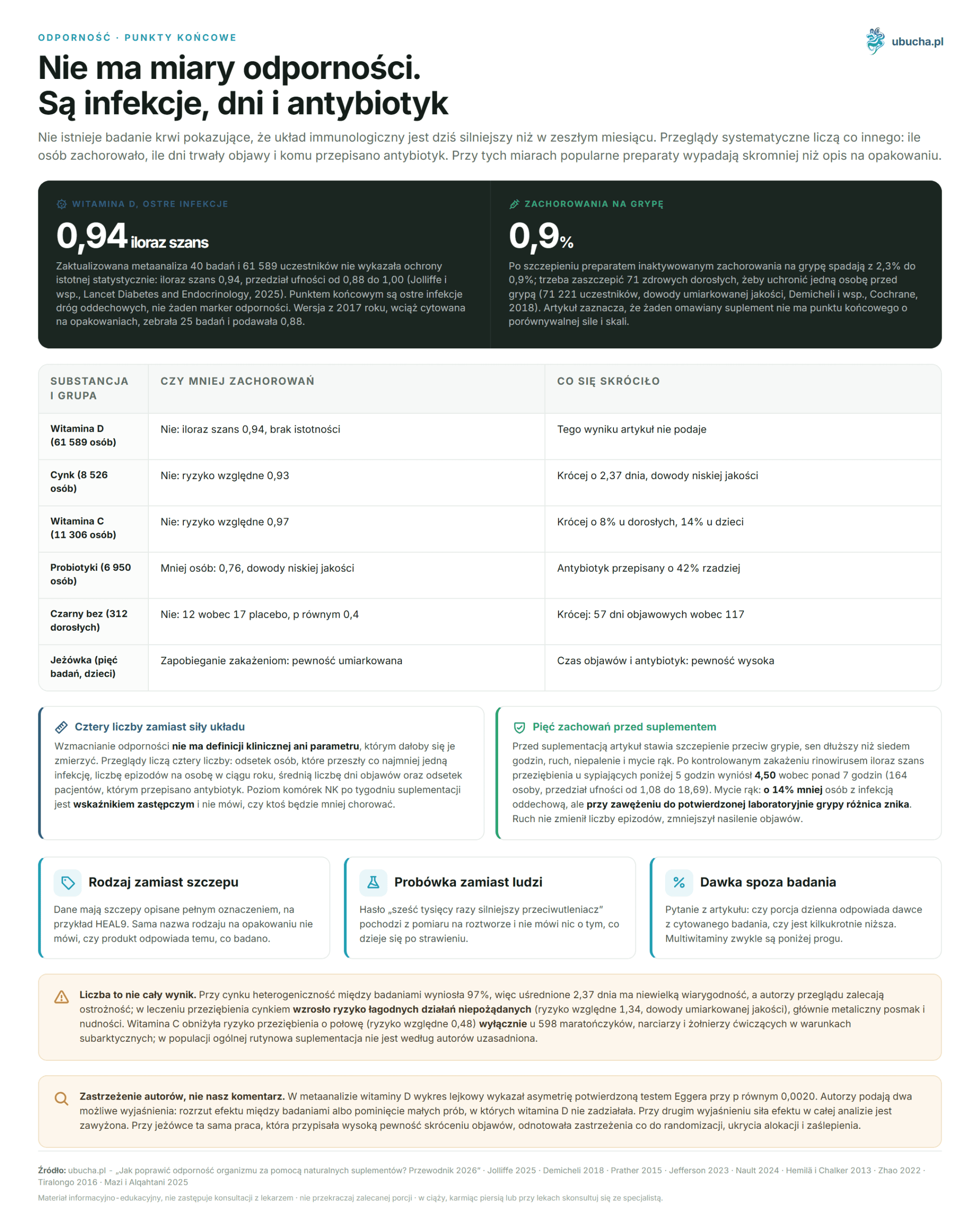
• Updated meta-analysis of 61,589 participants did not confirm protective effect of vitamin D on respiratory infections (Jolliffe et al., 2025).
• Cochrane 2024 rates evidence for zinc as low quality.
• Vitamin C does not reduce incidence, shortens colds by 8% in adults and 14% in children.
• Vaccination, sleep, exercise, not smoking, and handwashing have better documented effects than any supplement on this list.
Does any supplement really strengthen immunity?
Not in the sense promised by the label. Immune strengthening has no clinical definition or measurable parameter. Studies do not test immune system strength but the number of infections, symptom duration, and antibiotic use. By these measures, most popular preparations perform poorly or ambiguously.
The immune system does not behave like a muscle where stronger is better. Excessive immune response causes allergies, asthma, and autoimmune diseases. The goal is not “more immunity” but “an adequate response at the right time.” A preparation that would truly boost the entire machinery would be a drug with serious side effects, not a capsule from a store shelf.
Therefore, systematic reviews use countable endpoints. Usually four numbers: percentage of people with at least one infection, number of episodes per person per year, average days of symptoms, and percentage prescribed antibiotics. Everything else, including NK cell levels after a week of supplementation, is a surrogate marker and does not indicate whether you will get sick less.
This difference has practical implications. A manufacturer can honestly show that their product increases macrophage activity in the lab and simultaneously have no study showing anyone got sick less. Both statements are true, but the first does not answer the buyer’s question. That is why we mainly use systematic reviews here, as they collect all studies on a topic, including unfavorable ones.
There is also a problem manufacturers do not mention. In the updated vitamin D meta-analysis from 2025, the funnel plot showed asymmetry confirmed by Egger’s test with p = 0.0020 (Jolliffe et al., Lancet Diabetes and Endocrinology, 2025). Authors suggest two explanations: effect heterogeneity between studies or omission of small trials where vitamin D was ineffective. The latter inflates the overall effect, and the earlier positive result may have come from small-study effects. This is their own caveat, not our comment. The same mechanism applies to most supplements, but few substances have been studied widely enough to detect it.
What reduces infection risk more than supplements?
Five things: flu vaccination, sleep longer than seven hours, regular exercise, not smoking, and handwashing. Each has data from randomized trials or controlled infection experiments, with effects described numerically. Supplementation comes only after these, never instead of them.
| Behavior | What the data show | Source |
|---|---|---|
| Flu vaccination | Cases drop from 2.3% to 0.9%. Need to vaccinate 71 healthy adults to prevent one flu case. 71,221 participants, moderate-quality evidence. | Demicheli et al., Cochrane, 2018 |
| Sleep longer than 7 hours | After controlled rhinovirus infection, odds ratio for cold was 4.50 for those sleeping under 5 hours vs. over 7 hours. 164 people, confidence interval 1.08 to 18.69. | Prather et al., Sleep, 2015 |
| Handwashing | 14% fewer people with respiratory infections in hygiene intervention group. 9 studies, 52,105 participants, moderate-quality evidence. | Jefferson et al., Cochrane, 2023 |
| Moderate-intensity exercise | No change in number of episodes, but symptom severity on WURSS scale was lower. 2 studies, 373 people, moderate-quality evidence. | Grande et al., Cochrane, 2020 |
| Not smoking | Smokers have 2 to 4 times higher risk of invasive pneumococcal disease; flu is more frequent and severe. Mechanism: airway structural changes and weaker immune response. | Arcavi and Benowitz, Arch Intern Med, 2004 |
Let’s pause on exercise. The Cochrane review from 2020, covering 14 studies and 1,377 adults, found no difference in infection number between exercising and non-exercising groups (Grande et al., 2020). However, symptom severity decreased. This is a good example of an honestly described effect: some things improve, some do not, and both are part of the result.
Similarly with handwashing. Cochrane 2023 reports a 14% reduction in people with respiratory infection (relative risk 0.86), but when limited to lab-confirmed flu, the difference disappears (Jefferson et al., 2023). Even the best-documented behaviors have limits, and that is normal. What is abnormal is promising an effect without any number.
Does vitamin D protect against respiratory infections?
Probably less than thought eight years ago. The 2017 meta-analysis indicated risk reduction for acute respiratory infections with odds ratio 0.88. Its 2025 update, including 61,589 participants from 40 studies, showed no statistically significant protection: odds ratio 0.94 with confidence interval 0.88 to 1.00.
This change is more important than it seems. The 2017 version (Martineau et al., BMJ) collected 25 studies and is still cited on packaging. There was a 2021 update: 37 studies and odds ratio 0.92, still significant then. Six trials were added, including one with 15,804 people, and the confidence interval included one.
The second conclusion sounds even stronger. A preplanned subgroup analysis found no effect dependence on baseline 25(OH)D level, age, or dosing regimen. The widespread thesis “supplement if deficient, then it works” found no support in these data.
This does not mean vitamin D is unnecessary. Polish 2023 guidelines, prepared by 34 authors and agreed by eight scientific societies, maintain supplementation recommendations (Płudowski et al., Nutrients, 2023). The popular summary, however, diverges from the text in two places.
First concerns the calendar. The words “autumn” or “October” do not appear once in the document. The condition for stopping supplementation is sun exposure from May to the end of September, with forearms and lower legs uncovered, without sunscreen. Those who do not meet this should supplement year-round according to guidelines.
Second concerns justification. The guidelines do not limit it to calcium-phosphate metabolism and bone health. They cite pleiotropic effects of vitamin D and discuss the 2021 respiratory infection meta-analysis with favorable subgroup results. This is the same analysis that the 2025 update moved to a nonsignificant result. The document also does not give any percentage of Poles deficient: the phrase “90%” does not appear once. Dose ranges depend on age and body weight, so a doctor determines them, not the product description. The mechanism of combining D3 with K2 is explained separately in the post about vitamin D3 and K2.
Does zinc shorten colds?
It may shorten ongoing colds, but evidence is low quality. Cochrane 2024 analyzed 34 studies with 8,526 participants. Risk of getting a cold barely changed (relative risk 0.93). In treatment of established colds, average duration shortened by 2.37 days.
This second number looks attractive until you see its spread. Heterogeneity was 97%, meaning studies said almost opposite things, and averaging gives a value of low reliability. Authors rated this evidence as low quality and recommend caution in conclusions (Nault et al., Cochrane, 2024).
There is another side. Zinc treatment increased risk of mild adverse effects: relative risk 1.34 with moderate-quality evidence. Mainly metallic taste, nausea, and stomach discomfort.
Note what was actually studied. Lozenges were used in 17 of 34 trials; zinc gluconate in 9 of those 17, about one quarter of the review. Gluconate doses ranged from 45 to 276 mg daily for 4.5 to 21 days, i.e., acutely and very differently from daily preventive capsules. The review excluded preparations combining zinc with other vitamins or minerals. Multivitamins with zinc are thus not what was tested and do not inherit these results.
Another issue is administration route. Four trials used nasal zinc; one combined nasal and lozenge forms. Nasal use has raised concerns for years due to reported smell loss cases. The rest used lozenges, tablets, capsules, syrups, and powders, differing in zinc ion contact time with throat mucosa. Since this contact is considered the mechanism, mixing all forms in one recommendation makes no sense.
Does vitamin C prevent colds?
In the general population, no. The Cochrane review covering 29 comparisons and 11,306 participants found relative risk 0.97 in community studies, i.e., no effect on incidence. Regular intake shortened cold duration by 8% in adults and 14% in children.
Eight percent sounds better than it is on the calendar. For a cold lasting about nine days, this means about three quarters of a day less. In children, the effect was clearer, reaching 18% at doses of 1 to 2 g daily in this analysis. This is a real benefit but of a completely different order than the message “vitamin C for immunity.”
One group showed a different picture. Five studies included 598 marathon runners, skiers, and soldiers exercising in subarctic conditions. There, cold risk halved (relative risk 0.48). Authors conclude clearly: routine supplementation in the general population is not justified, but people exposed to short periods of extreme physical exertion may benefit (Hemilä and Chalker, Cochrane, 2013).
Separate analysis of therapeutic use, i.e., taking vitamin C only after symptoms appear, included seven comparisons and 3,249 episodes and found no consistent effect on duration or severity. The popular reflex “I take a gram when I feel it coming” is not supported by these data. Excess vitamin C is excreted in urine, so increasing dose does not increase effect, and several grams daily cause gastrointestinal discomfort.
Which probiotics have data on upper respiratory infections?
Data concern specific strains, not probiotics as a category. Cochrane 2022, covering 23 studies and 6,950 participants, found fewer people with at least one upper respiratory infection (relative risk 0.76), but evidence was low quality.
The strongest signal concerns something other than cold numbers. Antibiotic prescription rates dropped by 42% (relative risk 0.58) with moderate-quality evidence, a result of real health significance. Duration of single episodes shortened by 1.22 days, again with low-quality evidence (Zhao et al., Cochrane, 2022).
Now the marketing omission. Most included studies used one or two strains described by full designation, e.g., Lactobacillus plantarum HEAL9 or Lactobacillus paracasei 8700:2. Doses ranged from one billion to one hundred billion colony-forming units daily, and supplementation lasted over three months. The result for strain HEAL9 does not automatically apply to another strain of the same species, just as the result for one apple variety does not describe all apples.
The practical takeaway is simple. If the packaging shows only the species name, you cannot verify if the product matches anything studied. How to read strain designations and choose a preparation is explained in the post about probiotics for gut and immunity.
Remember also the time frames. Supplementation lasted over three months, and endpoints were collected throughout the infection season. A two-week pack bought on the day your throat starts to scratch does not replicate this scheme even approximately. Age groups were very diverse, from infants to people aged 84.6 years on average, so the averaged result masks large differences.
Do elderberry and echinacea work for colds?
Data are narrower than packaging suggests. The most cited elderberry study involved 312 adult intercontinental flight passengers. Number of cold episodes did not differ significantly: 17 in placebo vs. 12 in extract group, p = 0.4. However, total symptom duration and severity decreased.
It is worth separating these two results because product descriptions merge them into one sentence about “cold protection.” The study did not show the extract reduced the chance of getting sick. It showed that among those who got sick, illness lasted shorter (57 symptom days with extract vs. 117 placebo, p = 0.02) and was milder (Tiralongo et al., Nutrients, 2016). The group was adults in a specific situation, after a long economy-class flight. This is not the same scenario as autumn in preschool.
The 2019 elderberry meta-analysis is cited as strong evidence but included only 180 participants (Hawkins et al., 2019). For a meta-analysis, this is very small, and authors note lack of large studies.
For echinacea, the picture is mixed. A 2025 systematic review on children with acute respiratory infections found only five eligible studies and noted concerns about randomization, allocation concealment, blinding, and selective reporting (Mazi and Alqahtani, 2025). Some trials showed no difference vs. placebo; efficacy varied by preparation form and extraction method.
However, the same work has a second half often overlooked. Using GRADE, authors assigned high certainty to symptom duration reduction and antibiotic use limitation, and moderate certainty to infection prevention. Higher doses of Echinacea purpurea showed lower incidence, viral load, and milder course. Their conclusion is cautiously positive: echinacea may be a reasonable addition for children, but large, better-quality studies are needed to establish dose and form. The topic of supplements for the youngest is expanded in the post about immune supplements for children.
What is known about beta-glucans and medicinal mushrooms?
Less than product descriptions suggest. Beta-glucans have well-described lab mechanisms and over 80 clinical studies but no Cochrane review on respiratory infections. We found no such entry in Europe PMC, so there is no synthesized number like for zinc, vitamin C, and probiotics.
A 2019 review frames the knowledge state by asking if beta-glucan is still a supplement or already a drug (Vetvicka et al., Molecules, 2019). Authors answer optimistically that the question is not if glucans will become recognized drugs but how fast. It is important to know what this certainty concerns: the paper discusses glucans’ role in immune responses and cancer treatment, not cold prevention in healthy adults.
Another pitfall is treating beta-glucans as one substance. Molecules from Saccharomyces cerevisiae yeast have beta-1,3/1,6 structure; those from oats and barley beta-1,3/1,4; mushrooms provide other variants. They differ in solubility, molecular weight, and receptor affinity, so results for one source do not describe others.
For medicinal mushrooms, raw material matters. Preparations may come from fruiting bodies or mycelium grown on grain, where the latter contains much substrate mass, not mushroom. Declared beta-glucan content is the only info resolving this, and not every producer provides it. Species comparisons are in the post about adaptogenic mushrooms.
Interestingly, the best-documented beta-glucan effects from oats and barley are not about immunity but metabolic: lowering cholesterol and postprandial glucose. So if oat flakes are marketed with immunity claims, the description diverges from the area where this molecule has strong data. This is a good example of one chemical name covering two completely different marketing promises.
When does supplementation really make sense?
When it fills a confirmed or very likely deficiency, not when it aims to boost a healthy body. Supplementation is like adding fuel: it helps when the tank is empty and changes nothing when full. This difference explains most disappointments.
| Situation | What is justified | What it does not replace |
|---|---|---|
| September, April in Poland | Vitamin D per 2023 guidelines | Vaccinations and sleep |
| Diet without fish, eggs, and dairy | Supplementing nutrients indicated by blood test | Dietary changes |
| Senior age | Plan set with doctor, as absorption and medications affect status | Recommended vaccinations for this group |
| Antibiotic therapy | Probiotic strain with full designation | Completing therapy as prescribed |
| Pregnancy, breastfeeding, chronic illness | Only what the attending physician prescribes | Medical supervision |
On the other side are situations where supplements are an expense without coverage. Thirty-ingredient multivitamins usually contain each ingredient below clinically studied thresholds. Preparations advertised with immunity claims but without strain, active substance dose, or study reference cannot be compared to anything. The costliest mistake is taking a capsule instead of fixing sleep, as the data difference is huge.
Order of actions also matters. First, identify what really needs fixing: how many hours you sleep on workdays, whether your diet includes fish and vegetables, whether recommended vaccinations for your age are up to date. Only with such a list does it make sense to discuss 25(OH)D testing or probiotics after antibiotics. The reverse sequence - buying capsules and postponing the rest - is the most common scenario and fares worst in data.
What are risks and interactions with immune supplements?
The biggest risk is not that the product won’t work but that it interacts with medications or delays doctor visits. Cochrane 2024 noted higher risk of mild adverse effects with zinc, relative risk 1.34.
| Combination | Problem |
|---|---|
| St. John’s wort with antidepressants, hormonal contraception, or warfarin | St. John’s wort induces liver enzymes and lowers levels of many drugs, weakening their effect |
| Vitamin K with warfarin | Any change in vitamin K intake destabilizes coagulation control and requires dose adjustment |
| Calcium or iron with levothyroxine | Taken together reduce thyroid hormone absorption, so time gap is needed |
| Iron with tetracycline antibiotics | Preparations mutually inhibit absorption, weakening antibiotic effect |
| Echinacea with autoimmune disease | Manufacturers advise against use due to lack of safety data in this group |
There is also accumulation. Fat-soluble vitamins A, D, E, and K accumulate in the body, so overdose is real and usually results from summing several products containing the same ingredient. Vitamin C behaves oppositely and excess is excreted in urine, but gastrointestinal discomfort appears before any benefit.
Finally, legal status. A dietary supplement is notified to the Chief Sanitary Inspectorate; this is a notification procedure, not approval after clinical trials. Registration does not say anything about product efficacy. With shortness of breath, chest pain, fever lasting more than three days, or symptom recurrence after improvement, supplements lose relevance and consultation is needed.
How to read supplement label promises?
Start by asking what exactly the package declares and whether it can be verified. The phrase “supports immunity” does not indicate any endpoint. Specifics start where strain designation, active substance dose, and human study reference appear.
Five questions that practically resolve almost every case:
- Is the active substance dose given or only total extract mass?
- For probiotics, is the full strain designation given, e.g., HEAL9, not just species name?
- For plant extracts, is the plant part and raw material to extract ratio specified?
- Does the manufacturer cite a human study or a cell culture experiment?
- Does the daily portion match the dose from the cited study or is it several times lower?
A separate trap is numbers based on test-tube assays. Claims like “six thousand times stronger antioxidant” come from solution measurements and say nothing about what happens after digestion and liver passage. Similarly, references to receptor activation or NK cell increase are indirect markers, not illness outcomes.
A verifiable quality signal is whether the manufacturer even gives study name, year, and participant group. If they cite “studies” without any reference, you have nothing to verify, and the label statement is decorative.
The same rule applies to names and institutions. A signature like “according to the Institute of Immunity Research” means nothing unless you can check if such an entity exists and what exactly it published. A PubMed ID or DOI number takes about a dozen characters on the package and lets you reach the source in a minute. Its absence alongside scientific claims is itself product information.
Frequently Asked Questions
Does vitamin D only make sense in autumn and winter if it does not protect against infections?
Polish guidelines from 2023 do not divide the year into seasons. The condition for stopping supplementation is sun exposure from May to the end of September, without sunscreen, with forearms and lower legs uncovered. Those who do not meet this condition should supplement all year round. The dose range is determined by a doctor, as it depends on age and body weight.
How many Poles really have a vitamin D deficiency?
The exact number is unknown. The 2023 guidelines state that epidemiological studies indicate the prevalence of deficiency in the Polish population but do not provide a single percentage. The phrase “90%” does not appear even once in the full text, so the circulating claim about 90% of Poles has no basis in it. The answer is given by the 25(OH)D blood concentration measurement.
Is it worth keeping zinc lozenges in the medicine cabinet?
You can, but without high expectations. Cochrane 2024 reports shortening the duration of a cold by an average of 2.37 days with low-quality evidence and very high heterogeneity between studies. At the same time, the risk of mild adverse effects increases, mainly metallic taste and nausea.
Can elderberry be given to children?
The best-known elderberry study for colds involved 312 adult intercontinental flight passengers, not children. The results from this group cannot be directly transferred to preschoolers. Preparations intended for children differ in composition and concentration, so make the decision together with a pediatrician.
Is a probiotic from the pharmacy enough, or do you need to look for a specific strain?
Data concern strains, not bacterial species. In studies collected by Cochrane in 2022, preparations with one or two strains described by full designation were used, for example Lactobacillus plantarum HEAL9. The species name alone on the packaging does not indicate whether the product corresponds to what was actually studied.
Can flu vaccination be replaced by supplements?
No. Cochrane reports a decrease in flu cases from 2.3% to 0.9% after vaccination with an inactivated vaccine, with moderate-quality evidence and a group of over 71,000 participants. None of the supplements discussed in this text have an endpoint of comparable strength and scale.
How to recognize that an infection requires a doctor, not a supplement?
Worrying signs include shortness of breath, chest pain, fever lasting more than three days, significant worsening of symptoms after initial improvement, and any infection in an immunosuppressed person. In such situations, a supplement is not the topic of discussion, and delaying a visit only worsens the situation.
If after this reading you want to fill a specific deficiency confirmed by testing or choose a probiotic with a described strain, you can find preparations in the supplements category. But before ordering, check if your sleep and vaccinations are already in order, as they make the biggest difference.
This article is for informational and educational purposes and does not constitute medical advice. Consult a doctor before starting supplementation, especially if you take medications regularly, are pregnant or breastfeeding, or have chronic illness.
Author: Michał Waluk · Published: 2026-05-11 · Updated: 2026-08-15