
10 myths about vaporizing herbs: what research really says
Ten myths about vaporizing herbs compared with research: temperature, storage, differences between devices, and what the data does not confirm.
Vaporizing herbs has become surrounded by numbers that sound scientific, but upon checking, they turn out to be quotes from the manufacturer’s leaflet. We took ten statements that recur in Polish guides and compared them with the studies these guides refer to. The result is not clear-cut. Seven myths are debunked, one statement holds with reservations, and for two, there is simply nothing to compare because no one has measured them. One result even flips on its head: in Pomahacova’s measurements, the worst balance was not at the highest, but at the lowest of the tested temperatures. Here you will find each myth separately, the data that confirms or refutes it, and clear indications of places where research is simply lacking. At the end, there is a summary table indicating the source for each row.
KEY INFORMATION
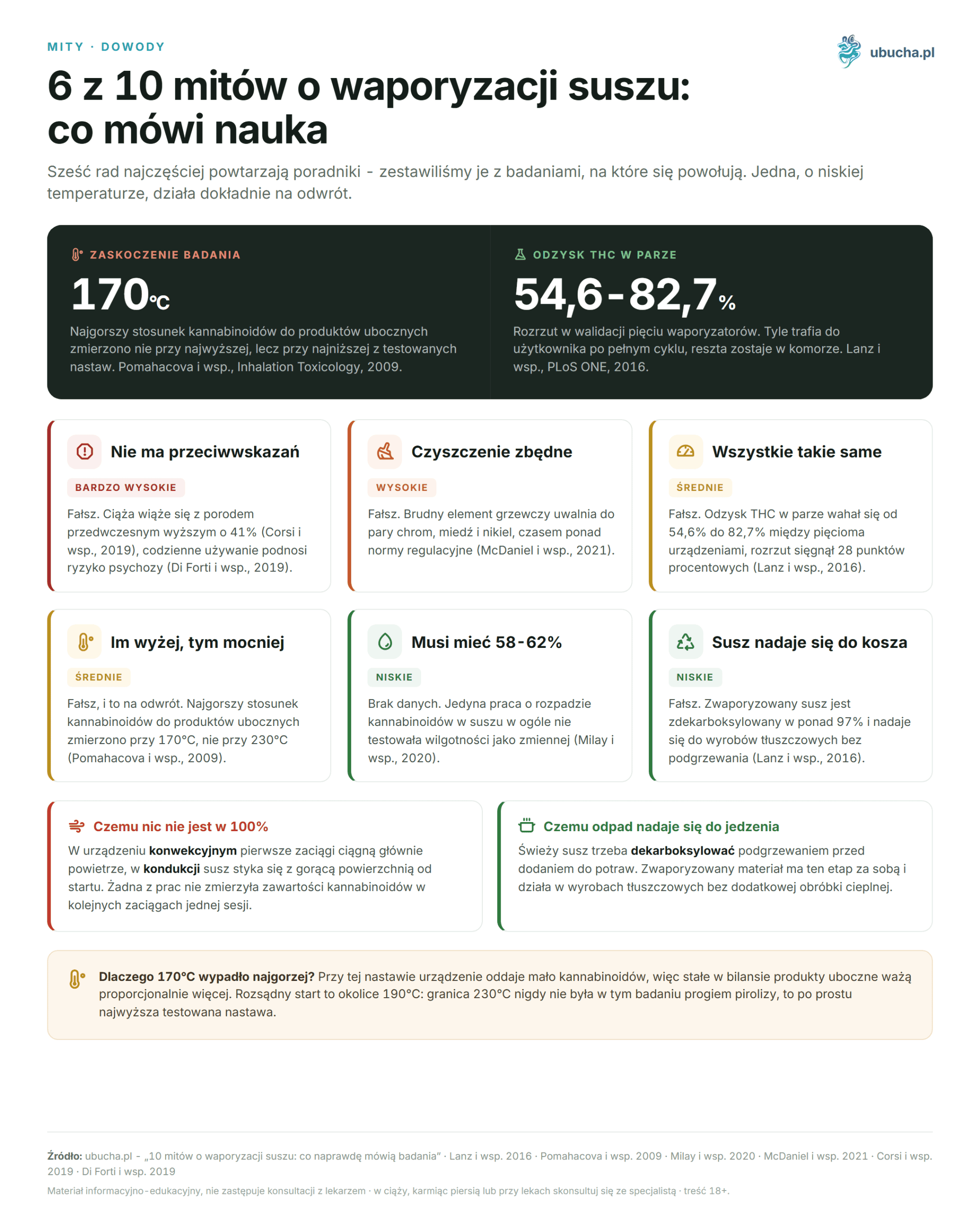
• THC recovery from vapor ranges from 54.6% to 82.7% depending on the device (Lanz et al., PLoS ONE, 2016).
• The worst ratio of cannabinoids to by-products was measured at 170°C, not at 230°C (Pomahacova et al., 2009).
• Vaporization is less harmful than smoking, but not harmless: there are no data from observations longer than a few years.
• Vaporized herbs are decarboxylated by over 97% and retain part of their content.
Is vaporizing herbs safe?
Vaporization is less harmful than smoking, but it is not harmless. Vapor contains a more favorable ratio of cannabinoids to by-products than smoke from a cannabis cigarette (Pomahacova et al., Inhalation Toxicology, 2009), but no study has shown that it is free from irritants to the respiratory tract.
The most frequently cited argument for vaporization is the survey by Earleywine and Barnwell from 2007. The summary of this work does not provide any numbers, so we read them from the full text. The survey included 6883 people, of whom 152 indicated the vaporizer as their main method, which is 2.2%. Among them, 100 people, or 65.8%, reported no respiratory symptoms, compared to 3767 out of 6731 in the other group, or 56.0% (Earleywine and Barnwell, Harm Reduction Journal, 2007). The difference is real, but smaller than in popular summaries, and one in three vaporizer users did report symptoms. This is a cross-sectional study based on declarations, not lung function measurements.
A separate chapter concerns ready-made cartridges. In 2019, an epidemic of lung injuries from vaping, called EVALI, broke out in the United States. Vitamin E acetate was detected in bronchoalveolar lavage fluid in 48 out of 51 tested patients, or 94%, and was not detected in any of the control group (Blount et al., New England Journal of Medicine, 2020). Among the sick, for whom the source of the THC product was known, 627 out of 809, or 78%, obtained it exclusively outside of legal trade (Ellington et al., MMWR, 2020). This concerned oily cartridges of unknown composition, not dried flowers in the heating chamber. The conclusion remains: the risk comes from what cannot be verified.
Is one chamber fill the whole session?
No. Extraction occurs over the entire cycle, and some content remains in the chamber even after it ends. In laboratory validation of five vaporizers, total THC recovery in vapor ranged from 54.6% to 82.7% (Lanz et al., PLoS ONE, 2016).
This one number is enough to debunk the myth of a single hit. Since the best of the tested devices did not yield nearly one-fifth of the total THC in vapor after a full cycle, a single puff extracts a fraction of the chamber’s content. A session ends when the vapor stops tasting, not after a counted number of seconds. Caveat: this is an in vitro measurement on equipment, not an observation of sessions in humans.
Popular guides provide precise schedules: so many minutes at one setting, so many at the next. We did not find a study that compared such schemes with each other, so treat them as a convention, not as a protocol. However, it makes sense to gradually increase the temperature, as compounds with lower boiling points evaporate earlier. Starting with a lower setting and raising it during the session organizes the flavor profile, although no one has measured by how much.
From our observations while conducting sessions, one more thing emerges. After a cycle without moving the chamber’s contents, the layer near the heating element is noticeably darker than the material from the center, and the difference can be visible to the naked eye. This is an argument for mixing the herbs halfway through the session.
Does a higher temperature give a stronger effect?
No, not in a straightforward way, and the measurement result is surprising. In a study comparing vapor from the Volcano with smoke from a cannabis cigarette, the worst ratio of cannabinoids to by-products was found in a sample vaporized at 170°C, which is the lowest, not the highest of the tested settings.
At 200°C and 230°C, this ratio was significantly better than in smoke from a cigarette. In this experiment, the temperature considered safe because it is low performed the worst. The explanation is probably simple: at 170°C, the device yields few cannabinoids, so the by-products, which always occur to some extent, weigh more in the balance.
| Setting | What was measured in vapor from Volcano |
|---|---|
| 170°C | Worst ratio of cannabinoids to by-products among the tested settings |
| 200°C | Significantly better ratio than in smoke from a cannabis cigarette |
| 230°C | Significantly better ratio than in smoke from a cannabis cigarette |
What does this work not say? It does not set a threshold above which pyrolysis begins. The popular boundary of 230°C does not come from this study, as 230°C was the highest setting in it and performed well. Gieringer and colleagues described a vaporizer in 2004 that delivers THC while suppressing pyrolytic compounds (Journal of Cannabis Therapeutics, 2004), but this work also does not establish a common threshold for all devices.
The practical conclusion is less spectacular than a table of boiling points of individual compounds. A range from about 190°C to 220°C is supported by measurements as a reasonable compromise. Going below 180°C for safety alone has no support at all. Separately, we outlined this in a guide on what temperature to choose during vaporization.
Does the herb for vaporization need to have 60% humidity?
The range of 58-62% relative humidity is repeated by guides and descriptions of humidifying packets, but we did not find a measurement that justified it. The work that actually measured the breakdown of cannabinoids and terpenes in stored herbs varied the temperature and degree of material grinding, and did not treat humidity as a variable at all.
The team kept the flowers and extracts for a year in the dark, at four temperatures: 25, 4, minus 30, and minus 80°C. The greatest changes in cannabinoid concentrations were found when stored at 25°C, which is typical room temperature (Milay et al., Frontiers in Plant Science, 2020). Terpene concentrations dropped quickly under all studied conditions, with the worst results at temperatures below minus 20°C and grinding the flowers. The authors considered whole flowers stored at 4°C to be optimal.
Humidity appears in this work in one place and not in the role that guides refer to: the material was seasoned at 21°C at 60% humidity, and then the water content was checked every four months. It did not change significantly in any of the studied variants. The number 60 thus describes the drying conditions of one batch, not a recommendation for storage.
What does this imply for vaporization? Three things can be defended by data. Cool and dark instead of a windowsill over a heater. Whole flowers instead of ground stock, because you grind just before the session. And awareness that terpenes decrease even with good storage, so herbs bought for months will lose aroma regardless of the packet.
Over-dried material indeed crumbles in the grinder and produces harsh vapor, while overly moist material risks mold. However, these are practical observations, not measured effects, and should be read as such. If you are looking for material for a session, check the category of cannabis herbs and accessories for storage.
Does every vaporizer work the same?
No, and the differences can reach several dozen percentage points. In the validation of five devices, total THC recovery in vapor ranged from 54.6% to 82.7%, and CBD recovery from 45.9% to 70.0%. The differences did not correlate with price.
| Device | THC recovery in vapor | CBD recovery in vapor |
|---|---|---|
| Arizer Solo | 82.7% | 70.0% |
| Plenty | 66.8% | 56.1% |
| Volcano Medic | 58.4% | 51.4% |
| Vape-or-Smoke (gas) | 55.9% | 45.9% |
| DaVinci | 54.6% | 56.7% |
The highest recovery was achieved by the Arizer Solo, a device cheaper than the Volcano Medic, which performed over 24 percentage points worse (Lanz et al., PLoS ONE, 2016). The authors observed combustion of the material only with the gas-powered model. The four electric devices decarboxylated very effectively: at least 97.3% for THC and 94.6% for CBD, while the gas model achieved at least 87.7% for both compounds.
This work did not compare convection with conduction as a separate variable. Common claims like “convection gives 15-20% more” have no support in it. The device as a whole differs, not just the heat transfer mechanism. How these solutions work and how they differ in practice is described in our comparison of vaporizer types.
The material in the chamber matters for a different reason than flavor. An analysis of thirteen cartridges randomly purchased in Washington showed that chromium, copper, and nickel migrate into the inhaled vapor, and the source turned out to be the heating element itself (McDaniel et al., Chemical Research in Toxicology, 2021). The study mainly focused on oil cartridges, but the comparison also included heating herbs.
Does vapor from a vaporizer smell the same as smoke?
No, although there are surprisingly few hard measurements here. We did not find a reviewed study that measured how long the smell of vapor from herbs lingers in a room, so circulating comparisons like twenty minutes versus two hours should be treated as user observations.
The mechanism of difference is well described, however. A burning joint operates at combustion temperature and produces solid particles and tar that settle on fabrics and hair. Vaporization operates at temperatures roughly from 170°C to 230°C, and with a functioning device, combustion does not occur. This was confirmed by Lanz’s validation: among the five devices tested, combustion of the material occurred only with the gas model.
However, the smell does not disappear. It is different, more herbal and less persistent, but in a small room, it is easily detectable. Herbs with a distinct terpene profile smell even in the chamber before the device heats up. If discretion matters to you, ventilation and a tight container for the material will change more than the choice of inhalation method. Clothes after a session with a vaporizer also smell, just shorter and weaker.
Is the first puff the strongest?
Usually not, but this is user observation, not a measured effect. It is known, however, that extraction occurs over the entire cycle: THC recovery in vapor ranges from 54.6% to 82.7%, so from less than one-fifth to almost half of the content does not reach the user at all.
In a convection device, the first puffs mainly draw air, which only transfers heat to the material. In conduction, the herb contacts the hot surface from the start, so the beginning of the session can be denser. This description aligns with the physics of both solutions, but we did not find a study that measured cannabinoid content in successive puffs of a single session.
The indicator used by most experienced users is the color of the material in the chamber. Green means the session has not yet picked up. A uniform medium brown indicates the moment when the vapor has the most flavor. Dark brown or black means that mainly degradation products remain, and it is time to finish. Color is an imperfect measure, but it is readily available, unlike a laboratory chromatograph.
Is vaporized herb only good for the trash?
No. After the session, material remains in the chamber from which the device did not extract everything, as THC recovery in vapor ranged from 54.6% to 82.7%. Additionally, it is already decarboxylated: the decarboxylation efficiency was at least 97.3% for THC (Lanz et al., 2016).
Decarboxylation is the stage for which fresh herbs need to be heated before adding to dishes. Vaporized material has already undergone this process, so it works in edible products without additional heat treatment. Cannabinoids are lipophilic, so they need a fat carrier: butter, coconut oil, or whole milk.
There is one condition that guides do not mention. The dose is unpredictable. You do not know how much is left in a specific batch, as it depends on the device, settings, and session length, and the variation between devices reached 28 percentage points. The effect appears noticeably slower orally than by inhalation, so adding more after twenty minutes is the most common mistake of beginners.
Collect the material in a tight, dark jar and keep it cool, for the same reasons as fresh herbs. The flavor is earthy and distinct, so it withstands cocoa or strong tea better than delicate pastries. What exactly can be done with it is outlined in the text about the second life of vaporized material, and edible products can be found in the category of cannabis food.
Does the vaporizer really need to be cleaned?
Yes, although not for the reasons given in guides. Numbers like a 30-50% drop in quality over twenty sessions do not come from any measurement we could find. The real argument is different: a dirty device heats differently, and the heating element can be a source of metals.
The same aerosol analysis showed that smaller amounts of lead, manganese, and tin also reach the vapor, and in some samples, the one-time dose of inhaled metals exceeded the limits set by several regulatory bodies (McDaniel et al., 2021). A layer of burnt resin on the walls of the chamber is not a neutral surface through which hot air flows.
For cleaning, isopropyl alcohol with a concentration of 90% to 99% and cotton swabs are suitable. Food alcohol or hand sanitizer with glycerin is not suitable, as they leave a residue that you then inhale. The same applies to detergents. After rinsing, wash the parts with distilled water and wait until they are completely dry before turning on the device.
Filters and seals are consumable materials. Replace the filter through which airflow has clearly decreased instead of cleaning it for the tenth time.
Who should not vaporize herbs?
Pregnancy and breastfeeding, being under eighteen years old, and a psychotic history are situations in which vaporizing material with THC is contraindicated. Two of these points have strong support in large population studies, while the others are based on caution.
The strongest data concern pregnancy. In a cohort of 661,617 pregnancies in Ontario, reported cannabis use was associated with a 41% higher risk of preterm birth after group matching (Corsi et al., JAMA, 2019). There was also an increase in the frequency of low birth weight relative to gestational age, below the third percentile, 6.1% versus 4.0%, and placental abruption, 1.6% versus 0.9%. Exposure was determined by interview, not laboratory testing, and the authors themselves caution that the result cannot be fully cleared of confounding factors.
The second area is psychosis. In the EU-GEI study, which included eleven centers in Europe and Brazil, 901 patients after their first episode of psychosis and 1237 people from the control group participated. Daily cannabis use was associated with more than three times the chances of developing the condition, and daily use of strains with at least 10% THC with nearly five times the chances (Di Forti et al., Lancet Psychiatry, 2019). The authors estimate that assuming causality, the disappearance of strong strains from the market would have prevented 12.2% of first episodes in the entire studied group. This is an observational study, so it does not prove causality, but the dose-response relationship is clear in it.
The remaining contraindications are based on caution, not measurements. We did not find studies on vaporization in patients with asthma or chronic obstructive pulmonary disease, and inhaling hot aerosol into irritated airways is not something that is tested on volunteers. If you are taking medications regularly, asking your doctor is cheaper than experimenting on yourself.
How to vaporize wisely?
Six principles can be directly derived from the cited studies, without referring to forum folklore. The rest of the popular advice is convention that harms no one but has no measurement behind it. The following list adheres to what someone has actually measured and published.
- Start with a setting around 190°C instead of 170°C, as the lowest of the tested temperatures gave the worst balance (Pomahacova et al., 2009).
- Keep the material cool and dark, in whole flower clusters, and grind it just before the session (Milay et al., 2020).
- Do not end the session on the first puff, as extraction occurs over the entire cycle (Lanz et al., 2016).
- Do not judge the device by price or declared heating mechanism, as in measurements, the cheaper model yielded the highest recovery.
- Collect vaporized material instead of throwing it away, as it is already decarboxylated.
- Clean the chamber and replace filters, as the heating element is a documented source of metals in vapor (McDaniel et al., 2021).
The legal issue remains, and guides usually summarize it incorrectly. The law defines hemp as plants of the species Cannabis sativa L., in which the sum of delta-9-THC and tetrahydrocannabinolic acid in the flowering or fruiting tips, from which resin has not been removed, does not exceed 0.3% in relation to dry mass; the sum is rounded to one decimal place. The basis is art. 4 point 5 of the act of July 29, 2005, on drug prevention, consolidated text Journal of Laws 2023 item 1939, as amended by the act of March 24, 2022, Journal of Laws 2022 item 763, effective from May 7, 2022. The difference is practical: a test result stating only delta-9-THC does not answer the question posed by the law. The vaporization device itself is not subject to regulation in this act, and the table above shows laboratory measurement results from 2016, not a purchase ranking.
Frequently asked questions
Is vaporizing herbs healthier than smoking?
It is less harmful, but not harmless. In a survey of 6883 people, 65.8% of vaporizer users reported no respiratory symptoms compared to 56.0% of others (Earleywine and Barnwell, 2007). However, one in three vaporizer users did report symptoms, and there are still no studies observing lungs over a decade.
At what temperature should I start vaporizing herbs?
A reasonable start is around 190°C. In Pomahacova’s measurements, the worst ratio of cannabinoids to by-products was found in a sample vaporized at 170°C, while settings of 200°C and 230°C performed significantly better than smoke from a cannabis cigarette. Going very low for safety alone is not supported by data.
Is vaporizing cannabis herbs legal in Poland?
The device itself is not regulated in the drug prevention act. The material is regulated: hemp plants are those in which the sum of delta-9-THC and THCA in the tips does not exceed 0.3% of dry mass, rounded to one decimal place (art. 4 point 5, Journal of Laws 2023 item 1939). The herb should come from legal trade and have a composition analysis.
Does a more expensive vaporizer yield more cannabinoids?
Not necessarily. In the validation of five devices, the highest THC recovery, 82.7%, was achieved by the Arizer Solo, while the more expensive Volcano Medic achieved 58.4% (Lanz et al., 2016). The variation between devices reached 28 percentage points, but did not correlate with price or declared heating mechanism.
How should I store herbs between sessions?
Cool, dark, and in whole flower clusters. In a year-long experiment, the greatest changes in cannabinoid concentrations were found when stored at 25°C, and grinding the material worsened the result (Milay et al., 2020). Terpenes decreased under all studied conditions, so herbs bought in bulk will lose aroma regardless of the packaging.
What to do with vaporized herbs?
Keep them. THC recovery in vapor ranged from 54.6% to 82.7%, so a real portion of the content remains in the chamber, and the material is decarboxylated by over 97% (Lanz et al., 2016). It is suitable for fat-based products without additional heating, although the doses cannot be predicted.
Does vapor from a vaporizer leave a smell in the apartment?
It does leave a smell, but it is different and less persistent than smoke. We did not find a reviewed measurement of how long the smell of vapor lingers, so popular comparisons like twenty minutes versus two hours are user observations. The mechanism of difference is real: with a functioning device, there is no combustion.
What is known about the long-term effects of vaporization on the lungs?
Not much. The most frequently cited work by Earleywine and Barnwell from 2007 is a cross-sectional internet survey based on declarations, not lung function measurements or cohort observation over time. Studies tracking vaporizer users for ten years have simply not been published.
What remains from the ten myths?
Seven statements turned out to be false or greatly exaggerated, one holds with reservations, and for two, there are simply no measurements. The biggest surprise was the temperature: the advice to start as low as possible performed the worst in the study among all tested settings.
| Myth | What the data shows | Source |
|---|---|---|
| Vaporization is completely safe | False. Less harmful than smoking, with no long-term data | Earleywine 2007 |
| One fill is the whole session | False. THC recovery after a full cycle is 54.6-82.7% | Lanz 2016 |
| The higher the temperature, the stronger the effect | False. The worst balance at 170°C, not at 230°C | Pomahacova 2009 |
| Herb must have 58-62% humidity | No data. The impact of temperature and grinding was measured | Milay 2020 |
| Every vaporizer works the same | False. The variation in recovery reaches 28 percentage points | Lanz 2016 |
| Vapor smells the same as smoke | Partially true. Different mechanism, no smell measurements | Lanz 2016 |
| The first puff is the strongest | No data. Extraction occurs over the entire cycle | Lanz 2016 |
| Vaporized herb is waste | False. Material decarboxylated by over 97% | Lanz 2016 |
| Cleaning is not necessary | False. The heating element releases metals into the vapor | McDaniel 2021 |
| Vaporization is for everyone | False. Contraindications in pregnancy and with psychosis risk | Corsi 2019, Di Forti 2019 |
If you are looking for material for a session, check the category of cannabis herbs, and while you’re at it, check storage containers, as they determine how much aroma lasts until the next session.
This article is for informational and educational purposes and does not constitute medical advice. Before starting to use cannabis or CBD for therapeutic purposes, consult your doctor, especially if you are taking other medications, are pregnant, or breastfeeding.
Author: Michał Waluk · Published: 2026-05-11 · Updated: 2026-08-15