
Marijuana Withdrawal Symptoms: Stages and When They Pass
Irritability, insomnia, and nightmares after marijuana withdrawal. Course in stages: 48 hours, one week, four weeks. What helps according to research.
The most common marijuana withdrawal symptoms are irritability, insomnia, and nightmares, with three stages: the first 48 hours, the first week, and four weeks, after which CB1 receptor density returns to normal. Withdrawal after years of daily use rarely occurs without symptoms. For a long time, part of the medical community considered these symptoms purely psychological difficulties until DSM-5 introduced cannabis withdrawal syndrome as a separate diagnosis in 2013. Today, it is supported by imaging, polysomnographic, and epidemiological studies, not just patient reports. This guide shows exactly what these studies say: how often the syndrome occurs, how long it lasts, what happens in the brain after cessation, which treatments have randomized trial evidence, and when to seek help. It also separates findings from unsupported internet figures and clearly indicates which questions remain unresolved by current research.
KEY INFORMATION
• Cannabis withdrawal syndrome affects 47 percent of regular users, with wide variation: 17 percent in population samples and 87 percent among inpatients (Bahji et al., 2020).
• Reversal of CB1 receptor changes begins within the first two days of abstinence, and receptor density normalizes after about four weeks (Bonnet and Preuss, 2017).
• Symptoms are mainly mood and behavioral, mild to moderate in severity, and usually manageable outpatient.
• Behavioral therapies outperform no treatment but not active comparative therapies (Davis et al., 2015).
• No medication is registered for this indication. In mental health crisis, call 116 123; in life-threatening situations, call 112.
What is cannabis withdrawal syndrome according to DSM-5?
It is a syndrome of symptoms appearing after stopping or significantly reducing heavy, long-term cannabis use. DSM-5 requires at least three of seven symptoms within about a week of cessation, causing clinically significant distress or impairment. The diagnosis was introduced in 2013 (American Psychiatric Association, DSM-5).
The earlier DSM-IV classification from 1994 did not include this entity. The change was not cosmetic: Bonnet and Preuss describe the syndrome as specific, confirmed in animal and human studies, with primarily mood and behavioral symptoms of mild to moderate severity (Bonnet and Preuss, 2017).
The practical significance is straightforward. A patient presenting with irritability, insomnia, and low mood after cessation is no longer seen as having purely motivational problems. The same review notes most cases can be managed outpatient and symptom severity varies widely in natural settings.
It is also important to know what the diagnosis does not mean. Withdrawal syndrome is not the same as cannabis use disorder, though it is one of its criteria. One can experience withdrawal symptoms without full disorder diagnosis and have the disorder without clear withdrawal symptoms.
The formal diagnosis also changes the conversation. When symptoms were seen as psychological reactions, it was hard to justify sick leave, pharmacological support, or care plans. Since 2013, there is a recognized entity to document and build treatment around, a practical rather than academic difference.
What symptoms are included in the seven DSM-5 criteria?
The list is closed and decisive for diagnosis. Three of seven symptoms suffice if they appear within about a week of cessation in a person with heavy, long-term cannabis use.
- Irritability, anger, or aggression.
- Nervousness or anxiety.
- Sleep disturbances, including insomnia and disturbing dreams.
- Decreased appetite or weight loss.
- Psychomotor agitation.
- Depressed mood.
- At least one physical symptom causing significant discomfort: abdominal pain, tremors, sweating, fever, chills, or headache.
Physical symptoms are often overlooked; Bonnet and Preuss note a clear sex difference here. Women report stronger withdrawal syndrome than men, including somatic complaints like nausea and abdominal pain. The authors even proposed adding physical symptoms and severity/duration specifications to the ICD-11 draft.
The last criterion has an additional condition often forgotten in self-diagnosis: symptoms must cause clinically significant distress or impair functioning at work, relationships, or school. Mere discomfort lasting two days is insufficient.
Craving is not on the list, though patients mention it most often. Craving is a criterion of cannabis use disorder, not withdrawal syndrome. This distinction causes confusion: one can lack withdrawal criteria yet have strong craving, which often drives relapse.
How common is cannabis withdrawal syndrome?
The most comprehensive answer comes from a meta-analysis of 47 studies with 23,518 participants. Overall prevalence was 47 percent, with a confidence interval of 41 to 52 percent. Variation between studies was very high, so the single figure should be read cautiously (Bahji et al., 2020).
Breaking down by sample type is more informative. Population studies found 17 percent prevalence, outpatient samples 54 percent, and inpatient treatment 87 percent. Differences were statistically significant. Higher prevalence was linked to daily use and co-use of tobacco and other substances.
| Sample Type | Withdrawal Syndrome Prevalence | Confidence Interval |
|---|---|---|
| Population Studies | 17% | 13-21% |
| Outpatients | 54% | 48-59% |
| Inpatients | 87% | 79-94% |
| Overall | 47% | 41-52% |
Separately, cannabis use disorder prevalence in a US study of 36,309 adults was 2.5 percent in the past 12 months and 6.3 percent lifetime. Another striking figure: only 13.2 percent of those diagnosed lifetime ever received treatment or a twelve-step program (Hasin et al., 2016).
One methodological caveat: study heterogeneity was extremely high, so the overall figure is a reference point, not a prediction for individuals. The sample was not population-representative: about 60 percent male, median age about 30.
Who is most at risk for severe symptoms?
Severity depends mainly on amount of cannabis used before cessation, sex, and genetic/environmental factors. This explains why two people with similar use history can have very different courses (Bonnet and Preuss, 2017).
Bahji’s meta-analysis adds measurable factors. Higher withdrawal prevalence was linked to daily cannabis use, concurrent tobacco smoking, and other substance use disorders. These are addressable in withdrawal planning.
Product potency also matters, though evidence relates more to risk of disorder than withdrawal symptoms. A systematic review of 20 studies found higher THC content products associated with increased risk of psychosis and cannabis use disorder; evidence for depression and anxiety was mixed (Petrilli et al., 2022).
In practice, a daily user of high-potency cannabis who also smokes cigarettes enters withdrawal at a disadvantage compared to an occasional user. However, variability remains high and none of these traits is deterministic. Duration of effects after use is discussed separately: how long effects last after smoking marijuana and THC.
Age of onset is also a risk factor epidemiologically, but differently than usually cited. Hasin’s study found cannabis use disorder diagnosis odds over seven times higher in ages 18-24 than over 45. This measures disorder prevalence, not withdrawal severity, and should be read accordingly.
How long does marijuana withdrawal last?
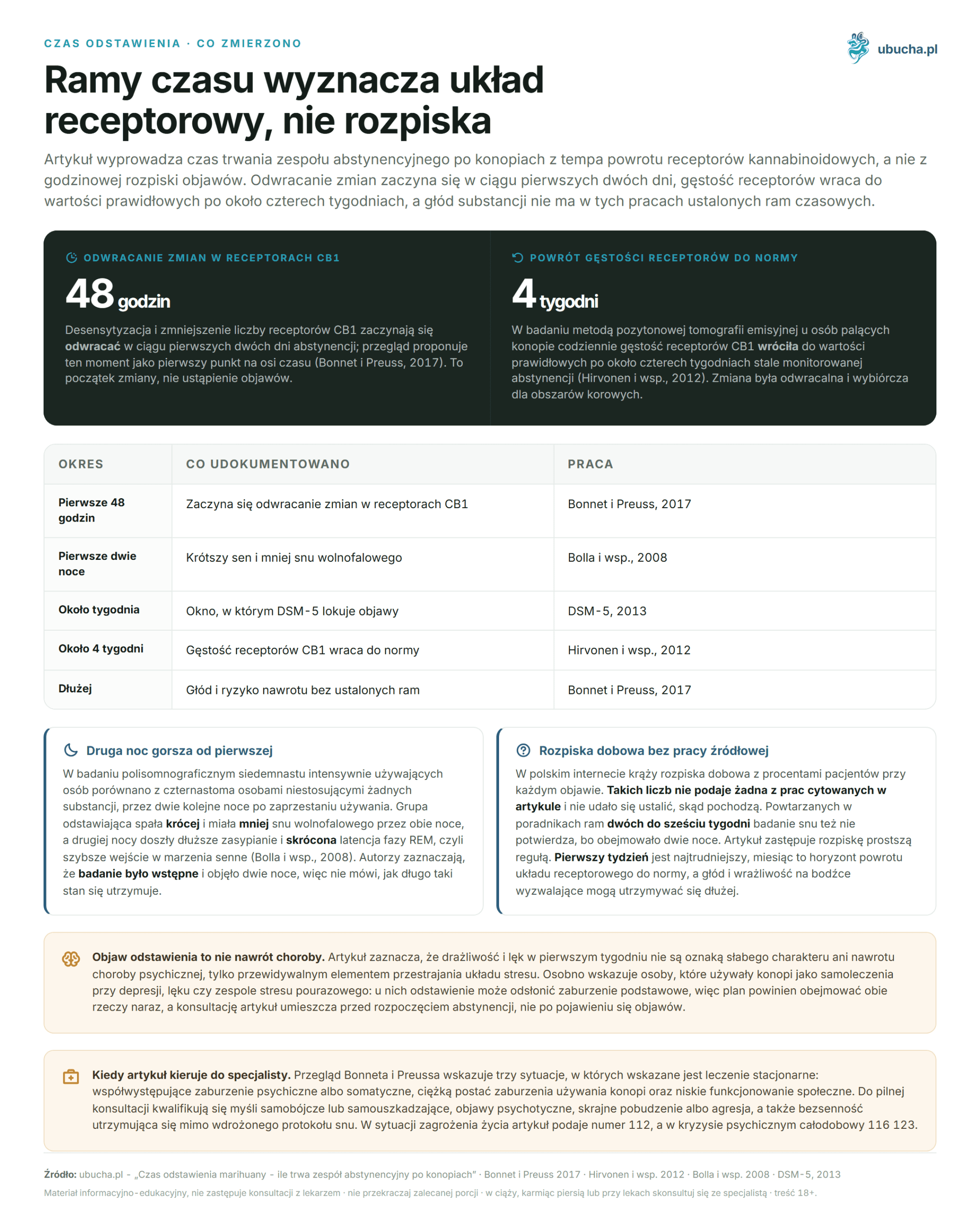
Timeframes are set by cannabinoid receptor recovery. Desensitization and CB1 receptor downregulation begin reversing within the first two days of abstinence, with full return to normal function in about four weeks. Authors propose this as the neurobiological timeframe for withdrawal syndrome (Bonnet and Preuss, 2017).
| Stage | Documented Evidence | Typical Symptoms | Source |
|---|---|---|---|
| First 48 hours | CB1 receptor changes begin reversing | Irritability, anxiety, restlessness, decreased appetite | Bonnet and Preuss, 2017 |
| First two nights | Shorter sleep and less slow-wave sleep; second night worse than first | Insomnia and reduced slow-wave sleep | Bolla et al., 2008 |
| About one week | Window when DSM-5 locates symptom onset | Symptom peak, including nightmares | DSM-5, 2013 |
| About 4 weeks | CB1 receptor density returns to normal | Symptoms subside, receptor density normalizes | Hirvonen et al., 2012 |
| Longer | Craving and relapse risk without fixed timeframe | Craving and relapse risk | Bonnet and Preuss, 2017 |
What is missing and why. Polish internet circulates daily breakdowns with percentages of patients per symptom, e.g., irritability in 80-95 percent from 12 hours. No cited study provides such numbers, and their origin is unknown.
For planning withdrawal, a simpler rule suffices. The first week is hardest, a month is the horizon for receptor system normalization, and craving and trigger sensitivity may last longer. Bonnet and Preuss note long-term plastic changes after years of use may underlie craving.
When planning a quit date, arrange a calendar accordingly. The first two weeks are when removing demanding tasks helps most. Scheduling a consultation before quitting, informing a trusted person, and preparing a night plan help more than resolutions made on the third sleepless day.
What happens to CB1 receptors after quitting?
Positron emission tomography imaging showed daily cannabis users have reduced CB1 receptor numbers in the brain. The change was reversible and selective to cortical areas, correlating with years of use. After about four weeks of monitored abstinence, receptor density returned to normal (Hirvonen et al., 2012).
Authors describe this as the first direct demonstration of cortical CB1 receptor downregulation in humans and a neuroadaptation that may promote addiction. Two points matter: the change is measurable, not assumed, and reversible over weeks, not years.
Receptor adaptation also has behavioral aspects. In an intravenous THC study, frequent users showed blunted responses compared to controls: weaker psychotic symptoms, memory and attention impairment, and cortisol increase, while euphoria remained (D’Souza et al., 2008).
This explains why the same amount has less effect over time but quitting becomes harder. The system adjusts to external substance presence and temporarily functions without sufficient endogenous support after cessation.
Previously known only from rodent studies, Hirvonen’s work translated this to humans and showed uneven brain distribution, limited to cortical areas. This is good news for quitters: a measurable substrate of symptoms has a defined recovery time and is not a matter of willpower.
Why does withdrawal cause anxiety and irritability?
The emotional component involves the stress system, specifically corticotropin-releasing factor. In rats given synthetic cannabinoid HU-210 for two weeks, withdrawal caused a marked increase in extracellular CRF and characteristic activation in the central amygdala (Rodríguez de Fonseca et al., 1997).
The key point is timing. The largest CRF increases coincided with peak behavioral withdrawal symptoms. Authors interpret this as limbic system function change similar to other addictive substances.
However, this is animal research with pharmacologically induced withdrawal, not natural cessation. Translating this mechanism to humans is a well-supported hypothesis but remains a hypothesis.
For patients, the practical takeaway is that irritability and anxiety in the first week are not signs of weak character or mental illness relapse but predictable stress system recalibration. Knowing the symptom has a biological basis and will pass reduces panic.
Use this knowledge proactively. Since emotional symptoms peak early, avoid conflicts and warn loved ones that short temper is not directed at them. This is one of few things you can plan before symptoms appear, not just react afterward.
Why do very vivid dreams occur after quitting?
Sleep is the area where changes after cessation have been measured instrumentally, not just by survey. A polysomnographic study compared 17 heavy users with 14 non-users over two nights immediately after stopping (Bolla et al., 2008).
The quitting group slept less and had less slow-wave sleep both nights. The second night also showed worse sleep efficiency, longer sleep latency, and shortened REM latency, meaning faster entry into dreaming. Sleep quality was worse on night two than night one, unlike healthy controls who improve after an adaptation night.
Shortened REM latency explains the impression of very intense, often disturbing dreams described as nightmares after marijuana cessation. The phase suppressed by regular THC use returns faster and stronger. Authors note the study was preliminary and cannot determine how long differences last.
One thing the study does not say: duration of this state, as it covered only two nights. Commonly cited two to six weeks have no basis in this work. We discussed how THC alters sleep architecture with long-term use separately: why THC disrupts sleep architecture long-term and CBD does not.
A notable detail: healthy subjects usually sleep better on the second lab night due to reduced novelty effect. The quitting group showed no such improvement, with worse sleep continuity parameters on night two. Symptom severity, craving, and mood did not explain these differences.
What does effective withdrawal treatment look like?
Psychological interventions remain the foundation, with moderate effect size depending on comparison. A meta-analysis of 10 randomized trials with 2027 participants showed behavioral therapies outperform controls, with Hedges’ g = 0.44 (Davis et al., 2015).
Authors translated this to patient terms: the average treated person did better than 66 percent of controls. Methods included contingency management, relapse prevention, motivational interviewing, and cognitive-behavioral therapy combinations.
However, a caveat often omitted: behavioral therapies outperformed waitlist controls but not active comparators. In other words, treatment is worthwhile, but no single method stands out clearly. Effect size was unaffected by session number, group vs individual format, or sample size.
Pharmacology evidence is more limited. Brezing and Levin’s review states no unequivocally effective medications for cannabis use disorder exist, though 20 years of research yielded some drugs effective for withdrawal symptoms (Brezing and Levin, 2018).
The review emphasizes tailoring treatment to the individual, not diagnosis alone. Sex, impulsivity, and use severity should guide off-label medication choice. It also critiques study design, outcome measures, and interpretation. This rare candor advises caution in overinterpreting single results.
Which medications have documented effects?
No medication is registered for this indication; all use is off-label and requires physician decision. Two drugs have randomized trial evidence; several others appear as less documented options in reviews.
| Medication | Evidence | Study |
|---|---|---|
| N-acetylcysteine 1200 mg twice daily | More than double odds of negative urine test, odds ratio 2.4 | Gray et al., 2012, 116 participants aged 15-21 |
| Gabapentin 1200 mg daily | Reduced cannabis use, milder withdrawal symptoms, improved executive function | Mason et al., 2012, 50 participants, pilot study |
| Mirtazapine | Reported helpful for insomnia during withdrawal | Bonnet and Preuss, 2017, review |
| Venlafaxine | May worsen withdrawal symptoms | Bonnet and Preuss, 2017, review |
The N-acetylcysteine study was the first positive pharmacological trial in cannabis addiction with primary endpoint analysis. It has two limitations: only adolescents and young adults were studied, and all received contingency management plus brief weekly counseling (Gray et al., 2012).
The gabapentin study was a phase 2 pilot with 50 participants over 12 weeks, all receiving weekly counseling. Authors call results preliminary and needing further research (Mason et al., 2012). Venlafaxine is listed as a warning, not a treatment option.
Other tested but ineffective drugs include atomoxetine, lithium, buspirone, and divalproex. Knowing ineffective options saves weeks of trial and side effects.
Does CBD help quit marijuana?
In the only randomized trial on cannabidiol for cannabis use disorder, 400 mg and 800 mg daily doses were effective; 200 mg was dropped as ineffective in interim analysis. There were 82 participants, treatment lasted four weeks, and all received brief motivational intervention (Freeman et al., 2020).
Effect size: 400 mg increased abstinent days by 0.48 per week vs placebo and lowered THC metabolite to creatinine ratio in urine. The 800 mg dose was less effective for abstinent days. CBD was well tolerated without serious adverse events.
Two points not supported by this study but often claimed: endpoints were cannabis use reduction, not withdrawal symptom relief; lower doses under 200 mg were not tested, so claims about ineffectiveness of typical supplement doses lack basis.
Practical takeaway: effective doses are many times higher than typical supplements, require pharmaceutical-grade product and supervision, especially given CBD’s drug interactions. This is not self-medication during withdrawal.
On the plus side, 94 percent completed treatment, a high rate for a four-week protocol during quit attempts. However, this was a phase 2 trial with a small, single-center sample. Larger, multi-site studies are needed before recommending this therapy.
Does gradual tapering make sense?
Gradual dose reduction using a controlled composition product was studied in very small groups. A proof-of-concept study with nine cannabis-dependent participants compared fixed and self-titrated doses of a THC-CBD spray in a 1:1 ratio (Trigo et al., 2016).
High fixed doses were well tolerated and significantly reduced withdrawal symptoms vs placebo but did not reduce craving. Self-titrated doses were lower and less effective. Authors conclude results justify further systematic research, not clinical implementation.
Nine participants is too small for clinical recommendations. Note the discrepancy between symptoms and craving: the product eased measurable symptoms but not the craving that often drives relapse.
Bonnet and Preuss list delta-9-THC analogs alongside gabapentin as promising for withdrawal treatment. Such approaches require psychiatrist supervision and clear end plans; otherwise, tapering becomes maintenance.
It is important to distinguish two things often conflated: a known, stable composition product given in planned doses under supervision is different from self-reducing unknown potency smoked cannabis. The latter has no randomized trial support and product potency variability makes control difficult.
Legal hemp cannabis flower without THC above threshold and not causing this syndrome is collected in the flower category.
How to care for sleep during withdrawal?
Sleep problems are the most common reason people relapse and the area where most can be done without medication. The starting point is cognitive-behavioral therapy for insomnia, a protocol based on regularity and limiting time in bed, not extending it.
- Wake up at the same time regardless of the previous night.
- Reduce time in bed to actual sleep time instead of going to bed earlier.
- After 20 minutes of insomnia, get out of bed and return only when sleepy.
- Avoid caffeine after early afternoon and limit alcohol, which worsens second half of night.
- Get daylight exposure within the first hour after waking.
The first week of this protocol may be worse than baseline, which is expected, not failure. Bolla’s polysomnography shows the second night after cessation is worse than the first, so expecting linear daily improvement is unrealistic.
Bonnet and Preuss recommend mirtazapine for insomnia during withdrawal; it is prescription-only and a physician’s decision. Melatonin and magnesium are sometimes used but lack high-quality evidence for this indication and should be seen as sleep hygiene support, not treatment.
Moderate physical activity improves sleep quality and relieves early tension. It is one of the few things you can start immediately, without prescription or specialist appointment.
What to avoid during marijuana withdrawal?
The most common pitfall is replacing cannabis with another substance, most often alcohol. The direction of association between these substances is well documented and differs from common belief: a three-year prospective analysis found cannabis use linked to over fivefold higher risk of alcohol use disorder onset and nearly double risk of persistence (Weinberger et al., 2016).
The study does not say alcohol increases risk of cannabis relapse, and such claims should not be made. It shows these substances co-occur, and those quitting one are at higher risk for problems with the other. This is reason enough not to use alcohol as a quitting tool.
Second pitfall: uncontrolled benzodiazepine use. These carry their own stronger addiction risk and withdrawal syndrome, more dangerous than cannabis withdrawal. If used, it should be short-term and supervised by a physician.
Third: products promising rapid THC detox. Such drinks and teas lack evidence for withdrawal symptom impact and can be costly. Fourth, the most insidious: unrealistic expectations. Since CB1 receptor normalization takes about four weeks, judging progress after five days leads only to disappointment.
Weinberger’s analysis included over 27,000 people without prior alcohol problems and over 2,000 with such diagnosis; associations held after adjusting for demographics, mental disorders, and other substance use. This is not explained solely by overlapping user groups.
When does withdrawal require medical help?
Most cases can be managed outpatient, but not all. Bonnet and Preuss identify three situations warranting inpatient treatment, ideally qualified detox with rehabilitation: co-occurring mental or physical disorder, severe cannabis use disorder, and low social functioning.
Mood disorder comorbidity deserves special attention. A meta-analysis of 11 prospective studies with 23,317 people found adolescent cannabis use linked to increased early adulthood depression risk (odds ratio 1.37) and increased suicidal ideation and attempts; anxiety results were not statistically significant (Gobbi et al., 2019).
Urgent consultation is indicated for suicidal or self-harm thoughts, psychotic symptoms, extreme agitation or aggression, and insomnia persisting despite sleep protocol. In life-threatening situations, call 112.
Separate advice applies to those who used cannabis for self-medication of depression, anxiety, or PTSD. Withdrawal may unmask underlying disorder, so plan should address both simultaneously. Scheduling consultation before abstinence is advisable. More on long-term effects here: long-term effects of marijuana use.
Where to find help in Poland?
Free 24/7 support lines and addiction treatment clinics within public healthcare are available. Numbers below are free and require no referral or registration.
- 112 - emergency number for immediate life or health threat.
- 116 123 - adult emotional crisis support, 24/7 and anonymous.
- 116 111 - trust helpline for children and youth, 24/7.
- 800 70 2222 - Mental Health Crisis Support Center, 24/7, staffed by psychologists.
The planned pathway differs from crisis pathway. Addiction clinics operate within public healthcare without referral, and family doctor consultation is the simplest entry point if unsure where to start. Contact before setting quit date is recommended.
Support outside healthcare matters too. Epidemiological data show only 13.2 percent of those diagnosed with cannabis use disorder lifetime ever received any treatment or twelve-step program. Informing even one trusted person about quitting plans is a change you can make the same day.
A more practical description of withdrawal course and symptom relief methods is in a separate text: cannabis withdrawal syndrome: recognition, duration, and effective symptom relief.
Summary: what to remember about withdrawal duration
Cannabis withdrawal syndrome is measurable, not just attitude-based. It affects nearly half of regular users, with 17 percent prevalence in population samples and up to 87 percent in inpatients. Symptoms are mainly mood and behavioral, mild to moderate.
Timeframes are set by receptor system. CB1 receptor changes begin reversing within two days, with density normalizing after about four weeks of monitored abstinence. This is the realistic horizon for progress assessment, not five or seven days.
Treatment strongest evidence is for psychological interventions, showing clear advantage over no treatment but not over other active therapies. Medications with randomized trial evidence include N-acetylcysteine in youth and gabapentin in adults, both small off-label trials. Cannabidiol showed effect only at 400 and 800 mg daily doses.
If planning cessation after years of daily use, schedule consultation before quit date, inform a trusted person, and prepare a sleep plan. In mental health crisis, 24/7 numbers are: 116 123 for adults, 116 111 for children and youth, 800 70 2222 for mental health crisis.
Frequently Asked Questions
Is cannabis withdrawal syndrome a recognized condition?
Yes. DSM-5 introduced it in 2013 as a separate diagnosis requiring at least three of seven symptoms within about a week of cessation, with clinically significant distress or impairment. It is also one of the criteria for cannabis use disorder.
How long does marijuana withdrawal last?
Changes in CB1 receptors begin to reverse within the first two days of abstinence, and receptor density returns to normal after about four weeks (Bonnet and Preuss, 2017; Hirvonen et al., 2012). Craving and sensitivity to triggers may persist longer.
How common is cannabis withdrawal syndrome?
A meta-analysis of 47 studies on 23,518 people reports an overall prevalence of 47 percent, with a confidence interval from 41 to 52 percent. The type of sample matters: 17 percent in population studies, 54 percent in outpatient samples, and 87 percent in inpatient treatment (Bahji et al., 2020).
Can marijuana withdrawal be dangerous?
Symptoms are usually mild to moderate and most cases are managed outpatient. Inpatient treatment is needed for those with co-occurring mental or physical disorders, severe cannabis use disorder, or low social functioning. In crisis, call 112 or 116 123.
Does N-acetylcysteine help quit marijuana?
In a randomized trial of 116 individuals aged 15-21, a dose of 1200 mg twice daily for eight weeks more than doubled the odds of a negative urine test compared to placebo, with an odds ratio of 2.4 (Gray et al., 2012). All participants also received counseling.
Does CBD help with THC withdrawal?
In the only randomized trial, doses of 400 mg and 800 mg per day were effective, while 200 mg was excluded as ineffective (Freeman et al., 2020). The endpoint was reduction in cannabis use, not symptom relief. Lower doses were not studied.
Why do I have very vivid dreams after quitting?
Because REM phase latency shortens, meaning you enter dreaming faster. Polysomnographic studies noted this on the second night after cessation, along with shorter sleep and less slow-wave sleep (Bolla et al., 2008). The study covered two nights only, so duration is unknown.
This article is for informational and educational purposes and does not constitute medical advice. Consult a physician before using cannabis or CBD therapeutically, especially if taking other medications, pregnant, or breastfeeding.
Author: Michał Waluk · Published: 2026-05-06 · Updated: 2026-08-24