
CBD and THC in the Treatment of Anxiety Disorders: Mechanism, Doses, and Safety
CBD and THC in anxiety disorders: doses from studies, results of the 2024 meta-analysis, interactions with medications, and the threshold beyond which a psychiatrist is needed.
Anxiety disorders are the most common group of mental disorders, yet the discussion about cannabinoids in anxiety is mainly anecdotal. Meanwhile, studies exist and say things that are much more ambiguous than advertising: the effect of CBD depends on the dose in a nonlinear way, THC can both reduce and induce anxiety, and the European regulator has set a safe dose for CBD supplements two orders of magnitude lower than that used in clinical studies. Additionally, a significant portion of the numbers repeated in Polish texts about cannabinoids and anxiety do not come from the works to which they are attributed, so for each of them we checked the source work and provide only what is actually stated in it. In this text, we compare the doses used in studies, effect sizes, methodological limitations, and the threshold beyond which a psychiatrist is needed, not a store.
KEY INFORMATION
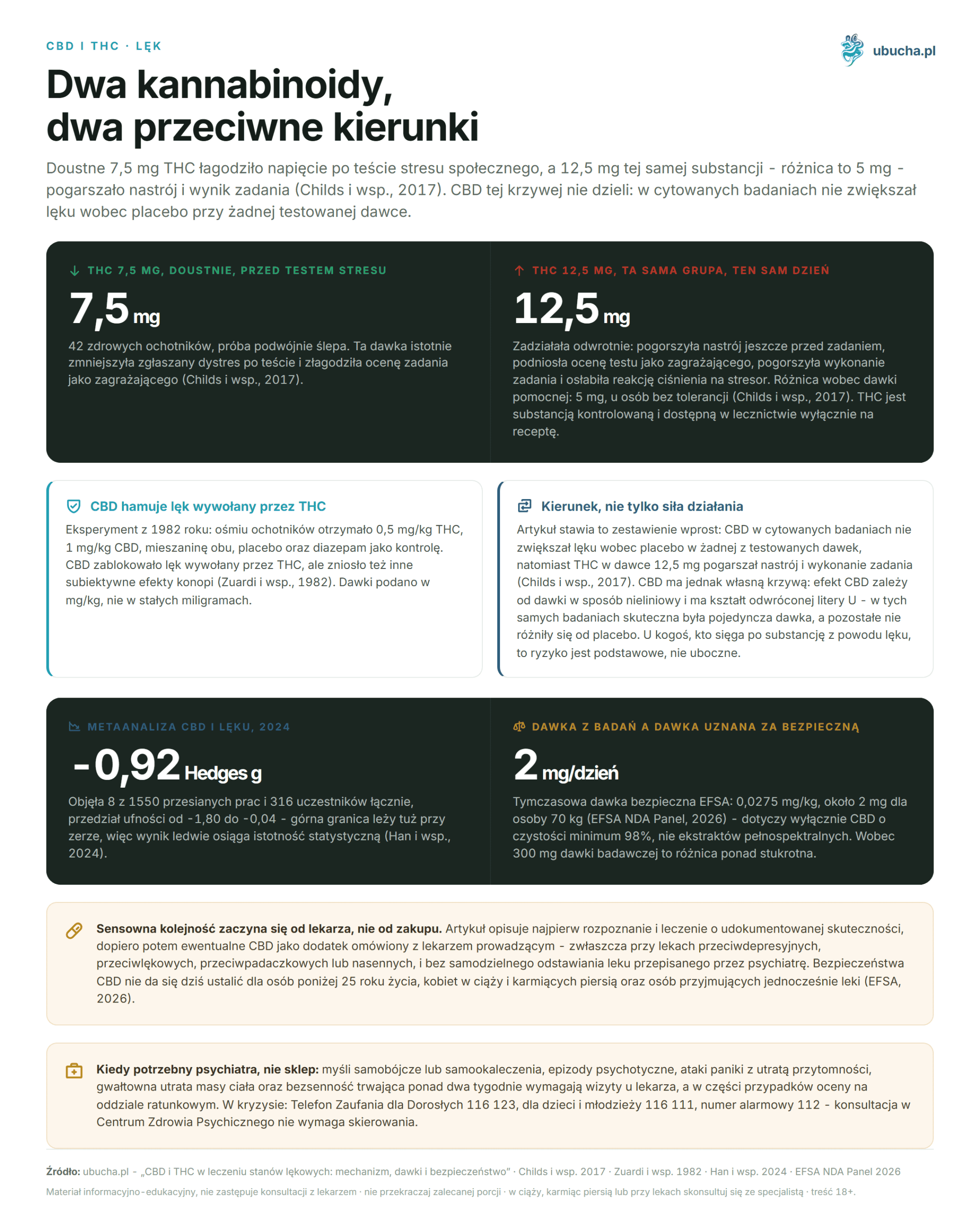
• A meta-analysis from 2024 included 8 out of 1550 screened works and a total of 316 participants, with the effect size of CBD on anxiety being Hedges’ g equal to -0.92 with a confidence interval from -1.80 to -0.04 (Han et al., 2024).
• The dose-response curve has the shape of an inverted U: in the public speaking test, an effective dose was 300 mg of CBD, while doses of 150 mg and 600 mg did not differ from placebo.
• THC acts biphasically. An oral dose of 7.5 mg reduced tension after a social stress test, while 12.5 mg worsened mood and task performance (Childs et al., 2017).
• EFSA has set a temporary safe dose for CBD supplements at 0.0275 mg/kg body weight per day, which is about 2 mg daily for a person weighing 70 kg.
• The safety of CBD cannot be established for individuals under 25 years of age, pregnant and breastfeeding women, and those taking medications simultaneously.
What is the difference between anxiety and fear in neurobiology?
Fear is a response to a stimulus that actually occurs, while anxiety arises without it and can last for months. This distinction makes practical sense, as different treatments are used: the reaction to a specific threat is treated with exposure, while chronic worrying requires work on the mechanism that maintains arousal despite the absence of a stimulus.
Functional imaging shows a common pattern. A meta-analysis of fMRI and PET studies in post-traumatic stress disorder, social phobia, and specific phobia showed that patients consistently have greater activity in the amygdala and insula than individuals in comparison groups, and the same pattern appears in fear conditioning in healthy individuals (Etkin and Wager, 2007).
This same work shows where the syndromes diverge. Excessive activity in the amygdala and insula was more common in social phobia and specific phobia than in post-traumatic stress disorder. However, only in post-traumatic stress disorder was there a decrease in activity in the dorsal and rostral parts of the cingulate cortex and the ventromedial prefrontal cortex, which are structures responsible for experiencing and regulating emotions.
Generalized anxiety disorder was not included in this meta-analysis at all, yet popular summaries attribute its conclusions to this diagnosis. This is one of those errors that get repeated on the internet for years because they sound plausible. Data about weakened connections between the prefrontal cortex and the amygdala in generalized anxiety come from other works and should not be linked to Etkin’s.
How common are anxiety disorders and what is their course?
The scale is larger than commonly assumed. According to large population studies, anxiety disorder affects up to 33.7% of the population during their lifetime, making this group the most common mental disorders and associated with high healthcare costs and a significant disease burden (Bandelow and Michaelis, 2015).
This group includes panic disorder, with or without agoraphobia, generalized anxiety disorder, social phobia, specific phobias, and separation anxiety. The authors of the review point out two phenomena significant for the reader. First, there is significant underdiagnosis and undertreatment of these disorders. Second, there is no evidence that their prevalence has changed in recent years, despite widespread belief in an “anxiety epidemic.”
There is also considerable variability between countries, which has a different explanation than commonly accepted. According to the authors, differences in cross-cultural comparisons arise more from research methodology than from cultural influence, so comparing rates from one country to those from another can involve comparing two different measurement tools.
The course is chronic but not linear. Prevalence naturally decreases with age, and comorbidity with other anxiety disorders and other mental disorders is high. This has practical significance: it is rare to treat one diagnosis separately, and each additional substance enters a system where something is already working.
What does standard treatment look like and why are supplements sought?
Pharmacotherapy for generalized anxiety disorder is well-researched and has several effective options. The largest network meta-analysis in this indication included 89 studies and 25,441 patients randomly assigned to 22 active drugs or placebo (Slee et al., 2019). This is the proper reference scale for any discussion about alternatives.
The results were presented as the mean difference on the Hamilton anxiety scale compared to placebo. Duloxetine yielded -3.13, pregabalin -2.79, venlafaxine -2.69, and escitalopram -2.45, all with good acceptability. Quetiapine had the largest effect, -3.60, but was poorly tolerated, as were paroxetine and benzodiazepines. Mirtazapine, sertraline, fluoxetine, buspirone, and agomelatine also proved effective, although these conclusions were limited by small trials.
The authors’ conclusion is worth quoting in full, as it is often misrepresented: failure of the first pharmacological therapy does not have to be a reason to abandon pharmacological strategy altogether. This is not a statement that medications do not work. It is a statement that in the absence of response, the medication is changed, not the category of treatment.
A real problem is the time to start treatment. The expert consensus on obsessive-compulsive disorder, mechanistically related to anxiety, describes the time of untreated illness in adults reaching about ten years and associates the delay with worse clinical outcomes (Fineberg et al., 2019). This is a gap that self-treatment, including cannabinoids, fills.
How does CBD affect the brain?
The most commonly repeated description of the mechanism, namely partial agonism of the 5-HT1A receptor, inhibition of the FAAH enzyme, and modulation of GABA, comes mostly from preclinical studies. A review dedicated to CBD in anxiety disorders states that preclinical data strongly support efficacy in generalized anxiety, panic attacks, social phobia, obsessive-compulsive disorder, and post-traumatic stress disorder, but only with acute administration (Blessing et al., 2015).
In humans, there are several specific observations. In a SPECT imaging study, ten previously untreated patients with social phobia received 400 mg of CBD or placebo. CBD significantly reduced subjective anxiety and decreased tracer uptake in the left parahippocampal gyrus, hippocampus, and inferior temporal gyrus, while increasing it in the right cingulate gyrus (Crippa et al., 2011).
Note what is not present in this work. There is no amygdala among the structures with altered flow, there is no functional resonance, and there are no percentage values. Popular summaries add all three things at once, while the conclusion of the study is a cautious statement that the effect of CBD is associated with the activity of limbic and paralimbic areas.
Two newer works add details. Magnetic resonance spectroscopy in 34 men after a single dose of 600 mg of CBD showed an increase in glutamate in subcortical structures and a decrease in the cortex (Pretzsch et al., 2019). Arterial spin labeling in 15 individuals after the same dose showed an increase in cerebral blood flow in the hippocampus of 15 ml per 100 g per minute, with no differences in memory task performance (Bloomfield et al., 2020).
Why does THC act biphasically and when does it increase anxiety?
THC can lower and raise anxiety, and the threshold lies lower than many assume. In a double-blind study, 42 healthy volunteers received orally 0 mg, 7.5 mg, or 12.5 mg of THC two and a half hours before a social stress test. The dose of 7.5 mg significantly reduced reported distress after the test and alleviated the assessment of the task as threatening (Childs et al., 2017).
The dose of 12.5 mg acted in the opposite way. It worsened mood throughout the study, including before the task, raised the assessment of the test as threatening even before it began, worsened task performance, and weakened the blood pressure response to the stressor. The difference between the helpful and harmful dose was therefore 5 mg, with oral administration in individuals without tolerance.
Popular summaries shift this threshold to “above 15 mg,” which is convenient commercially and inconsistent with the work. The study did not have an arm with 15 mg, so stating this value as a threshold is a fabrication. There is also no basis for claiming that in 20-30% of individuals, high doses induce panic attacks, as such a number does not appear in the cited study.
Separately, there is the classic observation that CBD weakens anxiety induced by THC. In an experiment from 1982, eight volunteers received 0.5 mg/kg of THC, 1 mg/kg of CBD, a mixture of both, placebo, and diazepam as a control. CBD blocked the anxiety induced by THC but also abolished other subjective effects of cannabis (Zuardi et al., 1982). The doses were given in milligrams per kilogram of body weight, not in fixed milligrams.
What do studies show about CBD in social anxiety?
This is the best-studied area and also the one where the studied groups are most often confused. In a simulated public speaking test, 57 healthy men were assigned to CBD at doses of 150 mg, 300 mg, 600 mg, or placebo. Anxiety during the speech was reduced only by the 300 mg dose, while the groups taking 150 mg and 600 mg did not differ from placebo (Linares et al., 2019).
These were healthy volunteers, not patients with social phobia, and the response to a stressful situation was measured, not the treatment of a disorder. This distinction is important because it determines to whom the result can be attributed.
The second study confirmed the same shape of the relationship in real-world conditions. Sixty individuals of both sexes aged 18-35 were assigned to placebo, clonazepam at a dose of 1 mg, and CBD at doses of 100 mg, 300 mg, and 900 mg, after which each person gave a speech in front of the other participants. Anxiety reduction in the post-speech phase was achieved for clonazepam and for CBD 300 mg, but not for 100 mg or 900 mg (Zuardi et al., 2017).
The practical conclusion is the opposite of consumer intuition. Increasing the dose above the optimum does not enhance the effect, but rather diminishes it. Clonazepam acted more sedatively than CBD at doses of 300 mg and 900 mg, which shows that the difference between these substances is not just about the strength of action.
What is known about CBD in treatment-resistant anxiety, PTSD, and OCD?
The data here is weaker and must be read together with the methodology. An open-label study included 31 young individuals aged 12-25 diagnosed with anxiety disorder according to DSM-5, who showed no improvement despite cognitive-behavioral therapy or antidepressant medication. For 12 weeks, they received CBD added to treatment, with a regimen increased to 800 mg per day (Berger et al., 2022).
The score on the OASIS scale decreased on average from 10.8 to 6.3, or by 42.6%. Symptoms of depression, CGI score, and functioning also improved. However, adverse effects occurred in 25 out of 31 participants, or 80.6%, and included fatigue, low mood, and hot flashes or chills. No serious or unexpected events were reported. The study had no control group, so the authors themselves state that randomized studies are needed.
In post-traumatic stress disorder, the result is negative. A randomized crossover study compared three preparations of smoked cannabis with different THC to CBD ratios to placebo in veterans. None of the active concentrations proved significantly better than placebo in the primary measure of symptom severity, although all groups, including placebo, improved over three weeks (Bonn-Miller et al., 2021).
In obsessive-compulsive disorder, data come from a symptom tracking application. Eighty-seven individuals reporting this diagnosis assessed the severity of symptoms before and after 1810 inhalation sessions spread over 31 months. A reduction in compulsions of 60%, intrusive thoughts of 49%, and anxiety of 52% was noted, with higher concentrations of CBD and higher doses associated with greater reduction in compulsions (Mauzay et al., 2021). The trial was self-selected, the diagnosis was self-reported, and there was no control group.
What does the latest meta-analysis say about the effectiveness of CBD?
The answer is: the effect is visible, but built on a very small base. A systematic review from 2024 screened 1550 articles and qualified eight for meta-analysis, encompassing a total of 316 participants. The aggregate effect size of CBD on anxiety was Hedges’ g equal to -0.92 with a confidence interval from -1.80 to -0.04 (Han et al., 2024).
This number looks impressive and requires immediate qualification. The upper limit of the confidence interval, -0.04, lies just above zero, meaning the result barely achieves statistical significance. The authors themselves recommend caution in interpretation due to the limited number of clinical trials and indicate the need for further research.
Let’s compare the scale. Eight studies and 316 people for CBD versus 89 studies and 25,441 patients for registered medications for generalized anxiety. This is not a difference in effect size, but a difference in how much is actually known. With 316 participants, a single study with an atypical result shifts the entire meta-analysis.
Numbers repeated in consumer texts, such as “37 randomized studies and 2384 patients” or “effect size d equal to 0.42,” do not come from any work we could trace. We checked them and found no source, so we do not repeat them here.
What doses were used in studies, and what are in supplements?
The discrepancy between clinical studies and the store shelf is the largest of all discussed issues. In studies on acute situational anxiety, single doses of 300 mg were used, while both 150 mg and 600 mg and 900 mg were ineffective. In the study of youth with treatment-resistant anxiety, the dose was increased to 800 mg per day over 12 weeks.
On the other side is the regulatory assessment. The EFSA panel derived a temporary safe dose for CBD as a food supplement at 0.0275 mg per kilogram of body weight per day, which is about 2 mg daily for a person weighing 70 kg, using the benchmark dose method with an uncertainty factor of 400 (EFSA NDA Panel, 2026).
Two mg versus 300 mg is a difference of over one hundred times. This does not mean that clinical studies were unsafe, as they were conducted under medical supervision, with parameter control, and for a limited time. However, it does mean that the doses from studies do not translate to self-supplementation, and a food product and a drug are two different categories with two different assessment regimes.
The EFSA limitation is also very narrow. The temporary safe dose applies only to supplements with a CBD purity of at least 98%, without nanoparticles, with a recognized safe production process, and with excluded genotoxicity. This value does not apply to other forms, including full-spectrum extracts.
How much CBD enters the bloodstream through different routes of administration?
Less than suggested by tables in product descriptions, and no one has calculated this precisely. A systematic review of the pharmacokinetics of CBD in humans included 24 works out of 792 screened and established absolute bioavailability only for one route: after smoking, it was 31%. No one has attempted to measure it for any other route of administration, even though intravenous preparations were available (Millar et al., 2018).
This means that values like “sublingual bioavailability 15-35%” or “inhaled 25-50%” repeated in marketing materials have no basis in this review. They are neither underestimated nor overestimated. They simply have not been measured.
What the review definitely established is the variability of the half-life: from 1.4 to 10.9 hours after oral spray, 2-5 days after chronic oral administration, 24 hours after intravenous administration, and 31 hours after smoking. The area under the curve and maximum concentration increase with the dose, and the peak is reached faster after inhalation than after oral or sublingual administration. Maximum concentration increases after meals and in fat-based preparations.
The EFSA assessment adds one sentence that is worth remembering when comparing products: the bioavailability of CBD is variable and depends on the carrier matrix and food intake. Therefore, two drops with the same declared content may not provide the same exposure.
How does CBD interact with psychiatric medications?
This is the most serious practical problem when combining CBD with psychiatric treatment and also the one most poorly communicated on labels. A review of adverse effects and toxicity of CBD states directly that studies in humans with epilepsy and mental disorders have described drug interactions and liver abnormalities caused by CBD, as well as diarrhea, fatigue, vomiting, and drowsiness (Huestis et al., 2019).
The EFSA assessment goes in the same direction and states it more sharply. Animal studies have shown consistent liver toxicity, with liver mass and histopathological changes being the most sensitive endpoints. In humans, hepatotoxic potential has been noted, especially when using CBD together with other medications. This is precisely the situation of a psychiatric patient who is already taking something.
The EFSA panel concludes with a statement that cannot be circumvented. The safety of CBD cannot be established for three groups: individuals under 25 years of age, pregnant and breastfeeding women, and those taking medications simultaneously. Note that the first of these groups overlaps with participants in the study on treatment-resistant anxiety in youth, who were aged 12 to 25 years.
The practical rule is simple and does not require knowledge of pharmacokinetics. If you are taking an antidepressant, anxiolytic, anticonvulsant, or sleeping pill, the decision to add CBD should be made with your attending physician, not based on the product description. Do not discontinue a medication prescribed by a psychiatrist on your own, as sudden discontinuation of therapy can be more dangerous than the symptom you want to alleviate.
What does the safety profile of CBD look like with long-term use?
The picture is more ambiguous than would be suggested by the slogan “natural, therefore safe.” A review from 2019 summarizes it in one sentence: CBD is not free of risk. In animal studies, developmental toxicity, embryonic-fetal mortality, central nervous system inhibition, neurotoxicity, hepatocyte damage, reduced spermatogenesis, and decreased blood pressure were described, although at doses higher than recommended in human treatment (Huestis et al., 2019).
The EFSA assessment from 2026 updates this picture and indicates what is still unknown. Gaps identified in 2022 have not been closed, as new works have methodological limitations: non-standardized protocols, short observation times, and simultaneous treatment with other medications. Data on neurological and psychiatric safety remain insufficient, and immunotoxicity has not been studied in any work.
Three findings from this assessment are worth knowing separately. CBD crosses the placenta and accumulates systemically, and prenatal exposure has been associated with long-term and sex-dependent neurodevelopmental effects. Hormonal disturbances have been noted, including altered thyroid hormone levels and histopathological changes in the adrenal glands. Gastrointestinal effects appeared at higher doses.
These are not reasons to consider CBD a dangerous substance. They are reasons not to treat it like a vitamin. The difference between “no evidence of harm” and “evidence of safety” is in this case the entire content of the regulator’s position.
What is the difference between the risks of THC and CBD?
The main difference concerns addiction and is measurable. In an analysis of data from a large population study, the cumulative probability of transitioning from use to addiction was 8.9% for cannabis users, compared to 67.5% for nicotine, 22.7% for alcohol, and 20.9% for cocaine (Lopez-Quintero et al., 2011).
This same work provides something that is often overlooked but has clinical significance. Half of the cases of cannabis addiction occurred about five years after first use, while for nicotine it was about 27 years, and for alcohol about 13. The transition to cannabis addiction occurs faster than with substances considered more dangerous, even if it concerns a smaller percentage of individuals.
The second difference is the direction of action on anxiety itself. CBD in the cited studies did not increase anxiety compared to placebo at any of the tested doses, while THC at a dose of 12.5 mg worsened mood and task performance (Childs et al., 2017). For a person reaching for a substance precisely because of anxiety, the risk of worsening the symptom is a primary risk, not a side effect.
The third difference is legal and practical. CBD in available studies does not show a profile of abuse, while THC is a controlled substance available in treatment only by prescription. This determines that the conversation about THC in anxiety takes place in the office, not on the shelf.
What is the legal status of CBD and medical cannabis in Poland?
cannabidiol is not listed in any of the lists of controlled substances, so its turnover is not subject to the Act on Counteracting Drug Addiction regarding narcotic and psychotropic substances. The basis is the regulation of the Minister of Health of August 17, 2018, on the list of psychotropic substances, narcotic drugs, and new psychoactive substances (t.j. Dz.U. 2024 poz. 1139, with amendments).
The threshold for plant material is 0.3% and is calculated as the sum of delta-9-THC and tetrahydrocannabinolic acid (THCA), rounded to one decimal place. The basis is Article 4 point 5 of the Act of July 29, 2005, on Counteracting Drug Addiction (t.j. Dz.U. 2023 poz. 1939), as amended by the Act of March 24, 2022 (Dz.U. 2022 poz. 763), effective from May 7, 2022. The previous value of 0.20% ceased to be in effect on May 6, 2022, yet it still circulates in product descriptions.
Cannabis in treatment is available only by prescription Rpw. The basis is Article 33a of the Act on Counteracting Drug Addiction, introduced by the Act of July 7, 2017 (Dz.U. 2017 poz. 1458), effective from November 1, 2017. Anxiety disorders are not typical indications, and the decision to issue a prescription is solely at the discretion of the physician.
Separately, it is worth remembering the distinction that confuses the most people in practice. Notification to the sanitary authority regarding the introduction of a product into circulation is not authorization for new food and does not change the status of the ingredient. The EFSA assessment from 2026 is a safety assessment with conditions, not an admission of CBD as new food.
When should you go to a psychiatrist instead of a store?
The boundary is simpler than it seems and does not depend on the severity of the symptom, but rather on its type. Suicidal thoughts or self-harm, psychotic episodes, panic attacks with loss of consciousness, rapid weight loss, and insomnia lasting more than two weeks require a visit to a doctor, and in some cases, assessment in the emergency department. In none of these scenarios is CBD or THC the appropriate first response.
In a mental health crisis in Poland, the 24-hour Adult Helpline operates at 116 123, the helpline for children and youth at 116 111, and the emergency number 112. Consultation at the Mental Health Center does not require a referral.
If treatment is already underway, CBD can at most be an addition, and that should be discussed with a doctor. A sensible order looks like this: first diagnosis and implementation of treatment with documented effectiveness, then possible supplementation. The reverse order delays the start of therapy, and the delay itself worsens the prognosis (Fineberg et al., 2019).
For those who want to organize the topic from the perspective of a single diagnosis, our entry on what studies say about CBD in social phobia and a separate discussion on what PTSD is and where the role of CBD ends will be helpful. The formalities on the patient’s side are described in our entry on how to become a medical marijuana patient in Poland.
Frequently Asked Questions
Can CBD replace anxiety medications?
No. The evidence base for CBD consists of eight studies and 316 participants in a meta-analysis from 2024, while for registered medications for generalized anxiety, there are 89 studies and 25,441 patients. This is a difference in what is known, not just in the strength of the effect. Never discontinue a medication prescribed by a psychiatrist on your own.
What dose of CBD was effective in anxiety studies?
In public speaking tests, a single dose of 300 mg was effective, while doses of 100 mg, 150 mg, 600 mg, and 900 mg did not differ from placebo. The relationship has the shape of an inverted U, so increasing the dose above the optimum does not enhance the effect, but rather diminishes it.
Why does EFSA state a dose of 2 mg when studies used 300 mg?
Because these are two different categories of assessment. The temporary safe dose of 0.0275 mg/kg per day applies to a food supplement taken without supervision, with a CBD purity of at least 98%, and was derived with an uncertainty factor of 400. The doses from clinical studies were used under medical supervision and for a limited time.
Does THC help or harm anxiety?
It depends on the dose. An oral dose of 7.5 mg reduced reported distress after a social stress test, while 12.5 mg worsened mood throughout the study and lowered task performance (Childs et al., 2017). The difference was 5 mg in individuals without tolerance, so the margin is narrow.
Can I combine CBD with psychiatric medications?
Only after discussing it with the attending physician. Human studies have described drug interactions and liver abnormalities caused by CBD (Huestis et al., 2019), and the EFSA panel stated that the safety of CBD cannot be established for individuals taking medications simultaneously.
Is CBD addictive?
In available studies, CBD does not show a profile of abuse. The situation is different with cannabis containing THC: the cumulative probability of transitioning from use to addiction was 8.9%, and half of the cases occurred within about five years of first use (Lopez-Quintero et al., 2011).
Does CBD help with PTSD?
The best-controlled study showed no advantage. In a randomized crossover study in veterans, none of the three active concentrations of smoked cannabis proved significantly better than placebo in the primary measure of symptom severity, although all groups improved over three weeks (Bonn-Miller et al., 2021).
How long does it take to assess the effects of CBD?
In situational anxiety, the effect was assessed after a single dose given before the task. In chronic anxiety, the only available data come from a 12-week open-label study without a control group, so it is not possible to provide a reliable timeframe today, after which a lack of improvement indicates a lack of effectiveness.
Summary
Evidence for the effectiveness of CBD in anxiety exists, is positive, and is very limited. Eight studies and 316 participants in a meta-analysis from 2024 yield a result that is barely statistically significant, and the best-repeated finding concerns not the treatment of the disorder but the one-time reaction to a stressful situation in healthy individuals. The optimum dose in these studies was 300 mg, and exceeding it negated the effect.
THC is in this context a substance with two faces. At a dose of 7.5 mg, it alleviated the reaction to social stress, while at a dose of 12.5 mg, it worsened it, with a difference of 5 mg. Additionally, there is the risk of addiction, which concerns 8.9% of users of cannabis and develops faster than with nicotine or alcohol.
The most practical information from this text, however, is the discrepancy between research and the shelf. The temporary safe dose for a CBD supplement is according to EFSA about 2 mg daily for a person weighing 70 kg, and safety cannot be established for individuals under 25 years of age, pregnant and breastfeeding women, and those taking medications. A sensible order of actions therefore begins with consultation, not purchase.
If after talking to a doctor you decide on a product, choose one that has the content per serving stated and an available certificate of analysis. Available concentrations can be found in the hemp oil category.
This article is for informational and educational purposes and does not constitute medical advice. Before starting to use cannabis or CBD for therapeutic purposes, consult a doctor, especially if you are taking other medications, are pregnant, or breastfeeding.
Author: Michał Waluk · Published: 2026-05-04 · Updated: 2026-08-10