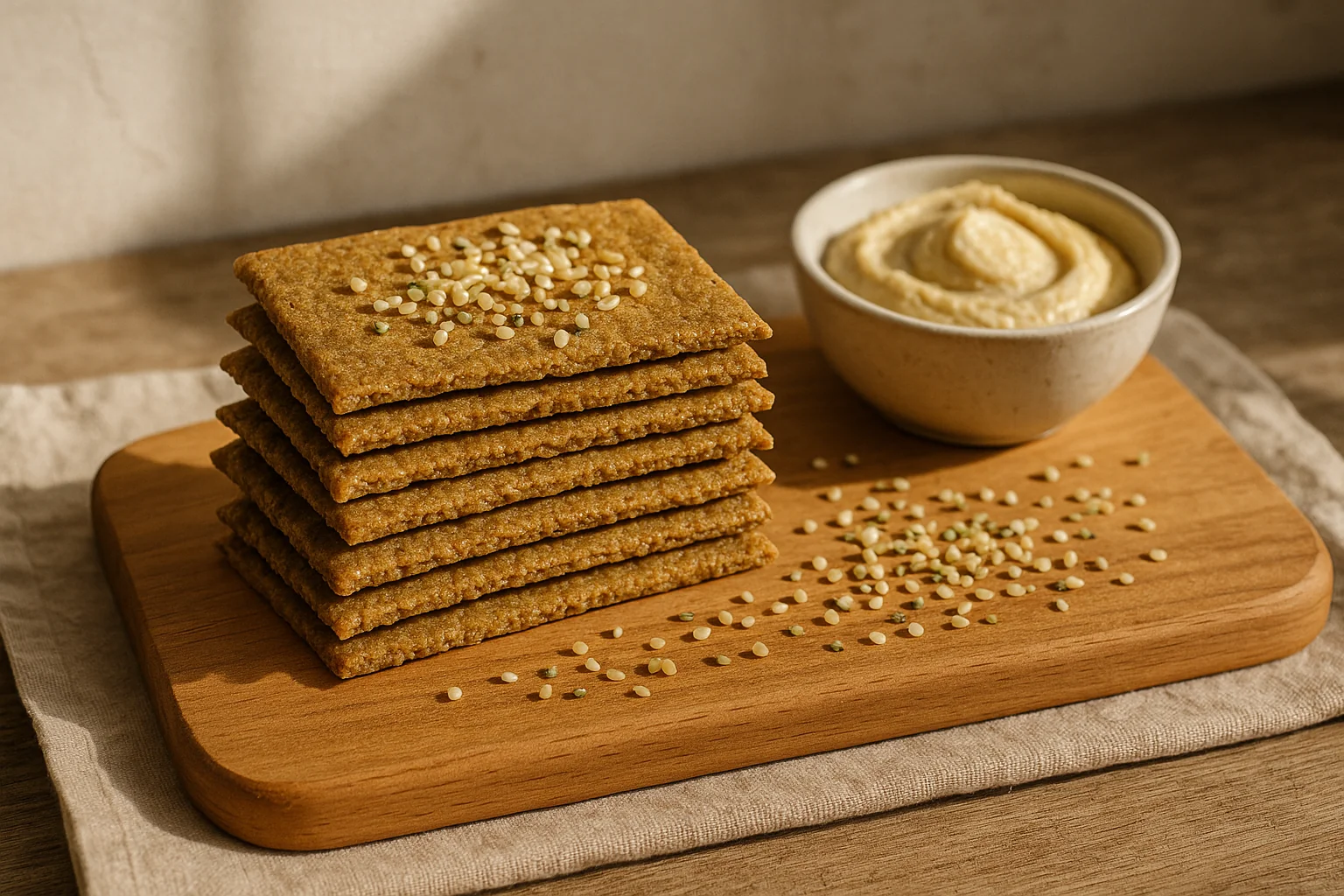

Hemp Flour Crackers: Crunchy Healthy Snack
Recipe for crunchy crackers made from hemp and rice flour. Gluten-free, ready in 30 minutes. Proportions of flours, thickness of dough, and a way to achieve lasting crunchiness.
Hemp flour crackers are baked instead of fried, and the nutty flavor of the flour makes them a base for thick, fatty dips. The whole difficulty lies in two numbers: how much hemp flour to use for the base flour and how thin to roll out the dough. Too much hemp flour makes the cracker hard and crumbly in your fingers, while too thick dough results in a cracker that never dries out. Below you will find proportions tested in a home kitchen, data on the composition of hemp flour from baking studies, and an explanation of why the label of a specific flour tells you more than any table on the internet. The recipe takes half an hour, of which about 15 minutes is for baking, and the rest for rolling and cutting.
KEY INFORMATION
• Hemp flour is ground cake, which is what remains from the seeds after oil extraction; in the studied batches, it contained about 8 percent fat (Bonacci et al., Foods, 2023).
• In gluten-free cookies, replacing 20-60 percent of corn flour with hemp flour increased the protein content by 40-122 percent, but reduced the volume and increased the hardness of the baked product (Korus et al., 2017).
• For industrial bread, the recommended proportion of hemp flour is up to 30 percent (Mikulec et al., LWT, 2019).
• The composition of commercial hemp flours varies between batches, depending on the degree of defatting and how much hull the mill leaves. Count from the label.
What is hemp flour?
It is ground cake from hemp seeds, which is the residue left in the press after oil extraction. Therefore, it is not flour in the grain sense, but a by-product of pressing, finely ground. Bonacci and colleagues analyzed two such flours with different milling and found that despite prior oil extraction, they contained about 8 percent fat, mostly linoleic and alpha-linolenic acids (Foods, 2023).
This leads to two properties that determine the success of the recipe. The flour is dark, green-brown, because it comes from the whole seed along with the remnants of the hull. It also contains no gluten, so it cannot build a dough that can be rolled out thinly without cracking. In crackers, the cohesion must therefore come from elsewhere: from rice or buckwheat flour, from fat, and from kneading.
The residual fat has another consequence that recipes do not mention. Hemp flour goes rancid faster than wheat flour because it contains polyunsaturated acids. Keep it in a closed container in the fridge and smell it before use: a bitter, paint-like smell means that the baked product will be bitter regardless of the other ingredients.
How much hemp flour to use for the base flour?
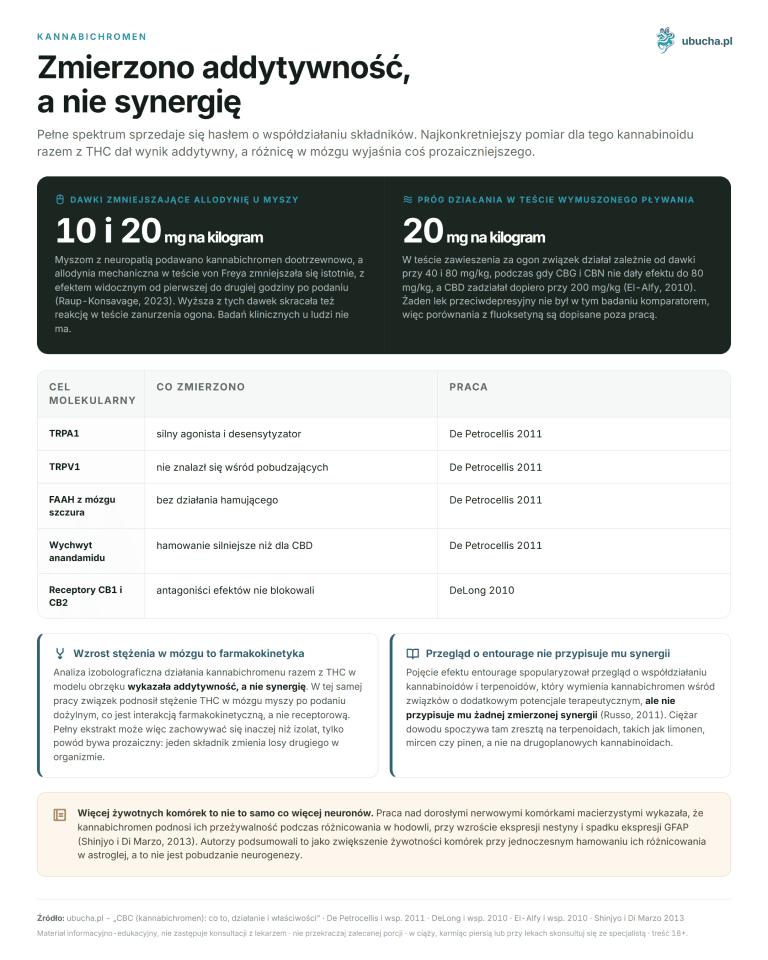
In this recipe, 80 g of hemp flour corresponds to 120 g of rice flour, which is 40 to 60. Above half, the crackers become brittle and crumble when dipped. This direction is confirmed by measurements on baked goods. Korus et al. replaced 20 to 60 percent of corn flour with hemp flour in gluten-free cookies: the protein of the baked product increased by 40-122 percent, and the fiber content also increased, but the cookies came out smaller and harder than the controls (European Food Research and Technology, 2017).
Similarly, this was the case in bread. Mikulec et al. studied bread with the addition of hemp flour and at 30 and 50 percent noted a decrease in organoleptic evaluation, and the browning index of the crumb increased from 29.7 for wheat bread to 46.3 with half the addition. The authors’ conclusion for industrial production was: do not exceed 30 percent (LWT, 2019). In a cracker, which is supposed to be hard by design, the limit is higher than in bread, but it is governed by the same relationship.
| Raw Material | Protein (g/100 g) | Fat (g/100 g) | Source |
|---|---|---|---|
| White wheat flour | 10.3 | 1.0 | USDA FoodData Central, record 168894 |
| White rice flour | 6.0 | 1.4 | USDA FoodData Central, record 169714 |
| Shelled hemp seeds | 31.6 | 48.8 | USDA FoodData Central, record 170148 |
| Hemp cake after cold pressing | 40.7 (standard deviation 8.8) | House et al., 2010, average from commercial batches |
The last row explains why we do not provide a single number for hemp flour from the shelf. House, Neufeld, and Leson measured thirty commercial hemp products and found an average of 40.7 percent protein with a standard deviation of 8.8 points for the cake. The variation between batches is therefore wider than the difference between various types of flour. The label of a specific package will tell you more about this flour than any general table.
What do you need for a tray of crackers?
The proportions are enough for 25-30 pieces, depending on how thinly you roll out the dough. Active work is 15 minutes, baking 15-18. You can replace rice flour with buckwheat flour, then the cracker will be darker and have a more pronounced earthy flavor. Olive oil is not a flavoring addition here. The fat surrounds the flour particles and limits their binding with water, allowing the baked cracker to crumble under the teeth instead of just being hard.
- 80 g hemp flour
- 120 g rice or buckwheat flour
- 3 tablespoons olive oil
- 4-5 tablespoons cold water
- half a teaspoon sea salt
- quarter teaspoon baking powder
- quarter teaspoon garlic powder, optional
- 1 teaspoon herbs de Provence or dried rosemary, optional
- 2 tablespoons shelled hemp seeds for sprinkling
Add water tablespoon by tablespoon. Hemp flour absorbs it unevenly, so the same recipe with a different batch of flour may need four or five tablespoons. The baking powder is not there to make the cracker rise, but to prevent the center from becoming dense and rubbery. Hemp seeds only go on top; mixed into the dough, they would tear the thin cake while rolling.
How to bake crackers step by step?
The dough does not rise and does not require resting, so from the moment you take out the flour to the moment you take the tray out, half an hour passes. You will need a rolling pin, two sheets of baking paper, and one large baking tray.
- Preheat the oven to 170 degrees, top and bottom mode. The convection mode speeds up baking, and the hemp flour darkens quickly, so it’s easy to burn the edges while the center remains light. Line the baking sheet with paper.
- Mix the dry ingredients. In a bowl, combine both flours, salt, baking powder, and chosen spices. Mix thoroughly before adding any wet ingredients, otherwise the powder will remain in one spot in the dough.
- Knead the dough. Pour in the oil, mix with a fork, then add water tablespoon by tablespoon and knead after each addition. The finished dough is compact, does not crumble, and does not stick to your hands. If too sticky, rescue it with a spoon of rice flour; if too dry, add a spoon of water.
- Roll out as thinly as possible. Place the dough on a sheet of paper, cover with another, and roll through the paper to a thickness of 2-3 mm. Remove the top sheet, sprinkle with hemp seeds, and press them down with your hand so they don’t fall off after baking.
- Cut and prick. Use a knife or pastry wheel to divide the dough into squares about 4 by 5 cm. Prick each several times with a fork, as the pricks release steam and the cracker won’t puff up. Crackers do not rise, so you can place them close together.
- Bake and cool on the sheet. Bake for 15-18 minutes, but check after thirteen. The finished crackers have golden-brown edges. When removed, they may seem limp, which is normal: they harden during cooling, so leave them on the sheet for a quarter of an hour and do not put them back in the oven.
How to change the flavor of the crackers?
The dough accepts almost any dry spice, as long as it does not change the proportions of liquid. Cumin with a bit of cayenne gives a spicy version, which can be brushed with a teaspoon of maple syrup diluted in water before baking. A tablespoon of sesame instead of a tablespoon of hemp seeds gives a topping with a similar nutty profile. Two tablespoons of finely chopped black olives add salt and Mediterranean flavor, but then reduce the salt in the dough by half.
The cracker is a carrier, not a standalone dish. It performs best with thick, fatty dips, as its nutty note complements fat without competing with it: it will work well with hemp seed hummus or hemp seed guacamole. If you are looking for a sweet hemp snack, the same baking logic applies to homemade granola with hemp seeds: a thin layer, low temperature, crispiness only after cooling.
The question remains, why reach for flour that increases the fiber content in baked goods. Threapleton et al. collected 22 cohort studies and calculated that each additional 7 g of fiber per day is associated with a 9 percent lower risk of cardiovascular diseases (BMJ, 2013). A serving of crackers alone does not reach those 7 g. What matters is the total for the whole day, and a homemade snack made from hemp flour is just one of its components.
Frequently Asked Questions
How much hemp flour should be added to the crackers?
From 30 to 40 percent of the total flour mass, which in this recipe is 80 g of hemp flour to 120 g of rice flour. Above half, the dough stops sticking, and the crackers crumble when dipped. In a study on gluten-free cookies, the addition of hemp flour reduced the volume of the baked product and increased its hardness, although it raised the protein and fiber content.
Are hemp flour crackers gluten-free?
Yes, as long as both flours are gluten-free. Hemp flour does not come from grains and contains no gluten, just like rice and buckwheat flour. If you have celiac disease, check both packages for a gluten-free certificate, as the risk lies in cross-contamination at the mill, not in the raw material itself.
Why are hemp flour crackers dark?
Because the flour is made from the whole seed along with the remnants of the hull and is itself green-brown. The color deepens in the oven: in a study on bread, the browning index of the crumb increased from 29.7 with wheat flour to 46.3 with a 50 percent addition of hemp flour. The color does not change the taste.
How long can crackers be stored?
Up to a week in an airtight container or metal tin, at room temperature and away from cooking steam. Crackers absorb moisture from the air and soften. If softened, place them in an oven preheated to 150 degrees for 5 minutes, then cool again on a rack.
What to serve with hemp flour crackers?
With thick dips: hummus, guacamole, hemp seed spreads, herb cheese. The nutty flavor of the cracker complements fat without competing for attention. For light, watery sauces, the cracker is too strong in flavor and will dominate the dish instead of complementing it.
With a plate of dips, something to drink without sugar fits well: hemp and herbal infusions we have gathered in the teas category.
This article is for informational and educational purposes and does not replace consultation with a doctor. If you are pregnant, breastfeeding, taking medications, or have chronic conditions, consult the use of supplements or herbs with a specialist.
Author: Michał Waluk · Published: 2026-06-22 · Updated: 2026-08-15