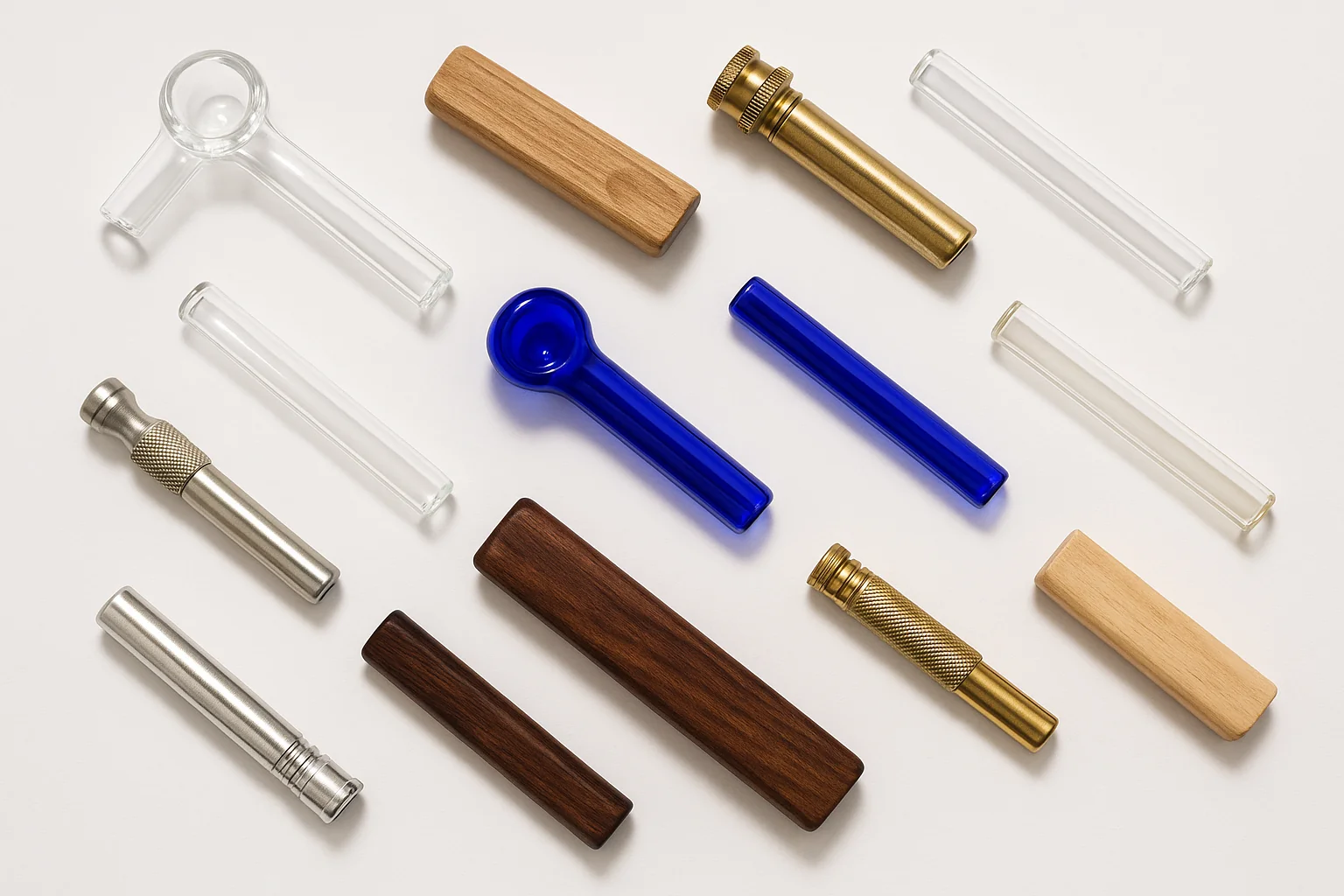

Pipes and One-Hitters: Types, Materials, and How to Choose (FAQ)
Pipes and one-hitters for dry herbs: what is the difference between a spoon pipe and a one-hitter, how to choose a material, and what does a carbon filter really retain in a one-hitter with a filter.
A dry herb pipe is one of the simplest accessories you can buy, and that is why the choice can be confusing: models differ in material, shape, and how they direct smoke, and sellers describe them interchangeably. They also confuse names: a one-hitter and a one-hitter are usually the same thing in stores, a one-hitter with a filter is the same tube with a chamber for an activated carbon insert, and a chillum is sometimes described as a regular pipe, although it has a different construction. The difference between glass, wood, metal, and ceramic translates into flavor, durability, and how much work it takes to keep the accessory clean. A separate question is whether a pipe is even the right choice, given that vaporization exists. This text organizes the types of pipes and one-hitters, compares materials without marketing gloss, explains what a carbon filter does in a one-hitter, and shows what two studies comparing it to vaporization say about pipe smoke.
KEY INFORMATION
• Borosilicate glass provides the most neutral taste and is the easiest to clean, but it is fragile.
• A one-hitter holds one portion: discreet, but it clogs quickly.
• A pipe works on combustion, so smoke is produced, not vapor.
• In a study using a vaporizer, the concentration of carbon monoxide in exhaled air was lower than after smoking (Abrams et al., 2007).
• A screen is mainly useful with finely ground material.
What is the difference between a pipe and a one-hitter?
The difference comes down to capacity and usage rhythm. A pipe has a bowl that holds material for a longer session and a tunnel leading smoke to the mouthpiece. A one-hitter, also called a one-hitter, is a narrow tube with a bowl for one portion. Both serve the same purpose, but lead to a completely different usage rhythm.
The practical consequences of this difference are significant. A pipe is filled once and returned to multiple times, which can be convenient at home but makes it harder to control material consumption. A one-hitter forces portioning: a finished portion means the end, unless you pack another. For some people, this is an advantage, as the amount is pre-measured rather than estimated by eye after the fact.
The third difference concerns discretion and portability. A one-hitter fits in the hand, often sold with a case called a dugout, where one chamber holds the material and the other the tube itself. A pipe is larger, more conspicuous, and easier to break in a pocket. We have detailed this construction in a separate text about what a one-hitter is and how to use it.
What are the main types of pipes and one-hitters?
There are six constructions that repeat on the market, and they differ not in decoration but in how they direct smoke. The table below compares them by construction and what distinguishes them.
| Type | Construction | What distinguishes it |
|---|---|---|
| Spoon pipe | Bowl, tunnel, mouthpiece, and a side hole regulating airflow | The most commonly encountered form; the side hole allows for ventilation at the end of the inhale |
| Chillum | A simple tube with a bowl at one end, without a side hole | Easier to use, but less control over airflow |
| One-hitter | A narrow tube with a bowl for one portion, often with a dugout case | Discreet and portioned; small bowl clogs faster |
| One-hitter with carbon filter | A tube like in a one-hitter, with a chamber for a replaceable activated carbon insert before the mouthpiece | Retains some gaseous phase and sticky residue; the insert saturates and needs to be replaced regularly |
| Bubbler | A pipe with a water chamber between the bowl and mouthpiece | Cools smoke without the bulk of a bong; harder to clean, as it is usually made from one piece of glass |
| Steamroller | A simple tube with a bowl on top and a wide opening at the back | No cooling or filtration, very intense inhale; not for beginners |
The choice between these forms does not come down to price or appearance. Bubbler and steamroller stand at two ends of the same scale: the former cools smoke through water, while the latter forgoes cooling and filtration for the strength of the inhale. Spoon pipe and chillum lie in the middle, while the one-hitter answers a completely different question, as its advantage is the measured portion and size.
Which material works best?
For most people, the most sensible choice is borosilicate glass. It does not react with smoke or condensate at user temperatures, so it does not add its own flavor, and residue washes off easily. The trade-off is fragility: a fall onto a hard surface usually ends the pipe.
| Material | Impact on taste | Mechanical resistance | Cleaning |
|---|---|---|---|
| Borosilicate glass | Neutral | Low, fragile material | Very easy, isopropanol with salt |
| Soda glass | Neutral | Lower than borosilicate, sensitive to temperature shocks | Easy |
| Wood | Own flavor, changes over time | High | Dry, with a pipe cleaner; no soaking |
| Metal | Noticeable metallic taste | Very high | Easy |
| Ceramic | Neutral | Higher than glass, but cracks on impact | Easy |
Wood has its own rules. A new wooden pipe requires lighting with a small amount of material to create a protective layer inside the bowl. Wood absorbs moisture and residue, so the taste changes over time, and soaking such a pipe in alcohol destroys it. With metal, the difficulty is different: the alloy composition is often not provided, and without this information, you cannot assess what you are dealing with. If the manufacturer does not declare what the part in contact with the heat is made of, treat it as a lack of information, not a detail.
How to prepare and use a pipe?
Start by grinding the material to a medium coarseness. Dust clogs the bowl opening and cuts off airflow, while too large pieces burn unevenly and leave unburned residue. A grinder is used for this task, and we described the differences between its constructions in the text about how to choose a grinder.
Fill the bowl loosely. Tightly packed material does not allow air to pass, making inhalation difficult and burning unevenly. Hold the pipe so that the bowl is horizontal or slightly raised; otherwise, the contents will spill out with the first strong inhale. If the pipe has a side hole, cover it with your finger while inhaling, and release it at the end of the inhale to ventilate the tunnel.
Light from the edge of the bowl, not from the center. The technique called cornering leaves the untouched residue, so the next person or the next inhale gets a fresh piece instead of the entire already burned surface. A screen placed at the bottom of the bowl is useful when the material is fine or very dry and crumbles to dust. With properly ground and loosely packed material, it is usually not needed, as the bowl itself retains larger fragments.
What is a one-hitter with a carbon filter and how to use it?
A one-hitter with a carbon filter is the same tube for one portion as a regular one-hitter, only it has a chamber for a replaceable insert filled with granulated activated carbon between the bowl and the mouthpiece. The insert retains some of the tarry substances and material particles, and the smoke reaches the mouth slightly cooler. It does not change the combustion itself.
Activated carbon works through adsorption: particles settle on the developed surface of the pores. The insert handles part of the volatile compounds and the sticky residue that would otherwise accumulate in the tunnel. It does not retain carbon monoxide, as that molecule is too small and passes along with the rest of the gaseous phase. Therefore, the filter does not turn smoke into vapor nor make combustion a safe process, although it is often sold that way.
It is packed the same way as a one-hitter without a filter: material ground to medium coarseness, bowl filled loosely, calm inhale. The insert adds resistance, so a strong, jerky pull will not speed anything up, but will only draw the ember deeper into the tube. The insert itself slides into the chamber before the mouthpiece so that it is only reached by smoke, never flame.
Replacement is part of use, not a malfunction. The pores fill up during smoking, and from that moment, the insert stops retaining anything and only starts to restrict airflow. Increasing resistance during inhalation, a bitter taste, and a dark ring on the insert indicate that it is time to throw it away. Rinsing or drying will not help, as carbon regains capacity only at high temperatures, not under running water. How many portions a specific insert will withstand can only be checked with the manufacturer, as it is not visible from the outside. The tube itself is cleaned like any other one-hitter, using the method described below.
How to clean a pipe and how long will it last?
The standard method for glass is high-concentration isopropanol with coarse salt added. The salt works as an abrasive, and the alcohol dissolves the resin. Plug the openings, shake vigorously, and for tougher deposits, leave the pipe for several to dozens of minutes, then rinse it with hot water and dry before the next use.
The moment for cleaning is recognized by symptoms, not by the calendar. Dark residue in the tunnel, resistance during inhalation, and a bitter taste are signals that the resin is starting to accumulate faster than it can be removed. The longer you delay, the harder it becomes, as hardened residue adheres to the glass. A wooden pipe should not be cleaned this way: alcohol washes away what determines its character and damages the material.
Durability mainly depends on whether the pipe falls. Borosilicate glass does not chemically degrade at the temperatures reached during use, so with regular cleaning, it will last a very long time. The real risk is breakage, and with thin soda glass, there is additionally the risk of cracking with sudden temperature changes, for example, pouring boiling water into a cold pipe. Metal and ceramic are more forgiving, wood ages gradually and requires constant maintenance.
Does a vaporizer put less strain on the respiratory system than a pipe?
A pipe works on combustion, just like a joint, so smoke is inhaled. A vaporizer heats the material below the combustion threshold and releases active substances in the form of vapor. Two independent studies from 2007 compared these methods, and both favored vaporization, although each measured different things.
In a hospital study, eighteen healthy individuals received material with three different concentrations for six days, once vaporized with a stationary device and once smoked. The peak concentration of the active substance in the blood and total exposure over six hours were comparable in both methods, while the concentration of carbon monoxide in exhaled air was lower after vaporization. No adverse events were reported (Abrams et al., Clinical Pharmacology and Therapeutics 2007).
The second study involved a large internet sample and asked about respiratory symptoms. Using a vaporizer was associated with fewer reported symptoms even after accounting for age, sex, smoking cigarettes, and the amount of material used, and the difference increased with the intensity of use. The authors state directly that individuals who regularly use joints, pipes, and water pipes could reduce symptoms by switching to a vaporizer (Earleywine and Barnwell, Harm Reduction Journal 2007). This survey-based study relies on participant declarations rather than lung function measurements, so it shows a correlation, not proof of causation. A broader comparison of consumption methods is gathered in the text bong vs vaporizer vs joint.
Frequently Asked Questions
What is the difference between a pipe and a one-hitter?
The capacity and rhythm of use. A pipe has a bowl for a longer session and a tunnel leading smoke to the mouthpiece. A one-hitter, or one-hitter, holds one portion and forces its measurement. A one-hitter is smaller and easier to carry, while a pipe is more convenient at home.
What material is best for a dry herb pipe?
For most people, borosilicate glass: it does not add its own flavor and is the easiest to clean, although it is fragile. Wood and ceramic are more mechanically resistant, metal the most, but can be noticeable in taste. With metal, check if the manufacturer provides the alloy composition.
How to clean a glass pipe?
Plug the openings, pour in high-concentration isopropanol with coarse salt, and shake. The salt acts as an abrasive, and the alcohol dissolves the resin. For tougher deposits, leave the pipe for several to dozens of minutes, then rinse with hot water and dry. Wooden pipes should not be cleaned this way.
Is a bubbler better than a regular pipe?
A bubbler directs smoke through water, so it reaches you cooler and is less irritating to the throat. This comes at the cost of more difficult cleaning, as the construction is usually made from one piece of glass. It is an intermediate solution between a pipe and a bong, not a definitively better choice.
Is a screen necessary?
It is useful when the material is ground very finely or so dry that it crumbles to dust and passes into the tunnel. With medium coarseness and loose packing, the bowl usually retains larger fragments by itself. Metal screens get clogged with residue and need to be replaced regularly.
How long will a good glass pipe last?
Borosilicate glass does not chemically degrade at user temperatures, so with regular cleaning, it will last a very long time. The main risk is breakage. Thin soda glass additionally cracks with sudden temperature changes, for example, pouring boiling water into a cold pipe.
Does a carbon filter in a one-hitter clean the smoke?
It retains some volatile compounds and sticky residue, making the smoke smoother. It does not remove carbon monoxide, as the molecule is too small to settle in the pores. The insert saturates and from that moment only restricts flow, so it needs to be replaced regularly.
One-hitters available in the store at Bucha are gathered in the one-hitters category.
This article is for informational and educational purposes. It contains internal links to product categories available in the store at Bucha. Prices and specifications may change: check the current data on the product page before purchasing.
Author: Michał Waluk · Published: 2026-08-09 · Updated: 2026-08-24