
What is NMN and does it work for longevity
NMN is the last precursor before NAD+. What have studies shown in mice, what in humans, why there is no authorization in the EU, and whether it is worth taking after the age of 40.
NMN is nicotinamide beta-mononucleotide, the last precursor before NAD+ in the salvage pathway, meaning it is a molecule one step away from the coenzyme whose levels decrease with age. In the European Union, it does not have authorization as a novel food, so it is not legally allowed to be sold here as a dietary supplement. Nevertheless, it is sold as a molecule that reverses the biological clock. When this message is compared with publications, the picture becomes much more modest. The most impressive results, from rejuvenated vessels to restored fertility, come from studies on mice. Human studies involve dozens of participants, last from two weeks to half a year, and primarily measure NAD+ levels in the blood, not lifespan. The longest of them lasted 24 weeks, and almost every one was funded by the manufacturer of the tested preparation. Additionally, there is a fact that sellers remain silent about: in the European Union, NMN does not have authorization as a novel food. Below you will find what has been studied, how many participants were involved, who paid for it, and what the legal status looks like in August 2026.
KEY INFORMATION
• A meta-analysis of 8 studies involving 342 adults did not show improvement in glycemia, insulin, or lipids (Current Diabetes Reports, 2024).
• Rejuvenation of vessels, fertility, and endurance was described in mice, not in humans.
• Human trials involve dozens of participants: ten of them contributed a total of 349 participants in the meta-analysis (Nutrients, 2026).
• In the EU, NMN is not authorized as a novel food.
What is NMN?
It is a nucleotide made of nicotinamide, ribose, and a phosphate group, formed in the body from vitamin B3 and further converted into NAD+ by enzymes from the NMNAT family. In short: the last stop before NAD+. This is where the whole logic of supplementation comes from, because since NAD+ decreases with age, providing the precursor is supposed to compensate for this loss.
This logic has two holes, which we describe below. First, raising the concentration of the precursor does not automatically mean that NAD+ increases in the tissue of interest. Second, even if it does increase, it is unknown whether it translates into anything that the patient feels. Human studies involve dozens of participants and mainly measure intermediate parameters.
What is NAD+ and why does its level decrease with age?
NAD+ is a coenzyme present in every cell. It carries electrons in cellular respiration and is consumed by DNA repair enzymes from the PARP family and by sirtuins, which are deacylases regulating gene expression. The body does not take NAD+ from food in its ready form, but builds it from precursors.
There are several synthesis pathways. The first starts from tryptophan, the second from niacin, and the third is the salvage pathway, in which nicotinamide returns to circulation thanks to the enzymes NAMPT and NMNAT. NMN is an intermediate product of this third pathway, just before NAD+ itself.
The decrease with age is explained by increasing PARP activity, declining expression of synthesis enzymes, and greater activity of the enzyme CD38, which breaks down NAD+. The most frequently cited measurement in humans is the work of Massudi et al. (PLoS ONE, 2012): 49 samples of human skin from individuals aged from newborn to 77 years. NAD+ levels decreased with age in both sexes, more strongly in men (r = -0.71 at p = 0.001) than in women (r = -0.54 at p = 0.01).
We have noticed something that is worth stating directly. The repeated claim in product descriptions that “50% less NAD+ between the ages of 20 and 60” does not come from any measurement in living humans in that age range. It is a rounding taken from correlations measured on skin samples and on rodents. The direction of change is well documented, but the specific percentage number is already a marketing interpretation.
How does NMN differ from NR and niacinamide?
These are three different molecules entering the same pathway at different points. Niacinamide (nicotinamide) is a form of vitamin B3, the cheapest and best-known. Nicotinamide riboside (NR) is formed from it by adding sugar. NMN is NR with an added phosphate group, meaning it is the last stop before NAD+.
Manufacturers like to argue that NMN is “closer” to NAD+, so it must work better. Biochemistry is less convenient here. A molecule with a phosphate group passes through the cell membrane less effectively, and the dispute over the transporter continues to this day. The team of Grozio et al. (Nature Metabolism, 2019) described the protein Slc12a8 as the NMN transporter in the small intestine of mice. In the same journal, a response from Schmidt and Brenner titled “Absence of evidence that Slc12a8 encodes a nicotinamide mononucleotide transporter” was published, followed by a replica from Grozio’s team. Both sides of the dispute have ties to the industry: Brenner collaborates with the NR manufacturer, and the authors of the work on Slc12a8 with NMN producers.
The regulator approached this without emotion. In evaluating synthetic beta-NMN, the EFSA panel treated it simply as a source of nicotinamide and accepted a conversion factor of 1, meaning 300 mg of NMN corresponds to 109.7 mg of nicotinamide. From a nutritional assessment perspective, NMN thus provides vitamin B3 through a roundabout and much more expensive route.
What have NMN studies on mice shown?
Almost everything that impresses in NMN advertisements has been measured on rodents. This is not a criticism of these works, just information about what stage we are at. Mice live about two years, so their aging experiment can be completed in a few months. In humans, such an experiment would take decades, and no one has conducted it so far.
The basic work is Mills et al. (Cell Metabolism, 2016): NMN was given to C57BL/6N mice in water for 12 months. The animals gained less weight with age, had better energy metabolism, higher insulin sensitivity, and improved eyesight. It is worth noting what this work did not show: it did not measure an extension of the animals’ lifespan.
Two other cited results also come from rodents. Das et al. (Cell, 2018) showed in old mice a restoration of capillary density and improved running endurance after administering NAD+ precursors. Bertoldo et al. (Cell Reports, 2020) described in aging female mice an improvement in egg cell quality and partial restoration of fertility after administering NMN.
Translating these results to humans breaks down on two things: the doses in relation to body weight are many times higher in mice, and laboratory animals live in controlled conditions. A result from a rodent is therefore a hypothesis to be tested, not a promise of effect in a forty-year-old.
How many people participated in NMN studies in humans?
Fewer than the market scale suggests. A typical trial involves from a dozen to several dozen participants, and ten studies collected in a meta-analysis yielded a total of 349 people. The endpoint is usually NAD+ levels in the blood or a simple fitness test, never lifespan. Below is a summary of the studies most often cited in product descriptions.
| Study | Participants | Dose and time | Outcome | Industry ties |
|---|---|---|---|---|
| Irie et al., Endocrine Journal 2020 | 10 healthy men | 100, 250, and 500 mg single dose | good tolerance during 5 hours of observation | NMN supplied by Oriental Yeast Co. |
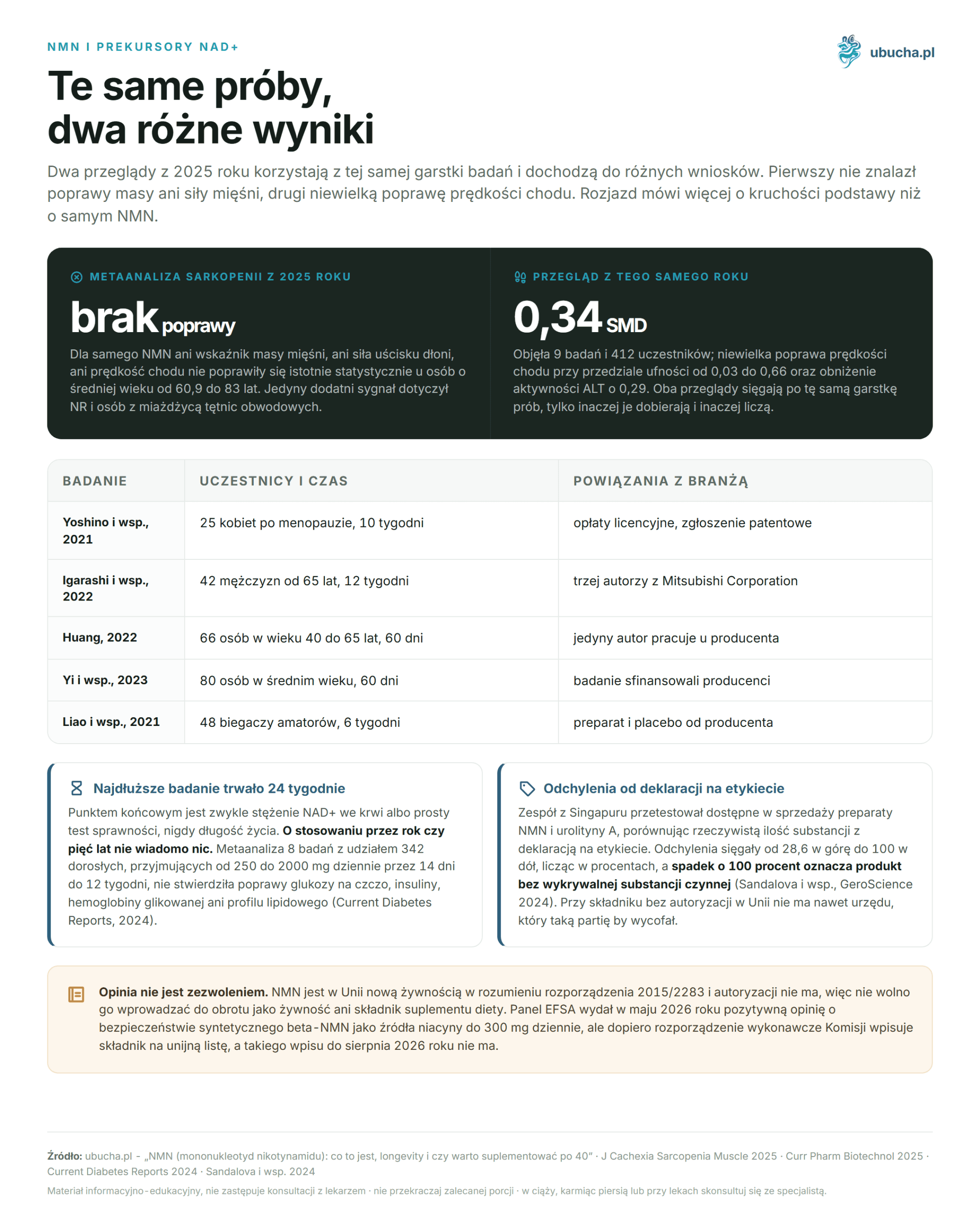
| Yoshino et al., Science 2021 | 25 postmenopausal women with prediabetes | 250 mg daily, 10 weeks | increased muscle sensitivity to insulin | one of the authors receives licensing fees from MetroBiotech and Teijin, another is a co-author of a patent application for NMN |
| Igarashi et al., npj Aging 2022 | 42 men aged 65 and older | 250 mg daily, 12 weeks | increase in NAD+ in the blood, slight improvement in walking speed and strength of the left hand | three authors are employees of Mitsubishi Corporation Life Sciences |
| Huang, Frontiers in Aging 2022 | 66 people aged 40 to 65 | 300 mg daily, 60 days | increase in NAD+, no change in HOMA-IR index | the sole author is an employee of Effepharm, the manufacturer of the tested preparation |
| Yi et al., GeroScience 2023 | 80 healthy middle-aged individuals | 300, 600, or 900 mg daily, 60 days | dose-dependent increase in NAD+, longer distance in the 6-minute walk test, no increase in biological age index, which rose in the placebo group | study funded by Aba Chemicals and Abinopharm, the first author is an employee of Abinopharm |
| Liao et al., JISSN 2021 | 48 amateur runners | 300, 600, or 1200 mg daily, 6 weeks | better oxygen uptake at ventilatory thresholds, no difference in VO2max | the preparation and placebo were supplied by GeneHarbor |
What do the meta-analyses of these studies together show?
When summing individual trials, enthusiasm clearly wanes. A meta-analysis published in Current Diabetes Reports (2024) included 8 randomized studies and 342 adults who took from 250 to 2000 mg of NMN daily for periods from 14 days to 12 weeks. No improvement in fasting glucose, insulin, glycated hemoglobin, HOMA-IR index, or lipid profile was found.
Similarly, physical fitness fared. A meta-analysis in Journal of Cachexia, Sarcopenia and Muscle (2025) gathered studies on NMN and NR in individuals whose average age ranged from 60.9 to 83 years. For NMN itself, neither muscle mass index, handgrip strength, nor walking speed improved significantly. The only positive signal concerned NR and a narrow group: longer distance in the 6-minute walk test in individuals with peripheral artery disease. The authors’ conclusion is clear: available data do not justify the use of both precursors in preventing sarcopenia.
Meta-analyses do not speak with one voice, however. Another work from 2025, in Current Pharmaceutical Biotechnology, included 9 studies and 412 participants and found a slight improvement in walking speed (standardized mean difference 0.34, 95% CI from 0.03 to 0.66) and a decrease in ALT (-0.29, 95% CI from -0.55 to -0.03). Both reviews use the same handful of trials, just selecting and counting them differently, so the discrepancy says more about the fragility of the foundation than about NMN itself.
One signal does repeat independently, however. A meta-analysis of 10 studies involving 349 adults with elevated blood pressure, published in Nutrients (2026), showed a slight decrease in diastolic blood pressure, on average by 2.15 mmHg (95% CI from -3.68 to -0.61). Systolic pressure decreased only in the subgroup of individuals over 60 years old, by 3.94 mmHg (95% CI from -7.06 to -0.82). This is a real result, but the scale corresponds more to a reduction in dietary salt than to a hypotensive drug, and the authors themselves describe it as preliminary.
Is NMN legally allowed to be sold in Poland as a supplement?
No. NMN is considered a novel food in the European Union under regulation (EU) 2015/2283, and novel food without authorization cannot be marketed as food or as an ingredient in dietary supplements. This applies to the entire Union, including Poland.
The basis is formal. In consultation of status conducted under Article 4 of this regulation, with the Czech Republic as the assessing country, it was stated that NMN has not been shown to have been consumed in the Union before May 15, 1997. The ingredient was classified into category 3(2)(a)(i), meaning a substance requiring authorization before being placed on the market. The document was published on October 11, 2022, and is still in effect.
In May 2026, the EFSA panel issued a positive safety opinion for synthetic beta-NMN, assessing it as a source of niacin in supplements up to 300 mg daily for adults, excluding pregnant and breastfeeding women. The corresponding dose of 109.7 mg of nicotinamide is about five times the reference intake value for niacin for adults, but still less than the upper limit of 900 mg daily. The EFSA opinion is not an authorization. Only an implementing regulation from the European Commission places the ingredient on the EU list, and as of August 2026, there is no such entry for NMN. The applicant has also applied for data protection from their own dossier.
In the United States, the situation has changed twice. In 2022, the FDA ruled NMN excluded from the definition of a dietary supplement because it had previously been allowed for research as a drug. In letters dated September 29, 2025, responding to industry petitions, the agency reversed this position and stated that NMN is not excluded. The ingredient still requires notification as a new dietary ingredient there. So if you come across a store claiming that “in Poland and the EU, NMN is a legal supplement,” you are dealing with a transfer of the American situation to the European ground.
Where the upper limits for supplements lie, we have gathered in the guide on which supplements are dangerous in excess.
What is known about the safety of NMN and the quality of preparations?
Short-term, the profile looks calm. A review of 15 studies published in Nutrients (2026), covering doses from 250 to 2000 mg daily and times from 14 days to 24 weeks, did not show an increase in adverse events, interruptions due to side effects, or elevated ALT and AST activity. Only 10 of these 15 trials entered the safety analyses, so the basis is narrower than the number in the title suggests. Reported complaints are mainly mild stomach discomfort.
However, the limit of knowledge is clear. The longest study lasted 24 weeks, so nothing is known about use for a year or five years. In the EFSA assessment, a 90-day study on rats showed changes in reproductive organs, based on which NOAEL was set at 400 mg per kilogram of body weight and a margin of exposure equal to 93. The panel did not find genotoxicity. Pregnant and breastfeeding women were excluded from the assessment.
A separate problem is the content of the packaging. A team from Singapore tested available NMN and urolithin A preparations, comparing the actual amount of substance with the declaration on the label. Deviations ranged from +28.6% to -100%, with the latter value meaning a product without detectable active substance (Sandalova et al., GeroScience 2024). With an ingredient without authorization in the EU, there is not even an office that would withdraw such a batch.
Which interventions have stronger evidence for slowing aging?
Significantly stronger evidence than any NAD+ precursor comes from things that are boring and cheap. Regular endurance and strength exercise, blood pressure control, not smoking, sleeping at a regular time, and maintaining body weight within a reasonable range. These interventions have been studied on tens of thousands of people over decades, not on dozens of volunteers over two months.
This order has practical significance. If the health budget is limited, spending it first on NMN and only then on sleep and activity is a reversal of priorities. A supplement with uncertain legal status and results measured in weeks will not replace a change whose effect is visible in population data. This is especially true for those over forty, where the first deviations in blood pressure and glycemia can still be reversed by lifestyle alone.
If you are still interested in this category, it is worth first getting to know the ingredients with better-described effects. On our blog, you can read about coenzyme Q10 after forty, about resveratrol and its real impact on aging, and about ingredients associated with longevity. A comparison of the precursors themselves can be found in the post NAD+ vs NMN.
Frequently Asked Questions
Does NMN extend life in humans?
There is no evidence for this. The longest study lasted 24 weeks, so none of them measured lifespan. Yi et al. (2023) did calculate the biological age of 80 people using an online calculator, but that is a surrogate marker, not a measure of aging rate. Longevity results come from rodents.
What doses of NMN were used in human studies?
Published studies used doses ranging from 250 to 2000 mg daily for periods from 14 days to 24 weeks. The most commonly repeated protocol is 250 mg daily, used by Yoshino et al. (2021) and Igarashi et al. (2022). This is a description of what was studied, not a dosing recommendation.
Can NMN be legally purchased in Poland as a dietary supplement?
No. NMN is considered a novel food in the European Union under regulation 2015/2283 and does not have authorization, so it cannot be marketed as food or as an ingredient in dietary supplements. EFSA issued a positive safety opinion in May 2026, but the opinion does not replace authorization from the European Commission.
NMN or NR: which precursor has more data?
Nicotinamide riboside (NR) has been studied longer and has the status of authorized novel food in the EU, which NMN does not have. However, a meta-analysis from 2025 in the Journal of Cachexia, Sarcopenia and Muscle did not show benefits from either for muscle mass or strength in people over 60 years old.
Is NMN safe?
In the short term, it looks good. A review of 15 studies from 2026, of which 10 entered safety analyses, did not show an increase in adverse events or elevated ALT and AST at doses from 250 to 2000 mg daily. There is no data beyond 24 weeks, and EFSA excluded pregnant and breastfeeding women from the safety assessment.
Who should not use NMN?
Pregnant and breastfeeding women, as they were excluded from the EFSA safety assessment. Caution also applies to those taking medications regularly and cancer patients, as the effect of raising NAD+ on cancer cell metabolism has not been studied in humans. Discuss the decision with your doctor.
u Bucha’s store, we do not carry NMN preparations. If you are looking for products with regulated status, check the supplements category.
This article is for informational and educational purposes and does not constitute medical advice. Before starting supplementation, consult your doctor, especially if you are taking medications regularly, are pregnant or breastfeeding, or have a chronic illness.
Author: Michał Waluk · Published: 2026-06-22 · Updated: 2026-08-24