
Hemp shot or CBD oil - what to choose and how much does it really cost
Price conversion per milligram for shots and oils in the store at Bucha, status as of 07.08.2026, and what is still unknown about the absorption of cannabidiol in humans.
In guides about cannabis, it is often repeated that the shot is several times more expensive than the oil and is only worth it occasionally. We checked this on products actually available in the store at Bucha, and the thesis does not hold: the price ranges per milligram for both formats overlap instead of dividing the market into cheap oil and expensive drink. Since price does not decide, something else does: portion resolution, composition, and whether you will even reach for a product whose taste you do not like every day. Below is a comparison based on current prices and what studies have actually shown, including what they have not shown and therefore we will not calculate here.
KEY INFORMATION
• Price per milligram of declared content: shots 0.09-0.13 PLN, oils 0.10-0.13 PLN (store at Bucha, status as of August 7, 2026).
• The conversion cannot be calculated for most Green Out drinks because the manufacturer does not declare the number of milligrams in the product description.
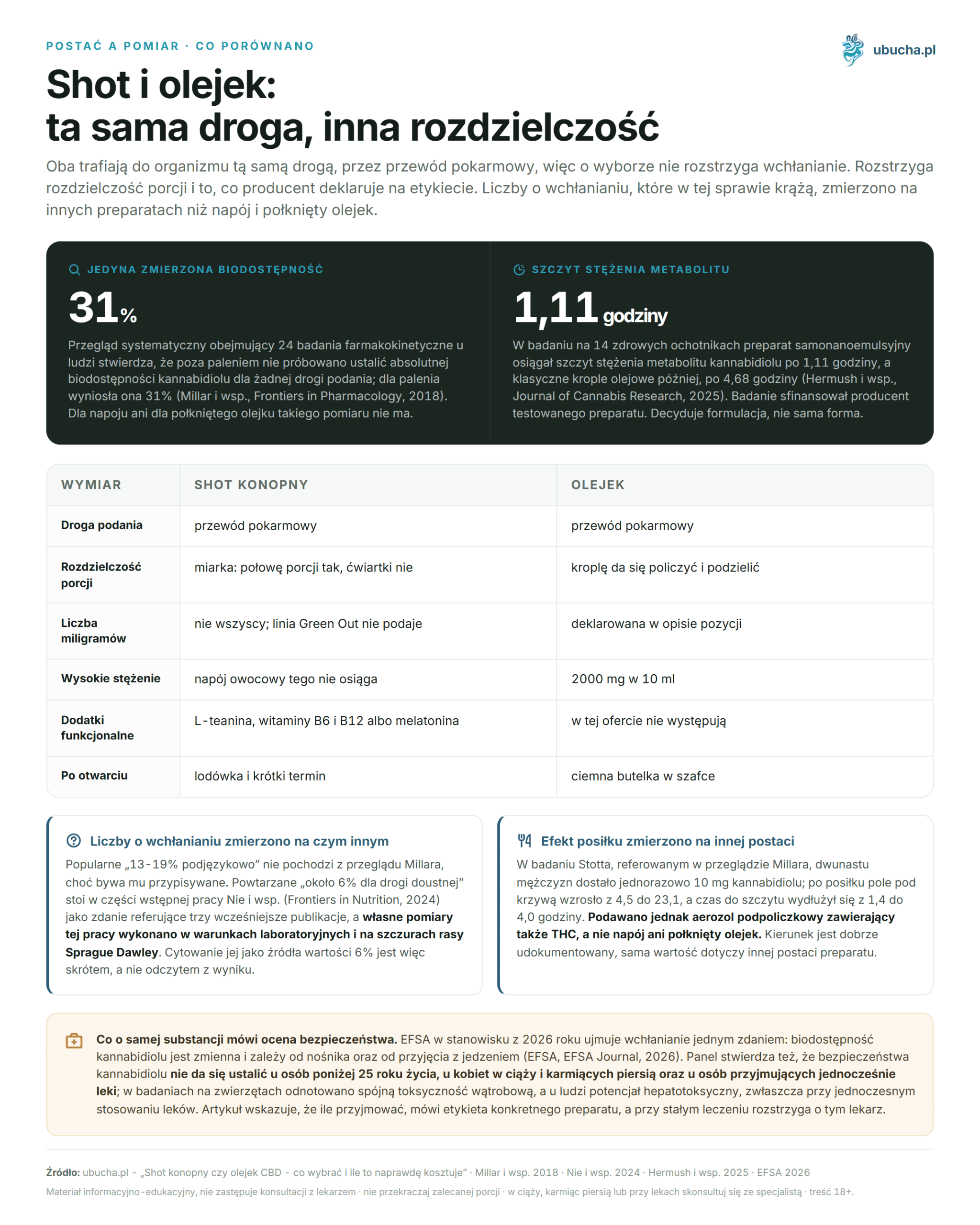
• Absolute bioavailability of cannabidiol in humans has not been attempted to be established for any route of administration other than smoking, where it was 31% (Millar et al., Frontiers in Pharmacology, 2018).
• The same review notes that after a meal, the area under the curve increased from 4.5 to 23.1, but this was measured on a sublingual aerosol, not on a drink.
• The article does not provide any portions or dosing schemes.
Which format to choose: shot or oil?
The shortest answer is this: choose oil when you want to gradually adjust the amount and do not mind the earthy taste; choose shot when you care about a repeatable portion without a pipette and that drinking is enjoyable. The table below breaks this down into specific situations.
Note that in this comparison, the argument about the effectiveness of one format over the other does not appear even once. This is intentional. Both enter the body through the same route, the digestive tract, so the differences come down to how much substance the manufacturer declares, how it is prepared, and whether you will actually reach for the product regularly.
| Your situation | Better choice | Why |
|---|---|---|
| You want to change the amount in small steps | oil | a drop can be counted and divided, a portion from a measuring cup cannot |
| You are put off by the taste of cannabis | shot | the fruit base masks the earthy note of the oil |
| You are looking for a high concentration in a small bottle | oil | 2000 mg in 10 ml, which a drink cannot achieve |
| You care about functional additives | shot | L-theanine, vitamins B6 and B12, or melatonin in the composition |
| You take the product at work or while traveling | shot | without a pipette and without holding anything under your tongue |
| You reach for the product irregularly | oil | a drink after opening goes to the fridge and has a short shelf life |
If you do not yet know exactly what a hemp shot is and what power variants are available on the market, start with our beginner’s guide to hemp shots, where we also outlined instructions for reading the label.
How much does it really cost?
We calculated the price per milligram of declared content for products that are currently on sale and that actually declare this number. The result contradicts the common belief: drinks and oils mix in the ranking instead of creating two separate price shelves.
| Product | Form | Declared mg | Price | Per mg |
|---|---|---|---|---|
| Elixir Panoramixa Strong+ 650 | shot 100 ml | 650 | 59 PLN | 0.09 PLN |
| CANNOVA Natural CBD Oil 20% | oil 10 ml | 2000 | 190 PLN | 0.10 PLN |
| CANNOVA Natural CBD Oil 10% | oil 10 ml | 1000 | 110 PLN | 0.11 PLN |
| Hemp Shot OG Kush | shot 100 ml | 490 | 65 PLN | 0.13 PLN |
| CANNOVA Natural CBD Oil 5% | oil 10 ml | 500 | 65 PLN | 0.13 PLN |
Prices are from the store ubucha.pl and describe the status as of August 7, 2026. We included only items available for sale, for which the declared content is provided in the product description.
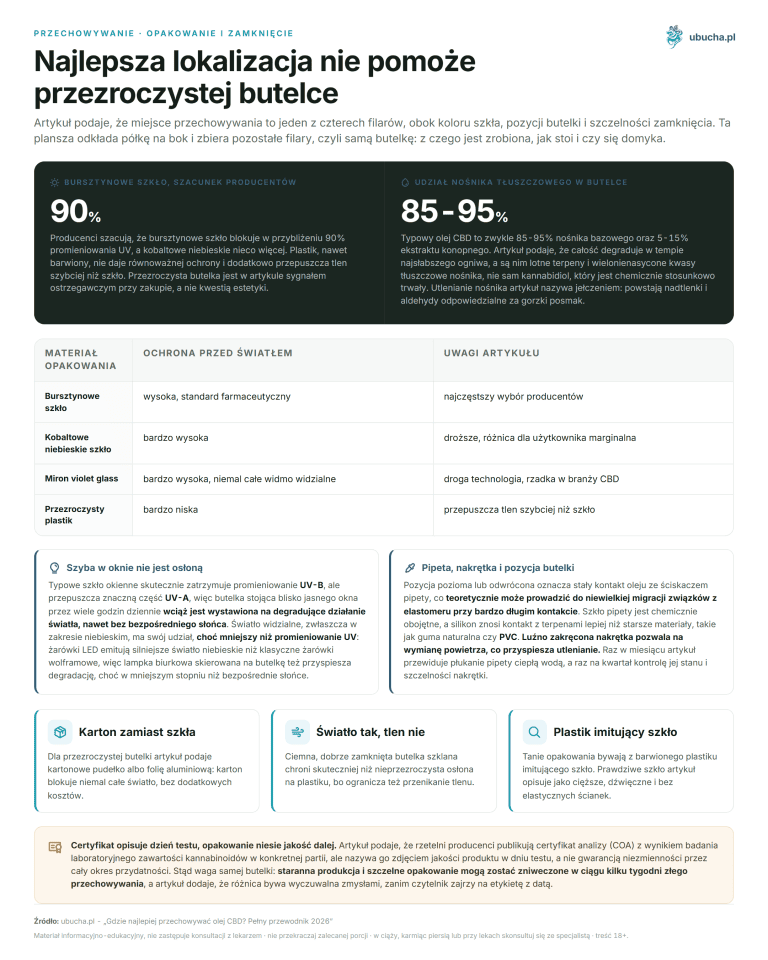
Two direct caveats must be made. First: oils declare milligrams of cannabidiol, while drinks most often declare milligrams of phyto-ingredients or full spectrum content, so the units are not fully equivalent and the conversion shows an order of magnitude, not equivalence. The second is more important and concerns the title of this article: for most drinks on offer, such a conversion cannot be calculated. The entire Green Out line, which is the widest family of drinks on the Polish shelf, describes potency in words (Lemonade, Fresh Bomb, Strong+, Shake) and does not provide the number of milligrams in the product description. We do not guess it and do not enter market roundings. This means that the table above describes that part of the market which declares its content, not the entire shelf.
However, the conclusion remains valid where it can be calculated: the claim that the shot costs several times more per milligram than the oil is not supported by Polish prices. The cheapest item in the entire comparison is a drink.
What is known about absorption, and what is not known?
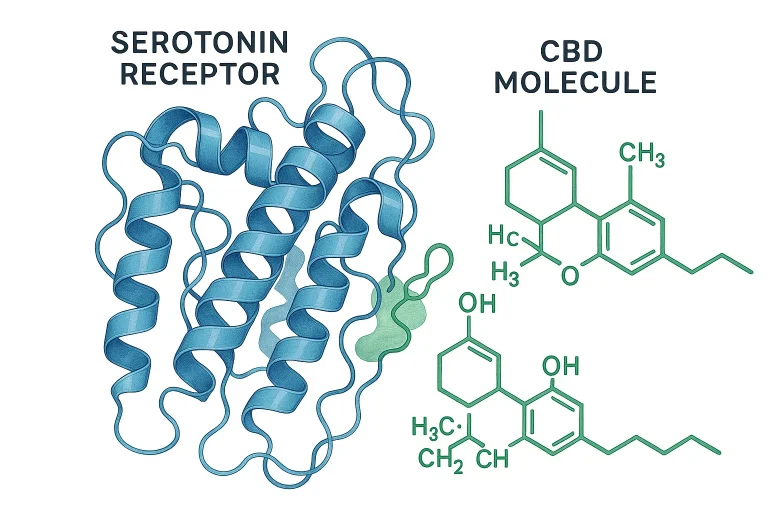
Here one must be cautious, as there are many numbers circulating on the internet without support. A systematic review covering 24 pharmacokinetic studies in humans states directly: besides smoking, absolute bioavailability of cannabidiol has not been attempted to be established for any route of administration, and for smoking, it was 31% (Millar et al., Frontiers in Pharmacology, 2018). The popular “13-19% sublingually” does not come from this review, although it is sometimes attributed to it.
Caution is also required for the opposite number, often repeated as “about 6% for the oral route.” It exists in the literature, but it is not anyone’s measurement provided at this address: it stands in the introductory part of the work Nie et al. (Frontiers in Nutrition, 2024) as a statement referencing three earlier publications, and the measurements of this work were made under laboratory conditions and on Sprague Dawley rats. Citing it as a source of the value 6% is therefore a shortcut, not a reading from the result.
What can be said reliably? That absorption is low and variable. EFSA in a statement from 2026 summarizes it in one sentence: the bioavailability of cannabidiol is variable and depends on the carrier and whether it is taken with food (EFSA, EFSA Journal, 2026).
The strongest single number in this area concerns food. In Stott’s study, referenced in Millar’s review, twelve men received a single dose of 10 mg of cannabidiol; after a meal, the area under the curve increased from 4.5 to 23.1, and the maximum concentration increased from 1.2 to 3.7 ng/ml, while the time to peak extended from 1.4 to 4.0 hours. A significant caveat is that a sublingual aerosol containing THC was administered, not a drink or swallowed oil. The direction is therefore well documented, but the value itself pertains to a different form of preparation. We have written separately about how this translates to drops in the text CBD oil before or after a meal.
Why does oil provide greater portion resolution?
This is the only dimension in which the advantage of oil is unequivocal and does not depend on prices or interpretation of studies. A drop can be counted, and when changing the amount, you can go down or up by one. A drink is measured with a measuring cup included with the bottle: you can still divide half a portion, but practically not a quarter.
Higher concentrations are also the domain of oils. A 10 ml bottle with a declared content of 2000 mg is a level that a fruit drink cannot achieve because the carrier in it is water with juices, not oil itself. The same difference works in the opposite direction with low contents: in a drink diluted to a drinkable taste, it is difficult to go below a certain threshold, while oil can easily go there.
Resolution also matters when you simply want to return to the same. A drop is a repeatable unit between bottles of the same concentration, while a measuring cup does not compare between brands, as each has its own volume and its own way of describing potency.
The practical conclusion is that both formats do not compete for the same place. Oil is a precise and capacious tool. A drink is a tool for repeatable use without counting drops. How much to actually take is indicated by the label of the specific preparation, and for medications taken regularly, it is determined by the doctor, not a table in an article.
When does the shot have a real advantage?
Besides convenience, which every guide mentions, the hemp drink has three advantages that are rarely mentioned.
- Regularity. A product that tastes good is simply drunk. A bottle of oil set aside after a week due to its earthy taste has zero bioavailability, regardless of what studies say.
- Functional additives. L-theanine, vitamins B6 and B12, or melatonin appear in the descriptions of drinks, while among oils in this offer, they do not. These often determine whether the product is suitable for morning or evening.
- Ready emulsion. An emulsifier in the composition means that the oil is already dispersed in water, which is in conditions similar to those that in pharmacokinetic studies favored absorption.
There is also the opposite situation where the drink performs worse, and it makes no sense to hide this. With a high daily required content, a high-concentration oil is simply more capacious: 2000 mg fits in a bottle that you can hide in your pocket, while the same content in a drink means several bottles from the fridge.
The second weakness of drinks is their durability after opening. Oil in a dark bottle sits in a cupboard, while a drink after opening goes to the fridge and is subject to the expiration date indicated on the label. For someone who drinks daily, this does not matter; for someone who reaches for the product once in a while, oil will survive breaks better. You can read about another form in the text hemp water and CBD shot.
What does the safety assessment say about cannabidiol?
Comparing formats makes sense only when next to it stands what institutions say about the substance itself. The European Food Safety Authority updated its position on cannabidiol as a novel food in 2026, and it is more cautious than the tone of most guides suggests.
The panel derived a provisional safe dose using the benchmark dose method at a level of 0.0275 mg per kilogram of body weight per day, which is about 2 mg daily for a person weighing 70 kg, using an uncertainty factor of 400. This value applies only to supplements with a purity of cannabidiol of at least 98%, without nanoparticles. It is not a recommendation, just a ceiling.
The panel also states that the safety of cannabidiol cannot be established in individuals under 25 years of age, in pregnant and breastfeeding women, and in individuals taking medications simultaneously. In animal studies, consistent liver toxicity was noted, and in humans, the potential hepatotoxicity, especially with simultaneous use of medications. If you belong to any of these groups, the choice between a drink and oil is secondary to a conversation with a doctor.
Frequently asked questions
Is the hemp shot more expensive than the oil?
Not to the extent that is often repeated. Among the products that declare content in milligrams, drinks cost 0.09-0.13 PLN per milligram, while oils cost 0.10-0.13 PLN. The cheapest item in the entire comparison is a drink. Price status as of August 7, 2026.
Why don’t you provide the price per milligram for all shots?
Because not all manufacturers declare the number of milligrams. The entire Green Out line describes potency in words, so the conversion cannot be calculated without guessing. We prefer to state what we do not know rather than enter a number that is not on the product card.
Which works faster: shot or oil?
The formulation matters, not just the form. In a study on 14 healthy volunteers, the self-nanoemulsifying preparation reached peak metabolite concentration of cannabidiol after 1.11 hours, while classic oil drops took 4.68 hours (Hermush et al., Journal of Cannabis Research, 2025). The study was funded by the manufacturer of the tested preparation.
How much cannabidiol is absorbed from the shot?
It is not exactly known. Absolute bioavailability of cannabidiol has not been measured in humans for any route of administration other than smoking, where it was 31%. EFSA adds that bioavailability is variable and depends on the carrier and whether it is taken with food.
Can shot and oil be combined?
The labels of both products provide the manufacturer’s recommendations, and those are binding here. If you are taking medications regularly, consult this with your doctor or pharmacist beforehand: EFSA states that the safety of cannabidiol in people taking medications cannot be established.
Should it be taken on an empty stomach or after a meal?
Data indicates taking it with a meal. In a study referenced by Millar, in twelve men, the area under the curve increased after a meal from 4.5 to 23.1, and the time to peak extended from 1.4 to 4.0 hours. However, a sublingual aerosol was administered, not a drink.
The full offer of both forms can be found in the categories hemp shots and oils.
The article is for informational and educational purposes. It contains internal links to product categories available in the store at Bucha. Prices and specifications may change: check the current data on the product page before purchasing.
Author: Michał Waluk · Published: 2026-06-22 · Updated: 2026-08-16