
Bongo: what is it and how to use it
A bong is a water pipe. Check what it consists of, how it works, whether it is legal in Poland, and what measurements say about water filtration and water cleanliness.
A bong is a water pipe: a vertical tube partially filled with water, a side bowl for plant material, and a mouthpiece at the top. The smoke from the bowl descends below the water’s surface, passes through it in the form of bubbles, and only then reaches the lungs. The water cools the smoke and retains some solid particles, but it does not make smoking a safe activity, and that is not its purpose. This text describes the equipment itself: what it consists of, what happens inside, how to clean it, and what measurements say about water filtration. It separately shows where Polish law draws the line between a legal object and illegal content, as these are two different things and are often confused.
KEY INFORMATION
• The object itself is legal in Poland: Article 54, paragraph 1 of the Act on Counteracting Drug Addiction refers to devices for illegal production, processing, or alteration, not smoking vessels
• Article 54, paragraph 2, point 1 of the same act penalizes the adaptation of vessels and devices for illegal consumption, even if they were created for another purpose
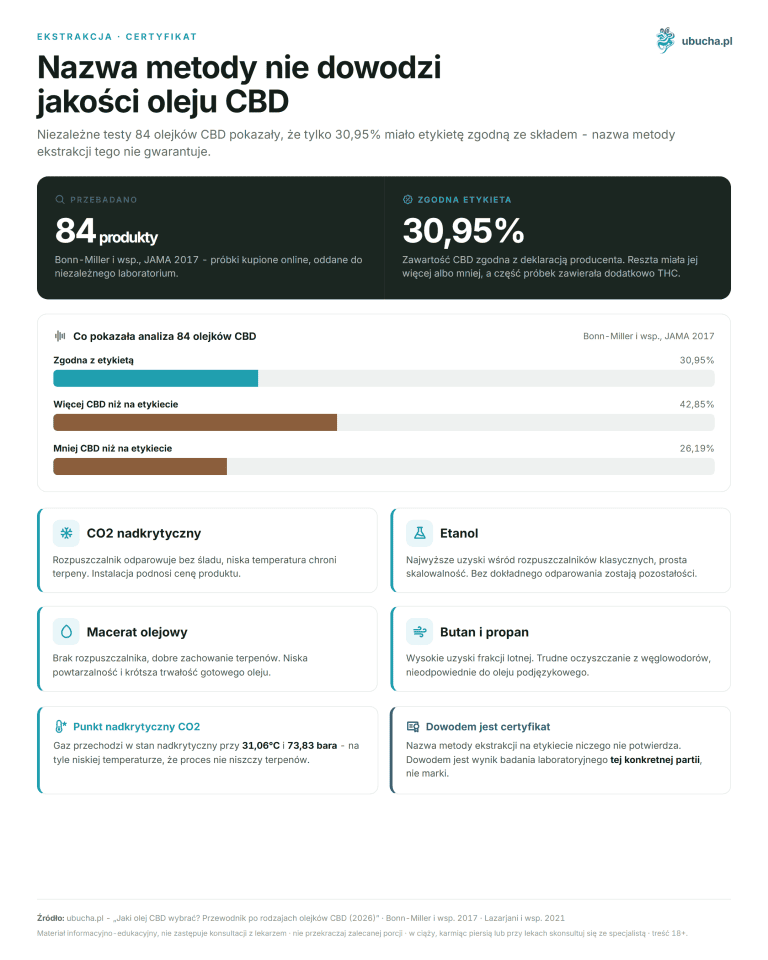
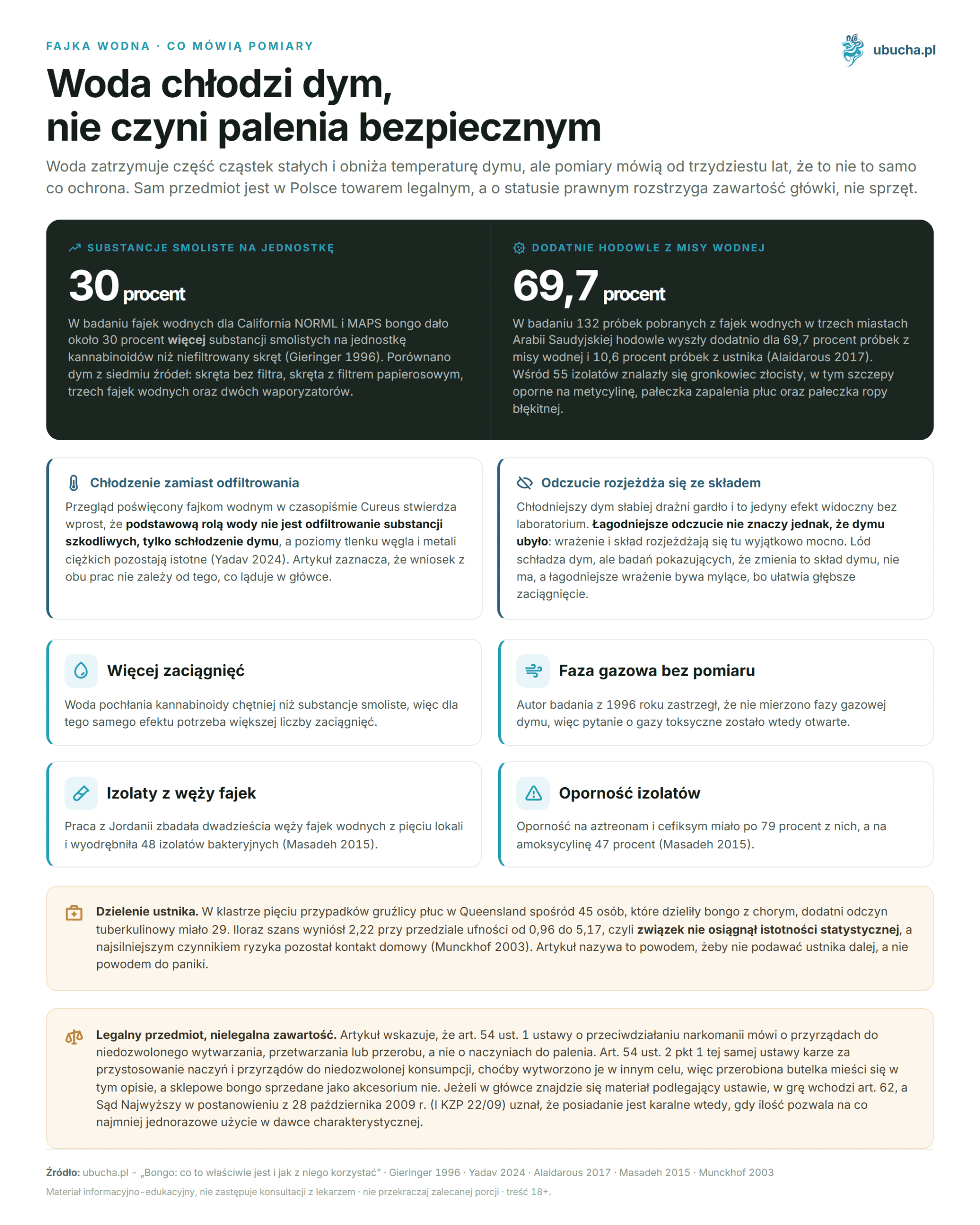
• Water filtration does not make smoking safe: in a study of water pipes for California NORML and MAPS, bongs produced about 30 percent more tar substances per unit of cannabinoids than unfiltered joints (Gieringer 1996)
• A review in the journal Cureus states directly that the primary role of water is not to filter harmful substances but to cool the smoke (Yadav 2024)
• In 132 samples from water pipes, bacteria were cultured from 69.7 percent of samples from the water bowl and 10.6 percent of samples from the mouthpiece (Alaidarous 2017)
• In a cluster of five cases of pulmonary tuberculosis in Queensland, 29 out of 45 people sharing a bong with an infected person had a positive tuberculin test, but the odds ratio of 2.22 with a confidence interval of 0.96 to 5.17 did not reach statistical significance (Munckhof 2003)
What is a bong and what is it made of?
A bong is a water pipe in which the smoke from the burned material passes through water before reaching the mouthpiece. It is distinguished from a regular pipe by its water chamber, and from a shisha by the fact that the material is burned directly rather than being heated by charcoal placed above it.
Today, borosilicate glass is most commonly found, less often acrylic, ceramic, and silicone. Glass does not impart flavor and easily shows how much residue has built up inside, but it can break upon impact and with sudden temperature changes. Silicone withstands drops but is opaque, so the condition of the interior is only assessed after disassembly.
The construction is the same in every model; only the number of accessories changes:
| Element | What it does | What to watch out for |
|---|---|---|
| Water chamber | Holds water through which the smoke passes; cools it and retains some solid particles | The water should cover the downstem’s exit but not reach high in the tube |
| Downstem | Tube leading smoke from the bowl below the water’s surface | Removable element where residue accumulates the fastest |
| Bowl | Cup for plant material, set in the downstem | Burnt residue changes flavor on the next use |
| Kicker | Hole covered by a finger; uncovering it lets air in and empties the tube | In some models, it is replaced by removing the bowl |
| Percolator | Additional chamber breaking the smoke into smaller bubbles | Difficult to clean due to many narrow crevices |
| Ice catcher | Narrowing of the tube where ice cubes rest | Cools the smoke but does not change its composition |
| Mouthpiece | End of the tube through which the smoke is inhaled | Contact point with the mouth, so it should not be shared without cleaning |
How does a bong work and what happens inside?
It works on a vacuum principle. Inhaling air through the mouthpiece lowers the pressure in the tube, so air is drawn through the bowl, pulling through the smoldering material and descending through the downstem below the water’s surface. There, the stream breaks into bubbles and rises, transferring heat to the water.
The smaller the bubbles, the greater the surface area of the smoke in contact with the water, and this is the entire idea behind percolators. Cooler smoke irritates the throat less, and that is the only effect that can be observed without a laboratory. However, a milder sensation does not mean that less smoke is present: the perception and composition diverge significantly here.
The water level is set dry, before the first use. The water should cover the downstem’s exit; otherwise, the smoke bypasses the bubbling, but it cannot reach high in the tube, as a stronger pull will bring it to the mouthpiece. The kicker is used to empty the tube at the end: when covered by a finger, it maintains the flow through the bowl; when uncovered, it lets in fresh air. The volume of the tube itself determines how much smoke will accumulate before inhalation; a larger model does not change the smoke’s composition, only the amount taken at once.
Is a bong legal in Poland?
The object itself is. The Act on Counteracting Drug Addiction penalizes in Article 54, paragraph 1 for the manufacture, possession, storage, sale, or acquisition of devices if the circumstances indicate that they are used for illegal production, processing, or alteration of narcotic substances. A bong is not used to produce anything, only to smoke, so this provision does not apply to it.
Paragraph 2, point 1 of the same article sounds different, as it mentions the adaptation of vessels and devices for illegal consumption, even if they were created for another purpose. A modified bottle or can fits this description; a store-bought bong sold as an accessory does not. The full text of both provisions is available in the consolidated text of the act.
Thus, the legal status is determined by the content, not the object. If the bowl contains material subject to the act, Article 62 comes into play, and the Supreme Court in the ruling of October 28, 2009 (I KZP 22/09) stated that possession is punishable when the amount allows for at least one-time use in a characteristic dose. Residue in uncleaned equipment is often assessed through this lens, and this is a practical reason to clean the equipment.
Does water filtration make smoking safer?
No, and measurements have been saying this for thirty years. In a study of water pipes conducted for California NORML and MAPS (Gieringer 1996), smoke from seven sources was compared: unfiltered joint, joint with a cigarette filter, three water pipes, and two vaporizers. The bong performed worse than the unfiltered joint, producing about 30 percent more tar substances per unit of cannabinoids.
The mechanism is simple and unpleasant: water absorbs cannabinoids more readily than tar substances, so for the same effect, one has to take more puffs. The author noted that the gaseous phase of the smoke was not measured, so the question of toxic gases was left open.
A later review dedicated to water pipes in the journal Cureus (Yadav 2024) puts it even more simply: the primary role of water is not to filter harmful substances but to cool the smoke, and levels of carbon monoxide and heavy metals remain significant. The methods themselves are compared in a separate compilation of what is least harmful. The conclusion from both works is the same and does not depend on what goes into the bowl: water changes the sensation during inhalation, not the composition of what enters the lungs.
What grows in the water of a bong?
Bacteria, and faster than intuition suggests. In a study of 132 samples taken from water pipes in three cities in Saudi Arabia (Alaidarous 2017), cultures were positive for 69.7 percent of samples from the water bowl and 10.6 percent of samples from the mouthpiece. Among 55 isolates were Staphylococcus aureus, including methicillin-resistant strains, pneumonia bacillus, and Pseudomonas aeruginosa.
An earlier study from Jordan (Masadeh 2015) examined twenty water pipe hoses from five establishments and isolated 48 bacterial strains. Resistance to aztreonam and cefixime was found in 79 percent of them, and to amoxicillin in 47 percent.
Sharing the mouthpiece adds a separate risk. In a cluster of five cases of pulmonary tuberculosis in Queensland (Munckhof 2003), among 45 people who shared a bong with an infected person, 29 had a positive tuberculin test. The odds ratio was 2.22 with a confidence interval of 0.96 to 5.17, meaning the association did not reach statistical significance, and the strongest risk factor remained household contact. This is a reason not to pass the mouthpiece around, not a reason for panic.
How to clean a bong and how often?
The water should be changed after each use, not once a week. This is the only procedure that realistically limits what was shown in the cultures from the water bowl and takes less time than refilling the equipment. Standing water with sediment is a breeding ground, not a filter.
The equipment itself is cleaned with warm water, coarse salt, and isopropyl alcohol: the salt acts as an abrasive, and the alcohol dissolves the resin. Glass should not be poured with boiling water, as the sudden temperature change can shatter it, and silicone should not be scrubbed with a wire brush. The bowl and downstem are removed and cleaned separately, as residue accumulates there the fastest. Fresh deposits come off immediately, while dried layers require soaking for several minutes. Step by step, this is described in the cleaning and maintenance guide for bongs.
A carbon filter in the mouthpiece is sometimes advertised as a solution to the problem, but that is a separate issue and separate data collected in the text about carbon filters. If you are considering another type of equipment, types and materials are compared in the guide on pipes and bowls, and the models themselves are listed in the bong category.
Frequently Asked Questions
How does a bong differ from a shisha?
By the method of heating. In a bong, the material is burned directly by fire, while in a shisha, it is heated by charcoal placed above the bowl. Therefore, carbon monoxide measurements from water pipes for tobacco do not directly transfer to bongs: a large part of that gas comes from the charcoal itself.
Does the water in a bong retain THC?
Yes, and that is the problem. A study of water pipes for California NORML and MAPS from 1996 showed that water absorbs cannabinoids more readily than tar substances, resulting in bongs producing about 30 percent more tar substances per unit of cannabinoids than an unfiltered joint.
How often should you change the water in a bong?
After each use. In a study of 132 samples from water pipes, bacteria were cultured from 69.7 percent of samples taken from the water bowl, and standing water with sediment is a breeding ground for them. Changing the water takes less time than refilling the equipment.
Is it legal to buy a bong in Poland?
Yes. The provision regarding devices in Article 54, paragraph 1 of the Act on Counteracting Drug Addiction concerns the illegal production, processing, or alteration of narcotic substances, not smoking vessels. The legal status is determined by what goes into the bowl, not the object itself.
What should I use to clean a bong?
Warm water with coarse salt and isopropyl alcohol: the salt acts as an abrasive, and the alcohol dissolves the resin. Glass should not be poured with boiling water, as the sudden temperature change can shatter it. The bowl and downstem are cleaned separately, as residue accumulates there the fastest.
Does ice in a bong make a difference?
It cools the smoke, making it less irritating to the throat. There are no studies showing that it changes the composition of the smoke, and the milder sensation can be misleading, as it facilitates deeper inhalation. The ice catcher is a convenience, not a safeguard.
This article is for informational and educational purposes only and does not constitute legal advice. The legal status described in the article is valid as of the publication date: regulations regarding cannabis may change. Consult a lawyer or current legal acts before making a decision.
Author: Michał Waluk · Published: 2026-08-24 · Updated: 2026-08-24