
CBN for Sleep: New Cannabinoid or Just Hype? What Studies Say 2026
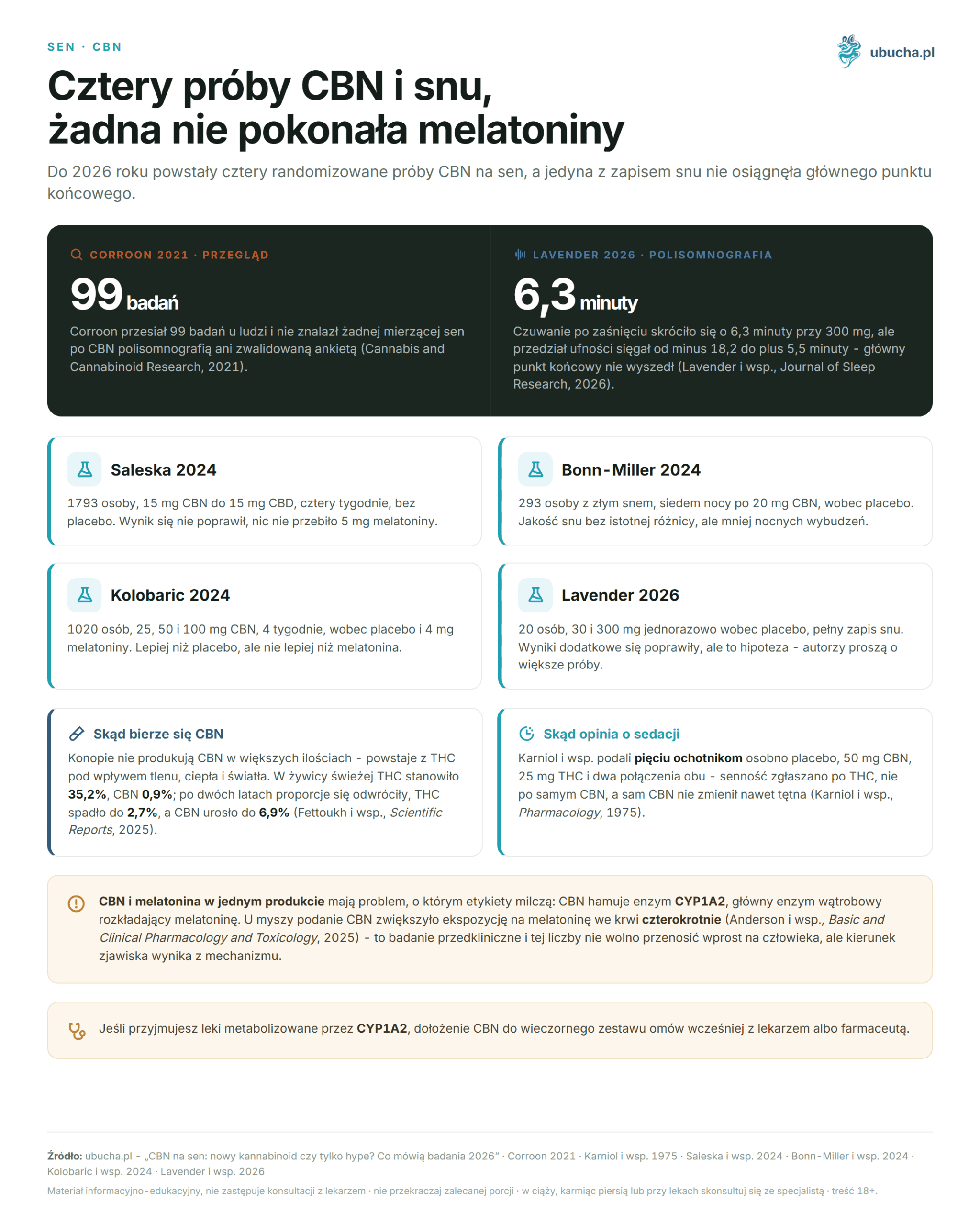
CBN for sleep has four studies in humans from 2024-2026. None showed an advantage over melatonin, and the trial with polysomnography did not achieve its goal.
CBN, or cannabinol, has been marketed for several years as the “sleep cannabinoid.” As of 2021, there was not a single clinical study that tested this description with sleep recording or validated surveys. By 2026, four randomized trials involving humans have been published, allowing for data-driven answers rather than analogies to THC or results from rodents. The answer is more modest than the labels suggest: in none of these trials did CBN perform better than a standard melatonin tablet, and the study with the most rigorous measurement did not achieve its primary endpoint. Below, we break down these four trials: who conducted them, at what doses, and what exactly was measured.
KEY INFORMATION
• Corroon’s review (Cannabis and Cannabinoid Research, 2021) sifted through 99 studies in humans and found no trial measuring sleep after CBN with polysomnography.
• The first such trial (Lavender et al., Journal of Sleep Research, 2026) did not reach its primary endpoint.
• In two large trials, CBN did not perform better than 4-5 mg of melatonin.
• The opinion about sedation comes from a 1975 study on five people, in which CBN alone did not induce sleep.
• CBN is formed from the oxidation of THC, so its presence mainly indicates the age of the raw material.
Where does CBN in sleep products come from?
CBN is not a compound that cannabis produces in larger quantities. It is formed from THC under the influence of oxygen, heat, and light, so its concentration increases with the age of the raw material. This is well demonstrated by a study that had nothing to do with sleep: Fettoukh et al. (Scientific Reports, 2025) analyzed 150 samples of cannabis resin secured by the Moroccan gendarmerie and stored for up to eight years using gas chromatography. In fresh material, THC constituted 35.2%, and CBN 0.9%. After two years of aging, the proportions reversed: THC dropped to 2.7%, and CBN rose to 6.9%.
This one relationship explains most misunderstandings surrounding cannabinol. A high CBN content in a sample is not a feature of the strain or a credit to the grower. It is a record of storage history: how many months the material has been stored and under what conditions. The authors of that study used this directly, building a regression model that predicts the aging time of a sample from the cannabinoid profile with a coefficient of determination of 0.99, for forensic purposes.
A producer who wants to put a specific number of milligrams of CBN on the label has three options. They can start with old plant material, deliberately oxidize THC under controlled conditions, or purchase an isolate obtained through chemical conversion. None of these is what the word “plant-based” on the packaging suggests, and none is a problem in itself. The problem arises when conclusions about its effects on sleep are drawn from the origin of the molecule. That is a separate question and has a separate answer.
Where did the opinion that CBN induces sleep come from?
From one study in 1975 on five volunteers. Karniol and colleagues administered them orally, at weekly intervals, five different substances: placebo, 50 mg of CBN, 25 mg of THC, and two combinations of both substances. After CBN alone, the participants did not report drowsiness or intoxication. They reported it after THC, and most strongly after THC given together with cannabinol (Karniol et al., Pharmacology, 1975).
This is the opposite of what marketing claims. In that experiment, cannabinol did not induce sleep on its own; it only enhanced the effect of THC, and to a degree that the authors themselves assessed as small. Their conclusion was that such an interaction does not explain the greater potency of the plant material. No one studied sleep at that time. Heart rate, pain threshold, and time perception were measured, and feelings were collected from a list of 66 adjectives. CBN alone did not even change heart rate, which increased after THC.
The second hypothesis suggests that the sedation attributed to old extracts was due to terpenes that remained in them. Russo (British Journal of Pharmacology, 2011) gathered arguments that myrcene and linalool have their own calming effects, independent of cannabinoids. The author himself speaks of this synergy conditionally, as something that still requires proof, and proposes methods to study it. This remains a hypothesis, not a result of an experiment separating both components in humans. We discuss these compounds further in the text Terpenes in CBD.
The scale of the phenomenon is real. In a survey of 1523 adult Americans, representative of 97% of households, 4.5% of respondents had ever used CBN, with a confidence interval of 3.7% to 5.6%. The most commonly cited medical reason was insomnia, with 15.4% of mentions (Satybaldiyeva et al., Journal of Cannabis Research, 2025).
How many CBN studies in humans are there in 2026?
Four randomized trials, all from 2024-2026. Previously, not a single one had assessed sleep with a proper tool. Corroon’s review sifted through the abstracts of 99 studies in humans, read eight full papers meeting the criteria, and found none measuring sleep with polysomnography or validated sleep surveys (Corroon, Cannabis and Cannabinoid Research, 2021). The author noted that most available studies on CBN come from the 1970s and 1980s, on small and poorly diversified groups.
Four trials are still very few for a substance that has been sold for years as a sleep aid. The following table shows exactly what was measured in them and what the results were.
| Study | Participants | Dose and Duration | Reference Group | Sleep Measurement | Primary Outcome |
|---|---|---|---|---|---|
| Saleska et al., 2024 | 1793 | 15 mg, 4 weeks | CBD isolate, no placebo | PROMIS survey | Adding CBN to CBD did not improve the outcome |
| Bonn-Miller et al., 2024 | 293 | 20 mg, 7 nights | placebo | survey | sleep quality with no significant difference compared to placebo |
| Kolobaric et al., 2024 | 1020 | 25, 50, and 100 mg, 4 weeks | placebo and 4 mg melatonin | PROMIS survey | improvement compared to placebo, no advantage over melatonin |
| Lavender et al., 2026 | 20 | 30 and 300 mg, one night | placebo | polysomnography | wakefulness after falling asleep unchanged |
The column with the reference group deserves special attention, as it is often overlooked. Only three of the four trials had a placebo. The largest, involving 1793 people, had no placebo arm at all: all six tested capsules contained an active substance, and the reference point was CBD isolate. Additionally, three of the four trials based sleep measurement solely on a survey filled out by the participant, and two were built around a specific commercial preparation from one manufacturer. This does not invalidate the results, but it requires caution, as surveys also capture the participant’s expectations, and placebo in sleep studies usually performs strongly.
What did the CBN study with polysomnography show?
That CBN did not shorten the time awake after falling asleep. In the CUPID trial, twenty people diagnosed with insomnia by a doctor took 30 mg of CBN, 300 mg of CBN, and placebo in random order, each time for one night under full sleep recording, with a two-week break between them. The primary endpoint was not met at any dose: wakefulness after falling asleep was shortened by 6.3 minutes at 300 mg, with a confidence interval from minus 18.2 to plus 5.5 minutes, which includes zero (Lavender et al., Journal of Sleep Research, 2026).
Additional results look more interesting. At 300 mg, sleep in NREM-2 stage increased, the time to fall asleep shortened, the rate of awakenings visible in the EEG recording decreased, and the subjective quality of sleep improved. Participants reported a total of 247 adverse events of mild to moderate severity, counting all arms of the study together.
This is an honest reading of the data. Additional points in a study that did not meet the primary endpoint raise a hypothesis, not confirm it. The authors state this directly: larger and longer trials are needed. Also note at what dose anything moved. That is 300 mg at once, which is a multiple of what you would find in a gummy or a drop of oil marketed with the sleep cannabinoid slogan. At 30 mg, none of these effects were recorded.
Does CBN perform better than melatonin?
No study has shown this. In the Kolobaric et al. trial, 1020 people received CBN for four weeks at doses of 25, 50, or 100 mg, 4 mg of melatonin, or placebo. All active groups improved compared to placebo, but no dose of CBN performed better than melatonin (Kolobaric et al., Pharmaceuticals, 2024). This is the only trial that placed CBN, melatonin, and placebo side by side, so it is the only one that answers this question at all.
The second study from the same group involved 1793 people, also for four weeks. Adding 15 mg of CBN to 15 mg of CBD did not improve the outcome compared to CBD alone, and none of the combinations surpassed 5 mg of melatonin (Saleska et al., Journal of the American Nutrition Association, 2024). It is worth noting that nothing was compared to placebo here, as there was no placebo in this trial.
The third trial yielded mixed results. 293 people who rated their sleep as poor or very poor took 20 mg of CBN, either alone or with CBD, for seven nights. The primary endpoint, overall sleep quality, did not achieve statistical significance. However, two additional points emerged: fewer awakenings at night and a lower rate of sleep disturbances. The time to fall asleep, wakefulness after falling asleep, and daytime drowsiness did not change at all, and adding CBD did not improve anything (Bonn-Miller et al., Experimental and Clinical Psychopharmacology, 2024).
The common denominator of these trials is that CBN is somewhere around melatonin, never above it. Melatonin is a substance known for decades, with a well-described usage pattern, and it is the reference point here, not the other way around.
Is it worth combining CBN with melatonin in one product?
Such preparations are on the market, but they have a pharmacokinetic problem that the labels are silent about. CBN inhibits the CYP1A2 enzyme, which is the main liver enzyme that breaks down melatonin. In mice, the administration of cannabinol increased blood exposure to melatonin fourfold (Anderson et al., Basic and Clinical Pharmacology and Toxicology, 2025).
This is a preclinical study, and this number should not be directly transferred to humans. But the direction of the phenomenon follows from the mechanism, not from guessing. The same group previously described CBN’s inhibition of caffeine metabolism, which breaks down through the same pathway. The practical conclusion is simple: a product combining CBN with melatonin may act like a higher dose of melatonin, rather than two independent ingredients.
For someone who wanted melatonin anyway, this is not a disaster, just a loss of control over the dose. With melatonin, not only how much matters, but also at what time, and both of these variables are easier to set when you take it separately. How to do this is described in the text Melatonin for Sleep. If you are taking medications metabolized by CYP1A2, discuss adding CBN to your evening regimen with your doctor or pharmacist.
Does the CBN dose on the label correspond to the doses in studies?
Rarely. Corroon noted that products sold for sleep usually contain up to 5 mg of CBN per serving, and directly recommended that future studies use much higher doses. The trials that have emerged since then have done just that: 15, 20, 25, 50, 100, and 300 mg.
The difference can be sixtyfold. The signals that did appear came at 20 mg and above, and in sleep recording only at 300 mg. A label with 5 mg does not replicate any of these conditions, even if the stated number is accurate.
A separate question is whether it is accurate. No study has been published checking the compliance of declarations with actual content for CBN, as has been done for CBD oils and flower. The only thing you can verify yourself is the certificate of analysis for a given batch from an external laboratory, stating the CBN content in milligrams per serving. Without this document, the number on the package remains a manufacturer’s declaration, not a measurement. What else to look for on the label is detailed in the text How to Read a Dietary Supplement Label.
What has stronger foundations than CBN if you want to sleep better?
A structured evening, and among preparations, melatonin. It has decades of research behind it and a clear usage pattern, and in the only trial that placed CBN, melatonin, and placebo side by side, it performed better than placebo, while no dose of cannabinol performed better than it.
Before you start looking for another molecule, check the conditions under which it would work. A consistent wake-up time, even on weekends. A bedroom cooler than the rest of the house. No caffeine in the afternoon and an evening without a bright screen. This is boring, free, and strikes at the cause, not the symptom. Our experience with reader questions is that people reaching for exotic cannabinoids usually have not yet gone through this stage.
If you are interested in the cannabinoid part of the puzzle, a better-documented starting point is CBD, which we discuss in the text Does CBD Help with Sleep. It has more studies and a clearer safety profile than cannabinol.
So the answer to the titular question is this: CBN is not a scam; it is a poorly studied substance sold in doses lower than those that have been tested, and without proven superiority over an alternative known for a long time. That is not enough to start with it.
Frequently Asked Questions
Does CBN help with sleep?
The data is weak. By 2026, four randomized trials of CBN in humans have been published. The only one with sleep recording (Lavender et al., Journal of Sleep Research, 2026, 20 people) did not reach its primary endpoint, meaning it did not shorten the time awake after falling asleep. The other three relied on surveys, and none showed an advantage of CBN over melatonin.
Does CBN work better than melatonin?
Not in any published study. In the trial Kolobaric et al. (Pharmaceuticals, 2024), 1020 people took CBN at doses of 25, 50, or 100 mg, 4 mg of melatonin, or placebo for four weeks. All active groups improved compared to placebo, but no difference between CBN and melatonin was found at any dose.
What dose of CBN was studied in clinical trials?
From 15 to 300 mg. Saleska et al. used 15 mg, Bonn-Miller et al. 20 mg, Kolobaric et al. 25, 50, and 100 mg, and Lavender et al. 30 and 300 mg. Corroon (2021) noted that commercial sleep products usually contain up to 5 mg of CBN per serving, which is less than any of the studied doses.
Does CBN induce sleep on its own, without THC?
In the study that started this opinion, it did not induce sleep. Karniol et al. (Pharmacology, 1975) administered five volunteers sequentially placebo, 50 mg of CBN, 25 mg of THC, and two combinations of both substances. Drowsiness and intoxication were reported after THC and the combinations, not after CBN alone. The effect attributed to cannabinol was a mixture effect.
Did all CBN studies have a placebo group?
No. The largest of the four trials, involving 1793 people, compared six preparations with an active substance, and the reference point was CBD isolate. Only three of the remaining trials had a placebo. The statement ‘four placebo-controlled trials’ is therefore false and should be kept in mind when reading summaries.
Is CBN safe?
Short-term, it appears to be well tolerated, but data is limited. In four-week trials with doses up to 100 mg, the frequency of adverse events did not differ from placebo. In a trial with 300 mg in one night, 247 events of mild to moderate severity were recorded across all arms. There is no data beyond a few weeks of use.
Where does CBN in products come from?
From the oxidation of THC. Cannabis does not produce CBN in larger quantities; it is formed from THC under the influence of oxygen, heat, and light. In resin stored for two years, THC dropped from 35.2% to 2.7%, while CBN increased from 0.9% to 6.9% (Fettoukh et al., Scientific Reports, 2025). Producers use old material, deliberate oxidation, or chemical conversion.
u Bucha’s store, there are no products with CBN, so we have nothing to sell you under this term. Evening support with stronger foundations can be found in the supplements section.
This article is for informational and educational purposes and does not constitute medical advice. Before starting to use cannabis or CBD for therapeutic purposes, consult your doctor, especially if you are taking other medications, are pregnant, or breastfeeding.
Author: Michał Waluk · Published: 2026-06-22 · Updated: 2026-08-15