
Omega-3 properties and dosage: when is it really worth taking capsules
How much EPA and DHA to take daily, how to calculate the dose from the label, and what large omega-3 studies have really shown. Interactions with medications, limits, and supplement selection.
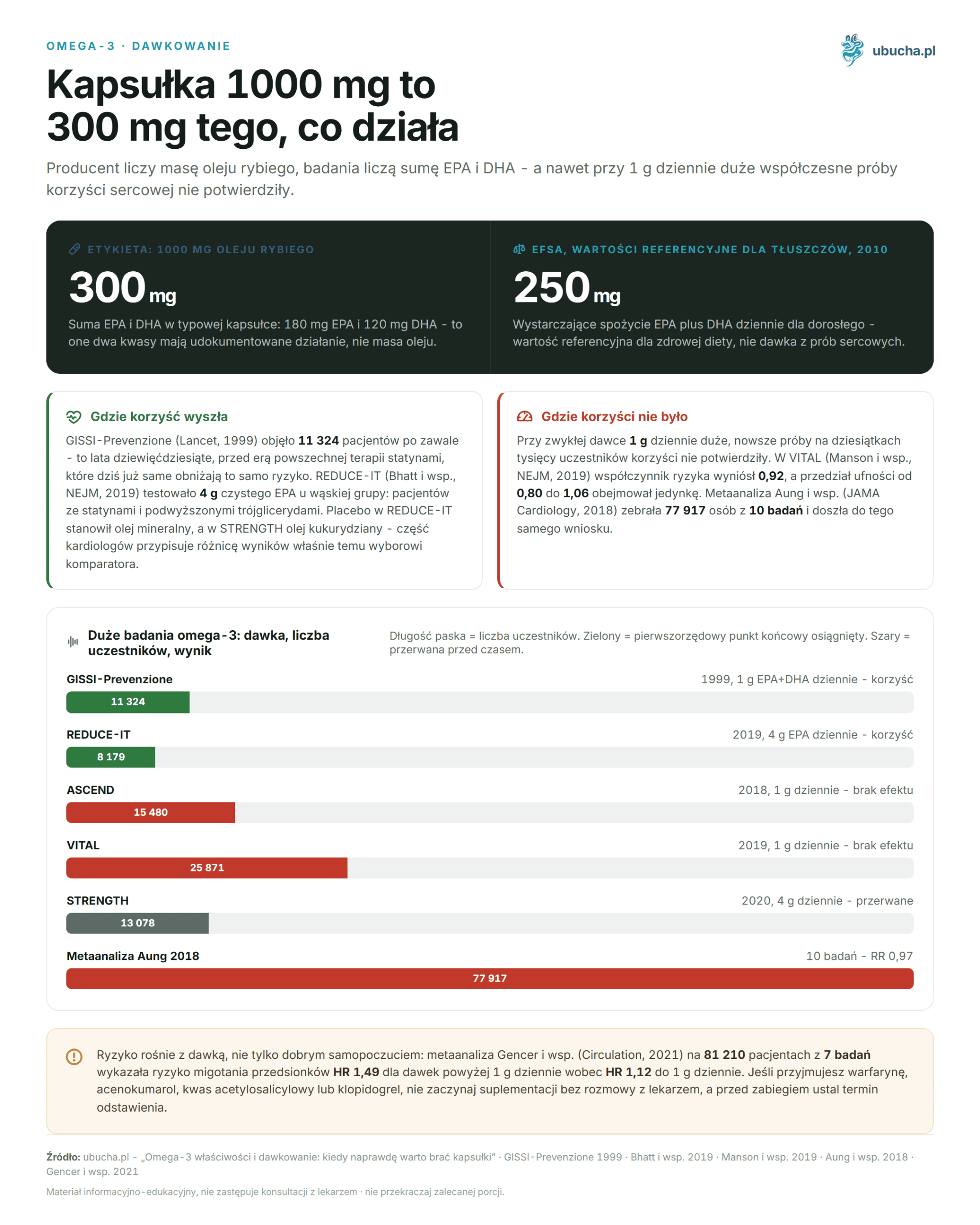
A capsule described as 1000 mg of fish oil usually provides about 300 mg of EPA and DHA, and it is these two acids that have documented effects. This one number explains why many people supplement omega-3 for years without effect: they take three times less than they think. Another thing that marketing is silent about is the discrepancy between studies. The first large clinical trials looked spectacular, while newer, much larger ones did not confirm cardiovascular benefits at a dose of 1 g daily. The reference point is official, not marketing: EFSA has set a sufficient intake for adults at 250 mg of EPA plus DHA daily. In this text, we show what exactly individual studies have demonstrated, how to calculate the dose from the label, and when omega-3 interferes with medications.
KEY INFORMATION
• Omega-3 supplementation did not reduce the risk of serious vascular events in a meta-analysis of 77,917 people from 10 large studies (Aung et al., JAMA Cardiology, 2018).
• EFSA: sufficient intake of 250 mg of EPA plus DHA daily for adults, and up to about 5 g daily from supplements without safety concerns.
• Doses above 1 g daily are associated with a higher risk of atrial fibrillation (Gencer et al., Circulation, 2021).
• The conversion of ALA from flaxseed to DHA reaches about 3.8 percent and halves with a diet rich in omega-6.
What are the differences between EPA, DHA, and ALA, and why does flaxseed not replace fish?
ALA from plants is a precursor, not a substitute. The body converts it to EPA at a few percent, and to DHA even less. EPA and DHA from fish and algae act directly, so they are responsible for the effects described in clinical studies.
The scale of this inefficiency is well measured. In a review of isotopic studies, Gerster (International Journal for Vitamin and Nutrition Research, 1998) reports a conversion of about 6 percent to EPA and 3.8 percent to DHA with a diet rich in saturated fats, while a diet rich in omega-6 reduces it by 40-50 percent. Burdge and Calder (Reproduction Nutrition Development, 2005) add that the conversion to EPA is limited in men, and further conversion to DHA is very low; in women, the fraction of processed ALA is higher, probably due to estrogen.
The practical consequence concerns DHA. It is the dominant fatty acid in neuronal membranes and the retina, and its reserves can only be realistically supplemented with ready-made forms, from fish or microalgae. EPA behaves differently: it participates in the resolution of inflammation, and its high doses have been studied in cardiology. Increasing flaxseed portions will not replace either of them, although it itself improves the omega-6 to omega-3 ratio in the diet.
Does omega-3 really protect the heart?
The answer is: at a dose of 1 g daily, probably not, and at 4 g of pure EPA in a narrow group of patients, probably yes. The marketing of supplements is based on two studies with favorable outcomes and ignores four large trials that did not show benefits.
GISSI-Prevenzione (Lancet, 1999) included 11,324 patients after a heart attack, and at 1 g of EPA plus DHA daily, it reduced the risk of death by 20 percent and cardiovascular death by 30 percent in a four-arm analysis. This study from the 1990s was conducted before the era of widespread statin therapy. REDUCE-IT (Bhatt et al., New England Journal of Medicine, 2019) administered 4 g of ethyl ester EPA to patients on statins and with elevated triglycerides: the primary endpoint event occurred in 17.2 percent of treated patients compared to 22.0 percent on placebo.
Newer trials have yielded different results. In the VITAL (Manson et al., New England Journal of Medicine, 2019) study involving 25,871 participants taking 1 g daily, the risk ratio for serious cardiovascular events was 0.92, and the confidence interval from 0.80 to 1.06 included one. ASCEND in 15,480 people with diabetes yielded a result of 0.97. STRENGTH with 4 g daily in 13,078 patients was prematurely stopped due to a low chance of demonstrating benefits. A meta-analysis Aung et al. (JAMA Cardiology, 2018) gathered 77,917 people from 10 studies and found no association between supplementation and serious vascular events (RR 0.97). It is worth noting that the placebo in REDUCE-IT was mineral oil, and in STRENGTH, corn oil, and some cardiologists attribute the difference in results to this choice of comparator.
How much omega-3 should I take daily and how to calculate the dose from the label?
The EFSA reference value for adults is 250 mg of EPA plus DHA daily, which is roughly two servings of fatty fish per week; the cardiovascular studies on which it is based included a range of 250-500 mg. Higher amounts are for the doctor, as this is already a pharmacological level, not a nutritional one.
The biggest trap is the arithmetic of the label. The manufacturer provides the mass of fish oil, but the sum of EPA and DHA counts. A typical 1000 mg capsule contains 180 mg of EPA and 120 mg of DHA, which is 300 mg of what works. Concentrates with 60-90 percent content allow fitting the same amount in one capsule instead of four. Calculating the portion from the label to the sum of EPA plus DHA can be surprising for the reader, as the numbers on the packaging and the numbers from studies describe two different things.
| What it concerns | Reference value | Who established it |
|---|---|---|
| Sufficient intake for an adult | 250 mg EPA plus DHA | EFSA, reference values for fats, 2010 |
| Pregnancy and breastfeeding | an additional 100-200 mg DHA | EFSA, reference values for fats, 2010 |
| Treatment of very high triglycerides | prescription preparations, 4 g daily | AHA, Circulation, 2019 |
| Amount from supplements without safety concerns | up to about 5 g daily for adults | EFSA, opinion on upper intake levels, 2012 |
In cases of very high triglycerides, a dose of 4 g daily reduces them by at least 30 percent according to the American Heart Association’s position (Circulation, 2019). This is treatment for a lipid disorder, not prevention for a healthy person.
When can omega-3 be harmful and which medications should be approached with caution?
Omega-3 is not neutral above nutritional doses. Two signals are well documented: an increased risk of atrial fibrillation at high doses and an effect on coagulation, which is significant for people taking anticoagulant and antiplatelet medications.
A meta-analysis Gencer et al. (Circulation, 2021) included 81,210 patients from 7 studies and showed an increased risk of atrial fibrillation with marine omega-3 supplementation (HR 1.25). The relationship increases with dose: for trials with doses above 1 g daily, HR was 1.49, and for doses up to 1 g, 1.12. REDUCE-IT itself recorded hospitalizations due to atrial fibrillation or flutter in 3.1 percent of treated patients compared to 2.1 percent on placebo.
The issue of bleeding requires separating two things. EFSA in its 2012 opinion concluded that supplements providing up to about 5 g of EPA plus DHA daily do not raise safety concerns for adults and are not associated with an increase in spontaneous bleeding. It is different with medications: omega-3 inhibits platelet aggregation, and in REDUCE-IT, serious bleeding occurred in 2.7 percent of treated patients compared to 2.1 percent on placebo, with the difference not reaching statistical significance. If you are taking warfarin, acenocoumarol, acetylsalicylic acid, or clopidogrel, do not start supplementation without consulting your doctor, and before a planned procedure, establish a cessation date. The same applies to individuals with a history of atrial fibrillation.
Which omega-3 effects are well proven, and which are weak?
Evidence is unevenly distributed. The strongest relates to lowering triglycerides and pregnancy, the weakest to dementia prevention and dry eyes. The following summary organizes what emerges from large studies and systematic reviews, not from manufacturer materials.
| Application | Strength of evidence | What studies show |
|---|---|---|
| Lowering triglycerides | strong | decrease of at least 30 percent at 4 g daily |
| Reducing the risk of preterm birth | strong | RR 0.89 for birth before 37 weeks, 70 studies |
| Rheumatoid arthritis | moderate | 16 out of 20 trials with improvement in clinical points |
| Support for depression treatment | moderate | effective preparations with an advantage of EPA, 28 studies |
| Prevention of cardiac events, 1 g daily | weak | no effect in a meta-analysis of 77,917 people |
| Maintenance of remission in inflammatory bowel diseases | weak | Cochrane reviews: probably ineffective |
| Prevention of cognitive decline | weak | no benefits in AREDS2 |
In pregnancy, the data are the strongest in the entire set. A Cochrane review (Middleton et al., 2018) gathered 70 studies involving 19,927 women and showed a reduction in births before 34 weeks from 4.6 to 2.7 percent.
How does omega-3 affect the brain, mood, and memory?
DHA builds neuronal membranes, so its deficiency has developmental significance, but in a person without a deficiency, supplementation has not improved cognitive function in studies. The situation with depression is more interesting: supportive action is attributed to EPA, not DHA, and only as an adjunct to treatment.
A meta-analysis Martins (Journal of the American College of Nutrition, 2009) included 28 randomized trials and showed that effectiveness depends on the ratio: preparations with an advantage of EPA helped, while those dominated by DHA did not. The probable mechanism leads through inflammatory pathways, as depression has a documented inflammatory component. This is not a standalone therapy and does not replace psychiatric treatment.
With memory, results depend on the starting point. Yurko-Mauro et al. (Alzheimer’s and Dementia, 2010) administered 900 mg of DHA daily for 24 weeks to 485 people over 55 with age-related memory decline and noted improvement in associative learning and word recognition tests. In the AREDS2 (Chew et al., JAMA, 2015) study, where 1 g of omega-3 was administered for 5 years to older individuals treated ophthalmologically, and not selected due to memory issues, there was no cognitive benefit. Supplementation thus appears to be filling a deficiency rather than enhancing a healthy brain.
Does omega-3 reduce inflammation and speed up recovery?
The mechanism is real, but clinical effects can be more modest than expected. EPA and DHA are substrates for resolvins and protectins, mediators of inflammation resolution. This action is different from anti-inflammatory drugs, which block the formation of prostaglandins.
Calder (British Journal of Clinical Pharmacology, 2013) points out the dose threshold: in adults, the anti-inflammatory effect usually requires more than 2 g of EPA plus DHA daily, and there are few studies establishing the dose. In rheumatoid arthritis, the balance is favorable. A review Akbar et al. (Journal of Clinical Rheumatology, 2017) summarized 20 clinical trials, of which 16 showed improvement in disease parameters.
In inflammatory bowel diseases, the picture is the opposite of what is often repeated. A Cochrane review on Crohn’s disease (Lev-Tzion et al., 2014) deemed omega-3 probably ineffective in maintaining remission and noted more frequent diarrhea and upper gastrointestinal discomfort. An earlier review on ulcerative colitis, based on three trials with 138 patients, found no data supporting its use (Turner et al., 2007). In post-exercise recovery, the data are preliminary: Smith et al. (Clinical Science, 2011) administered 4 g daily for 8 weeks to nine healthy individuals aged 25-45 and observed a stronger anabolic response of muscles to insulin and amino acids. This involved nine participants, so treat this result as a hypothesis.
Fish, algae, or hemp seeds: which source and which supplement to choose?
If you eat fatty fish twice a week, you provide yourself with as much EPA and DHA as recommended by EFSA, and supplementation adds nothing. Supplementation makes sense with a fish-free diet, during pregnancy, and with a doctor’s indication. Vegans have one good option: oil from microalgae.
Geppert et al. (Lipids, 2005) administered 0.94 g of DHA from microalgae daily for 8 weeks to 104 vegetarians and raised the omega-3 index from 4.8 to 8.4 percent, while the level of EPA increased much less. This is an important practical piece of information: an algal preparation based solely on DHA supplements one of the two acids, so for indications dependent on EPA, look for a version containing both.
Hemp seeds and hemp seed oil provide ALA in an omega-6 to omega-3 ratio close to 3:1, which falls within the range that Gerster considers reasonable, not exceeding 4-6. This is a sensible element of a daily diet and a real improvement in the ratio of fatty acids, but not a source of EPA or DHA; we write about the seeds in the post on the nutritional values of hemp seeds. When choosing capsules, look at the sum of EPA plus DHA per serving, the purity certification such as IFOS or NSF, and freshness, as oxidized oil loses its effectiveness and causes a characteristic fishy taste. After opening, store the package in a cool place, as the taste of rancid oil is often the reason why supplementation ends after a few weeks.
Frequently asked questions
How much omega-3 should I take daily?
EFSA has set a sufficient intake for adults at 250 mg of EPA plus DHA daily, and cardiovascular studies on which it is based included a range of 250-500 mg. Prescription preparations at a dose of 4 g for very high triglycerides are for the doctor. Count the sum of EPA plus DHA from the label, not the mass of fish oil: a 1000 mg capsule usually contains about 300 mg of what works.
Does ALA from flaxseed and chia replace EPA and DHA from fish?
No. The conversion reaches about 6 percent to EPA and 3.8 percent to DHA, and a diet rich in omega-6 reduces it by 40-50 percent (Gerster, 1998). Flaxseed, chia, and hemp seeds are valuable, but do not provide ready-made EPA or DHA.
Does omega-3 interact with anticoagulant medications?
Yes, and this is the most important warning in this text. Omega-3 inhibits platelet aggregation, so if you are on warfarin, acenocoumarol, or clopidogrel, inform your doctor. In REDUCE-IT, serious bleeding occurred in 2.7 percent of treated patients compared to 2.1 percent on placebo, although the difference was not statistically significant. Before any procedure, establish a cessation date.
When is the best time to take omega-3?
With a meal containing fat. Lawson and Hughes (BBRC, 1988) showed an increase in EPA absorption from triglycerides from 69 to 90 percent, and ethyl esters about threefold. The time of day has no documented significance; regularity and the presence of fat in the meal matter.
Does omega-3 from fish contain mercury?
Mercury accumulates in the muscles of fish, not in the fat, so fish oil contains much less than the flesh of predatory fish. IFOS and NSF certifications confirm heavy metal content below standards. Raw material from sardines or anchovies is safer in this regard than from tuna.
Does omega-3 help with dry eyes?
The DREAM study (New England Journal of Medicine, 2018) administered 3000 mg of EPA plus DHA for 12 months and did not show an advantage over placebo with olive oil. Earlier, smaller trials were more favorable, so the evidence remains conflicting, and omega-3 does not replace ophthalmic treatment.
If you are looking for a product with a measurable content of EPA and DHA, start with the label, not the slogan on the package. The current assortment can be found in the supplements category, and we write more broadly about nutritional gaps in plant-based diets in the post supplements for vegetarians and vegans.
This article is for informational and educational purposes and does not constitute medical advice. Before starting supplementation, consult your doctor, especially if you are taking medications regularly, are pregnant or breastfeeding, or have chronic illnesses.
Author: Michał Waluk · Published: 2026-06-22 · Updated: 2026-08-11