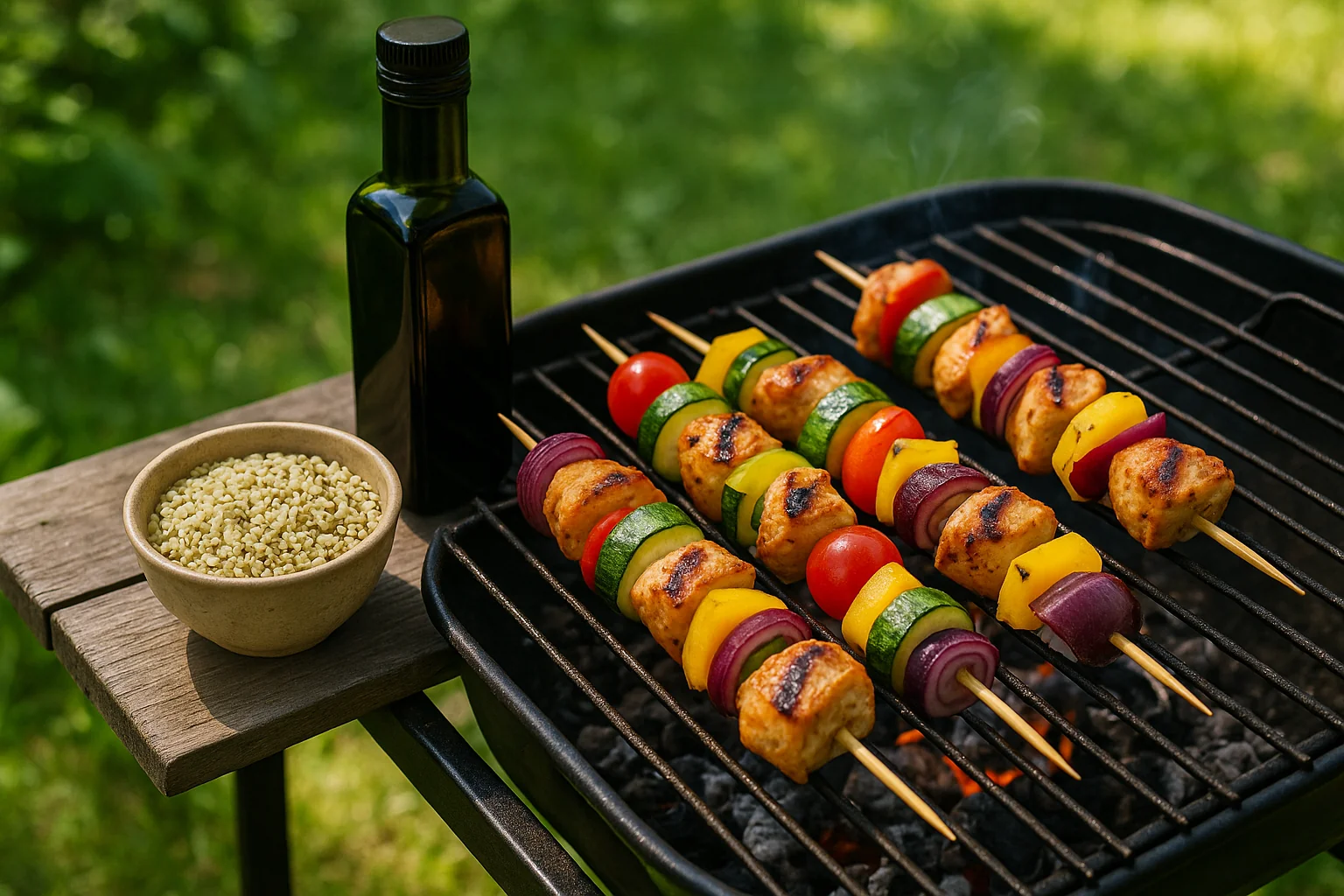

Hemp Grill - Marinades and Additions with Seeds and Oil
Grilling marinades with hemp oil and hemp seeds: 6 recipes, marinating times, why hemp oil does not withstand the grill, and cold additions to meat.
The grilling season starts with a marinade, and hemp oil brings something that olive oil does not: a predominance of polyunsaturated fatty acids and a distinctly nutty aroma. However, this same advantage is its weakness over fire. Polyunsaturated fatty acids oxidize faster than saturated ones, and cold-pressed oil has not undergone refining, which increases heat resistance. Poured onto heated cast iron, it loses its fatty acid profile and becomes bitter, so its place is in cold marinades and on the plate just before serving. Hemp seeds behave exactly the opposite: they withstand high temperatures well and create a crunchy crust on the meat. Below are six marinades and additions that play on this difference, with marinating times and proportions for four servings.
KEY INFORMATION
• Polyunsaturated fatty acids make up 70% to over 80% of the fatty acids in hemp oil (Farinon et al., Nutrients, 2020), hence its sensitivity to heat.
• Hemp oil goes into cold marinades and as a finishing touch, never on the grill.
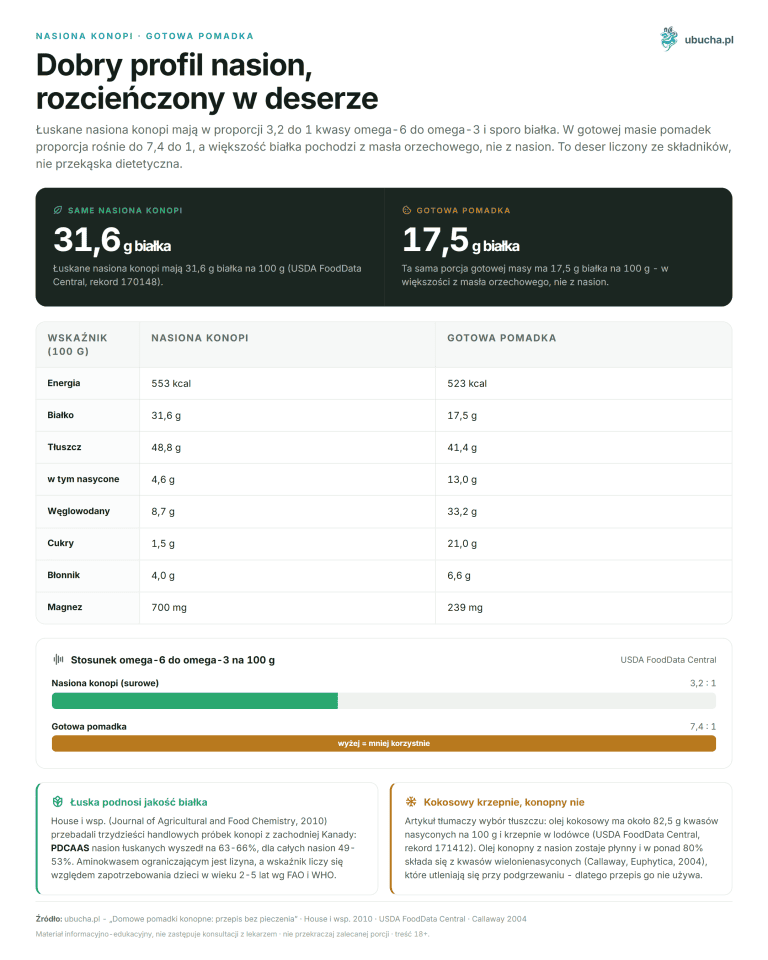
• Hulled hemp seeds: 31.6 g of protein per 100 g (USDA FoodData Central, record 170148).
• Seeds in the marinade replace breadcrumbs, as they themselves create a crunchy layer.
Why shouldn’t hemp oil be poured onto the grill?
Because it is the fat most susceptible to oxidation of everything that stands by the grill. A review by Farinon et al. (Nutrients, 2020) gathered analyses of many varieties and states that hemp seed oil contains up to 90% unsaturated fatty acids, of which 70% to over 80% are polyunsaturated. The more double bonds, the faster the fat reacts with oxygen at high temperatures.
Additionally, there is the method of production. Hemp oil is sold cold-pressed and unrefined, and it is precisely refining that removes free fatty acids and residual pulp from the oil, which are the fractions that smoke first over fire. Canola oil from the shelf next to it is refined and therefore withstands the pan, even though it also has a lot of polyunsaturated fatty acids. It is a difference in processing, not in the type of plant.
In a cold marinade, the same oil works to your advantage. At refrigerator temperature, it remains liquid, while olive oil thickens, so it covers the surface more evenly and penetrates between the fibers more easily, carrying dissolved aromas of garlic and spices. After removing the meat from the heat, you return to it a second time. A teaspoon of fresh oil on a hot fillet evaporates some of the aroma and smells stronger than everything you added earlier.
Hemp seeds are a completely different story. Their shell is thermally resistant, and the nutty flavor deepens when grilled. The seeds stick to the moist surface of the meat or fish and toast into a crunchy layer, which is normally achieved with breadcrumbs. Two tablespoons of topping per serving, or about 20 g, also add about 6 g of plant protein.
Which hemp marinade to choose for meat and fish?
For chicken, use the basic lemon-garlic marinade with overnight marination, and for salmon, the lime version with ginger and a maximum of an hour in the fridge. The difference arises from the structure of the protein: the delicate fibers of fish are coagulated by acid much faster than poultry meat.
| Marinade or addition | Fat base | Time | For what |
|---|---|---|---|
| Lemon-garlic | 4 tablespoons hemp + 3 olive | 4-12 h | chicken, wings, kebabs |
| Lime with ginger | 3 tablespoons hemp + 2 canola | 30-45 min | salmon, trout, shrimp |
| Herb marinade for vegetables | 3 tablespoons hemp + 2 olive | 30 min | zucchini, bell pepper, eggplant |
| Dry hemp salt | no fat | 30 min | steaks, ribs, root vegetables |
| Hemp coleslaw | a tablespoon of hemp in the dressing | 1-2 h chilling | cold side dish for meat |
| Garlic sauce with yogurt | 2 tablespoons hemp | 30 min chilling | kebabs, steaks, bread |
The basic marinade for four servings consists of 4 tablespoons of hemp oil, 3 tablespoons of olive oil, 3 tablespoons of lemon juice, 3 crushed garlic cloves, a teaspoon of cumin, a teaspoon of sweet paprika, 3 tablespoons of hulled hemp seeds, and salt and pepper.
- Combine both oils with lemon juice and garlic.
- Add spices and hemp seeds and mix until you have a uniform emulsion.
- Pour over the chicken, cover, and place in the fridge for at least 4 hours, preferably overnight.
- Remove 20 minutes before grilling, shaking off the excess marinade.
- Grill for 8 to 10 minutes on each side, and after removing from the grill, drizzle with fresh hemp oil.
The version for salmon is milder: 3 tablespoons of hemp oil, 2 tablespoons of canola, zest and juice of one lime, 2 garlic cloves, a tablespoon of grated ginger, 2 tablespoons of hemp seeds, salt. The fillets should sit in it for 30 to 45 minutes and not a moment longer, as the lime acid will start to coagulate the protein before grilling. Grill on a mat or foil for 4 to 5 minutes on each side, adding the seeds just before serving.
How to make a hemp marinade for vegetables and a dry topping?
Vegetables need only half an hour in hemp oil with lemon and fresh herbs, as they do not have protein that needs to be relaxed. Dry hemp salt is a variant for meat that needs to be seared: the salt draws moisture from the surface, and the seeds stick to it and form a crust.
For the herb marinade, pour 3 tablespoons of hemp oil, 2 tablespoons of olive oil, and 2 tablespoons of lemon juice into a bowl, add a clove of garlic, a handful of chopped thyme with rosemary, and 2 tablespoons of hemp seeds. Cut zucchini, bell pepper, and eggplant into thick slices, coat in the marinade, and let sit for half an hour. Grill for 3 to 5 minutes on each side over medium heat. Add the seeds only on the plate to keep them crunchy.
A dry mix for a jar consists of 4 tablespoons of coarse sea salt, 3 tablespoons of hulled hemp seeds, a teaspoon of smoked paprika, a teaspoon of granulated garlic, and half a teaspoon each of coarsely ground pepper and cumin. Crush the seeds with a fork or in a mortar, but do not grind them into powder, as larger pieces stick better. Rub the meat 30 minutes before grilling, about a tablespoon on each side of the steak. The tightly sealed mix lasts a month. We used the same topping in vegetable casserole with hemp topping, where it is baked in the oven instead of over coals.
Safety: meat and fish should marinate in the fridge, never at room temperature. Do not reuse marinades that have held raw meat as a sauce unless you boil them for at least a minute.
How much protein do hemp seeds really add?
Hulled hemp seeds contain 31.6 g of protein per 100 g (USDA FoodData Central, record 170148), which is almost twice as much as sesame, for which the same catalog lists 17.7 g per 100 g. Three tablespoons for a marinade for four people is about 30 g of seeds, so per serving, it amounts to about 2.4 g of protein.
It is worth knowing where the differing numbers circulating online come from. The USDA record pertains to hulled seeds, from which the shell has been removed. The review by Farinon states that whole hemp seeds typically contain 20-25% protein, and the analyses of various varieties collected in it range from 21.3% to 28.1%. This is not a contradiction: the shell is mainly fiber, so its removal concentrates the protein in what remains.
A separate issue is the quality of this protein, as the grilling slogan about a complete set of amino acids is a simplification. The seeds do indeed contain all nine essential amino acids, but House et al. (Journal of Agricultural and Food Chemistry, 2010) measured in thirty commercial samples that the limiting amino acid is lysine. For hulled seeds, the digestibility of protein was 83.5-92.1%, and the PDCAAS score was 63-66%. Therefore, the seeds are a good addition to a plate with meat, not a substitute for that meat.
What cool hemp additions go well with grilled meat?
Two that balance the fattiness: coleslaw with hemp seeds instead of sesame and garlic yogurt sauce with hemp oil. Both can be prepared the day before, and after a night in the fridge, they taste better than freshly made, as the flavors have had time to meld.
For the coleslaw, shred a quarter of a white cabbage as thinly as you can, grate two carrots on a coarse grater, and finely chop a quarter of a red onion. The dressing consists of 4 tablespoons of mayonnaise, a tablespoon of hemp oil, a tablespoon of apple cider vinegar, a teaspoon of honey, salt, and pepper. Mix with the vegetables and chill for at least an hour. Add three tablespoons of hemp seeds just before serving, otherwise, they will soften in the dressing.
The garlic sauce is made from 200 g of thick Greek yogurt, 2 tablespoons of hemp oil, 2 crushed garlic cloves, and a tablespoon of lemon juice, seasoned with salt and chopped dill or mint. In yogurt, hemp oil creates a smooth emulsion with a nutty finish, less dominant aromatically than olive oil. It will last in the fridge for 2 to 3 days.
We have noticed a recurring pattern: marinades with hemp oil and acid work better on poultry and fish than those with just olive oil. The reason is the same as in the fridge, which is viscosity. After grilling, this is seen as fewer dry spots on the fillet.
How to match hemp additions to guests’ diets?
Almost everything on this list is naturally gluten-free and plant-based, with exceptions concerning exactly two ingredients: mayonnaise in the coleslaw and yogurt in the garlic sauce. Neither hemp oil nor seeds contain gluten, lactose, or milk proteins.
- Gluten-free: all six items, but check the mayonnaise label in the coleslaw, as some brands thicken it with wheat starch.
- Vegan: the first three marinades and the dry salt are plant-based by definition. In the coleslaw, use vegan mayonnaise, and in the sauce, replace Greek yogurt with coconut or almond yogurt.
- In advance: marinades and both cold additions can be prepared the day before, and the dry salt lasts a month. Only the oil for finishing should be added fresh.
A separate issue is seed allergies. This is rare but can be confused with nut allergies, although hemp belongs to a completely different botanical family. If someone among the guests reacts to sesame or sunflower, do not assume that hemp will harm them, just as do not assume that it is safe. Ask, and in case of doubt, serve them a portion without the topping.
If you are grilling for a larger group, the safest bet is to place dry hemp salt and herb marinade for vegetables on the table. Both are simultaneously gluten-free and vegan, so no one needs to be asked about restrictions beforehand. The rest can be added by everyone on their plate.
Frequently Asked Questions
Is hemp oil suitable for direct grilling?
No. It is unrefined oil, in which polyunsaturated fatty acids make up 70% to over 80% of the fatty acids (Farinon et al., Nutrients, 2020), and such fat oxidizes and becomes bitter at grill temperatures. Use it for cold marinades or as a finishing touch after removing the dish from the heat. For greasing the grill, use refined oil, such as canola.
How many hemp seeds should be added to the grilling marinade?
Two to three tablespoons for a marinade for four people, which is about 20 to 30 grams. The seeds create a crunchy layer on the meat and fish, replacing breadcrumbs. Hulled hemp seeds contain 31.6 g of protein per 100 g (USDA FoodData Central, record 170148), so three tablespoons add just under 10 g of protein to the entire marinade.
How to make hemp coleslaw for grilling?
Shred a quarter of a white cabbage and grate two carrots. Dressing: 4 tablespoons of mayonnaise, a tablespoon of hemp oil, a tablespoon of apple cider vinegar, a teaspoon of honey, salt. Mix with the vegetables and chill for an hour. Add three tablespoons of hemp seeds just before serving to keep them crunchy.
How long to marinate chicken in hemp marinade?
At least 4 hours in the fridge, optimally overnight. Citric acid starts to relax the surface proteins after about 30 minutes, and after a day, the meat becomes mushy. Marinate fish for a maximum of 30 to 60 minutes, as its protein reacts to the acid much faster.
Can hemp seeds replace sesame as a grilling topping?
Yes, with a higher protein content. Hulled hemp seeds provide 31.6 g of protein per 100 g compared to 17.7 g in whole sesame seeds (USDA FoodData Central, records 170148 and 170150). The flavor is milder, so it does not overpower the marinade spices.
Is protein from hemp seeds complete?
It contains all nine essential amino acids, but is limited by lysine. House and colleagues measured the digestibility of hulled seeds at 83.5-92.1% and the PDCAAS score at 63-66%, which is around that of grains and some nuts. It is a good addition to the plate, not a substitute for meat or legumes.
Hemp teas and herbal blends that can be brewed and chilled for a grilling afternoon can be found in the hemp food category. The store does not carry cold-pressed hemp oil or hulled seeds. More uses for both ingredients have been gathered in the guide hemp in the kitchen, and cold oil is practically demonstrated in the beet and feta salad.
This article is for informational and educational purposes and does not replace consultation with a doctor. If you are pregnant, breastfeeding, taking medications, or have chronic conditions, consult the use of supplements or herbs with a specialist.
Author: Michał Waluk · Published: 2026-06-15 · Updated: 2026-08-16