
Does CBD help with nausea? Mechanism, research, and practice 2026
CBD and nausea: the 5-HT1A mechanism, data from chemotherapy, dosing, pregnancy, and cannabinoid hyperemesis syndrome. What studies confirm and what does not.
Nausea is one of the most commonly reported symptoms in medicine, with sources ranging from chemotherapy and pregnancy to migraines, motion sickness, and inflammatory bowel diseases. Cannabinoids have entered this area not by chance: their mechanism differs from everything that current antiemetic pharmacology has to offer. The text below separates what has been shown in human studies from what comes from animal models or user reports. You will also find an area that guides are silent about, which concerns every regular cannabis user: the situation where cannabis is the cause of vomiting, not a remedy for it. Without marketing simplifications, with references to source works.
KEY INFORMATION
• CBD suppresses vomiting and nausea behaviors in animals through indirect activation of the 5-HT1A receptor in the dorsal raphe nucleus, not through the CB1 receptor (Rock et al., 2012).
• It works within a limited dosage range: above a certain threshold, the effect diminishes.
• The strongest clinical data concern the combination of THC with CBD, not CBD alone.
• During pregnancy and breastfeeding, the FDA advises against cannabinoids in any form.
• Regular cannabis use can itself cause cyclic vomiting, known as cannabinoid hyperemesis syndrome.
What are nausea and why do antiemetic drugs sometimes fail?
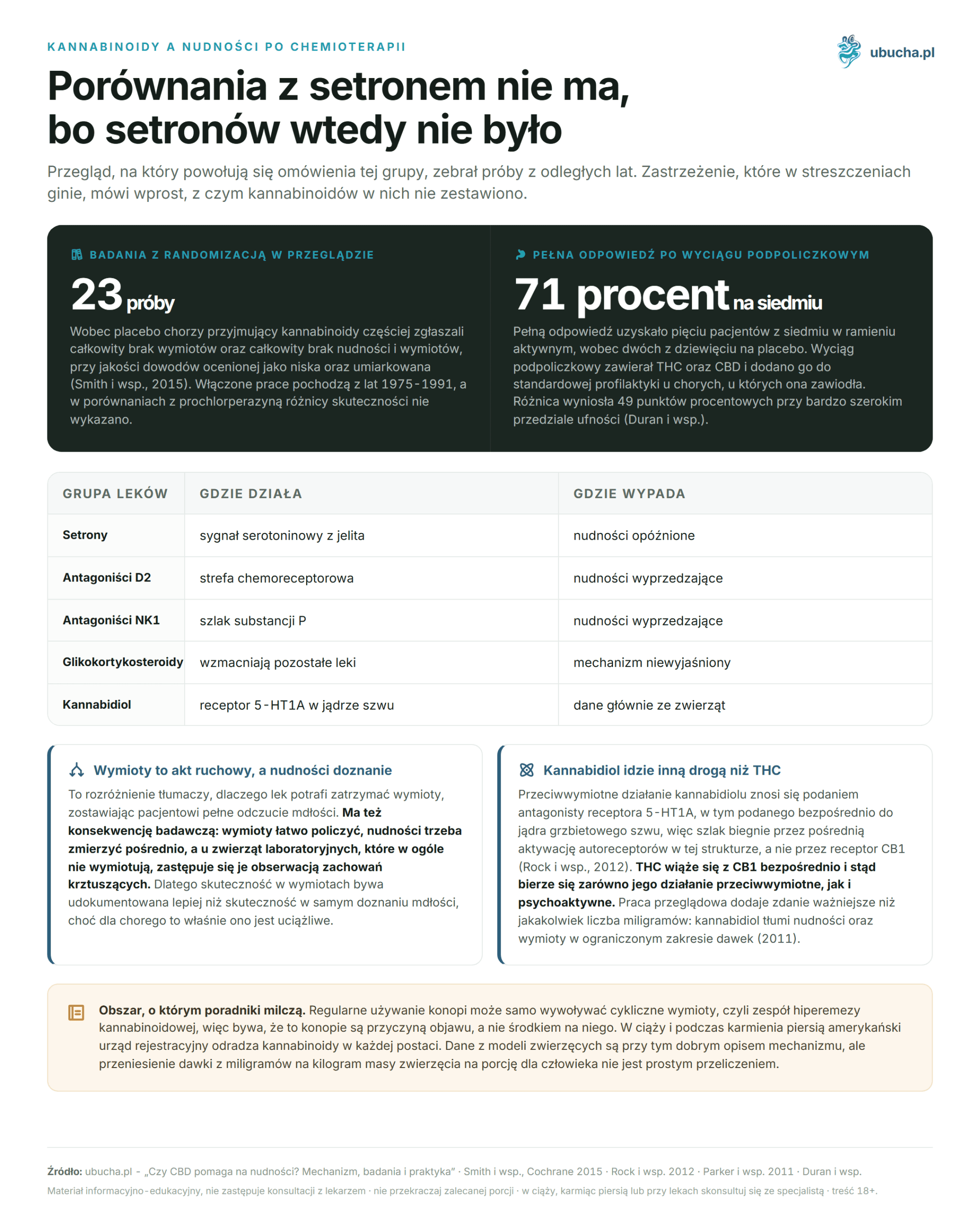
Nausea is an unpleasant sensation preceding vomiting, controlled by centers in the medulla oblongata, primarily by the nucleus of the solitary tract and the area postrema. Vomiting is a motor act, while nausea is a sensation. This distinction explains why a drug can stop vomiting while leaving the patient with a full sensation of nausea.
Standard pharmacology is based on four groups. 5-HT3 receptor antagonists, or setrons, block the serotonin signal from the intestine. D2 receptor antagonists act on the chemoreceptor trigger zone. NK1 antagonists block the substance P pathway. Glucocorticoids enhance the effects of other drugs through a mechanism that is not fully understood.
Each of these groups has its window of effectiveness and falls short outside of it. Setrons work well in the first day after cytostatic treatment and after surgery, but much less effectively in delayed nausea. The reason is mechanistic: 5-HT3 receptors undergo desensitization, and after the first day, another pathway is responsible for the symptoms.
A separate category is anticipatory nausea, which is a conditioned reflex triggered by the mere sight of a hospital or the smell of a disinfectant. This is not a receptor problem, but a learned response, and no drug acting on the vomiting center reaches it at the source.
The separation of these two phenomena also has a research consequence that the patient usually does not know. Vomiting is easy to count, while nausea must be measured indirectly, and in laboratory animals that do not vomit at all, it is replaced by observing gagging behaviors. Therefore, effectiveness in vomiting is often documented better than effectiveness in the sensation of nausea itself, even though for the patient, it is precisely this sensation that is burdensome.
It is precisely in these two gaps, delayed and anticipatory, that researchers have been looking for new tools for a decade. Cannabinoids have entered there not because they work stronger, but because they work differently.
How does CBD affect nausea?
Indirectly, through the serotonin system. Rock and colleagues demonstrated that the antiemetic and anti-nausea effects of CBD are negated by administering a 5-HT1A receptor antagonist, including one administered directly to the dorsal raphe nucleus. The authors conclude: CBD acts through the indirect activation of somatodendritic 5-HT1A autoreceptors in this structure (Rock et al., 2012).
This distinguishes CBD from THC. THC binds directly to the CB1 receptor, which is why it has both antiemetic and psychoactive effects. CBD takes a different route, thus suppressing the vomiting reflex without intoxication. Combinations containing both cannabinoids utilize both pathways simultaneously.
In the same study, CBD suppressed vomiting induced by nicotine, lithium chloride, and cisplatin, but with cisplatin only at the lower of the tested doses of the cytostatic. The authors also noted a bell-shaped dose-response curve in studies on brainstem slices, which is the first signal that more does not mean better.
A review by Parker, Rock, and Limebeer states this directly: CBD suppresses nausea and vomiting within a limited dosage range (Parker et al., 2011). This statement is more important than any number of milligrams circulating on forums.
This same work brings another observation. When administered together, CBD and a 5-HT1A receptor agonist acted synergistically, stronger than either alone. This is an additional argument that the described pathway is the correct one, not a random correlation.
It must be said honestly where this data comes from. Vomiting models are conducted on shrews, and in rodents, gagging behaviors are measured as a substitute. These are good models of the mechanism, but they do not replace studies in humans, and transferring doses from milligrams per kilogram of animal weight to a human serving is not a simple conversion.
Does CBD help with nausea after chemotherapy?
The data is moderate and pertains more to cannabinoids as a group than to CBD alone. A Cochrane review included 23 randomized studies. Compared to placebo, patients on cannabinoids more frequently reported a complete lack of vomiting and a complete lack of nausea and vomiting, with the quality of evidence rated as low to moderate (Smith et al., 2015).
This same review contains a caveat that gets lost in summaries. The studies included in the analysis date from 1975 to 1991, and none compared cannabinoids with ondansetron, as setrons did not exist at that time. In comparisons with prochlorperazine, no difference in efficacy was demonstrated, while patients more frequently chose cannabinoids and more often discontinued them due to adverse effects.
On the side of newer studies, there is a small trial with a sublingual extract containing THC and CBD, added to standard prophylaxis in patients for whom it had failed. Of the seven patients in the active arm, five achieved a complete response, or 71 percent, compared to two out of nine on placebo. The difference was 49 percentage points with a very wide confidence interval (Duran et al., 2010).
The figure of 71 percent should be read together with the sample size. This was a phase II pilot study involving sixteen people, whose authors themselves state that the result requires confirmation in a phase III study. Adverse effects were more frequent in the active group.
It is also worth knowing a result that does not make it to advertisements. The same Cochrane review found two trials involving 141 people, in which the cannabinoid was added to an antiemetic drug instead of replacing it. No difference between the groups was demonstrated, although the authors note that most analyses were based on one small study.
A broader picture of the use of cannabinoids in cancer patients, along with their place in current recommendations, is described in a separate text on cannabinoids in oncological therapy. The decision to include anything is made by the treating oncologist.
Why do anticipatory nausea and regular nausea respond differently?
Because they are not a response to a toxin, but a learned reflex. The authors of a review on the regulation of nausea by cannabinoids point out that animal data indicate a particular usefulness of cannabinoids precisely in those forms that conventional drugs control the weakest: in nausea itself and in anticipatory nausea (Parker et al., 2011).
The mechanism is easy to describe. A patient who has vomited several times after an infusion begins to feel nauseous already in the parking lot in front of the hospital. A neutral stimulus has become associated with a symptom-triggering stimulus and has begun to trigger it itself. This is classical conditioning, not the action of a cytostatic.
Therefore, a setron given before the infusion does not solve the problem. It blocks a pathway that in this case is not the causal pathway. The symptom appeared before any substance entered the vein.
Cannabinoids can act here in two ways simultaneously. They suppress the sensation of nausea itself, and through their effect on anxiety tension, they also weaken the conditioning component. However, the data comes from animal models, in which anticipatory nausea is recreated by associating taste or context with a toxic stimulus.
From the same review comes an observation showing that the endocannabinoid system regulates nausea in both directions. Substances acting on the CB1 receptor, in contrast to agonists, increase nausea, and at subthreshold doses, they enhance symptoms induced by another toxin. Endocannabinoid signaling is therefore not a switch, but a knob that works in both directions.
This thread is developed in a separate paper on why anticipatory nausea escapes setrons. The practical conclusion for the patient is: report this symptom directly, as it is treated differently than vomiting after an infusion.
When do cannabis products themselves cause nausea?
When used regularly and for a long time. Cannabinoid hyperemesis syndrome is characterized by cyclic episodes of nausea and vomiting in individuals who use cannabis systematically. In a systematic review encompassing 183 publications, a history of regular use and cyclic vomiting were present in 100 percent of described patients (Sorensen et al., 2017).
The clinical picture has features that are hard to confuse with anything else. Relief after hot baths, taking the form of compulsive behavior, occurred in 92.3 percent of patients. Abdominal pain was reported by 85.1 percent, and using cannabis at least once a week concerned 97.4 percent, with men making up 72.9 percent of described cases.
The strongest element of this picture is what happens after cessation. Symptoms resolved after stopping cannabis in 96.8 percent of patients, and it is precisely cessation that the authors indicate as the most effective course of action. Intravenous hydration, dopamine antagonists, and capsaicin in cream form help temporarily, while avoiding opioids.
The pathophysiology remains unclear, and the authors of the review state this directly, pointing to a lack of studies dedicated to the mechanism. It is not possible today to answer why the same substance suppresses vomiting in some and induces it in others.
For the reader of this text, this has a concrete consequence. If nausea has intensified after weeks or months of regular cannabis use, increasing the dose is the worst possible reaction. A break and consultation are needed, not another dose.
Is CBD safe to use during pregnancy?
No. The American Food and Drug Administration advises against the use of CBD, THC, and marijuana in any form during pregnancy and while breastfeeding, citing potential effects on fetal brain development and a higher risk of low birth weight and preterm birth (FDA Consumer Update).
This is one of the few fragments of this article where there is no room for nuance. The endocannabinoid system participates in the development of the nervous system throughout pregnancy, and there is insufficient data on the safety of exogenous cannabinoids in humans to consider anything safe.
Observational data support this caution. In a prospective cohort of 5610 women in their first pregnancy, children of those who used cannabis still at 15 weeks had a lower average birth weight by 127 grams, a smaller head circumference by 0.5 centimeters, and a shorter gestational age by 8.1 days than children of women who never used (Grzeskowiak et al., 2020). The study concerned cannabis as a whole, not isolated CBD.
What instead? A Cochrane review encompassing 41 studies and 5449 women evaluated interventions used for nausea in early pregnancy: ginger preparations may help, although the evidence is limited and inconsistent, and for vitamin B6 and the combination of doxylamine with pyridoxine, the evidence was also deemed limited (Matthews et al., 2015). The authors emphasize the lack of high-quality evidence for any method.
Ginger itself has been discussed separately in a text about what studies confirm about ginger for nausea. The choice of treatment during pregnancy is up to the treating gynecologist, even for over-the-counter methods.
Does CBD work for motion sickness?
The most direct test yielded a negative result. In a study on shrews subjected to a motion stimulus, CBD at doses from 0.5 to 40 milligrams per kilogram did not change the vomiting response compared to the control group, while THC weakened it, and the effect of THC was negated by a CB1 receptor antagonist (Cluny et al., 2008).
This result is worth knowing because in popular content, CBD is sometimes presented as a remedy for motion sickness. The study that tested this directly in a motion stimulus model found no such effect. However, it did find it for THC, which for obvious reasons is not used before travel.
Separately, there is an observation in humans that speaks to something different. In 21 volunteers subjected to parabolic flights, seven developed symptoms of motion sickness, and it was precisely in them that the level of anandamide decreased, while in the others it increased, and the concentration of 2-AG remained low and unchanged (Choukèr et al., 2010).
The authors of this study link motion sickness to reduced activity of the endocannabinoid system and suggest enhancing signaling in this system as a possible direction for therapy. This is a mechanistic hypothesis, not a treatment outcome, and does not automatically translate to the effectiveness of CBD.
Summarizing this thread honestly: the data support the hypothesis about the role of the endocannabinoid system, but the only direct test of CBD for this indication yielded a negative result, and there are no randomized studies in humans. Established methods are ginger and antihistamines used for this indication.
What about nausea in bowel diseases and migraines?
Here, the data concern overall improvement, not the symptom of nausea itself. In a placebo-controlled study of 21 patients with Crohn’s disease, resistant to previous treatment, a clinical response was achieved in 10 out of 11 people in the active group compared to 4 out of 10 on placebo, although the primary endpoint, remission, was not reached (Naftali et al., 2013).
Two things must be said directly about this study. First, it used cannabis cigarettes containing 115 milligrams of THC, not CBD. Second, improvement was noted in appetite and sleep, and nausea was not a measured endpoint in this work. Attributing a percentage of relief in nausea to this study is an overinterpretation.
The theoretical basis for the bowel issue is the involvement of the endocannabinoid system in regulating motility and visceral sensation, described in a review on cannabinoids and the gastrointestinal tract (Izzo and Sharkey, 2010). This explains why cannabinoids may affect digestive comfort, but does not prove efficacy in a specific diagnosis.
In migraines, the picture is similarly preliminary. A review of 34 studies indicates that the use of medical cannabis is associated with a reduction in the duration and frequency of migraine attacks, with a clear caveat from the authors that the studies are few and limited (Poudel et al., 2021).
Migraine-related nausea may therefore subside indirectly, along with the attack itself. The topic is developed in a separate paper on CBD in the treatment and prevention of migraines.
What dose of CBD for nausea and how to start?
There is no dose established by clinical studies for this indication, and that is an honest answer. The only guideline from the data is this: CBD suppresses nausea and vomiting within a limited dosage range, and outside of that range, the effect diminishes (Parker et al., 2011).
This relationship is contrary to user intuition. In most supplements, increasing the dose simply enhances the effect or does not change it. Here, exceeding the effective range extinguishes the action, so the reflex reaction, which is to double the dose when there is no improvement, leads in the opposite direction than intended.
The practical conclusion is therefore: start with a low dose, increase it slowly, observe for several days, and stop at the first amount that brings improvement. If there is no improvement after several steps up, further increases are not a strategy, but a resignation from observation.
Three things are worth recording from day one: the time of administration, the size of the dose, and the severity of the symptom on a scale from zero to ten. After four weeks, this record will tell you more than any description from the manufacturer, as it concerns you, not the average study participant.
The size of the dose makes sense only when it is known how much substance is actually in the preparation. Therefore, before the first measurement, check the declared content and the certificate of analysis of the batch. Without this, you are recording milliliters, not the dose, and comparing week to week will not resolve anything.
If you are taking prescription antiemetics, a conversation with your doctor must precede, not follow, the inclusion of CBD. The reason is described in the section on interactions, and the WHO Expert Committee points to interactions as a possible source of reported adverse effects.
How quickly does CBD start to work and how long does it last?
Exact data is less than what tables circulating on the internet suggest. A systematic review of the pharmacokinetics of CBD in humans included 24 studies and found that maximum concentration is reached within zero to four hours, and the half-life ranges from 1.4 to 10.9 hours after administration via the oral mucosa (Millar et al., 2018).
The authors of this work state something worth quoting literally in the summary. The absolute bioavailability of CBD in humans has only been determined for one route of administration, smoking, and was 31 percent. For other routes, none of the analyzed studies attempted to determine it. Therefore, the percentages of sublingual or oral bioavailability that you find in product descriptions are not supported by this review.
However, several things from this work translate into practice. After oral administration, steady state builds over days, as the half-life with chronic oral administration is counted in days, not hours. Assessing the effect after a single dose is therefore premature.
The second observation concerns meals. Maximum concentration increases after eating and in fatty forms, so the same dose taken on an empty stomach and after a hearty meal is not the same exposure. If you are comparing days with each other, take it in a consistent relation to meals.
The authors conclude with a statement that should not be overlooked: there is little data, and results can be inconsistent despite the widespread use of CBD in humans. This is a good reference point for any promise given to the minute.
What interactions and contraindications should be known?
Interactions are more important than the adverse effects of CBD itself. The WHO Expert Committee stated that CBD is generally well tolerated and has a good safety profile, and reported adverse effects may result from interactions with medications taken by the patient (WHO ECDD, 2018).
A review dedicated specifically to this issue indicates that CBD interacts with biological targets involved in drug metabolism, including isoenzymes CYP3A4 and CYP2C19, as well as P-glycoprotein responsible for excretion. The authors note that adverse effects occurred in nearly half of users and were dose-dependent, with more common ones including increased aminotransferase activity and sedation (Brown and Winterstein, 2019).
The practical recommendation from the same work is to consider lowering doses of drugs metabolized by these pathways, monitor the patient, and seek alternative therapies, especially in individuals taking multiple medications at once. This applies, among others, to cancer patients, for whom some cytostatics are metabolized by CYP3A4.
The safety review of CBD lists the most common symptoms as fatigue, diarrhea, and changes in appetite and body weight, and assesses the profile of adverse effects as more favorable than those of drugs compared in the same indications. The authors also note that the impact of CBD on liver enzymes and drug transporters requires further research (Iffland and Grotenhermen, 2017).
Stop the preparation and contact your doctor if there is an increase in vomiting despite ongoing treatment, jaundice, dark urine, sedation preventing functioning, or allergic symptoms. In a person undergoing chemotherapy, an additional signal is a deterioration in general condition.
Summary: what to take from this text
CBD is not an antiemetic drug and does not replace registered preparations. However, it has a described mechanism, different from all currently used drug groups, and moderate strength clinical data, mainly concerning combinations that also include THC.
The most important thing to remember from the whole text concerns dosage. The effective range is limited on both sides, so increasing the dose when there is no effect is a move in the wrong direction. Start low, increase slowly, observe for several days, and record the results.
Two categorical exceptions close the topic. The first is pregnancy and breastfeeding, where cannabinoids are excluded in any form. The second is the situation where nausea has intensified during regular cannabis use, because then one must consider cannabinoid hyperemesis syndrome and cessation, not an increase in dosage.
It is also worth remembering what is not in this text and why. There is no table of action times with minute accuracy or percentages of absorption for individual forms, as the pharmacokinetic review in humans does not confirm these values. There is also no number describing relief in motion sickness, as the only study that tested this directly found no effect of CBD.
The last thing concerns the conversation with the doctor. Reporting that you are taking CBD is not a formality or an admission of anything. It is pharmacological information of the same weight as the name of any other preparation, as it concerns the pathways by which the body eliminates other drugs.
Frequently asked questions
Does CBD really help with nausea?
Indirectly and within a limited dosage range. Animal studies indicate that CBD suppresses the vomiting reflex through indirect activation of the 5-HT1A receptor in the brainstem, rather than through the CB1 receptor. Clinical data in humans mainly concern products containing both THC and CBD, not cannabidiol alone.
What dose of CBD for nausea is effective?
Clinical studies have not established a dose for this indication. However, it is known that the effective range is limited and above a certain threshold the effect diminishes. The practical rule is: start low, increase slowly, and stop at the first amount that brings improvement.
Can CBD be used during pregnancy for morning sickness?
No. The FDA advises against CBD, THC, and marijuana in any form during pregnancy and while breastfeeding, citing potential effects on fetal brain development. For pregnancy-related nausea, methods agreed upon with a gynecologist are used, including ginger and vitamin B6, with limited evidence strength.
Does CBD help with nausea after chemotherapy?
The evidence is moderate and pertains to cannabinoids as a group. A Cochrane review included 23 studies, all from before the era of setrons, and showed superiority over placebo with low to moderate quality evidence. Start the conversation about including anything with the treating oncologist.
Does CBD work for motion sickness?
A direct test yielded a negative result. In a motion stimulus model in shrews, CBD did not change the vomiting response, although THC weakened it. Separately, in humans, it has been shown that individuals prone to motion sickness have lower levels of endocannabinoids, but this is a mechanistic hypothesis, not a treatment outcome.
Can cannabis itself cause vomiting?
Yes, and it is called cannabinoid hyperemesis syndrome. In a review of 183 publications, cyclic vomiting and a history of regular use were present in all described patients, and symptoms resolved after stopping cannabis in 96.8 percent. Relief after hot baths is characteristic.
Does CBD interact with antiemetic medications?
It may interact. CBD affects the isoenzymes CYP3A4 and CYP2C19 and the P-glycoprotein, which are involved in the metabolism and excretion pathways of many drugs. The recommendation from the review on this topic is to consider lower doses of the primary medication and monitor the patient, especially in polypharmacy situations.
How quickly does CBD start to work?
Maximum concentration is reached within zero to four hours, depending on the route of administration and meal. Absolute bioavailability in humans has only been determined for smoking and was 31 percent, so the percentages given for other forms are not supported by data.
If you are looking for products with declared cannabidiol content and a certificate of analysis, you can find them in the hemp oil category in the u Bucha store.
This article is for informational and educational purposes and does not constitute medical advice. Before starting to use cannabis or CBD for therapeutic purposes, consult your doctor, especially if you are taking other medications, are pregnant, or breastfeeding.
Author: Michał Waluk · Published: 2026-04-27 · Updated: 2026-08-10